
A company seal authenticates cross-border trade documents, verifies corporate authority, and satisfies foreign legal requirements when trading internationally. Foreign customs authorities and overseas banking institutions require sealed documentation to validate corporate signatures and execute binding commercial agreements.
Do UK Companies Legally Require a Common Seal for International Trade?
UK companies do not require a common seal for domestic transactions, but international trade jurisdictions often mandate sealed documents to authenticate corporate authority. Overseas regulatory bodies demand physical seals to validate export contracts, customs declarations, and overseas banking instruments.
UK company law shifted significantly under the Companies Act 2006. Modern corporations execute documents via signature by two authorised signatories or a single director in the presence of a witness. Domestic institutions accept electronic signatures and standard execution methods without mechanical stamping.
International trade operates under different legal frameworks. Civil law jurisdictions across Europe, the Middle East, and Asia place heavy reliance on physical impressions. Foreign customs officials often reject unsealed commercial invoices and certificates of origin. Securing proper authentication prevents customs delays and contractual disputes during cross-border operations.
Corporate governance policies dictate internal rules regarding seal usage. Companies establish formal resolutions detailing who holds custody of the physical device. Directors delegate stamping authority to designated company secretaries or senior export managers. Maintaining strict physical security prevents fraudulent document execution and unauthorized international commitments.
How Does a Company Seal Function in Cross-Border Transactions?
A company seal functions as a physical stamp that presses metal dies into paper or foil, creating a raised impression that signifies official corporate approval. Overseas partners recognize this embossed mark as definitive proof that the board of directors authorized the transaction.
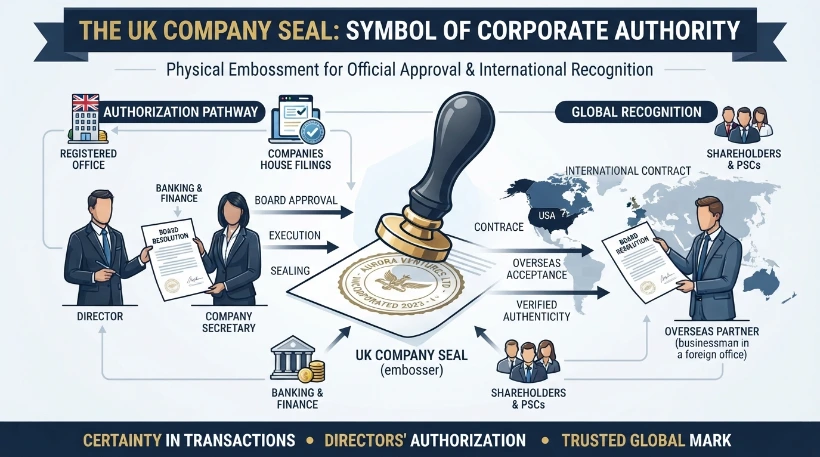
International counterparties examine trade documents for physical evidence of corporate legitimacy. Digital files lack the tactile verification provided by an embossed metallic die. Customs authorities in destination markets inspect import documentation for authentic company marks before releasing shipments from port facilities.
Export documentation requires multiple layers of verification. Commercial invoices, bills of lading, and packing lists travel across international borders daily. Applying a wet-ink signature alongside the embossed impression satisfies strict evidentiary standards in foreign courts.
Trading partners use sealed agreements to mitigate financial risks. Banks issuing letters of credit demand strict compliance with documentary requirements. Financial institutions reject applications containing unsealed certificates when local regulations specify embossed corporate validation.
What Types of Company Seals Are Available for Purchase?
Companies purchase pocket seals for portable convenience, desk seals for office use, and electronic seal software for digital document workflows. Selecting the correct format depends on export volume, document types, and international recipient preferences.
| Seal Type | Best Suited For | Key Operational Feature |
| Pocket Seal | Field sales and travel | Compact chromium-plated handheld device |
| Desk Seal | Office administration | Heavy cast-iron base for high-volume stamping |
| Electronic Seal | Digital trade platforms | Cryptographic token binding identity to files |
Pocket seals provide mobility for executives traveling to international client meetings. The lightweight metal construction produces crisp impressions on standard paper weights without requiring excessive manual force.
Desk seals anchor securely to administrative workstations. Heavy leverage mechanisms process high volumes of export paperwork quickly and efficiently. Corporate secretaries maintain these devices within secure company register storage locations.
Electronic seals utilise advanced cryptography to sign digital PDF documents. Modern cross-border platforms accept digital certificates when physical transport proves impractical. Businesses integrate these tools into existing enterprise resource planning software.
UK businesses seeking complete corporate governance solutions often acquire a comprehensive Company Pack containing physical seals, registers, and incorporation documents.
Why Do Foreign Customs Authorities Request Sealed Documents?
Foreign customs authorities request sealed documents to verify exporter legitimacy, prevent commercial fraud, and comply with local statutory import regulations. Border control agencies inspect physical impressions to confirm that official corporate officers approved the export shipment.
International trade involves complex legal jurisdictions. Customs officials cannot easily verify the validity of foreign digital signatures across disparate national databases. Physical seals provide a tangible verification method that customs inspectors recognize instantly.
Import compliance regulations change across different global markets. Nations enforcing strict documentary controls reject shipments lacking traditional corporate authentication. Meeting these specific formatting rules prevents costly cargo seizures and port storage fees.
Supply chain security benefits from standardized authentication methods. Importers protect their commercial interests by demanding verifiable proof of origin from suppliers. Embossed company marks provide undeniable evidence of direct manufacturer participation.
Businesses preparing for international expansion should review the insights outlined in our What Does Section 44 of the Companies Act Say About Seals? guide to understand statutory compliance baselines.
How Do You Order and Maintain a Corporate Seal?
Companies order corporate seals by submitting official registration details to authorized manufacturers who engrave customized brass dies. Administrators store these physical devices securely and record every application in official company registers.
Manufacturing a compliant seal requires precise company naming conventions. Suppliers engrave the exact registered company name and registration number onto precision-cut brass inserts. Quality control teams test each device on paper stock to ensure deep, legible impressions.
Internal asset management protects the seal from misuse. Companies restrict physical access to authorized directors and designated company secretaries. Storing the device in a locked safe prevents unauthorized stamping of financial guarantees or contracts.
Organizations ready to streamline their export documentation can Order Your Common Seal Today With Form My Company to secure professional authentication tools for global markets.
International trade demands rigorous adherence to cross-border verification standards. Company seals bridge the gap between UK corporate law and foreign customs requirements by providing tangible, recognized proof of corporate authority. Selecting the appropriate seal format ensures smooth export operations and protects commercial agreements. Brand Name delivers reliable corporate governance tools designed to satisfy international trade regulations efficiently.
Explore our Company Pack guide,
How to Set Up a Room for Panel Interviews
How to Budget for Apostille and Legalisation Costs for Your Company
Frequently Asked Questions
What items are included in a standard Form My Company company pack?
A standard Form My Company company pack typically includes the digital certificate of incorporation, memorandum and articles of association, and share certificates. These essential constitutional documents verify corporate existence and establish internal governance rules for UK registered entities.
Do I need a physical company seal when ordering a company pack?
While UK companies are no longer legally mandated to use a physical seal for domestic operations, international trade partners often require embossed verification. Form My Company includes options for traditional pocket or desk seals within specialized corporate bundles to satisfy overseas export requirements.
How quickly are digital documents delivered after purchasing a company pack?
Digital documents provided through Form My Company are typically dispatched via email within hours of successful incorporation approval by Companies House. This rapid delivery enables company directors to immediately open business bank accounts and execute commercial contracts.
Can I use the documents in a company pack to open a business bank account?
Financial institutions require the certified incorporation documents and registers found in a Form My Company company pack to complete mandatory anti-money laundering and Know Your Customer checks. These verified files prove legal compliance and corporate identity to high street and digital business banks.
Are statutory registers updated automatically within a company pack subscription?
Statutory registers must be maintained accurately by directors to comply with UK company law provisions under the Companies Act 2006. Form My Company provides compliant register templates within their company pack solutions to help businesses record shareholder changes and officer appointments properly.