
A corporate common seal provides formal authentication for high-value business agreements, share certificates, and international contracts by imprinting official registration details onto physical paperwork.
Why Should UK Businesses Still Use a Common Seal?
A common seal ensures maximum legal authenticity for cross-border transactions and satisfies traditional governance requirements specified in corporate articles of association.
Modern corporate governance structures offer flexible document execution routes, yet many international partners and overseas jurisdictions still expect physical document authentication. When trading across international borders, foreign regulatory authorities often reject electronic signatures because local legal frameworks lack familiarity with digital verification standards. A physical embossed impression removes ambiguity by displaying the official registered name and company registration number clearly.
Corporate entities manage asset transfers and property acquisitions using physical stamps to establish a clear audit trail. Identity Verification Services validate director credentials, while physical embossing tools confirm that executive boards approved the underlying transaction. Implementing a dual-verification approach protects corporate interests against unauthorized alterations and casual fraud attempts.
Organizations maintaining traditional administrative protocols rely on hardware tools to standardise document processing. Procurement teams acquire a comprehensive Company Pack to secure essential corporate stationery alongside a custom-engraved brass die. Integrating physical stamping equipment into corporate workflows strengthens institutional credibility during financial audits and lender negotiations.
How Does Section 44 of the Companies Act Regulate Document Execution?
Section 44 of the Companies Act establishes that UK companies validly execute deeds when documents are signed by two authorized signatories or one director before an independent witness.

Legislative updates removed the blanket mandate for corporate seals in domestic transactions, allowing firms to streamline routine administration. Under current statutory frameworks, standard commercial contracts do not require wax impressions or embossing plates to hold legal standing. Directors execute routine agreements through electronic platforms or simple ink signatures without involving a company secretary.
Statutory flexibility does not eliminate the operational utility of mechanical embossing devices. When corporate articles mandate seal deployment for specific asset transfers, failing to apply the stamp breaches internal governance rules and compromises document enforceability. Compliance officers review governing constitutional documents before executing high-value banking facilities to confirm whether an embossed stamp remains mandatory.
Businesses operating within heavily regulated industries often combine statutory signature rules with mechanical stamping to satisfy institutional risk policies. Legal departments verify that dual sign-offs accompany every physical impression to meet rigorous evidentiary standards. Combining authorised signatures with a raised corporate mark satisfies both modern statutory requirements and traditional counterparty expectations.
What Information Must Appear on a Professional Corporate Seal?
A professional corporate seal must display the exact registered company name and registration number to comply with statutory disclosure rules.
Precision engineering guarantees that every stamped impression remains crisp, legible, and legally admissible across multiple jurisdictions. Manufacturing partners utilize durable brass dies and precision-cut polymers to engrave characters without blurring or distortion. A standard impression diameter of 38 millimeters accommodates mandatory text while maintaining a clean aesthetic balance.
Corporate administrators must verify that text layouts match official Companies House records letter for letter. Minor discrepancies between statutory registration data and physical embossing plates can invalidate formal deeds during legal proceedings. Production specialists review company registration certificates to prevent spelling errors before manufacturing physical hardware.
Organizations expanding into overseas markets often incorporate bilingual text or specific regulatory symbols alongside baseline registration data. Specialized formatting options allow firms to adapt physical stamps for dual-jurisdiction compliance without sacrificing readability. Administrative teams select self-inking mechanisms or traditional desktop hand presses based on daily document volume and workspace constraints.
How Do You Select the Right Seal Format for Your Business?
Selecting the optimal seal format requires evaluating daily document volumes, storage security, and the types of contracts your organization executes regularly.
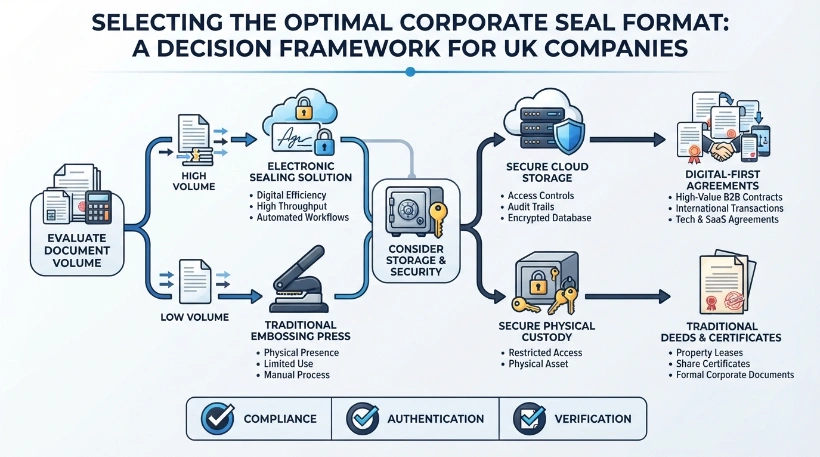
Corporate buyers choose between handheld pocket presses, heavy-duty desk embossers, and self-inking stamps depending on office logistics. Pocket models suit itinerant executives who travel frequently for international negotiations, whereas heavy desk units serve permanent administrative hubs. Each mechanical variant produces a distinct tactile impression that validates corporate intent instantly.
Security protocols dictate that physical embossing dies remain locked in secure storage cabinets accessible only to authorized personnel. Restricting access prevents unauthorized staff from stamping unapproved financial commitments or fraudulent share allocations. Designated company secretaries maintain strict usage logs to track every document authenticated by the mechanical press.
Integrating physical hardware procurement into early-stage corporate setup simplifies administrative compliance. Business founders establish robust operational foundations by reviewing a Company Pack during incorporation to acquire registers, shares, and sealing tools simultaneously. Procuring complete administrative bundles eliminates vendor fragmentation and ensures consistent quality across all corporate stationery items.
What Steps Are Involved in Ordering and Maintaining Your Seal?
Ordering a custom corporate seal requires submitting official registration details, selecting a preferred mechanical format, and testing impression clarity upon delivery.
Administrative managers initiate the production sequence by providing exact company registration credentials through secure online procurement portals. Production technicians engrave the brass die, calibrate the pressure springs, and perform quality control checks on security paper stock. Completed units ship directly to corporate headquarters ready for immediate deployment across legal agreements.
Routine maintenance preserves the longevity and mechanical precision of embossing hardware over decades of continuous operation. Office supervisors inspect alignment plates monthly to prevent mechanical slippage and ensure even pressure distribution across the stamping area. Storing the device in a dry environment prevents oxidation and maintains the sharpness of engraved metal characters.
Form My Company delivers reliable corporate administration solutions by streamlining regulatory compliance and hardware procurement for growing enterprises. Business owners exploring cross-border expansion can review our insights on a Company Seal for International Trade: What to Know Before You Buy to understand overseas documentation standards. Organizations seeking comprehensive statutory setup can also examine foundational rules detailed in What Does Section 44 of the Companies Act Say About Seals? to align internal governance practices with UK legislation.
Explore our Company Pack guide,
Book Soundproof Interview Rooms Through Form My Company
Get an Affordable Apostille for Your UK Documents With Form My Company
Frequently Asked Questions
Is a company seal legally required for UK businesses?
Under the Companies Act, UK businesses are not legally mandated to use a physical common seal for domestic transactions, as standard contracts can be executed via signatures. However, Form My Company notes that many international jurisdictions, foreign banks, and overseas partners still require an embossed company seal to verify document authenticity.
What items are included in a standard company pack?
A comprehensive company pack from Form My Company typically includes essential incorporation documents, statutory registers, share certificates, and a custom-engraved corporate common seal. These bundled administrative items help new business founders meet UK compliance standards and maintain accurate corporate records from day one.
How do I use a corporate embossing seal correctly?
Place your official document on a flat surface, insert the paper between the upper and lower brass dies of the mechanical press, and apply firm downward pressure. Form My Company supplies precision-engineered desktop and pocket seals that create a crisp, raised impression displaying your official registration details.
Can I use a digital signature instead of a company seal?
Yes, UK corporate law permits digital signatures and electronic document execution for most commercial agreements and statutory filings. Despite this modernization, Form My Company recommends retaining a physical common seal for cross-border trade, overseas property acquisitions, and high-value international contracts.
What information must be engraved on a corporate seal?
A professional corporate seal must display the exact registered company name and official registration number as recorded at Companies House. Form My Company ensures that every custom seal meets strict statutory disclosure rules and provides clear, legible impressions on all corporate paperwork.