
To confirm who counts as a Person with Significant Control (PSC) in your business, check your share register and governance documents against statutory criteria. Anyone holding over 25% of shares or voting rights, controlling board majority appointments, or exercising significant operational influence qualifies as a PSC.
What Is the Legal Definition of a Person with Significant Control?
A Person with Significant Control is an individual or eligible legal entity that holds substantial ownership or operational authority over a UK business. Statutory rules require companies to identify every entity meeting specific influence thresholds.
UK corporate law requires all limited companies and limited liability partnerships (LLPs) to maintain an accurate records register. This mandate ensures ultimate transparency regarding business ownership and governance. Identifying these individuals prevents illegal corporate activities and maintains statutory compliance across official registries. Business owners must differentiate between executive officers and ultimate controllers to prevent filing errors. Understanding these boundaries forms the base of accurate governance. Executive directors manage daily operations, but they are not automatically control holders. You can review What Is the Difference Between a PSC and a Director? to clarify how functional roles differ from statutory ownership.
Statutory definitions look past official job titles to locate real decision-making authority. Corporate governance checks must evaluate both direct shareholdings and indirect contractual rights. Identifying control structures requires assessing voting agreements, trust mechanisms, and board appointment privileges.
Which Five Conditions Trigger PSC Registration Requirements?
Five statutory conditions trigger mandatory registration when an individual or entity meets specific ownership or control thresholds. Exceeding 25% ownership or holding dominant administrative rights activates these legal reporting obligations.
1. Share Ownership Thresholds
Holding directly or indirectly more than 25% of nominal share capital satisfies condition 1. Exact percentages dictate compliance, meaning an individual holding precisely 25% falls outside this rule. You calculate this figure by dividing individual nominal share value by total issued capital.
2. Voting Rights Allocations
Condition 2 applies when an individual holds more than 25% of total company voting rights. Special share classes often carry weighted voting privileges that detach voting power from nominal equity percentages. You must review articles of association to verify exact voting allocations.
3. Board Appointment Privileges
Condition 3 targets individuals holding rights to appoint or remove a majority of board directors. This power often stems from shareholder agreements rather than direct equity ownership. Controlling executive appointments gives an entity direct influence over strategic decisions.
4. Direct Operational Control
Condition 4 covers individuals who exercise significant influence or control without meeting equity or voting thresholds. Shadow directors, key advisors, or founders holding absolute veto powers over operational choices trigger this rule. Statutory guidance evaluates actual decision-making behavior during corporate audits.
5. Control via Trust or Unincorporated Firm
Condition 5 activates when an individual controls a trust or partnership that satisfies conditions 1 through 4. Trustees or ultimate beneficiaries managing asset structures must register as primary control holders.
| Control Condition | Statutory Threshold | Core Evaluation Mechanism | Primary Data Source |
| 1. Share Ownership | Exceeds 25% nominal shares | Calculates individual shares divided by total issued capital | Register of Members |
| 2. Voting Rights | Exceeds 25% total votes | Checks weighted voting structures across share classes | Articles of Association |
| 3. Board Control | Appoints/removes board majority | Assesses contractual powers to control board composition | Shareholders’ Agreements |
| 4. Direct Influence | Absolute veto/operational direction | Audits real decision-making behavior and shadow management | Governance Minutes |
| 5. Indirect Control | Controls qualifying trust or firm | Traces ultimate beneficiaries through non-corporate entities | Trust Deeds |
How Do You Assess Complex Ownership and Indirect Control Structures?
Complex ownership requires tracing equity chains upward through corporate layers until reaching individuals or Relevant Legal Entities. Multi-tiered corporate groups must register intermediate holding entities that meet statutory transparency criteria.
Corporate chains often feature intermediate parent companies holding direct shareholdings. When a corporate entity holds over 25% of your company, you must check if it qualifies as a Relevant Legal Entity (RLE). An RLE must maintain its own register or list shares on a recognized stock exchange. Registering an eligible RLE satisfies statutory requirements without tracing further up that specific ownership arm.
Joint shareholdings and formal voting arrangements alter standard control calculations. When two shareholders agree to vote jointly, their combined rights count toward individual totals. If four partners jointly hold 28% of voting rights, each partner is treated as holding the entire 28%. You must review formal shareholder agreements to locate combined voting blocs.
Offshore entities, trust arrangements, and indirect ownership models complicate statutory reporting. Corporate officers must systematically examine ownership trees to document ultimate beneficial owners. Managing complex compliance requires dedicated administrative oversight. Businesses can get professional PSC assessment from Form My Company to verify intricate holding structures accurately.
What Steps Must You Follow to Confirm and Register a PSC?
Confirming a PSC requires collecting verified identity details, confirming exact ownership tiers, and filing statutory records. Companies must complete updates within 14 days of internal changes.
To guide corporate officers through this administrative task, follow these essential compliance steps:
Review internal share registers, articles of association, and shareholder contracts to identify control triggers.
Issue formal statutory information notices to identified individuals or relevant corporate entities.
Collect personal identification details, including legal name, service address, date of birth, and nationality.
Verify identity through official channels, obtaining required verification codes.
Log confirmed details into your company’s internal administrative documentation.
Submit formal notifications to Companies House within statutory filing deadlines.
Mandatory identity verification rules require all reported individuals to verify their identity. Verification occurs through official digital identity systems or authorized verification agents. Failing to confirm details before public registration violates corporate compliance standards. Complete your filings using our professional PSC Register services to satisfy statutory deadlines.
What Penalties Apply for Non-Compliance with PSC Regulations?
Failing to maintain an accurate register carries criminal liability, uncapped financial fines, and prison terms up to two years. Companies can also issue formal restrictions to freeze non-compliant shares.
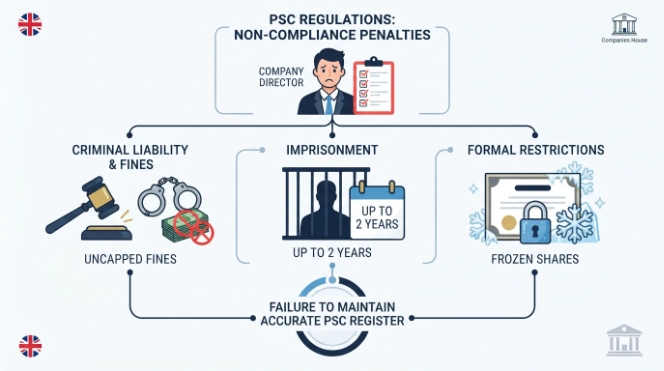
The Economic Crime and Corporate Transparency Act grants regulators strong enforcement powers. Regulatory bodies actively monitor corporate registers for missing, conflicting, or unverified information. Company officers face personal criminal prosecution for failing to record accurate ownership data.
Companies must issue formal statutory notices when individuals ignore requests for control details. If an individual fails to respond within one month, the company can issue a formal restriction notice. Restrictions render share transfers void, stop dividend payouts, and freeze voting rights. These measures protect corporate transparency and force compliance.
How Does Form My Company Simplify Your Business Governance?
Form My Company provides comprehensive governance solutions for UK businesses. Evaluating complex share structures, verifying identity records, and filing updates demand technical regulatory expertise. Form My Company manages all statutory reporting obligations to safeguard your business against compliance breaches. Form My Company ensures your corporate records remain accurate, verified, and aligned with Companies House rules.
Explore our PSC Register guide,
How to Amend Your Articles of Association Correctly
Company Seal for International Trade: What to Know Before You Buy
Frequently Asked Questions
What is a PSC Register, and why is it mandatory for UK businesses?
A Persons with Significant Control (PSC) Register is a statutory record that documents the ultimate beneficial owners and key controllers of a business. UK law requires all limited companies and limited liability partnerships (LLPs) to submit this information to Companies House to ensure corporate transparency and prevent financial fraud. Professional filing through the Form My Company PSC Register service ensures complete legal compliance and prevents regulatory penalties.
Who qualifies as a Person with Significant Control in a company?
An individual or corporate entity qualifies as a PSC if they hold over 25% of shares or voting rights, control majority board appointments, or exercise significant operational influence. Under UK Economic Crime and Corporate Transparency Act standards, every qualifying controller must also complete mandatory identity verification. Form My Company accurately assesses multi-tiered ownership structures to confirm every registrable controller for your business.
What happens if a company fails to maintain or update its PSC Register?
Failing to identify controllers or submit accurate updates to Companies House is a criminal offense that carries uncapped court fines and potential prison terms up to two years. Non-compliant entities face severe enforcement actions, including frozen voting rights, blocked share transfers, and potential striking off from the official register. Utilizing the Form My Company PSC Register solution protects business officers from legal liability by maintaining accurate filings.
What is the statutory deadline for updating PSC information with Companies House?
Companies must record changes to their internal records within 14 days of confirming new controller information. The updated PSC details must then be formally submitted to Companies House within a further 14-day statutory deadline. Form My Company tracks these mandatory compliance timeframes to file official statements without delay.
Can a UK limited company exist without registering any PSC?
Every UK company must submit a official PSC statement to Companies House, even if no single individual meets the 25% control thresholds. In these instances, a specific statutory statement must be filed stating that the business has no registrable controllers or that inquiries remain active. Form My Company manages all official statement submissions to ensure your legal registers remain compliant regardless of your governance structure.