
Apostille costs differ because document types require different government departments, varying processing times, and distinct notarisation steps. Providers also add administrative fees, courier charges, and handling surcharges based on service urgency, dispatch locations, and the specific legalisation tiers demanded by foreign authorities.
Why Do Government Fees Vary Across Different Document Types?
Government fees vary because different official documents require distinct issuing bodies, specific verification channels, and separate legalisation steps before the Foreign, Commonwealth & Development Office processes them.
The Foreign, Commonwealth & Development Office charges a standard fee of 45 pounds per document for a standard apostille stamp. However, getting your paperwork ready for that stamp changes the total cost. Personal certificates like birth, death, or marriage certificates require certified copies from the General Register Office. These registry fees range from 11 pounds to 22 pounds per certificate. Commercial documents like certificates of incorporation or power of attorney need a practising UK solicitor or notary public to witness and sign them first. Solicitor certification fees typically range from 50 pounds to 150 pounds per document depending on the complexity of the attestation.
Public documents issued by government departments bypass the solicitor stage. Educational degrees from UK universities require verification by a recognised solicitor or notary before submission. This extra verification step adds direct third-party costs to your total invoice. Government departments update their statutory fees annually based on operational overheads. Public bodies manage different databases, which influences how fast officials can authenticate your records. When you request multi-document authentication, you pay separate fees for each individual paper. Separate fees apply because government clerks examine every single page independently for integrity and official seals.
How Do Provider Pricing Models Create Cost Disparities?
Provider pricing models create cost disparities because agencies bundle different levels of customer support, tracking features, physical collection services, and fast turnaround options into their overall service fees.
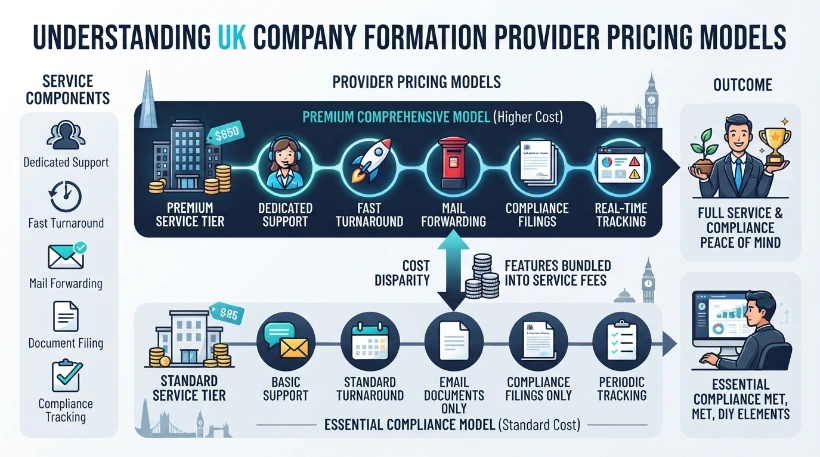
Basic providers charge a low base rate that covers only the official government fee and standard postal return. Premium agencies charge higher service fees to cover dedicated account managers, same-day document collection, and thorough pre-checks of your paperwork. Pre-checks prevent government rejections that waste both time and money. Hidden administrative surcharges often appear during checkout when companies add digital handling fees or international postage costs. Standard postal return uses Royal Mail standard delivery, while express agencies use secure courier services like DHL or FedEx. Courier fees add between 15 pounds and 50 pounds depending on your destination country.
Independent notary offices charge hourly rates for document authentication. Corporate legalization specialists charge flat rates per document bundle to make budgeting easier for businesses. Companies managing global expansion often need Appostiled Documents to validate their corporate status abroad. Transparent providers list their solicitor fees, government charges, and courier costs separately on their pricing pages. Cheaper providers omit solicitor fees from their initial quotes, which leads to unexpected invoices later in the process. Comparing provider quotes requires checking whether VAT is included in the headline price.
What Role Do Urgency and Processing Speeds Play in Total Pricing?
Urgency and processing speeds play a major role in total pricing because expedited services require dedicated couriers, priority queue placement, and out-of-hours administrative handling by agency staff.
Standard government processing takes up to five working days once the Foreign, Commonwealth & Development Office receives your physical paperwork. Standard service keeps your costs at the baseline level. Urgent processing services use premium courier drop-offs and priority government submission windows to secure turnaround times within 24 to 48 hours. Priority handling increases operational costs for agencies, and those costs transfer directly to your final bill. Emergency legalisation services often require hand-delivery of documents to government offices in Milton Keynes or London. Hand-delivery incurs travel expenses and staff time charges that raise the service fee significantly.
Business clients facing tight international tender deadlines willingly pay premium rates to secure rapid authentication. Individual clients submitting university applications or visa renewals choose standard processing to avoid extra surcharges. Selecting expedited tiers without a genuine deadline increases your legalisation expenses unnecessarily. Planning your document preparation weeks ahead eliminates rush fees completely. Understanding how processing timelines affect your budget helps you balance speed against operational costs effectively. You can learn more about managing these timelines by reading How to Avoid Hidden Fees When Getting Documents Apostilled.
Why Do Destination Countries Influence Legalisation Expenses?
Destination countries influence legalisation expenses because non-Hague Convention nations require an additional consular attestation step at foreign embassies after the standard apostille process.
Countries that signed the 1961 Hague Convention accept a single apostille stamp for official document recognition. Nations outside the Hague Convention framework require a secondary legalisation layer through their specific London embassy or consulate. Embassy attestation fees vary wildly by nation, ranging from 50 pounds to over 500 pounds per document. Arab, Asian, and African nations frequently demand embassy legalisation before recognising foreign commercial records. Embassy processing adds extra administrative days and requires physical document submission to diplomatic missions in London.
Commercial invoices and certificates of origin destined for non-Hague countries also require prior certification by the British Chambers of Commerce. Chamber certification adds another layer of fees, typically around 50 pounds per document. Form My Company assists UK enterprises by streamlining these multi-tier legalisation workflows for global trade. Businesses expanding into multiple international markets face complex fee structures that scale with the number of target countries. Accurately budgeting for international compliance means researching your destination country requirements before submitting paperwork. Proper planning prevents unexpected embassy rejection fees and diplomatic processing delays. You can review our dedicated corporate packages at Apostille Multiple Company Documents and Save With Form My Company.
How Do Volume Discounts and Corporate Packages Alter Per-Document Costs?
Volume discounts and corporate packages alter per-document costs because agencies reduce their administrative overhead margins when processing large batches of paperwork for commercial clients.
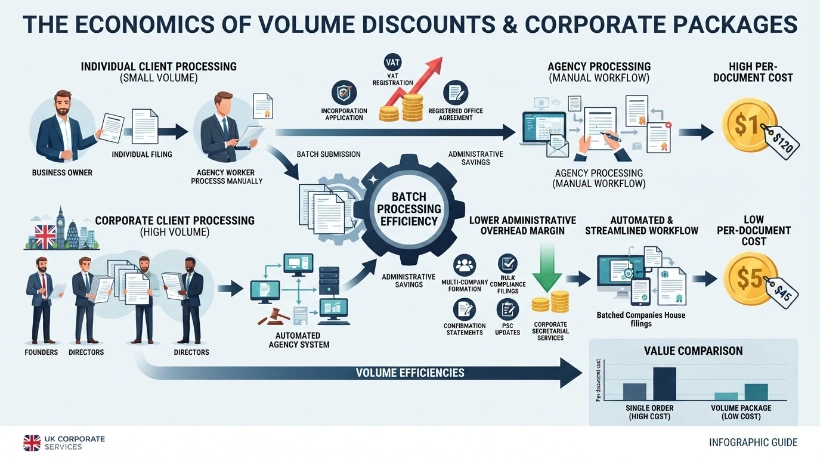
Single document orders carry higher relative administrative costs because staff spend the same amount of time processing intake forms for one paper as they do for ten. Corporate legalisation packages reduce the per-document rate by spreading courier, solicitor verification, and handling charges across bulk submissions. Form My Company structures corporate pricing to help businesses reduce expenditure when authenticating complete sets of company registers, board resolutions, and certificates of incorporation simultaneously. Businesses ordering in volume benefit from dedicated account management and centralised invoicing.
Tiered pricing models reward large enterprises with reduced rates once their order exceeds specific document thresholds. Small businesses submitting occasional paperwork pay standard retail rates because administrative overhead remains fixed per transaction. Corporate clients also save money by using pre-approved digital templates for solicitor certifications. Evaluating total project costs requires looking at both baseline government fees and bulk service discounts. Selecting an experienced provider ensures your high-volume commercial submissions remain cost-effective and legally compliant across all international jurisdictions.
Apostille costs differ due to variable government charges, solicitor certification requirements, processing speeds, and destination country rules. Navigating these complex fee structures requires careful planning and transparent provider selection. Form My Company delivers reliable legalisation services to help you manage your international documentation efficiently and transparently.
Explore our Appostiled Documents guide,
What Rules Do Articles of Association Set for Directors and Shareholders?
Can You Change Your Company’s Articles of Association?
Frequently Asked Questions
How long does it take to get documents apostilled in the UK?
Standard processing for apostilled documents through the Foreign, Commonwealth & Development Office typically takes five working days from receipt. Form My Company also offers expedited handling services to reduce this turnaround time to 24 to 48 hours for urgent international submissions.
Do my original documents need solicitor certification before getting an apostille?
Commercial and private documents often require verification by a UK solicitor or notary public before government submission. Form My Company ensures your paperwork meets all legalisation prerequisites by coordinating necessary solicitor attestations prior to applying the official stamp.
What is the difference between a standard apostille and embassy legalisation?
A standard apostille is sufficient for countries signed to the 1961 Hague Convention, whereas non-Hague nations require an additional consular attestation step at their foreign embassy. Form My Company assists businesses in navigating both processes to ensure complete international compliance for all target markets.
Can I get multiple company documents apostilled at the same time?
Businesses can submit large batches of corporate paperwork, such as certificates of incorporation and board resolutions, for simultaneous authentication. Form My Company provides streamlined multi-document processing packages that reduce administrative overhead and per-unit handling costs for corporate clients.
What information does Form My Company need to process my apostilled documents?
Processing requires your original physical certificates or verified digital copies, along with details regarding your destination country and preferred turnaround speed. Form My Company uses this information to calculate accurate government fees and arrange secure courier collection for your paperwork.