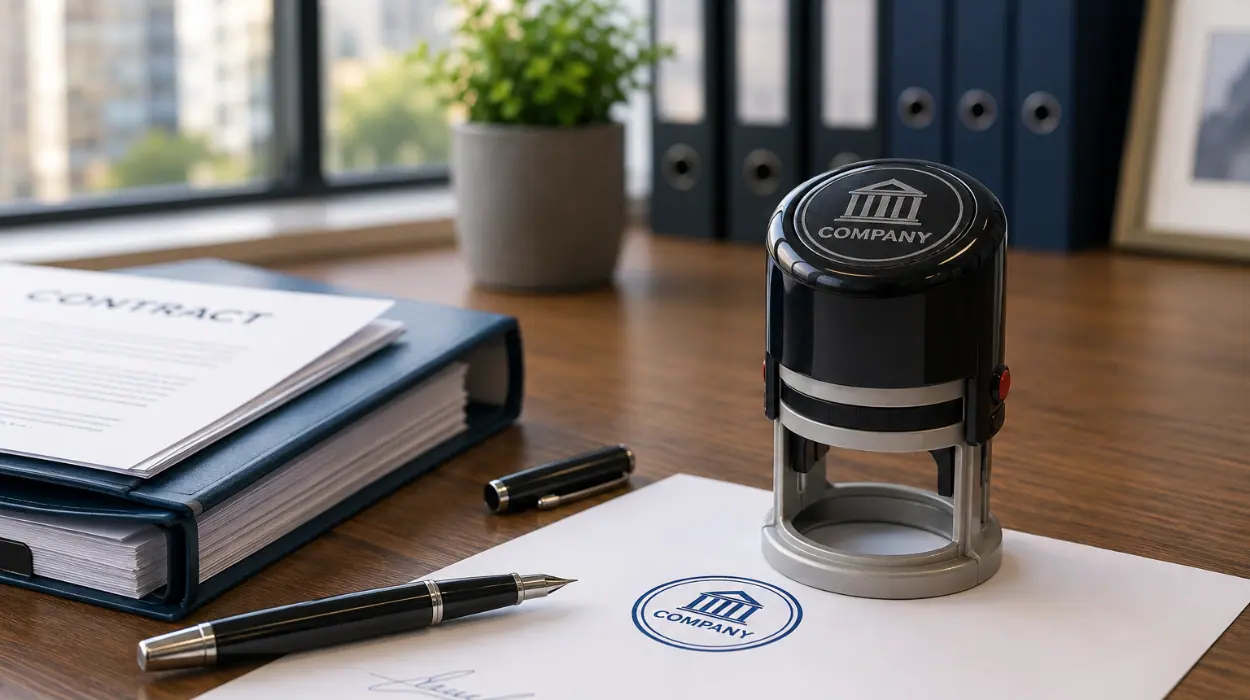
A company stamp is a physical or digital tool engraved with official corporate details used to authenticate business documents. It is used to validate contracts, endorse share certificates, and execute formal resolutions within corporate governance frameworks.
What Is a Company Stamp and How Does It Function?
A company stamp is a specialized mechanical or electronic device that imprints registered corporate details onto legal paperwork. It functions as an official identifier that prevents forgery, establishes organizational legitimacy, and secures transactions across international business sectors.
Corporate validation requires physical or digital proof of authority. Modern companies deploy rubber stamps, self-inking models, or embossing seals. Each stamp contains specific statutory information required by corporate law. This information includes the registered company name, company registration number, and jurisdiction of incorporation. Organizations apply these impressions directly to paper certificates, bank documents, and statutory registers.
Legal frameworks accept company stamps as reliable evidence of corporate intent. When directors execute documents, the impression confirms that the action carries official corporate approval. Banks and financial institutions frequently request stamped documentation to verify account instructions. International trade transactions rely heavily on physical stamps to clear customs and authenticate commercial invoices.
Operational efficiency improves significantly when organizations utilize standardized marking tools. Instead of collecting multiple physical signatures, authorized personnel apply a single clear impression. This process reduces administrative delays during high-volume document execution. Furthermore, clear ink impressions prevent ambiguity regarding which corporate entity authorized a transaction.
Why Do Businesses Use Company Stamps Today?
Businesses use company stamps today to meet international trade requirements, secure banking relationships, and prevent fraudulent document alteration. They utilize these tools to authenticate paper certificates and demonstrate official corporate approval on legal agreements.
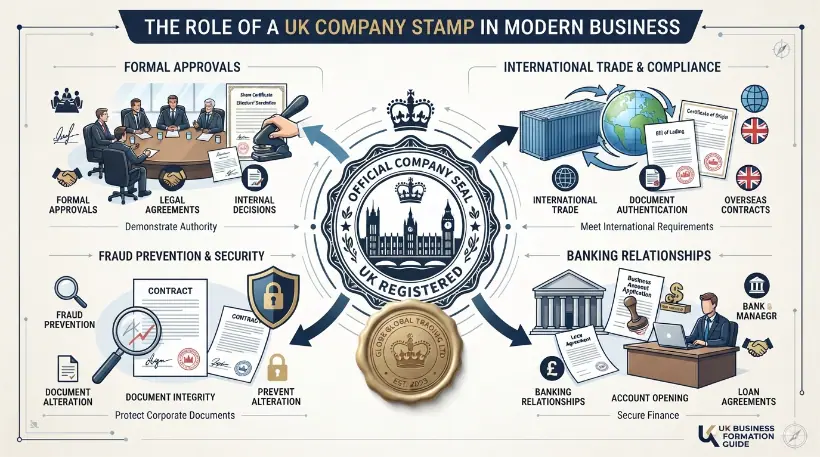
Global commerce demands high levels of document verification. Overseas partners often refuse unsigned or unstamped agreements because foreign legal systems prioritize physical seals. Export documentation, bills of lading, and certificates of origin require official stamps to pass regulatory inspections. Without these impressions, shipments face severe delays at international ports.
Financial institutions maintain strict compliance protocols for corporate accounts. When companies open new credit facilities, banks require authorized signatories to imprint corporate seals on signature cards. Loan agreements, corporate guarantees, and treasury instructions require official stamps to bind the organization legally. This requirement protects banks against unauthorized borrowing attempts by rogue employees.
Fraud prevention represents another critical operational benefit. Embossing seals and custom colored inks create physical barriers against document tampering. Criminals find altering stamped paper much harder than modifying digital files. Consequently, risk management teams mandate physical stamping for all high-value contracts and board minutes.
What Information Must Appear on a Company Stamp?
A company stamp must display the exact registered corporate name, the official company registration number, and the jurisdiction of incorporation. It should also include regulatory details such as the registered office address when required by local commercial law.
Regulatory compliance dictates the exact layout of corporate marking devices. The registered name must match Companies House records word for word. Using abbreviations creates legal ambiguity and invalidates the authentication process. The registration number must appear in clear, legible digits to allow instant cross-referencing by auditors.
Jurisdictional clarity prevents cross-border confusion. Companies registered in England and Wales must state their incorporation jurisdiction on official instruments. When businesses operate across multiple regions, they often order separate stamps for each operating subsidiary. This practice ensures local compliance during tax audits and regulatory inspections.
Additional text elements depend on internal governance needs. Some organizations include designated spaces for authorized signatures or dates. Other businesses add specific department identifiers like finance or legal affairs. However, statutory identifiers remain the most critical components of any compliant corporate seal.
How Does a Company Stamp Relate to Corporate Governance?
A company stamp relates to corporate governance by providing a physical mechanism to execute board resolutions and maintain statutory records. It works alongside internal compliance systems like the [PSC Register] to prove transparent ownership and valid decision-making.

Corporate governance frameworks require verifiable proof of authorized actions. When directors approve strategic decisions, they document those choices in written resolutions. Applying a corporate stamp to these minutes confirms that the board executed the decision properly. This documentation protects directors during shareholder audits and regulatory investigations.
Statutory record-keeping demands absolute accuracy and authenticity. Companies must maintain physical or digital registers of directors, shareholders, and significant controllers. When updating these critical files, compliance officers use official seals to mark verified entries. This discipline supports broader transparency initiatives required by modern business law.
Maintaining clear corporate records ensures readiness for external scrutiny. Organizations preparing for mergers or acquisitions must present flawless historical documentation. Investors review stamped board minutes and share certificates to confirm clean ownership chains. Proper use of corporate marking tools eliminates due diligence delays and accelerates successful transactions.
How Do You Select and Order the Right Company Stamp?
You select and order the right company stamp by evaluating your daily document volume, choosing between self-inking or embossing formats, and verifying your registration details. You then [Order a Custom Company Stamp From Form My Company] to receive a precision-crafted device.
Selecting the correct device depends on your specific workflow requirements. High-volume offices benefit from self-inking models because they apply thousands of impressions without requiring ink pads. Legal departments often prefer traditional embossing seals because they create raised, tamper-proof impressions on heavy paper stock.
Customization requires precise data entry. Buyers must input their exact corporate name and registration number into the supplier portal. Reviewing proofs before production prevents costly typos that render the device legally useless. Manufacturers engrave the rubber or metal plates using laser technology to ensure razor-sharp clarity.
Streamlining administrative workflows starts with reliable procurement partners. Business leaders seeking guidance on product selection can review the insights shared in [How to Choose a Company Stamp That Looks Professional]. Following these expert tips ensures your final product meets both aesthetic standards and statutory requirements.
Company stamps remain vital instruments for document authentication, international trade, and corporate governance compliance. They secure financial transactions and protect organizations against fraudulent alterations. Form My Company delivers precision-crafted corporate tools that meet strict regulatory standards.
Explore our Company Pack guide,
How Do You Notify Companies House of a New PSC?
Why Do Some Institutions Require Certified Company Documents?
Frequently Asked Questions
What is included in a company pack when registering a UK business?
A company pack typically contains essential statutory documents such as your certificate of incorporation, memorandum and articles of association, and share certificates. When entrepreneurs use Form My Company to streamline incorporation, their company pack delivers these vital legal records in both digital and printed formats. This comprehensive bundle ensures businesses meet all initial compliance requirements immediately after formation.
Do I legally need a company register and binder?
UK companies are legally required to maintain statutory registers containing details of directors, secretaries, and shareholders. Form My Company provides a structured company register within a professional binder to help businesses organize these mandatory records efficiently. Keeping these documents updated ensures full compliance with Companies House regulations during audits.
How long does it take to receive a physical company pack?
Physical company packs and binders are usually dispatched within 1 to 2 working days following successful incorporation by Companies House. Form My Company ensures these high-quality presentation folders reach your registered office promptly so you can execute agreements without delay. Express delivery options are often available for time-sensitive business launches.
Can I update my company pack if my registered office changes?
Statutory documents within your company pack must reflect your current corporate details at all times. When businesses update their registered office address or appoint new officers, they must document these changes in their statutory registers. Form My Company offers ongoing support and replacement documentation to keep your corporate binder accurate and legally compliant.
What is the difference between digital and printed company packs?
Digital company packs provide instant PDF access to incorporation certificates and constitutional documents for fast online sharing. Printed company packs include physical paper copies housed inside a custom-branded corporate binder designed for board meetings and banking verification. Form My Company supplies both formats to give modern businesses maximum administrative flexibility.