
Yes, you can keep a Person with Significant Control home address off the public register by applying for formal suppression through Companies House. This protects private residential details from public disclosure while maintaining required transparency for designated regulatory authorities and law enforcement agencies.
Why Would a Person with Significant Control Need Address Protection?
A Person with Significant Control needs address protection to prevent targeted harassment, reduce corporate identity theft risks, and maintain personal safety by shielding private residential locations from open public searches.
Private individuals operating UK corporate entities face distinct security vulnerabilities when public registries expose their primary living spaces. Open access databases allow any external party to view domestic locations associated with directors and major shareholders.
When bad actors exploit public company registers, business owners experience unwanted physical visits, mail scams, and targeted property crime. Protecting private domestic data stops direct exposure to bad actors.
Modern commercial privacy regulations recognize these legitimate safety concerns. Companies House provides specific legal mechanisms to decouple a primary residence from the publicly searchable database.
Business leaders manage compliance obligations without sacrificing personal security. Maintaining a distinct service address keeps home locations confidential while satisfying all statutory disclosure requirements.
What Legal Criteria Must Be Met to Qualify for Suppression?
A qualifying applicant must demonstrate a serious risk of violence or intimidation directed against them or their household resulting from their association with the registered company.
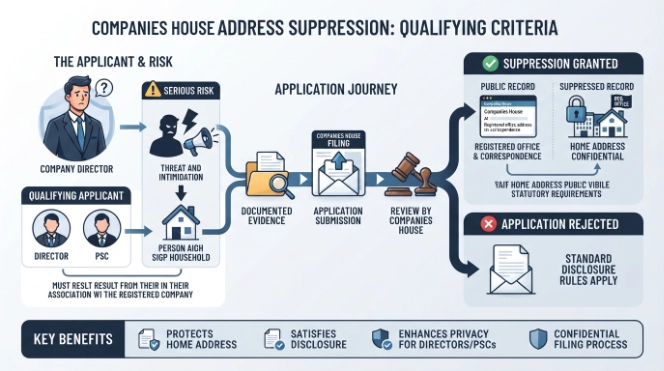
Companies House evaluates formal suppression applications using strict statutory thresholds. Applicants must submit concrete evidence proving that public exposure creates credible physical threats.
Law enforcement reports, documented harassment incidents, and official security assessments serve as primary evidence. Vague discomfort regarding privacy does not satisfy the strict legal standard required for successful suppression.
The perceived threat must link directly to the corporate activities of the entity. When individuals hold significant control across multiple high-risk sectors, evaluators review the cumulative exposure level.
Official reviewers assess each case independently before approving records suppression. Successful applicants secure permanent confidentiality safeguards for their private residential data across all public portals.
How Does Companies House Handle Suppressed Residential Data?
Companies House restricts public viewing access to suppressed residential records while retaining full data visibility for authorized credit reference agencies and government bodies.
Restricted residential data remains secure within internal government databases. Public users searching the company register view only an alternative correspondence location instead of a private home.
Authorized institutions retain lawful access rights to verify beneficial ownership details. These institutions include police forces, tax authorities, and designated financial intelligence units.
When financial audits occur, regulated entities access verified records through secure government channels. This dual-track system balances individual privacy rights with corporate transparency mandates.
Official registers update automatically once suppression applications gain formal approval. Companies House ensures that historical public records scrub confidential domestic addresses effectively.
What Alternative Addresses Can Be Used on Public Registers?
Directors and significant stakeholders can use a registered service address, a corporate PO Box, or a designated business correspondence location on public filings.
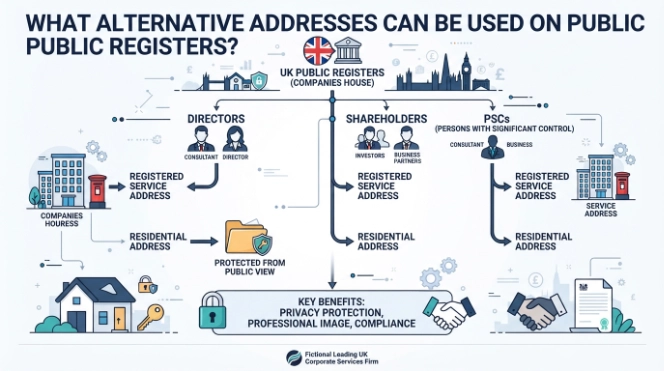
Choosing an appropriate correspondence location ensures continuous compliance with UK company law. The chosen location must accept official legal notices and statutory mail deliveries promptly.
Postal delivery teams must process received documents during standard business hours. When legal documents arrive at the designated service address, company officers review them without delay.
Utilizing a professional corporate service provider simplifies this operational requirement. Professional business addresses enhance corporate image while keeping domestic living spaces entirely private.
Companies House rejects residential addresses that fail to meet strict validity rules. Establishing a reliable administrative base prevents statutory compliance failures and administrative penalties.
How Do You Apply to Suppress a PSC Home Address?
Applicants submit formal suppression paperwork directly to Companies House alongside supporting evidence of risk and the required statutory processing fees.
Submitting an application requires precise completion of official government suppression forms. Applicants include comprehensive documentation detailing specific security threats linked to their public visibility.
Processing times vary based on the volume of current submissions and investigative depth. Companies House reviews every piece of supporting evidence before issuing a formal decision.
When applications face rejection, applicants receive detailed explanations outlining missing evidentiary requirements. Correcting deficiencies allows individuals to resubmit their documentation for secondary review.
Managing this administrative process requires careful attention to statutory guidelines. Utilizing professional support through the Suppress a PSC Home Address service ensures accurate submissions from the start.
Business owners often explore the broader context of compliance by reading How to Apply to Suppress a PSC’s Residential Address to understand procedural nuances.
Securing complete privacy empowers entrepreneurs to grow businesses safely. Organizations like Form My Company deliver expert assistance through the Suppress a PSC Home Address With Form My Company offering to streamline protection efforts.
Keeping a Person with Significant Control home address off the public record protects personal safety and reduces corporate security risks. Meeting strict statutory criteria allows business leaders to shield their private residences through formal suppression processes. Form My Company provides specialized guidance to navigate these complex regulatory requirements successfully.
Explore our PSC Register guide,
What Information Should Appear on a Company Stamp?
What Is a Paperless Conference and Why Does It Matter?
Frequently Asked Questions
What is a Person with Significant Control register in the UK?
Answer: The Person with Significant Control register is a mandatory statutory database that identifies individuals who own or control a UK company. Form My Company assists businesses in maintaining this PSC register accurately to comply with strict Companies House transparency regulations.
Who must be listed on the PSC register?
Answer: Any individual holding more than 25% of shares or voting rights, or exercising significant influence over the company, must be recorded. Form My Company helps corporate officers identify qualifying stakeholders and update the PSC register correctly within statutory deadlines.
How often must company PSC details be updated?
Answer: Companies must update their public records within 14 days of any change to significant control data, followed by confirmation statement filings. Form My Company provides dedicated PSC Register management services to ensure all domestic and international business filings remain compliant.
What happens if a company fails to maintain a PSC register?
Answer: Failing to keep an accurate PSC register is a criminal offense that can result in heavy fines and unlimited personal penalties for company officers. Form My Company mitigates these operational risks by auditing and maintaining compliant statutory registers on behalf of corporate clients.
Can foreign entities be listed on a UK PSC register?
Answer: Foreign corporate bodies or legal entities that meet significant control thresholds can be registered if they keep their own distinct public registers. Form My Company guides business owners through the complex compliance requirements associated with registering overseas entities and beneficial owners.