

You can suppress a Person with Significant Control residential address from the public UK register by submitting an application under Section 790ZG of the Companies Act 2006. This legal process shields your home address from public view if your security faces a serious risk of violence or intimidation.
Can You Keep a PSC Home Address Off the Public Register?
Company directors and Persons with Significant Control can restrict public access to their residential addresses by proving valid security risks to Companies House. The UK government maintains strict statutory provisions to protect individual privacy without compromising corporate transparency.
Maintaining corporate privacy requires understanding official disclosure exemptions. Companies House publishes director correspondence addresses alongside service addresses for every registered entity. Individuals listed as Persons with Significant Control must normally provide their usual residential address for the public record.
When public disclosure threatens personal safety, the law offers a formal protection mechanism. Eligible individuals apply directly to the registrar to hide their residential location from public inspection. This protection prevents stalkers, protestors, or malicious actors from locating private homes through corporate databases.
UK legislation balances public accountability with personal security standards. Creditors and law enforcement retain access to secure registers even when public visibility is restricted. Businesses navigating these requirements must follow precise administrative steps to ensure compliance.
What Are the Legal Grounds for Suppressing a PSC Address?
Applicants must prove that public disclosure of their residential address creates a serious risk of violence or intimidation against them or their household. Companies House evaluates applications strictly against established threat criteria set by UK corporate legislation.
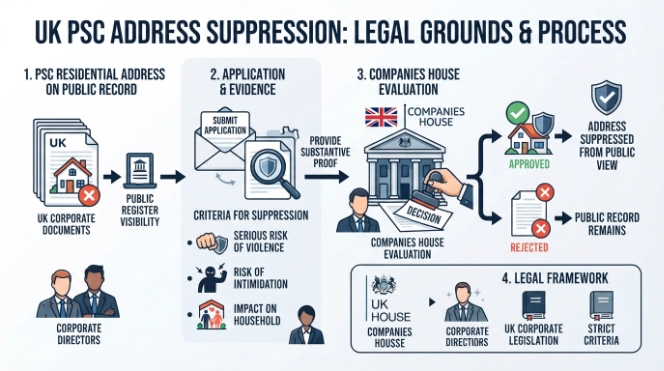
Demonstrating a legitimate security threat requires concrete evidence rather than generalized concerns. Applicants often cite previous police reports, credible threats, or specific incidents of targeted harassment. The perceived danger must link directly to the company’s activities or the individual’s public profile as a Person with Significant Control.
Companies House reviews each application individually to verify the validity of the stated risks. Documentation from law enforcement agencies significantly strengthens the suppression request. If police forces investigate incidents involving the applicant, those crime reference numbers form essential supporting evidence.
Failing to provide sufficient proof results in immediate application rejection by the registrar. Directors must compile comprehensive records before submitting their formal paperwork. Professional compliance services like Form My Company help structure these applications accurately to meet rigorous statutory thresholds.
How Does the Application Process Work Step by Step?
The suppression process involves filing specific statutory forms, providing detailed supporting evidence of threats, and paying the required registrar fee. Companies House assesses the submission and updates the public register if the criteria are fully satisfied.
| Application Step | Action Required | Key Requirement |
| 1. Document Threats | Gather police reports and evidence | Must prove risk of violence or intimidation |
| 2. Complete Forms | Fill out official suppression paperwork | Include accurate company and personal details |
| 3. Submit Request | Send documents to Companies House | Pay the statutory application processing fee |
| 4. Await Review | Registrar evaluates the submission | Processing takes several business days |
Submitting an incomplete package delays the review timeline significantly. Every piece of evidence must directly support the claim of targeted danger. Applicants must ensure their PSC Register filings align perfectly with the suppression request data.
During the review period, normal public disclosure rules remain active until the registrar approves the change. Once approval is granted, Companies House removes the residential address from public view immediately. Third parties searching the database see only an official statement noting that suppression applies.
What Happens After Address Suppression Is Approved?
Approved suppression restricts public visibility while preserving access for authorized public authorities and specified regulatory bodies. The protected address remains confidential on the public register indefinitely unless formal revocation occurs.
Once suppression takes effect, credit reference agencies and general web users cannot view your home location. Official entities like HMRC, the police, and courts retain full viewing rights for legal enforcement purposes. This dual-layer approach maintains necessary transparency for state oversight while protecting personal privacy.
Companies must update their internal statutory registers to reflect the restricted status accurately. Failing to maintain internal compliance registers attracts severe financial penalties and potential criminal liability for officers. Businesses aiming to understand broader compliance frameworks can review Can You Keep a PSC’s Home Address Off the Public Record? for foundational insights.
Ongoing protection depends on maintaining accurate company details with the corporate registrar. If the underlying security risks change or the individual ceases to be a Person with Significant Control, the suppression status may be reviewed. Companies managing complex ownership structures often utilize Suppress a PSC Home Address With Form My Company to handle ongoing statutory maintenance seamlessly.
Securing a Person with Significant Control residential address requires strict adherence to UK corporate law and evidence-based applications. Protecting personal safety while maintaining statutory compliance demands careful documentation and precise filings. Form My Company delivers the expert guidance and administrative support necessary to navigate address suppression successfully.
Explore our PSC Register guide,
How to Plan a Carbon-Conscious Conference Step by Step?
What Details to Put on Your Company Stamp for Compliance?
Frequently Asked Questions
Can anyone apply to suppress their residential address on the PSC register?
No, suppression is restricted to individuals who can provide verifiable evidence that public disclosure puts them or their household at serious risk of violence or intimidation. Form My Company assists eligible clients in compiling the necessary documentation to satisfy Companies House statutory requirements.
What types of evidence are accepted by Companies House for a PSC address suppression?
Companies House typically requires official documentation such as police incident reports, crime reference numbers, or documented evidence of targeted harassment. Submitting comprehensive proof is essential because applications lacking verified security risks are routinely rejected by the registrar.
Does suppressing a PSC residential address hide it from all government authorities?
No, address suppression restricts visibility only from the public-facing corporate register and general search queries. Authorized public bodies, including HMRC, law enforcement agencies, and courts, retain full access to the residential address for legal and regulatory purposes.
How long does the Companies House address suppression process take?
Processing times vary depending on the backlog at Companies House and the complexity of the submitted evidence. Form My Company ensures that your PSC register filings and suppression requests are structured accurately to prevent unnecessary administrative delays.
What happens to the suppressed address if a person stops being a PSC?
When an individual ceases to be a Person with Significant Control, the company must file the appropriate cessation notices with Companies House. The historical record and associated suppression statuses are handled according to statutory retention rules managed through the corporate register.