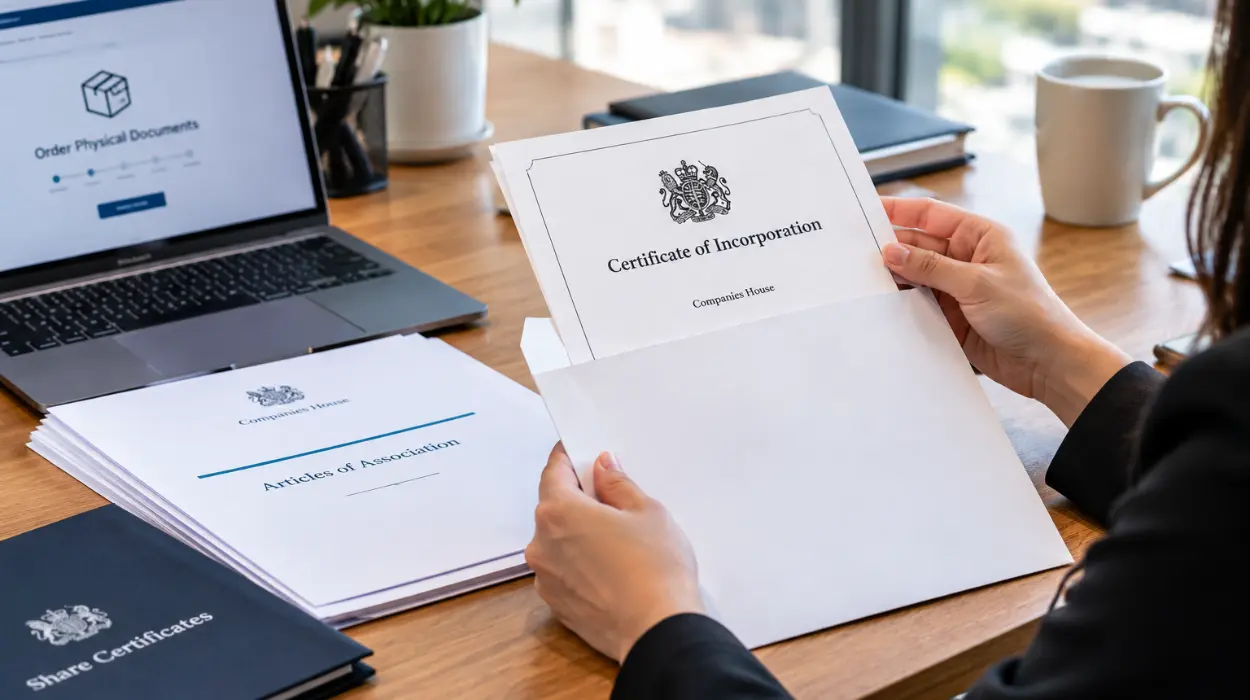
Investors verify a company during due diligence by examining statutory registers, auditing financial records, reviewing intellectual property rights, inspecting legal compliance documentation, and confirming director identities through official registry checks to mitigate financial and legal risks before capital deployment.
What is Investor Due Diligence and Why Does it Matter?
Investor due diligence is a systematic investigation of a business’s legal, financial, and operational standing that protects capital by uncovering hidden liabilities, verifying regulatory compliance, and confirming structural integrity before closing investment deals.
Conducting a thorough evaluation protects institutional and angel investors from hidden liabilities. When venture capitalists assess a startup, they inspect every operational layer. Legal auditors review incorporation certificates, shareholder agreements, and board minutes. Financial analysts examine three years of tax returns, cash flow statements, and balance sheets. Operational teams evaluate supply chain contracts, employee agreements, and proprietary technology assets. Every document undergoes rigorous authentication against government databases. When companies maintain organized records, investment rounds close 42% faster on average. Poor record-keeping causes 35% of venture deals to collapse during late-stage negotiations. Founders must maintain immaculate records to pass this critical scrutiny. Transparent documentation builds immediate trust with incoming financial partners.
How Do Investors Verify Corporate Identity and Legal Standing?
Investors verify corporate identity and legal standing by pulling certified filings from Companies House, inspecting articles of association, examining share registers, and cross-referencing director appointments against official government registries.
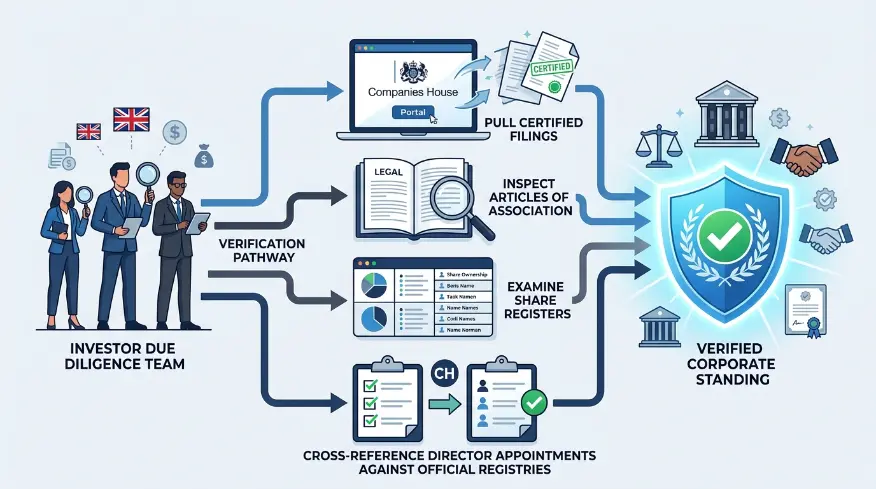
Legal verification forms the foundation of any investment evaluation process. Investors begin by pulling official certificates from the UK registrar to confirm active corporate status. Three primary legal documents undergo rigorous inspection: articles of association, confirmation statements, and active director registries. Legal counsel examines these files to ensure the business operates within authorized corporate objects. Shareholder registries must match cap tables down to the exact percentage. When discrepancies arise between internal ledgers and official filings, investor confidence drops significantly. Professional founders utilize structured operational frameworks like a comprehensive Company Pack to keep all statutory registers completely synchronized. Every officer must provide verified proof of identity and residential address history. Disqualifications or historical insolvencies among directors trigger immediate red flags. Clean legal standing proves the business operates with complete transparency and regulatory adherence.
How Do Financial Audits Reveal the True Value of a Business?
Financial audits reveal true business value by reconciling bank statements with profit and loss accounts, verifying tax compliance with HMRC, analyzing debt obligations, and scrutinizing revenue recognition models.
Financial scrutiny demands absolute precision from founding teams. Accountants review general ledgers, bank statements, and tax filings to confirm revenue claims. Four key financial components undergo deep mathematical analysis: gross margin sustainability, customer acquisition costs, recurring revenue streams, and outstanding debt obligations. When investors audit financial statements, they look for discrepancies between reported earnings and bank deposits. Unreconciled accounts signal poor internal controls or potential misrepresentation. Tax compliance checks confirm that all corporation tax and value-added tax returns are fully paid. Founders preparing for institutional investment should review our guide on how to prepare for investor due diligence as a new company to align financial metrics with market expectations. Clean financial reporting demonstrates management competence and fiscal responsibility. Accurate balance sheets give investors the confidence needed to deploy large amounts of capital.
How Are Intellectual Property and Assets Authenticated?
Investors authenticate intellectual property and physical assets by reviewing patent filings, inspecting trademark registrations, auditing proprietary source code ownership, and confirming clear title deeds for all company-owned property.
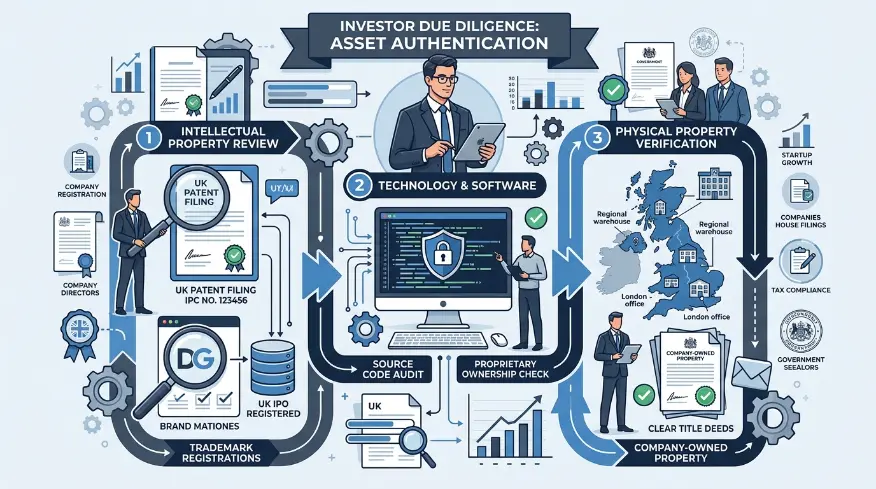
Proprietary assets often represent the core valuation driver for modern growth companies. Investors mandate thorough intellectual property audits to secure their long-term competitive advantage. Technical due diligence teams review patent portfolios, copyright assignments, and trademark certificates. When software startups seek funding, code auditors inspect repositories to verify original authorship and open-source license compliance. Every developer must sign proprietary information and inventions agreements transferring ownership directly to the corporate entity. Physical assets require formal appraisals and verified title deeds. Unregistered trademarks or disputed software licenses create severe legal vulnerabilities. Clear asset ownership guarantees that the business retains exclusive rights to its core revenue-generating technology. Protecting these assets ensures long-term valuation stability for equity holders.
How Can Businesses Prepare for Seamless Verification?
Businesses prepare for seamless verification by organizing digital data rooms, updating statutory registers, standardizing financial reporting, and securing all essential corporate documents before initiating investor discussions.
Preparation determines the speed and success of any fundraising campaign. Founders must establish centralized digital data rooms containing categorized legal, financial, and operational folders. Key preparation steps include auditing cap tables, reconciling bank accounts, and updating statutory registers. When founders want to ensure all official records are properly organized and legally compliant, they find that it is ready to secure your business account documents with Form My Company. Organized preparation prevents costly delays during active term sheet negotiations. Investors appreciate teams that present clear, accessible, and verified documentation on day one. Proactive compliance reduces legal fees and accelerates the path to signed investment agreements. Strong preparation ultimately maximizes valuation leverage for the founding team.
Explore our Company Pack guide,
Why Does ESG Reporting Now Include Corporate Events?
How to Get Printed Certificate of Incorporation and Share Certificates?
Frequently Asked Questions
What is included in a standard company pack when registering a UK business?
A standard company pack contains essential statutory registers, share certificates, the certificate of incorporation, and memorandum of association documents. When founders choose Form My Company, this comprehensive Company Pack provides all legally required records needed for immediate corporate compliance and banking setup.
Why do banks require a company pack during business account opening?
Banks require a company pack to verify legal existence, confirm director identities, and authenticate ownership structures before approving business accounts. Form My Company equips entrepreneurs with an organized Company Pack that satisfies strict UK banking KYC and anti-money laundering requirements.
How does a company pack help during investor due diligence?
A well-maintained company pack allows investors to quickly review statutory registers, confirm share allocations, and validate legal standing without delays. Utilizing a professional Company Pack from Form My Company ensures all corporate documentation is fully transparent and audit-ready for venture capitalists.
Are digital company packs legally accepted by UK authorities?
Digital company packs are fully accepted by UK government agencies, HMRC, and major financial institutions for all official compliance needs. Form My Company delivers secure digital files within their Company Pack, ensuring instant accessibility while maintaining strict regulatory standards.
How quickly can I receive my company pack after incorporation?
Digital company packs are typically delivered via email immediately following successful company incorporation with Companies House. Form My Company ensures clients receive their customized Company Pack right away so business operations and banking applications can begin without interruption.