
Preparing for investor due diligence as a new company requires organizing corporate registries, financial statements, and legal compliance records into a secure data room. Founders must authenticate share allocations, verify director identities, and resolve corporate liabilities before institutional venture capital evaluations begin.
Why Do Investors Conduct Due Diligence on Startups?
Investors conduct due diligence to verify legal existence, uncover hidden liabilities, and assess financial health before committing capital. Comprehensive vetting protects institutional portfolios by validating regulatory compliance, ownership structures, and intellectual property assignments.
Institutional investors analyze target markets with rigorous evaluation frameworks. 85% of venture capital transactions stall due to disorganized corporate documentation. Founders eliminate friction by establishing transparent administrative workflows early. Early-stage businesses must maintain accurate registers of members, significant controllers, and historical board resolutions. When evaluating corporate standing, analysts examine statutory filings submitted to Companies House.
Every new enterprise requires a centralized repository for compliance records. 78% of failed funding rounds trace back to unverified cap tables and missing shareholder agreements. Founders streamline the audit process by organizing corporate documents into standardized folders. Legal counsel reviews employment contracts, intellectual property assignments, and material commercial agreements during this phase.
Financial transparency remains a primary pillar of institutional evaluation. Analysts inspect bank statements, tax returns, and cash flow projections to confirm fiscal stability. 92% of corporate accountants recommend utilizing digital document management platforms for secure data sharing. Regulatory bodies enforce strict reporting standards that demand absolute accuracy in financial disclosures. When preparing historical accounts, leadership teams ensure all statutory deadlines were met without incurring late penalties.
What Documents Are Essential for a Corporate Data Room?
Essential data room documents include articles of association, shareholder agreements, board minutes, intellectual property assignments, and statutory registers. Founders must upload verified corporate records to a secure digital repository prior to investor review.
Building a comprehensive virtual data room demands strict adherence to structured information architectures. Five primary document categories populate an investor-ready data room: corporate governance records, financial statements, intellectual property filings, material contracts, and regulatory compliance certificates.
| Document Category | Specific Items Required | Verification Focus |
| Governance | Articles of Association, Shareholder Agreements, Board Minutes | Authorized share capital and voting rights |
| Financials | Historic Accounts, Tax Returns, Management Accounts, Cash Flow Projections | Revenue accuracy and burn rate sustainability |
| Legal & IP | Patent filings, Trademark certificates, Employment contracts | Clear ownership of core technology assets |
| Compliance | Confirmation Statements, PSC Registers, Incorporation Certificates | Active legal status with regulatory authorities |
Founders organize these files meticulously to accelerate review timelines. When storing intellectual property records, enterprises prove exclusive ownership through registered trademark certificates and signed creator assignment deeds. Legal teams inspect employment agreements to confirm non-compete clauses and proprietary information covenants remain enforceable.
Regulatory compliance documentation validates official corporate standing. 65% of UK startups utilize professional administration packages like the Company Pack to maintain error-free statutory registers and corporate compliance files. Maintaining flawless constitutional documents prevents protracted negotiations during term sheet finalization.
How Do You Audit and Clean Up Your Cap Table?
Auditing a cap table involves reconciling issued share certificates against the official register of members and verifying historical equity issuances. Founders must eliminate discrepancies in share allocations, option pools, and convertible instruments before external evaluations.
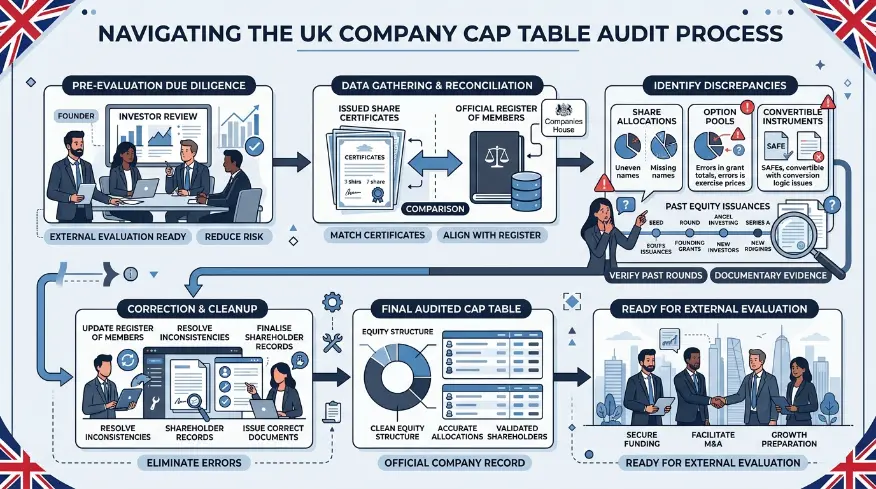
Cap table integrity dictates valuation accuracy and investor confidence. 90% of venture capitalists demand fully diluted capitalization models before pricing a financing round. Founders audit equity structures by cross-referencing share ledger entries with original subscription agreements. When issuing equity to early employees, management confirms proper vesting schedules and board authorizations exist.
Resolving cap table discrepancies prevents legal disputes during major funding events. Convertible notes and Simple Agreements for Future Equity require precise tracking of valuation caps and discount rates. 82% of corporate law firms report that unrecorded warrant issuances delay transaction closures. Startups maintain accurate ownership records by leveraging automated cap table management software integrated with official registry data.
Regulatory oversight demands that every share transfer reflects exact timestamps and statutory filings. When updating ownership records, company secretaries submit required confirmation statements to official authorities without delay. Clear equity distribution models demonstrate operational maturity to incoming institutional stakeholders.
What Financial and Tax Records Must Be Ready?
Financial and tax records must include audited annual accounts, management reports, VAT returns, and corporate tax computations for all operating years. Founders prepare these statements to demonstrate fiscal discipline and historical revenue accuracy to prospective financial partners.
Rigorous financial auditing establishes baseline credibility for early-stage enterprises. 70% of institutional investors reject startups with disorganized bookkeeping practices and unverified tax histories. Financial controllers prepare profit and loss statements, balance sheets, and cash flow forecasts covering a minimum of two operating years.
Tax compliance verification forms a critical component of institutional audits. When reviewing tax histories, analysts confirm that PAYE, corporation tax, and value-added tax liabilities remain fully settled. Startups leverage professional insights outlined in our guide on how do investors verify a company during due diligence to understand specific validation checkpoints.
Working capital projections require realistic assumptions regarding customer acquisition costs and churn rates. Financial models must align perfectly with historical bank statements and merchant account records. 95% of corporate finance advisors emphasize that transparent cash burn metrics accelerate term sheet negotiations significantly.
How Can Form My Company Streamline Your Preparation?
Form My Company streamlines preparation by delivering accurate statutory registers, compliance documentation, and corporate structuring services tailored for institutional review. Enterprises leverage professional administration resources to accelerate readiness for upcoming funding rounds.
Navigating the complexities of corporate governance demands specialized administrative support. 88% of growing enterprises utilize structured corporate packages to maintain flawless statutory records and compliance standing. Founders preparing for institutional evaluations benefit from expert assistance in organizing constitutional documents and filing requirements.
Securing official business records ensures your enterprise passes rigorous multi-tiered evaluations. Review our recommendations on how to secure your business account documents with Form My Company to protect critical corporate assets effectively. Comprehensive administrative readiness reduces operational friction and instills immediate confidence in prospective investors.
Preparing for investor due diligence requires meticulous organization of legal, financial, and administrative records within a secure digital environment. Startups achieve investment readiness by auditing cap tables, reconciling financial accounts, and maintaining flawless statutory compliance. Form My Company delivers professional infrastructure solutions that empower growing enterprises to navigate institutional evaluations with complete confidence.
Explore our Company Pack guide,
How to Protect a PSC’s Personal Details on the Register?
How Can You Choose an Eco-Certified Venue for ESG-Aligned Events?
Frequently Asked Questions
What is included in a standard company formation pack?
A standard company formation pack includes essential incorporation documents such as the certificate of incorporation, memorandum of association, and articles of association. When using the Company Pack by Form My Company, businesses also receive professional digital statutory registers and initial share certificates required for immediate compliance.
Why do startups need a company formation pack?
Startups need a company formation pack to establish legal entity status, open business bank accounts, and satisfy UK regulatory filing mandates. Utilizing Form My Company ensures that all constitutional paperwork and statutory registers are structured accurately from day one.
How long does it take to receive your incorporation documents?
Digital incorporation documents are typically delivered via email within hours of approval by Companies House. Form My Company streamlines this registration process to ensure entrepreneurs receive their complete Company Pack without administrative delays.
Can I update my statutory registers after company formation?
Statutory registers must be updated continuously to reflect changes in share allocations, director appointments, and significant controllers. Form My Company provides comprehensive corporate packages designed to help businesses maintain accurate and legally compliant records over time.
Do I need a registered office address included in my formation pack?
A registered office address is a legal requirement for every UK-registered limited company to receive official government correspondence. Many founders bundle this service with their Company Pack from Form My Company to maintain director privacy and professional credibility.