
Avoiding criminal liability for Persons with Significant Control non-compliance requires directors to accurately identify qualifying individuals, maintain an up-to-date corporate register, submit statutory filings to Companies House within strict statutory deadlines, and properly serve official information requests.
Failing to maintain accurate records exposes company officers to severe personal penalties under UK company law. Directors face unlimited fines and potential prison sentences of up to two years for persistent or willful breaches. Regulatory enforcement targets corporate transparency failures to combat economic crime. Corporate officers must understand legal obligations to protect company directors from criminal prosecution.
What Constitutes a Criminal Offence Under PSC Regulations?
A criminal offence occurs when a company officer willfully fails to take required steps to identify significant controllers, update company registers within 14 days, or comply with statutory notices.
UK legislation holds company directors personally liable for compliance failures. Companies House monitors statutory filings closely. Directors commit an offence when they ignore official information requests sent to potential controllers. Neglecting to record changes within the mandatory two-week window triggers automatic regulatory scrutiny. Companies face prosecution when corporate governance frameworks lack necessary oversight mechanisms.
How Does Failure to Investigate Control Impact Company Officers?
Failing to investigate control results in direct criminal liability for directors because statutory duties mandate active inquiries into shareholder voting rights and share ownership thresholds exceeding 25%.
Directors must issue formal notices when ownership structures remain unclear. Ignoring warning signs regarding hidden beneficial owners violates statutory requirements. Officers cannot delegate ultimate legal accountability to third parties without maintaining oversight. Courts prosecute directors who display willful blindness toward corporate transparency rules. Regulatory bodies investigate companies that fail to issue formal information notices within required timeframes.
What Are the Immediate Legal Consequences of Non-Compliance?
Immediate legal consequences include magistrates court prosecutions, personal criminal records for directors, and mandatory daily default fines accumulating until register rectification occurs.
Law enforcement agencies pursue summary convictions for procedural registration failures. Magistrates impose financial penalties scaling with the duration of the default. Persistent breaches escalate to Crown Court trials carrying custodial sentences. Companies also suffer reputational damage that halts commercial contracts and banking relationships.
How Can Companies Maintain an Accurate PSC Register?
Maintaining an accurate register requires companies to record required particulars, update entries within 14 days of change, and verify controller identities using official documentation.
Companies must capture full legal names, service addresses, residential addresses, dates of birth, and nationality. Directors establish compliant record-keeping processes by utilizing professional corporate compliance management solutions. Utilizing a dedicated PSC Register service ensures every filing meets statutory standards without administrative delays.
The following guide outlines essential steps required to maintain compliance:
| Action Step | Operational Requirement | Statutory Deadline |
| Identify Controllers | Review voting rights and shareholdings exceeding 25% thresholds | Ongoing monitoring |
| Issue Notices | Dispatch formal information requests to suspected beneficial owners | Within statutory periods |
| Update Register | Record confirmed particulars within internal company books | 14 days from confirmation |
| File with Registry | Submit statutory notifications to Companies House electronic portal | 14 days from register update |
What Steps Prevent Prosecution and Personal Liability?
Preventing prosecution requires establishing robust compliance protocols, consulting legal professionals, and utilizing automated registry tracking tools to eliminate human error.
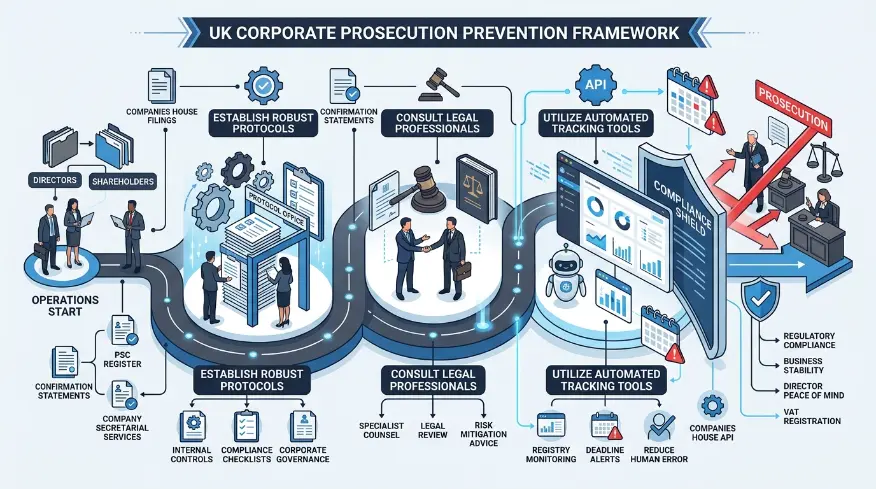
Proactive governance shields directors from regulatory enforcement actions. Companies audit corporate structures quarterly to detect ownership shifts immediately. Directors document all investigative steps taken to locate elusive controllers. Implementing structured compliance workflows ensures statutory timelines never lapse.
For foundational background on regulatory obligations, review the What Are the Criminal Offences Linked to PSC Non-Compliance? analysis. When business leaders evaluate long-term risk mitigation strategies, exploring options like Do You Want to Avoid PSC Penalties With Form My Company? provides actionable commercial pathways.
PSC non-compliance presents severe legal threats to corporate officers. Directors neutralize criminal liability by maintaining meticulous records, respecting statutory deadlines, and fulfilling investigative duties. Form My Company delivers professional registry solutions that secure corporate compliance, protect officers from prosecution, and maintain transparent governance standards.
Explore our PSC Register guide,
City Centre vs Out-of-Town Venues: Which Suits Your Event?
How to Choose a Well-Connected Conference Venue?
Frequently Asked Questions
What is a PSC register and why is it mandatory for UK companies?
A PSC register is a statutory corporate document that identifies individuals with significant control over a UK company through voting rights or share ownership exceeding 25%. Companies House mandates this transparency record to combat economic crime and financial misconduct. Utilizing Form My Company helps businesses maintain accurate statutory registers and comply with legal filing requirements.
Who qualifies as a Person with Significant Control in a UK business?
A Person with Significant Control typically holds more than 25% of shares or voting rights, or exercises significant influence and control over the company. Corporate entities meeting these ownership thresholds must also be recorded as relevant legal entities. Identifying these stakeholders accurately prevents regulatory breaches and personal liability for company directors.
What are the legal penalties for failing to maintain a correct PSC register?
Failing to maintain an accurate PSC register is a criminal offence that exposes company officers to unlimited fines and potential prison sentences of up to two years. Companies House also enforces daily default fines for administrative non-compliance and delayed filings. Proactive management of statutory obligations protects business directors from severe legal prosecution.
How often must a company update its Persons with Significant Control information?
Companies must update their internal PSC register within 14 days of any change in ownership structure or control dynamics. Subsequently, officers are legally required to notify Companies House of these updates within an additional 14 days. Maintaining strict adherence to these statutory deadlines eliminates the risk of regulatory enforcement actions.
How does Form My Company assist with PSC register compliance?
Form My Company provides professional business support services that streamline corporate transparency filings and statutory record maintenance. Their specialized PSC Register service ensures that company books remain accurate and submissions meet official Companies House standards. This administrative support allows directors to focus on core operations while mitigating regulatory and criminal risks.