What if a request for a letter is simply a check that your company has permission to use an address, rather than a warning that something is wrong? If an address provider has asked you to sign one, it’s natural to wonder: “Why Would a Company Need a Letter of Authority for Its Address?” The request can sound like a legal filing or proof that your proposed registered office is valid, but it doesn’t automatically mean either.
A letter of authority records permission for an address provider to receive or handle correspondence for your company. It isn’t a universal Companies House filing requirement, and it’s different from proof of address or authority to act on the company’s behalf. Your registered office must still meet the relevant address requirements, including being a physical UK address where documents can be delivered and their delivery acknowledged.
This guide explains who may ask for written authority, what it confirms and how it fits into a registered office arrangement. You’ll also learn what to check before signing, so you can respond confidently and avoid confusing separate company documents.
Key Takeaways
- Why Would a Company Need a Letter of Authority for Its Address? It can clarify who has permission to use the address and how correspondence will be handled.
- Separate a provider’s permission checks from the requirements a registered office address must meet.
- Check how an authority letter differs from proof of address and a director’s service address before submitting documents.
- Find out why the provider needs written authority and which address and company the request covers.
- Before signing, review who is giving permission, the wording and any limits on how the address may be used.
Why might a company need a letter of authority for its address?
You’ve arranged a business address, then the provider asks you to confirm in writing that your company may use it. It can sound like an extra legal filing. In practice, the request may be part of the provider’s process for recording who has permission to use the address and what the arrangement covers. So, why would a company need a letter of authority for its address? It can give both parties a clear written record of that permission.
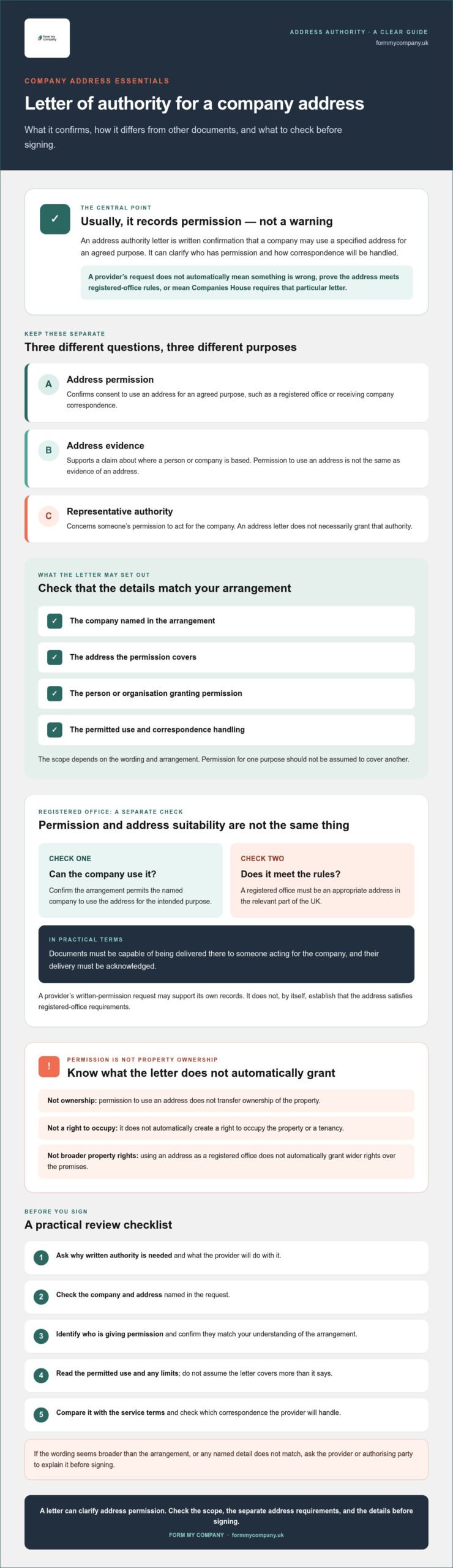
A letter of authority for an address is written confirmation that a company may use a specified address for an agreed purpose; it does not, by itself, give the company ownership of the property. It isn’t a universal Companies House filing requirement. Whether a particular document or arrangement is needed depends on the circumstances, so check current requirements rather than treating a provider’s request as proof of a general legal rule.
What does address authority confirm?
The letter may name the company, the address and the person or organisation granting permission. It may also describe the permitted use, such as using the address as a registered office or receiving company correspondence there. Read the wording carefully: the scope depends on the document and arrangement, and permission for one purpose shouldn’t be assumed to cover another.
This distinction matters when a company uses premises it doesn’t own. Written permission can help clarify what has been agreed, but it doesn’t automatically transfer ownership, create a right to occupy the property or grant broader property rights. If the wording seems wider than the arrangement you discussed, ask the provider or authorising party to explain it before signing.
Why can the request feel confusing?
Provider procedures and legal requirements can appear similar, especially during company set-up. But a provider asking for written authority doesn’t, on its own, establish that Companies House requires that particular letter. Check the current rules for your company’s circumstances separately. A registered office is the company’s official address for formal correspondence; permission to use that address is a separate question.
It also helps to distinguish three things: address permission records consent to use an address; address evidence supports a claim about where a person or company is based; and representative authority concerns someone’s permission to act for the company. One document doesn’t necessarily prove all three.
If you’re arranging an address for your company, compare the letter with the service terms and confirm exactly what correspondence the provider will handle. Form My Company offers a business address service that can help founders set out an address arrangement clearly. Ask questions before signing if the named company, address, authorised person or permitted use doesn’t match your understanding.
How does an address authority letter relate to a UK registered office?
A company’s registered office is its official address for formal company communications. Companies House records it, and official documents may be sent there. It’s important to distinguish two separate checks: whether the address meets the rules for a registered office, and whether the company has permission to use it.
Current Companies House guidance says a registered office must be an appropriate address in the relevant part of the UK. In practical terms, documents must be capable of being delivered there to someone acting for the company, with delivery acknowledged. Review the Companies House registered office rules before relying on an address. A provider’s request for written permission may support its own records, but it doesn’t by itself establish that the address meets those requirements or that Companies House requires a particular letter.
Permission to use an address isn’t ownership
A company may be allowed to use an address through a service agreement or another permission arrangement, even if it doesn’t own or occupy the property. Using it as a registered office doesn’t automatically give the company ownership, a tenancy or wider rights over the premises. Check that the agreement covers the intended company and use. A registered office address service is one option for setting out an address arrangement clearly.
What should a company verify about its address?
Before registering or relying on an address, confirm that the arrangement permits the intended use and names the right company. Then check what happens to official correspondence. Who receives it? How will it be brought to the company’s attention? Is it forwarded or made available for collection? The answers depend on the specific service or agreement.
Why Would a Company Need a Letter of Authority for Its Address? In a registered office arrangement, it may help document the link between the company and the address provider. But the letter is only one part of the picture. Check the terms alongside current Companies House guidance, and ask the provider to clarify any limits on address use or correspondence handling before proceeding.
Which address documents are different from a letter of authority?
Address paperwork can look similar, but each document answers a different question. A letter of authority records permission to use a particular address for an agreed purpose. Proof of address helps show that a person or organisation is connected to an address. A director’s service address is the address recorded for a director to receive official communications. None should be assumed to replace the others: what a provider asks for depends on the arrangement and its checks.
| Document | Purpose and usual issuer | What it doesn’t prove by itself |
|---|---|---|
| Address authority letter | Records permission for a company to use an address. Usually supplied or approved by the person or organisation controlling the address. | Property ownership, proof of a person’s residence or authority to act for the company. |
| Proof of address | Supports a connection between a person or organisation and an address. It may come from a bank, utility provider or other organisation. | Permission for a company to use that address as its registered office. |
| Director’s service address | Identifies where official communications for a director may be sent, as recorded in company information. | That the company has permission to use the address, or that the director can authorise an agent to act. |
| Authority to act | Records that a representative may deal with specified matters on the company’s behalf. The company or an authorised person may provide it. | Permission to use the representative’s address as the company’s address. |
Address permission versus proof of address
Think of permission as “you may use this address for this purpose” and proof of address as “this person or organisation is connected to this address”. A provider may ask for both: one to record the agreed use, the other as part of its checks. Check who each document relates to and whether the address and company details match. A document confirming a director’s home address, for example, doesn’t automatically give the company permission to use that home as its business address.
Address authority versus authority to act for a company
Authorising an agent to contact an organisation or handle a matter is different from allowing a company to use an address. For example, a company might authorise an agent to discuss business rates with a council, without granting the agent’s address for company correspondence. The council’s Letter of Authority guidance illustrates this separate purpose. This example isn’t a universal rule for address providers.
So, why would a company need a letter of authority for its address? It may be requested to document address permission, but it doesn’t automatically prove identity, address evidence or representative authority. Read each request on its own terms and ask what the document is intended to confirm.
When might an address provider ask for written authority?
A request for written authority can arise when a company plans to use an address it doesn’t own or occupy, or when it signs up for a professional registered office or virtual office arrangement. The provider may want a clear record of which company can use the address, for what purpose and how related correspondence will be handled.
It’s understandable to wonder whether the request means something is wrong. On its own, it doesn’t show that the company has breached a rule or that the address is unsuitable. Providers’ processes differ, and a particular letter isn’t a universal statutory requirement. Ask what the provider needs to confirm and how the request fits the service you’ve arranged.
Using an address you do not own
If you’re using premises belonging to a landlord, another occupier or a service provider, they may want the agreed use recorded in writing. This can help avoid uncertainty about which company has permission and whether the address may be used for business correspondence or as a registered office. Check any existing lease or service agreement before signing a separate letter. Don’t assume a new letter cancels or overrides restrictions in another agreement.
Using a professional address service
A professional provider may request authority as part of setting up an address arrangement, but there’s no single process followed by every provider. The document or onboarding request may clarify which company is covered, the permitted use and arrangements for receiving, handling or forwarding correspondence. Check that those details match what you’ve agreed, and ask about any limits before returning the paperwork.
If you’re comparing address options, review the scope of the provider’s virtual office services and confirm which uses and correspondence arrangements are included. The practical question is whether the written permission matches the service and the company that will rely on the address.
Why Would a Company Need a Letter of Authority for Its Address? Often, it’s to make the agreed relationship between the company and address provider clear, not because every company must submit the same letter. Read the request, check the names and address, and clarify anything that doesn’t match your understanding. Form My Company provides business address support as part of its company services.
What should you do after receiving an address authority request?
A request for written authority doesn’t automatically mean there’s a problem. Check what’s being requested, who needs it and how it relates to your address arrangement. Why Would a Company Need a Letter of Authority for Its Address? The answer may be straightforward: the provider needs a clear record of the permission and correspondence arrangements. Confirm the details before signing or sending documents.
Use this quick sequence:
- Identify the requester and purpose. Check which provider or organisation sent the request and what it says the letter will confirm.
- Check the names and address. Make sure the correct company, address and person or organisation granting permission are identified.
- Read the scope. Look for the intended use, such as a registered office or receipt of company correspondence, and note any limits.
- Compare related documents. Check the letter against the service agreement, lease or other terms that govern the address arrangement.
- Ask about evidence. If the request is unclear, ask the provider what information it needs and what alternative evidence it accepts.
- Keep a copy. Save the signed letter and any related correspondence with your company records.
Questions to ask before signing
Before you agree, confirm which company the permission covers and exactly how it may use the address. Ask whether there are conditions, a time limit or a defined end point, and what happens if the service or arrangement ends. If the wording appears to create obligations you don’t understand, pause and seek independent legal advice before signing.
When an address service may help
Founders who want a clearly documented arrangement may prefer to use a dedicated business address provider. Check what the service permits, how correspondence is received and handled, and whether the proposed letter reflects those terms. Form My Company offers a Business Address service for companies seeking an address arrangement. Review the service details and clarify any questions about the paperwork directly with the provider.
Set up your address arrangement with confidence
A letter of authority can record permission for your company to use an address, but a provider’s request doesn’t make that letter a universal Companies House filing requirement. Keep address permission separate from proof of address and authority for someone to act on the company’s behalf. Before signing, check the company and address named, the permitted use, any conditions and how correspondence will be handled.
Why Would a Company Need a Letter of Authority for Its Address? Often, it helps clarify the arrangement between a company and an address provider. The right paperwork depends on the circumstances, so ask the provider to explain anything unclear and review the letter alongside the relevant service agreement.
Form My Company offers a Registered Office Address Service and Virtual Office Services for businesses seeking address support. Explore Form My Company’s business address support to find an option that suits your company.
Frequently Asked Questions
Is a letter of authority for a company address a legal requirement?
There isn’t a universal Companies House requirement to file a letter of authority for a company address. A company must provide a registered office address that meets current requirements, but an address provider may separately ask for written permission as part of its own process. Check the rules that apply to your company and address arrangement, and ask the provider to explain the purpose of any document it requests.
Why would Companies House or an address provider ask for an authority letter?
An address provider may ask for a letter to record which company has permission to use an address and how correspondence will be handled. The practical answer to “Why Would a Company Need a Letter of Authority for Its Address?” is to make that arrangement clear. Companies House requires registered office details, but that doesn’t mean an authority letter is a standard filing. Don’t assume the two requests are the same.
Can a company use an address without owning the property?
Yes, a company may be able to use an address without owning the premises if the relevant arrangement permits that use and the address meets applicable requirements. Permission might be set out in a service agreement or other written confirmation. Check any lease or existing terms as well: a separate letter shouldn’t be assumed to override restrictions or grant property rights that the company wasn’t given.
Does a letter of authority prove a company’s registered office address?
Not by itself. A letter may record permission to use a specified address, but it doesn’t automatically prove that the address meets Companies House requirements or that it has been properly registered for the company. Check the address arrangement and the company’s official details separately. If a provider requests other documents, ask what each one is intended to confirm, as permission and address evidence serve different purposes.
Who should sign a letter authorising a company to use an address?
The person or organisation granting permission should sign, or the letter should be approved by someone authorised to act for them. Depending on the arrangement, that might be an address provider, property owner or another party with authority over the address. Don’t assume a company director should sign on behalf of the address owner. If you’re unsure who can authorise its use, check with the requester before proceeding.
What should a company address authority letter include?
Check that the letter clearly identifies the company, the full address and the person or organisation granting permission. It should state the permitted use, such as receiving company correspondence or using the address as a registered office, and explain any conditions or time limits. The precise wording depends on the arrangement. Compare it with the relevant service agreement, and ask the provider to clarify any unclear terms before signing.
What happens if a company cannot provide an address authority letter?
Ask the requester why it needs the letter and whether it accepts another form of confirmation or evidence. The outcome depends on the provider and the address arrangement; it may be unable to proceed with the service until its checks are complete. Not having this particular letter doesn’t by itself establish that a company has broken a rule. Check that you can still use the address and meet current registered office requirements.