
Form My Company secures long-lasting apostilled documents by managing official UK Foreign, Commonwealth & Development Office legalisation procedures, verifying corporate credentials against Companies House registers, and delivering globally recognized legal attestations for cross-border business compliance.
What Makes an Apostille Valid for Long-Term International Use?
An apostille remains legally valid indefinitely under the 1961 Hague Convention framework because the official certificate verifies the authenticity of a signature, seal, or stamp on a public document at the specific moment of legalisation.
The longevity of a legalised document depends on the accepting country rather than the apostille certificate itself. The UK Foreign, Commonwealth & Development Office attaches an apostille to confirm that an official signature or seal is genuine. International authorities evaluate whether underlying public records remain accurate over time. Statutory registers, corporate certificates of good standing, and criminal record checks often require legalisation within three to six months of issuance.
Cross-border authorities enforce temporal limits to prevent outdated corporate governance data from entering foreign legal systems. A certificate of incorporation retains permanent validity because registration facts never change. Financial audit reports and powers of attorney expire quickly under foreign commercial codes. Businesses must verify target country regulations before submitting older legalised paperwork to international registries.
Securing durable documentation requires executing proper verification protocols at the original point of issuance. Form My Company assists commercial entities with official apostilled documents to ensure cross-border filings meet strict statutory legalisation requirements. Public authorities reject improperly legalised records, forcing directors to restart administrative submissions from the beginning.
Why Do Foreign Authorities Require Freshly Issued Legalised Records?
Foreign authorities require recently legalised public records to confirm that corporate status, officer appointments, and legal capacity reflect current statutory registers rather than historical or revoked business data.
International commerce relies on verifiable entity records to mitigate legal risk in multi-jurisdictional transactions. Foreign commercial registries demand updated documentation to ensure signing officers hold active corporate authority. If corporate directors alter share structures or statutory filings, older legalised filings become inaccurate under international law. Regulators protect domestic markets by enforcing strict document freshness windows for incoming commercial applications.
Jurisdictions operating outside standard trade agreements review document issuance dates during routine compliance audits. Overseas banks reject old corporate credentials during annual anti-money laundering checks to align with global financial intelligence standards. Entities submitting historical legal records face immediate application rejections and delayed market entry. Overseas legal representatives must review the target country regulations prior to initiating administrative filings.
Commercial organisations mitigate filing risks by reviewing regulatory acceptance rules before commissioning legalisation services. Business leaders can learn how to check whether an old apostille is still accepted abroad before spending capital on unnecessary document renewals. Understanding foreign registry rules prevents operational delays in international expansion projects.
How Does the UK Legalisation Process Standardise Corporate Documents?
The UK legalisation process standardises corporate documents through solicitor certification, notary public attestation, and official verification by the Foreign, Commonwealth & Development Office under international legal standards.
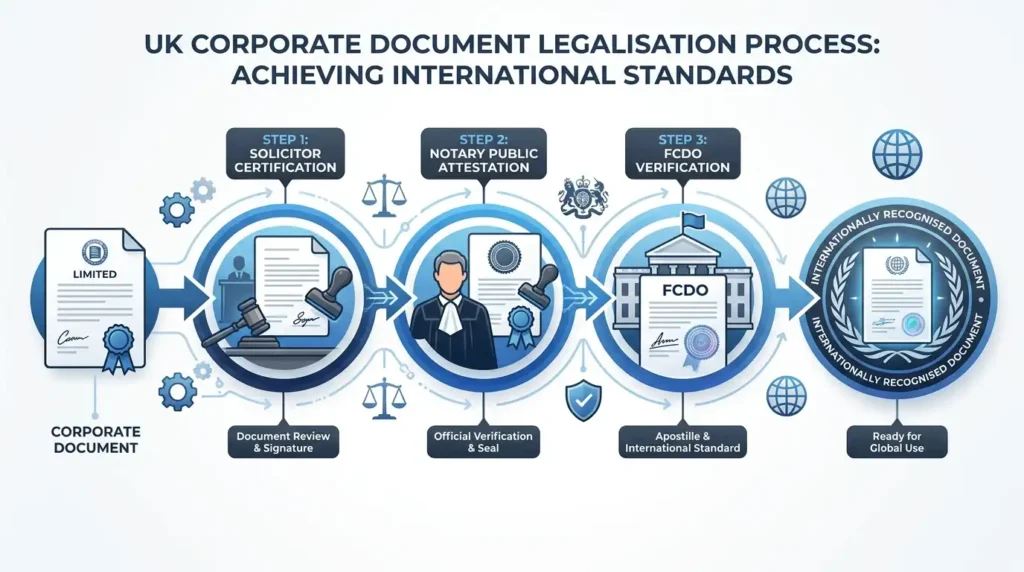
Official legalisation follows precise statutory procedures established by UK administrative law. A registered UK solicitor or notary public verifies original corporate filings against official government databases. The legal professional attaches a formal certificate confirming document authenticity and officer signatures. This initial validation prepares private commercial paperwork for formal government recognition.
The Foreign, Commonwealth & Development Office receives certified documents at secure processing centres. Government officials match notary signatures and official seals against national registration indices. Once validated, officials fix a physical or electronic apostille certificate directly to the paper record. This legal act transforms a domestic UK document into an internationally recognised public instrument under Hague Convention rules.
Proper execution of each administrative phase prevents formal legal rejections by foreign government agencies. Companies seeking long-term validity must submit accurate original filings from Companies House registers. Form My Company coordinates legalisation workflows directly with official UK authorities to ensure flawless document processing. Standardised processing eliminates administrative friction during international corporate expansion.
Which Business Documents Require Apostille Services for Global Operations?
Business documents requiring apostille services for global operations include certificates of incorporation, articles of association, powers of attorney, board resolutions, and official financial audit statements.
Constitutional records form the foundation of foreign branch registration and subsidiary formation. Overseas authorities examine articles of association to verify corporate capacity and governance limits. These structural documents maintain long-term validity provided internal corporate charters remain unamended. Updating company rules requires legalising newly registered statutory filings to maintain valid international records.
Operational instruments like powers of attorney carry strict temporal limitations in international commercial practice. Foreign financial institutions reject authorization deeds executed more than twelve months prior to contract execution. Directors must legalise fresh mandate letters when executing significant cross-border acquisitions or opening overseas bank accounts. Timely document legalisation maintains legal authority across international supply chains.
Regulatory filings demand systematic legalisation schedules to satisfy ongoing international compliance frameworks. Tax residency certificates and statutory audit reports require annual legalisation to support cross-border tax treaty claims. Failing to supply fresh legalised proof exposes multinational operations to double taxation risks and administrative fines. Strategic planning ensures corporate documentation remains compliant across all active trading jurisdictions.
How Can Businesses Prevent Rejection of Apostilled Records Overseas?
Businesses prevent rejection of apostilled records overseas by matching foreign registry requirements, securing certified translations, confirming document freshness windows, and verifying notary signature registrations.
International registries impose specific formatting mandates that differ across legal jurisdictions. Certain nations require official translations executed by sworn court translators before accepting apostilled paperwork. If local authorities demand consular legalisation alongside Hague certificates, companies must complete secondary authentication steps. Ignoring specific jurisdictional formatting rules results in immediate document rejection by administrative officers.
Executing double-check procedures prior to document dispatch protects commercial timelines. Directors should review whether the receiving country accepts e-Apostilles or requires traditional paper certificates with wet-ink signatures. When foreign regulators update compliance codes, legal teams must adjust document preparation steps to reflect new statutory requirements. Proactive verification eliminates expensive re-issuance cycles for international commercial ventures.
Evaluating document legalisation requirements early prevents project stalls during foreign market entry. Corporate decision-makers should evaluate is an apostille valid forever once it is issued to design sustainable long-term compliance strategies. Proper planning ensures cross-border corporate filings achieve swift regulatory approval.
What Are the Key Steps to Obtain Long-Lasting Apostilled Documents?
The key steps to obtain long-lasting apostilled documents involve extracting current registry records, notarising paperwork, submitting filings to government legalisation departments, and securing certified translations.
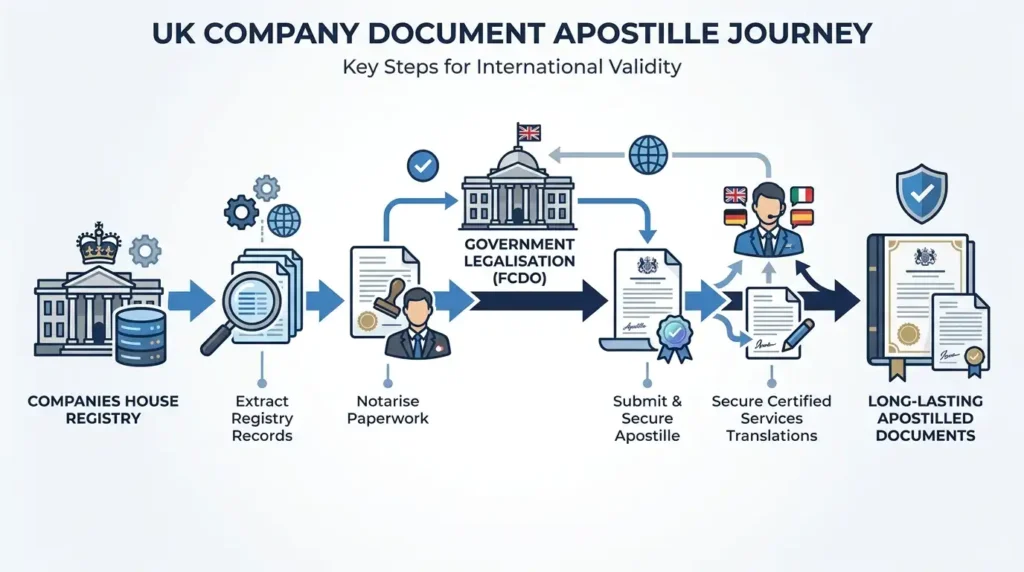
The legalisation process begins with retrieving updated corporate filings directly from official registers. Obtaining freshly certified copies from Companies House ensures underlying factual data reflects active corporate status. Using old certificates introduces immediate compliance vulnerabilities into cross-border filings. Precision at the initial retrieval stage guarantees document longevity in overseas jurisdictions.
Qualified legal professionals must execute notarisation procedures according to strict legal protocols. Notaries check government registries, verify director identities, and apply official seals to corporate instruments. The Foreign, Commonwealth & Development Office then validates these notary seals against central records before affixing the final apostille certificate. Each step creates an unbroken chain of legal authenticity recognised worldwide.
Retrieve official corporate certificates from Companies House registers.
Certify document signatures through a qualified UK solicitor or notary public.
Submit authenticated paperwork to the Foreign, Commonwealth & Development Office.
Affix the official UK apostille certificate to legalised documents.
Translate legalised records using certified sworn translators for local foreign registries.
Executing these administrative steps requires specialized knowledge of international legalisation frameworks. Professional document managers handle submission schedules to eliminate processing bottlenecks at government offices. Streamlined logistics ensure commercial entities receive fully legalised documentation ready for immediate international deployment.
Explore Our Apostilled Documents Guide,
Want to Reserve Conference Rooms With Parking via Form My Company?
Want to Buy Bank-Ready Company Certificates From Form My Company?
Why Choose Professional Services to Secure International Corporate Documents?
Choosing professional services to secure international corporate documents guarantees adherence to statutory legalisation standards, reduces administrative processing times, and eliminates risk of foreign registry rejections.
Managing cross-border legalisation internally consumes substantial administrative resources and introduces compliance risks. Unofficial submission errors lead to rejected applications, wasted government fees, and missed commercial deadlines. Professional legalisation providers maintain direct operational links with official departments and notary networks. Specialist management guarantees documents pass rigorous government checks on the initial submission.
Professional document specialists evaluate target country rules before initiating certification workflows. Service teams identify whether specific documents require notarisation, apostille seals, or secondary embassy attestations. End-to-end management protects corporate executives from navigating complex administrative bureaucracies in foreign languages. Standardised filing procedures accelerate global expansion timelines for growing enterprises.
Form My Company delivers comprehensive document legalisation solutions tailored for international corporate expansion. Dedicated compliance specialists manage every stage of certification, government submission, and secure global delivery. Partnering with experienced professionals ensures your commercial documents maintain long-lasting legal validity across all foreign trading jurisdictions.
Frequently Asked Questions
How long does it take to get apostilled documents in the UK?
Standard processing for apostilled documents through the UK Foreign, Commonwealth & Development Office typically takes 3 to 10 working days, depending on government submission volumes. Form My Company offers expedited legalisation workflows to accelerate document verification and dispatch for time-sensitive international transactions. Urgent commercial filings can also be completed via same-day e-Apostille processing when digital public records qualify.
What is the difference between notarisation and an apostille?
Notarisation involves a qualified solicitor or notary public verifying the identity of signatories and authenticating the original document’s execution. An apostille is an official certificate attached by the government confirming that the notary’s or public official’s signature and seal are genuine under the Hague Convention. Form My Company handles both notarisation and government legalisation to ensure corporate records are fully authenticated for global use.
Can an apostille be issued electronically for UK business documents?
Yes, the UK government issues electronic apostilles (e-Apostilles) for eligible digital documents that bear verifiable electronic signatures from registered UK legal professionals. Electronic legalisation reduces turnaround times and simplifies international submission for modern digital corporate filings. Form My Company assists businesses in preparing compatible PDF records to secure valid e-Apostilles for overseas regulatory compliance.
How much does it cost to apostille a business document?
The cost of obtaining apostilled documents includes government legalisation fees alongside any required solicitor certification or notary public charges. Total expenses vary depending on whether the filing requires physical paper legalisation or digital e-Apostille processing. Form My Company provides transparent, structured pricing for corporate document legalisation to cover verification, government fees, and secure delivery.
Do apostilled documents ever expire?
An apostille certificate itself does not carry an expiration date under international law, but foreign registries often enforce strict temporal limits on underlying records. Many overseas banks and government bodies require commercial documents, such as certificates of good standing or powers of attorney, to be legalised within three to six months of submission. Form My Company ensures your company documents are freshly legalised to meet the specific freshness windows of foreign jurisdictions.