
If your company records are stored online, do you really need paper copies as well? It’s a fair question, and it gets to the heart of why printed company documents still have a place in modern business. Why Are Printed Company Documents Still Important? Not because every file needs printing, but because some paperwork is easier to access, review or keep securely in physical form.
Digital records are convenient to search, share and back up. Paper can be a useful extra for documents you need close to hand or want to keep alongside your digital files. The right balance depends on how you manage your business, the documents involved and any format requirements that apply. Printed copies shouldn’t replace authoritative records or a reliable digital filing system.
This article explains where paper can help, where digital records are more practical and how to keep important company paperwork organised. You’ll learn which documents may suit an accessible physical file and how to choose a format that fits your administration habits. The aim is a straightforward, paper-light approach: keep what’s useful, store it sensibly and make sure you can find it when needed.
Key Takeaways
- Why Are Printed Company Documents Still Important? They can make key information easier to access and handle, while working alongside digital records rather than replacing them.
- Choose paper copies selectively: their usefulness depends on the document’s purpose and how you manage company records.
- Compare paper and digital formats for everyday tasks such as finding, sharing, updating and storing business information.
- Build a simple filing routine by sorting, labelling and securely storing selected documents, with digital reference copies where appropriate.
- Consider whether digital-only or paper-and-digital administration suits your habits, including Form My Company’s Digital & Print Package as a format option.
Why printed company documents still matter in a digital-first business
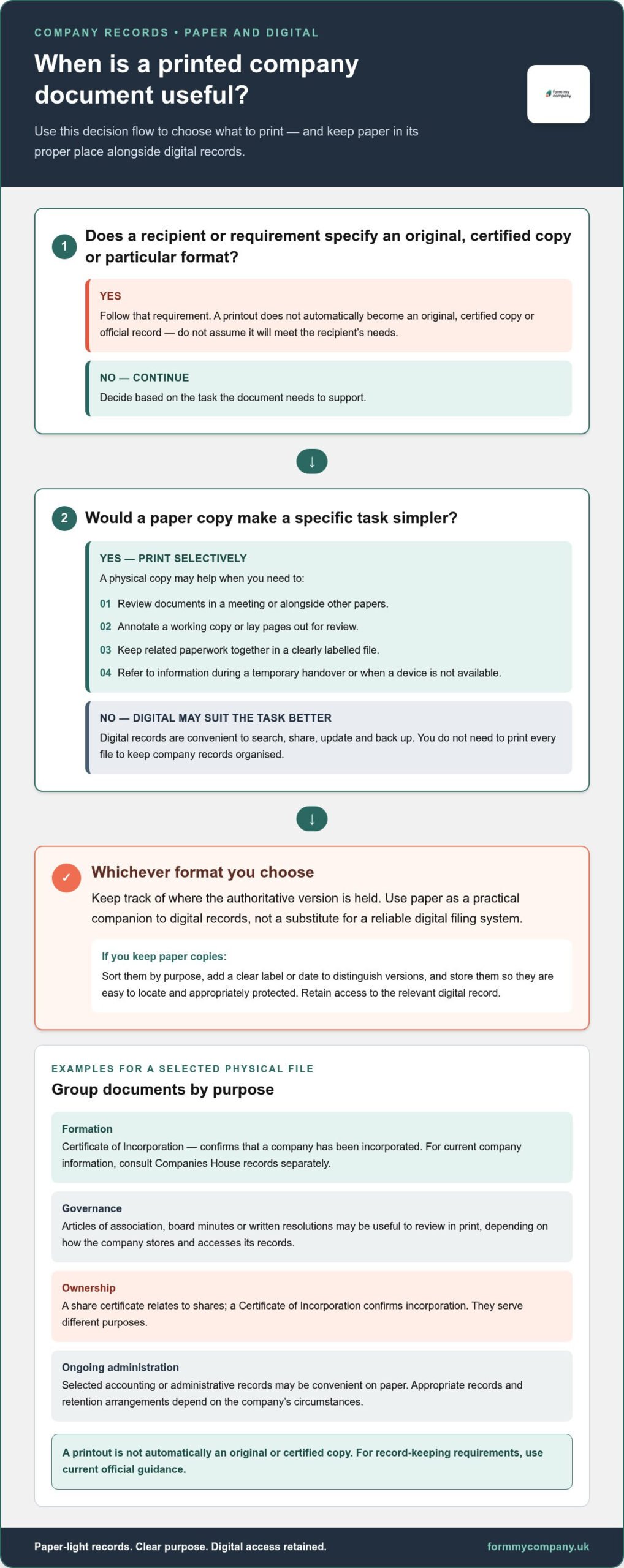
Printed company records can make information easier to access and handle, but they complement digital records rather than replace them. You don’t need to print every file to run a well-organised business. Instead, consider whether a paper copy will make a particular task simpler, such as reviewing documents in a meeting, passing information to a colleague or checking details when you don’t have a device to hand.
What counts as a printed company document?
A printed company document is a paper copy of information relating to your company’s formation or administration. It might be a printout of a certificate or another company document kept for reference. Printing a file doesn’t automatically make it an original, a certified copy or the official record. Keep track of where the authoritative version is held, and don’t assume a printout will meet a recipient’s requirements.
Why keep paper when company records are digital?
A practical records management approach means organising information so it can be found and used appropriately, whether it’s on paper or stored digitally. Keep the digital version available as your main reference where appropriate, and use paper selectively for convenience. A physical copy can also help during a temporary handover or when a device isn’t available, but it shouldn’t replace a reliable digital record.
Paper is a practical companion to digital records, not a substitute for them. Choose what to print based on how you’ll use it, and store copies so they remain easy to locate and appropriately protected. If you need additional company paperwork, explore supplementary company documents.
Which company documents can be useful to have in print?
Think about what each document needs to do before printing it. A paper copy may help you consult key information during a meeting or keep related paperwork together, but not every company record needs a physical version. Useful examples fall into four groups: formation evidence, governance, ownership and ongoing administration.
Formation and governance paperwork
A Certificate of Incorporation confirms that a company has been incorporated. It can be useful in an organised file, but it isn’t a complete record of every company detail. For current company information, consult Companies House records as a separate source.
Ownership and administration records
A share certificate is an ownership-related document that can be useful to keep with other company paperwork. It serves a different purpose from a Certificate of Incorporation: one relates to shares, whilst the other confirms incorporation. A printed copy can help owners review information during internal administration, but don’t assume its format determines its status or sufficiency. Follow current official guidance if you need to establish a specific requirement.
Selected accounting or administrative records may also be convenient to consult on paper. The appropriate records and retention arrangements depend on the company’s circumstances. GOV.UK explains what companies need to know about company and accounting records. Use that guidance for record-keeping requirements rather than assuming a printed file, by itself, meets them.
For a practical file, group documents by purpose: incorporation, governance, ownership and ongoing administration. Add a date or clear label so you can distinguish versions, and retain access to the relevant digital record. Print only what helps with a real task, and remember that a printout isn’t automatically an original or certified copy. For additional paperwork, see supplementary company documents.
If you’re planning a new company and considering how you’d like to receive formation information, explore Form My Company’s company formation options.
Printed copies versus digital records: what is the difference?
| Consideration | Printed copy | Digital record |
|---|---|---|
| Access | Ready to hand in a physical file, but unavailable if you’re away from it. | Can be accessed on a suitable device, subject to access and connectivity. |
| Sharing | Useful for an in-person review, but sharing usually means handing over or sending the paper. | Can often be shared electronically, with access controls where available. |
| Updating | Handwritten notes may help during a review, but copies can become out of date. | Can be revised and saved, though you’ll need a clear way to identify the current version. |
| Storage | Needs physical space and suitable protection. | Needs organised digital storage and appropriate access arrangements. |
| Reference | Convenient to consult beside other papers or annotate as a working copy. | Convenient to search, retrieve and refer to across devices when accessible. |
When is a printed copy only a convenience?
When should you check the required document format?
Applications, counterparties and formal processes may set different instructions. The receiving organisation may ask for a digital submission, an original paper document or a certified copy. Check its current guidance before preparing or sending paperwork, and consult relevant official information for company record-keeping, including GOV.UK’s legal requirements for company records.
How to organise printed company documents securely
A useful paper file should be easy to navigate and handled with care. Set it up to match the way you work, then keep its labels consistent with your digital folders. This makes it simpler to locate a document and spot when paper and digital copies refer to different versions.
Build a simple company document file
Choose an arrangement that makes sense for your business. You could group documents by purpose, then order them by date within each section. A basic file might include formation, governance, ownership and ongoing administration. There’s no single filing method that suits every company; consistency matters more than complexity.
Use clear labels on dividers and apply the same names to matching digital folders. An index at the front can list each section, document name and date, helping directors find what they need without searching through the whole file.
Follow this straightforward routine:
- Sort: Group the paper records you’ve chosen to keep by purpose or date.
- Label: Mark folders and documents clearly, using names that match your digital filing system.
- Store securely: Keep the file in a dry, secure place, and limit access to people who need the information. Don’t leave sensitive paperwork unattended in shared spaces.
- Keep a digital reference: Where appropriate, retain an accessible digital version and note which copy is current.
Protect paper records and keep copies aligned
Handle reference copies carefully. If you need to add a note, use a separate sheet or mark the copy clearly as a reference, rather than writing on a document that may need to remain unaltered. Make sure labels identify the document and its date, so a printed version isn’t mistaken for a later or authoritative copy.
Build in a periodic review. Check that the file is still organised, access remains appropriate and any paper copies can be matched to the relevant digital records. If a document has changed, update the reference copy or remove an outdated one in line with your record-handling approach. This helps prevent confusion during a handover or review.
If you’re starting a company and deciding how you’d like to manage formation paperwork, explore Form My Company’s formation options.
Choosing a company formation package with printed documents
Your preferred way of managing paperwork can help you choose a formation package. If you’re comfortable saving, sorting and retrieving files electronically, digital access may suit your routine. If you like having selected documents to hand for administration or review, you may prefer a paper-and-digital option. Neither choice means printing every record is necessary.
Is a digital-only or print-and-digital approach right for you?
Your preferred format doesn’t determine whether a document will be accepted for a particular application or formal process. If an organisation specifies an original, certified copy or another format, follow its current instructions. Treat package choice as an administration preference, not a decision about a document’s status.
How to move forward with the right document format
Before choosing, consider your usual record-keeping habits and likely scenarios: will you mainly retrieve files digitally, or would you use selected paper copies as well? Form My Company offers Digital and Digital & Print formation packages, giving founders a choice of format. The Digital & Print Package is an option if you prefer print alongside digital access.
If you need company paperwork beyond formation, explore supplementary company documents. Keep in mind that the format that works for day-to-day reference may differ from the format a recipient requires.
There’s no need to print everything. Choose an approach you can maintain, keep important records organised, and check specific format instructions whenever a document is being submitted or shared for a formal purpose. To compare the available options and choose a format that fits your administration habits, explore company formation packages.
Choose a document format that works for your business
Printed company documents can make selected records easier to consult, organise and use, but they work best alongside accessible digital records. You don’t need to print everything. Choose paper copies based on how you handle company administration, and check the required format whenever a document is intended for a formal process.
A physical copy can be a practical reference, while a digital record remains useful for storing, searching and sharing information. A clear filing routine helps you keep both formats identifiable and find the right document when you need it.
Form My Company offers both Digital and Digital & Print formation packages, so you can choose the format that fits your record-keeping habits. Supplementary company documents are also available through a related company service. Take the next step that suits your plans and explore company formation packages. With a straightforward approach to your paperwork, you can build organised business records from the start.
Frequently Asked Questions
Are printed company documents legally required in the UK?
No, there isn’t a general requirement for every company document to be kept on paper. Companies do have record-keeping responsibilities, and the relevant format and retention period can depend on the type of record. HMRC accepts electronic versions of most business records if they’re legible and accessible. Keep the records your company needs, and check current official guidance for the specific documents and requirements that apply.
Can a printed copy of a Companies House document be used as an official document?
Not automatically. Printing a Companies House document gives you a paper copy, but it doesn’t by itself make that copy an original or certified document. It may be useful for reference or internal administration. If you’re submitting it for an application or formal process, follow the recipient’s current instructions. They may specify an electronic version, an original, a certified copy or another format.
What company documents should I keep in a paper file?
Choose documents that are useful to consult or handle in paper form, rather than printing everything. You might keep selected formation paperwork, constitutional documents, governance records such as minutes or resolutions, ownership-related records such as share certificates, and administrative information you regularly refer to. Organise them by purpose or date, label copies clearly and keep relevant digital records accessible. Your paper file is a practical reference, not automatically the authoritative record.
Do share certificates need to be printed?
Don’t assume that every share certificate must be printed or that a printout will meet every purpose. The appropriate format can depend on how the document was issued and what a recipient or process requires. Keep ownership-related records organised and identifiable, and check current official guidance or the receiving organisation’s instructions if a certificate is needed for a formal matter. A paper copy can still be convenient for reference.
Can I rely on digital company records instead of printed documents?
How should I store printed company documents securely?
Sort documents into clearly labelled sections, such as formation, governance, ownership and administration. Store the file in a dry, secure place and limit access to people who need the information. Don’t leave sensitive paperwork unattended in shared areas. Where appropriate, keep a digital reference copy and use matching labels or file names. Review both formats periodically so you can identify the relevant version and remove or update outdated reference copies.
What is included in a digital and print company formation package?
Form My Company offers a Digital & Print Package for founders who want a print-and-digital format choice. A Digital Package is also available for those who prefer electronic administration. Whichever format you choose, check recipient instructions separately when a document is needed for a formal process.