
Could a company holding a significant stake in your business still be the wrong entity to enter on its PSC record? The answer depends on more than ownership percentage. What Is a Relevant Legal Entity (RLE) on the PSC Register? It’s a legal entity that meets a PSC control condition and is subject to its own disclosure requirements. Even then, its place in the ownership chain affects whether it’s registrable.
It’s understandable to find the rules confusing: control, disclosure and registrability are related, but they’re not the same test. An RLE is not an individual PSC, and not every corporate shareholder qualifies. This guide explains the RLE criteria, how to distinguish an RLE from an individual or another entity, and why the first registrable RLE in an ownership chain matters. You’ll also learn what to assess before making or updating a Companies House entry, including how identity verification for individuals differs from deciding whether an entity is an RLE. A clear, step-by-step assessment can help you make more accurate PSC disclosures and keep the different compliance tasks separate.
Key Takeaways
- What Is a Relevant Legal Entity (RLE) on the PSC Register? It’s a legal entity that meets a relevant control condition and is subject to its own disclosure requirements.
- Assess both parts of the RLE test. Share ownership is not the only route to relevant control.
- Distinguish an individual PSC from an RLE and from a corporate shareholder that doesn’t meet the qualification criteria.
- Trace the ownership chain to identify which entity, if any, may be registrable, rather than assuming every company in the chain should be recorded.
- Keep PSC information accurate and current. Identity verification applies to individuals, not to classifying an entity as an RLE.
What Is a Relevant Legal Entity (RLE) on the PSC Register?
A Relevant Legal Entity (RLE) is a legal entity that meets at least one relevant control condition and is subject to its own disclosure requirements. It may be registrable in the ownership chain of a UK company.
So, What Is a Relevant Legal Entity (RLE) on the PSC Register? It’s not simply a company that owns shares. The entity must meet both the control test and the disclosure test. Whether it should be recorded is a separate question: registrability depends on its position in the ownership chain.
What does “relevant legal entity” mean in practice?
A legal entity is an organisation with a legal identity distinct from the people or organisations that make up or own it. A company can therefore hold shares in another company in its own name. That fact alone, however, doesn’t make it an RLE.
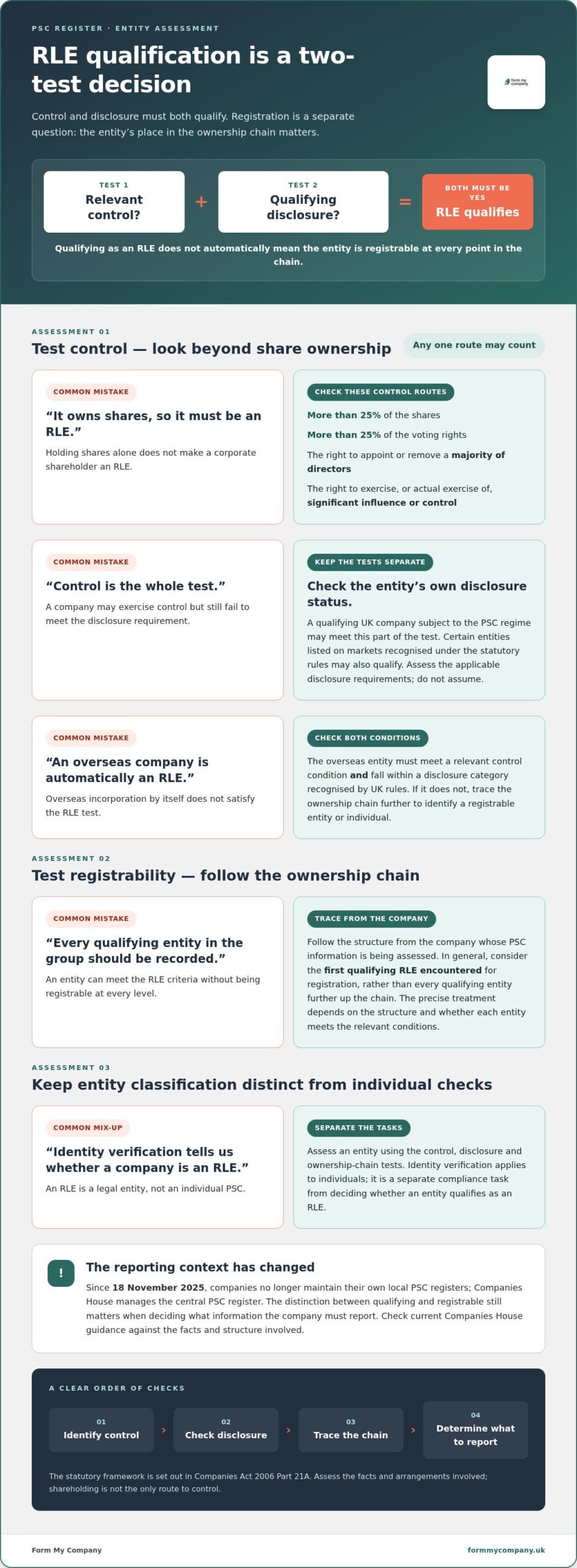
Start by assessing control. A legal entity may meet a condition if it holds more than 25% of the shares or voting rights, has the right to appoint or remove a majority of the directors, or otherwise has the right to exercise, or actually exercises, significant influence or control. Control isn’t limited to share ownership, and the details of the arrangements can matter.
Then assess disclosure status separately. The entity must be subject to its own qualifying disclosure requirements. A corporate shareholder that exercises control but doesn’t meet this requirement won’t qualify as an RLE under this test. Don’t treat the two questions as interchangeable.
What does “registrable” mean on a PSC register?
An entity can meet the RLE criteria without being registrable at every level of a group’s ownership chain. Trace the structure from the company whose PSC information you’re assessing. In general, the first qualifying RLE encountered in that chain is considered for registration, rather than every qualifying entity further up. The precise treatment depends on the ownership structure and whether each entity meets the relevant conditions.
Since 18 November 2025, companies no longer maintain their own local PSC registers; Companies House manages the central PSC register. The distinction still matters when deciding which information the company must report. Check current Companies House guidance against the facts and structure involved before making or updating an entry.
For information about the related administrative process, see the PSC register page.
Which conditions must an entity meet to qualify as an RLE?
Use two linked questions to test whether an entity qualifies: does it meet a relevant control condition, and is it subject to the required disclosure regime? Both answers must be yes. Control alone doesn’t make a corporate shareholder an RLE, and qualifying disclosure status alone isn’t enough either.
The statutory framework is set out in Companies Act 2006 Part 21A. In summary, an entity may meet a control condition if it holds more than 25% of a company’s shares or voting rights, has the right to appoint or remove a majority of its directors, or has the right to exercise, or actually exercises, significant influence or control over the company.
How do the PSC control conditions apply to legal entities?
Look beyond the share register. An entity with 30% of a company’s shares may meet a control condition, as may one with more than 25% of voting rights, even if its shareholding is lower. Rights to appoint or remove most directors provide another route, including where those rights arise through an agreement rather than share ownership.
Significant influence or control is a separate condition. Assess the entity’s actual role, rights and arrangements. Don’t assume that a large shareholder automatically exercises significant influence or control, or that a smaller shareholder cannot. The facts matter.
In brief: the control conditions cover more than 25% of shares, more than 25% of voting rights, the right to appoint or remove a majority of directors, and significant influence or control.
Why do disclosure requirements matter?
After assessing control, consider whether the entity is subject to its own qualifying disclosure requirements. A UK company subject to the PSC regime may be an example; certain entities listed on markets recognised under the statutory rules may also qualify. The applicable disclosure test matters, so don’t treat a familiar company structure or a market listing as an automatic answer.
Overseas incorporation by itself doesn’t make an entity an RLE. An overseas entity must meet the relevant control condition and fall within a disclosure category recognised by the UK rules. If it doesn’t, trace the ownership chain further to identify a registrable entity or individual.
Keep qualification separate from registration. An entity can meet both RLE tests yet not be the entity entered for the company at that point in the ownership chain. For information about the related administrative process, see the PSC register page.
RLE, individual PSC or corporate shareholder: what is the difference?
The same ownership structure can include individuals and several legal entities, but they aren’t all treated alike. The key distinctions are the holder’s legal status, whether it meets a control condition, whether it meets the disclosure test, and where it sits in the chain. Asking “What Is a Relevant Legal Entity (RLE) on the PSC Register?” is only part of the assessment: you must also decide who is registrable.
| Holder | Relevant control | Disclosure status | Potential register treatment |
|---|---|---|---|
| Individual PSC | A natural person meets one or more PSC conditions, such as holding more than 25% of shares or voting rights, or having significant influence or control. | Individual status, not an entity disclosure test. | May be registrable if the relevant conditions are met and no applicable rule changes the treatment. |
| Registrable RLE | A legal entity meets a relevant control condition in relation to the company. | It also meets the applicable disclosure requirements. | May be entered as the registrable entity at its position in the ownership chain. |
| Corporate shareholder that doesn’t qualify | It may hold shares, but may not meet a control condition. | Or it may exercise control but fail the disclosure test. | Not registrable as an RLE on that basis. The ownership chain may need to be examined further. |
How is an RLE different from an individual PSC?
A PSC is an individual. An RLE is a legal entity that meets both the relevant control and disclosure tests. For example, a person may directly hold more than 25% of a company’s voting rights and qualify as a PSC, but that person can’t be an RLE.
Identity verification is a separate requirement concerning individuals, not a test for classifying an entity as an RLE. For related information, see director and PSC identity verification.
Is every corporate shareholder an RLE?
No. Suppose Company A holds 30% of Company B’s shares but doesn’t meet the applicable disclosure test. Its shareholding may meet a control condition, but that alone doesn’t make it an RLE. By contrast, an entity that meets a control condition and the disclosure test may qualify, subject to whether it is registrable at that point in the chain.
Don’t assume that an individual further up or down the structure makes an entity irrelevant, or that every shareholder belongs on the register. Assess each holder’s status and the ownership chain under the applicable rules.
How can you assess an RLE in a company ownership chain?
Work through the structure from the company whose PSC information you’re assessing. Identify each individual and legal entity with a potential control interest, then test the relevant facts before deciding whether an entity qualifies and is registrable. Treat this as an assessment framework, not a filing checklist.
What information should you map before classifying an entity?
Build a clear picture of direct and indirect ownership. For each person or entity, note:
- Shareholdings and voting rights, including how they are held through other entities.
- Rights to appoint or remove directors, and any agreements that may affect those rights.
- Other arrangements or circumstances that could indicate significant influence or control.
- Each entity’s legal form and the basis for deciding whether it meets the applicable disclosure requirements.
What if the ownership chain includes several entities?
Assess each level in sequence. Don’t assume that every parent company is registrable, or that the appearance of an individual further up the chain automatically removes the need to assess an entity below them. Determine which qualifying person or entity meets the relevant conditions at the appropriate point in the chain.
Hypothetical example: Company A owns Company B, which owns shares in Company C. Start with Company C and assess Company B’s control and disclosure status. If B meets both tests, consider whether it is the registrable RLE in that chain; then apply the relevant rules to determine whether an entity further up should also be recorded. The outcome depends on the facts and statutory treatment, not simply on which company is the ultimate parent.
In short, assess control, disclosure status and position in the ownership chain together. For information about the related administrative process, see Form My Company’s PSC register page.
What should a company do after identifying a registrable RLE?
Identifying an RLE is only one part of a company’s PSC compliance. The company must also provide accurate information to Companies House and keep it current. Since 18 November 2025, companies no longer maintain their own local PSC registers; Companies House holds the central register. Correct classification still matters because it determines what information the company reports and whose details it submits.
Which RLE details and changes may need recording?
Depending on the entity and its circumstances, required particulars may include its name, registered or principal office, legal form, governing law, relevant registration details, the date it became registrable and the nature of its control. Check the current Companies House requirements for the exact fields that apply. Don’t assume that recording an entity’s name alone is enough.
Where can a company get help with PSC register administration?
Identity verification is a separate matter. It applies to individuals, such as directors or PSCs, and doesn’t determine whether a corporate entity qualifies as an RLE. Keep that process distinct from classifying the entity and updating PSC information.
For information about the administrative process, visit the Form My Company website.
Make your PSC information clear and current
RLE classification comes down to three connected checks: whether an entity meets a control condition, whether it is subject to the required disclosure rules, and whether it is registrable at its place in the ownership chain. A corporate shareholder doesn’t automatically qualify, and an individual PSC is a different category altogether.
If you’re still asking, “What Is a Relevant Legal Entity (RLE) on the PSC Register?”, revisit the structure and evidence behind each ownership or control relationship before updating the company’s information. Keep classification, reporting duties and individual identity verification as separate steps. That makes it easier to record the right details and maintain accurate PSC information.
Form My Company provides UK company formation packages, including the Digital Package, and support such as VAT registration and registered office services. Explore Form My Company’s company formation packages.
Frequently Asked Questions
Is a relevant legal entity the same as a person with significant control?
No. A person with significant control (PSC) is an individual, whilst a relevant legal entity (RLE) is a qualifying organisation with its own legal identity. In answering “What Is a Relevant Legal Entity (RLE) on the PSC Register?”, keep those categories separate: an individual may meet a control condition directly, but can’t be an RLE. Identity verification relates to individuals and is distinct from deciding whether an entity meets the RLE tests.
Can every company shareholder be recorded as an RLE?
No. A company’s shareholding alone doesn’t make it an RLE or mean it should be recorded as one. Assess whether it meets a relevant control condition, whether it is subject to the required disclosure regime and whether it is registrable at its position in the ownership chain. For example, a corporate shareholder may have control but fail the disclosure test, so it won’t qualify as an RLE.
What makes a legal entity registrable on a PSC register?
An entity must meet a relevant control condition and the applicable disclosure requirements. It must also be registrable under the rules for its place in the company’s ownership chain. In general, the first qualifying RLE in the chain is considered for registration, rather than every qualifying entity further up. Companies now report PSC information to Companies House, which maintains the central register. Check current guidance for the circumstances involved.
Does an RLE need to own more than 25% of a company?
No. Holding more than 25% of the shares is one route to meeting a control condition, but it isn’t the only one. An entity may also meet a condition through more than 25% of voting rights, the right to appoint or remove a majority of directors, or significant influence or control. It must still meet the disclosure test, and its position in the ownership chain affects registrability.
What happens if a company has several entities in its ownership chain?
Assess each entity in sequence, starting with the company whose PSC information is being considered. Check the control and disclosure tests at each level, then determine which entity may be registrable under the ownership-chain rules. Don’t assume every parent or subsidiary belongs on the register. Nor should you assume an individual further along the chain automatically means an entity nearer the company can be ignored.
How is an RLE different from a corporate shareholder that is not registrable?
An RLE meets both a relevant control condition and the applicable disclosure requirements. A corporate shareholder that isn’t registrable may fail either test, or may not be registrable at that point in the ownership chain. For instance, a company could hold more than 25% of shares but fail the disclosure test. Its shareholding alone doesn’t make it an RLE for reporting purposes.
Do RLE rules apply to overseas companies?
They can, but overseas incorporation alone doesn’t qualify a company as an RLE. An overseas entity must meet a relevant control condition and fall within a disclosure category recognised by the UK rules. The treatment can depend on the market on which it is listed and the applicable jurisdiction. If the overseas company doesn’t qualify, trace the chain further to identify any registrable entity or individual, using current Companies House guidance for complex structures.