
Could the company above yours in an ownership chain be the right PSC register entry, or does control sit elsewhere? Getting this wrong can leave your Companies House information incomplete. To Record Your Relevant Legal Entity With Form My Company, start by tracing who controls the business, then check whether that entity meets the RLE requirements.
It’s understandable to find the rules difficult to apply. A corporate shareholder doesn’t automatically qualify: the entity must meet at least one control condition and satisfy the relevant transparency requirements. You also need to distinguish an RLE from an individual PSC and identify the first registrable RLE in the ownership chain.
This guide explains how to assess share ownership, voting rights and other forms of significant influence or control. You’ll learn what details to prepare for an accurate register entry and how to review the PSC record when circumstances change. Follow each step to reach a clear, evidence-based decision before filing, and keep your company records organised.
Key Takeaways
- Trace ownership and decision-making rights to identify which entity, if any, exercises significant control.
- Check both the entity’s transparency status and its place in the ownership chain before treating it as registrable.
- Compare corporate entities with individual PSCs so you can choose the correct type of register entry.
- Gather the entity’s identifying details and supporting records before preparing and reviewing the filing.
- Use a clear process to Record Your Relevant Legal Entity With Form My Company and keep PSC information under review when circumstances change.
What is a registrable relevant legal entity on a UK PSC register?
A relevant legal entity (RLE) is a qualifying organisation that can be recorded in a company’s register of people with significant control (PSC register). It must meet a control condition and the relevant transparency requirements. Owning shares alone isn’t enough. A corporate shareholder may have no relevant control, or may not meet the transparency test, so don’t assume it qualifies just because its name appears in the ownership structure.
Registrability also depends on the entity’s position in the ownership chain. The first RLE in that chain may be entered for the company it controls. An entity further up or down the structure doesn’t automatically take its place. Trace the chain rather than stopping at the first organisation you see.
Keep the PSC register distinct from the wider company record. The wider Companies House record includes information such as the company’s officers and submitted documents. PSC information is a specific part of the central Companies House register. Since 18 November 2025, companies no longer maintain a separate local PSC register. Keep supporting evidence and working records organised, even though the PSC information is filed centrally.
How an RLE differs from an individual PSC
A PSC may be an individual or, if it meets the requirements, a qualifying legal entity. The distinction matters in a layered structure. For example, a person may own shares in a holding company, which in turn owns shares in the company being assessed. Follow ownership and control through each layer to see whether an individual or an RLE is registrable in relation to the company. Recording an RLE doesn’t remove the need to assess other people or entities separately where the rules apply to them.
For a practical overview of organising this record, read this guide to PSC register support. This is company administration information, not legal advice. For decisions about a particular structure, refer to current official GOV.UK and Companies House guidance.
Why a correct RLE entry matters
Accurate PSC information helps make ownership and control clearer and supports reliable company administration. An incorrect classification can leave the record incomplete or give a misleading impression of who controls the company. Check the entity’s legal identity, control and transparency status against the documents available to you, and keep a note of the reasoning behind the decision.
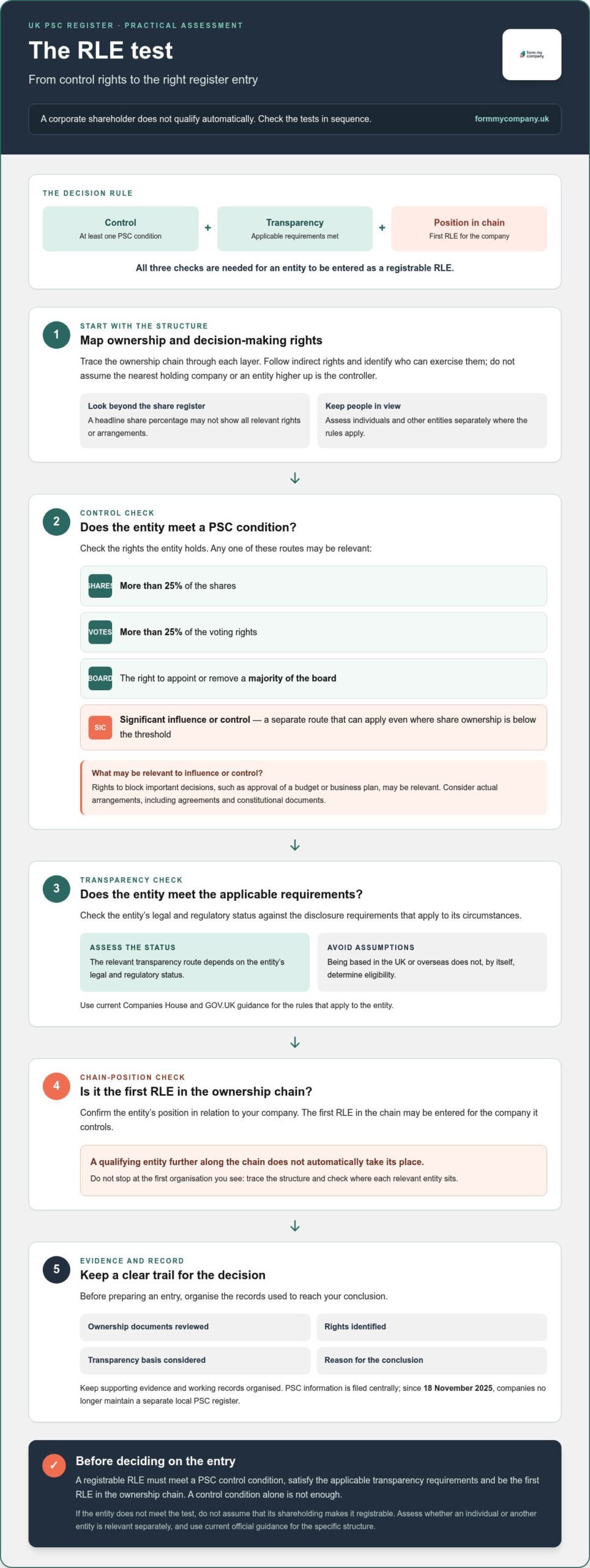
An entity may be entered as a registrable RLE only when it meets a PSC control condition, satisfies the applicable transparency requirements and is the first RLE in the ownership chain.
Use that test before preparing a filing. If you’re ready to Record Your Relevant Legal Entity With Form My Company, establish the entity’s place in the structure first, then use current Companies House guidance to confirm the required information and filing process.
Apply the RLE test: control, transparency and registrability
Assess a potential RLE in sequence. First, decide whether it meets a PSC control condition in relation to your company. Next, check whether it satisfies the applicable transparency requirements. Finally, confirm that it is registrable in its position in the ownership chain. Passing the control test alone doesn’t make an entity a registrable RLE.
Does the entity meet a PSC condition?
Check the rights the entity holds, not just the percentage shown beside its name on a share register. A PSC condition may be met if it holds more than 25% of the shares or more than 25% of the voting rights, or has the right to appoint or remove a majority of the board. Significant influence or control is a separate route, which can apply even when share ownership is below the threshold.
For example, rights to block important decisions, such as approval of a budget or business plan, may be relevant to assessing significant influence or control. Consider the actual arrangements, including agreements and constitutional documents, rather than relying on a headline ownership percentage. The government published statutory guidance on this test on 4 March 2026. Use the current official guidance when assessing a specific arrangement.
Control may arise through more than 25% of shares, more than 25% of voting rights, the right to appoint or remove most directors, or significant influence or control.
Trace indirect rights through every layer. If Entity A owns shares in Entity B, which owns shares in your company, establish how the rights flow through that structure and who can exercise them. Don’t assume that an intermediate holding company is the ultimate controller, or that an entity higher up automatically qualifies. Map the chain, then check each relevant entity and any individuals separately.
Is the entity transparent and registrable?
Once a control condition appears to be met, test transparency separately. The entity must fall within the applicable disclosure requirements to qualify as an RLE. The relevant route depends on its legal and regulatory status, so don’t treat an entity as eligible or ineligible solely because it is based in the UK or overseas. Check current Companies House and GOV.UK guidance for the rules that apply to its circumstances.
Then establish whether it is the first RLE in the ownership chain for your company. A qualifying entity further along the chain doesn’t automatically become the entry to record. Keep a short evidence trail: note the ownership documents reviewed, the rights identified, the transparency basis considered and why you concluded the entity is, or isn’t, registrable. The Law Society Gazette’s overview of PSC registers and RLEs offers additional professional context.
Use the sequence consistently before filing. Record Your Relevant Legal Entity With Form My Company only after checking control, transparency and its place in the chain. Then use current official guidance to confirm the filing requirements.
RLE or individual PSC? Compare the record before filing
A corporate shareholder isn’t automatically a registrable RLE, and an entity that fails the RLE test doesn’t end the enquiry. You may still need to identify an individual who has significant control through that organisation, or assess other people and entities in the structure. Before preparing a filing, separate the question of who exercises control from the question of which type of PSC entry applies.
| Compare | Relevant legal entity | Individual PSC |
|---|---|---|
| Subject | A qualifying legal entity, such as a company. | A person who meets a PSC condition. |
| Control test | Assess whether the entity meets a relevant control condition in relation to your company. | Assess the person’s shareholding, voting rights, board appointment rights or significant influence or control. |
| Transparency test | Check whether the entity meets the applicable disclosure requirements to qualify as an RLE. | The RLE transparency test does not apply to an individual entry. |
| Record information | Entity-specific details, such as its name, legal form and relevant registered or principal address. | Personal PSC details, recorded in line with the current Companies House requirements. |
Trace control through a company ownership chain
Start with the immediate shareholder, then follow ownership and decision-making rights upwards. Hypothetical example: Company A owns shares in Company B, and Company B holds shares in your company. Review Company B’s rights first, then examine whether Company A or an individual behind it also has a relevant route to control. This example doesn’t determine who is registrable; the documents and applicable tests decide that.
More than one layer, overlapping voting agreements or separate board appointment rights can make the picture less straightforward. Keep a simple ownership chart and note where each right sits. That makes it easier to distinguish direct ownership from indirect control, and to identify when a person needs assessing even if an intermediate entity isn’t a registrable RLE.
Keep entity records separate from individual PSC details
Don’t copy an individual’s control description into an entity entry without assessing the entity’s own rights. An organisation’s legal name and form identify the entity; a person’s entry concerns that individual and their own control. Treat each potential PSC separately, then check the current Companies House filing and information requirements before submitting. The applicable process may depend on whether you’re recording an entity or an individual.
Clear records make later reviews easier, especially when ownership or control changes. To Record Your Relevant Legal Entity With Form My Company, keep the entity and individual assessments distinct and use current official guidance to prepare the right record.
How to record a registrable RLE accurately
Once you’ve assessed control, transparency and the entity’s place in the ownership chain, prepare the record methodically. A clear evidence trail helps you complete the filing consistently and makes future reviews easier. Use this workflow, then check the latest Companies House instructions before submitting.
- Confirm eligibility. Record how the entity meets a PSC condition, why it satisfies the applicable transparency requirements and whether it is the first registrable RLE in the chain.
- Collect evidence. Gather relevant ownership records, constitutional documents, voting arrangements and information about rights to appoint or remove directors. Keep a note of how these support your decision.
- Prepare the entry. Check the entity’s exact name, legal form, governing law and registered or principal address against reliable corporate records. Identify the nature of its control and relevant dates using the current Companies House wording and requirements.
- Notify Companies House. Check the current PSC02 form and official guidance to confirm the right filing route and information for your circumstances. Don’t rely on an old form or saved process without checking it’s still current.
- Review the record. Compare the submitted details with your evidence, then set a reminder to reassess the entry if ownership, voting rights or control arrangements change.
Prepare the entity information and supporting evidence
Use the entity’s formal details, not an informal trading name. Match spelling, legal form and address to its corporate records, and check which address the current filing instructions require. Keep supporting documents together with your reasoning. This helps distinguish a direct shareholding from another control route, and makes it easier to explain why the entity qualified when the entry was prepared.
Dates matter. Record when the relevant control arrangement began or changed in line with the latest Companies House instructions. The company must notify Companies House of changes to PSC information within 14 days of confirming the change. Check current official guidance for how the confirmation date and other dates should be treated in your circumstances.
Submit, check and maintain the PSC entry
Companies House has managed the central PSC register since 18 November 2025, so companies no longer need to keep a separate local PSC register. That doesn’t remove the value of maintaining internal working records: retain your evidence, decision notes and a copy of what was filed. Check the current process to confirm how to notify an addition or change.
Before submission, compare the entity’s name, legal form, address, control description and dates against your source documents. After filing, retain confirmation and diarise a review when a share transfer, voting agreement or board-right change occurs. The practical sequence is simple: verify eligibility, document the evidence, prepare and submit the entry, then review it when circumstances change.
To Record Your Relevant Legal Entity With Form My Company, use this checklist to organise the information you’ll need for an accurate, well-supported filing.
Get practical support for your RLE and PSC register administration
A dependable PSC record starts with four checks: does the entity meet a control condition, satisfy the transparency requirements, qualify as registrable in the ownership chain, and have accurate details ready for the entry? If any answer is uncertain, organise the evidence before updating the record. A clear process makes it easier to see what’s established and what still needs review against current Companies House guidance.
When company secretarial support can make administration easier
Layered ownership can mean dealing with several companies, different legal forms and overlapping control arrangements. Keep PSC information organised, maintain clear records and establish a consistent review process. For example, use ownership changes or updated governing documents as prompts to revisit existing records and decide whether an entry needs attention.
Keep the decision trail accessible so the basis for an entry is easier to understand during a later review. A review routine is useful even when the ownership structure seems stable. Assign responsibility for keeping the ownership chart, entity details and PSC information aligned. When a shareholder changes, voting rights are revised or board appointment powers shift, use that event to prompt a fresh assessment. This helps prevent old assumptions from carrying forward after the underlying arrangements have changed.
Take the next step with your PSC register
Prepare the documents that give a clear picture of the company’s structure before you review or organise its PSC information:
- An ownership chart showing direct and indirect shareholders.
- Entity names, legal forms and relevant address details.
- Existing PSC records and documents describing voting, appointment or control rights.
With these materials to hand, you can check each layer systematically, distinguish entity details from individual PSC information and note any points that need further assessment. Then compare the working records with the current filing requirements before making a change. The aim is straightforward: keep the record clear, consistent and supported by evidence.
To Record Your Relevant Legal Entity With Form My Company, bring your ownership information and existing PSC records into a structured review. Explore Form My Company’s company formation packages if you’re setting up a new UK business.
Make PSC administration part of your company’s routine
A reliable PSC record isn’t a one-off task. Build its review into the way your business handles ownership and governance changes, so the information stays connected to what’s happening in the company. Keep the relevant documents together and make clear who is responsible for reviewing the record when circumstances shift.
Explore Form My Company’s company formation services if you’re preparing to establish a UK company.
Frequently Asked Questions
What is a relevant legal entity on a PSC register?
A relevant legal entity, or RLE, is a qualifying organisation that may be recorded as having significant control over a company. It isn’t a label for every organisation with shares. For instance, a supplier that owns a small shareholding wouldn’t qualify on that fact alone. Before making an entry, assess the entity’s control, transparency and registrability against the current Companies House requirements.
Can a parent company be recorded as an RLE?
Yes, a parent company may qualify, but being a parent doesn’t automatically make it registrable. Check its rights in relation to the company, its disclosure status and where it sits in the ownership chain. Keep documents such as group structure charts and agreements that support your assessment. If the parent doesn’t qualify, continue tracing control: relevant individuals or another entity may still need to be assessed.
What information do I need to record for an RLE?
Prepare the organisation’s correct legal name, legal form, governing law and registered or principal address, as well as the control description and relevant dates. Compare the details with reliable corporate documents rather than copying an entry from another company. Companies House instructions determine the exact fields and wording required, so check the current form and guidance before filing, especially if the entity has changed its name or address.
Is every company that owns more than 25% an RLE?
No. A holding above 25% may meet a share ownership control condition, but it doesn’t settle whether the shareholder is an RLE or registrable. You must also assess transparency and its position in the ownership chain. Check whether voting rights, board appointment powers or other control arrangements change the picture. If the shareholder fails the RLE test, assess whether people or other entities still meet the relevant conditions.
Which Companies House form is used to report an RLE?
PSC02 is the Companies House form identified for reporting relevant legal entity information. Before using it, check the latest official guidance to confirm that it remains the correct form and applies to your circumstances. Follow the current instructions for submitting the information, and retain a copy of the completed filing and any confirmation. Prepare an accurate entry with a clear evidence trail.
What happens if an RLE’s ownership or control changes?
A change may affect the entity’s eligibility, its control description or whether it remains the registrable entity. Reassess the PSC position after a share transfer, revised voting arrangement or change to board appointment rights. Under the current rules described in Companies House guidance, changes must be filed within 14 days of the company confirming them. Check the latest official instructions for the applicable deadline and filing steps, then keep your supporting records up to date.
Should I record an RLE or the people behind it?
Record an RLE only if it qualifies under the applicable tests, and assess individuals separately where the ownership and control structure points to them. For example, a company may hold shares while an individual has additional voting or decision-making rights. Don’t treat an entity entry as proof that everyone behind it has been considered. Map the structure, assess each relevant route to control and use current Companies House guidance to determine the appropriate entries.