
The standard Certificate of Good Standing processing takes 8 to 10 working days through Companies House, while the express service delivers the official document within 24 to 48 hours for urgent international trade, banking compliance, or corporate restructuring requirements.
Choosing between turnaround speeds depends strictly on your corporate timeline and administrative urgency. Companies House issues these official documents to verify that a registered company exists legally and maintains active status. Directors select processing speeds based on tight regulatory deadlines, overseas expansion schedules, or urgent legal proceedings. Selecting the correct dispatch option prevents costly delays in cross-border transactions.
What Is a Certificate of Good Standing?
A Certificate of Good Standing is an official document issued by Companies House that confirms a corporate entity has a continuous, active trading history and complies with all UK filing requirements.
Companies House generates this authoritative paper to authenticate corporate existence for international authorities. Overseas regulators require this legal proof before foreign branches register local subsidiaries or open commercial bank accounts. Three primary entities request this verification: foreign tax authorities, international financial institutions, and overseas business partners. The document displays the official registrar seal, company registration number, incorporation date, and current compliance status. Directors secure a Certificate of Good Standing when expanding operations into foreign jurisdictions.
How Does the Standard Processing Timeline Operate?
Standard processing takes 8 to 10 working days, relying on routine queue placement at Companies House without priority dispatch fees or expedited courier handling.
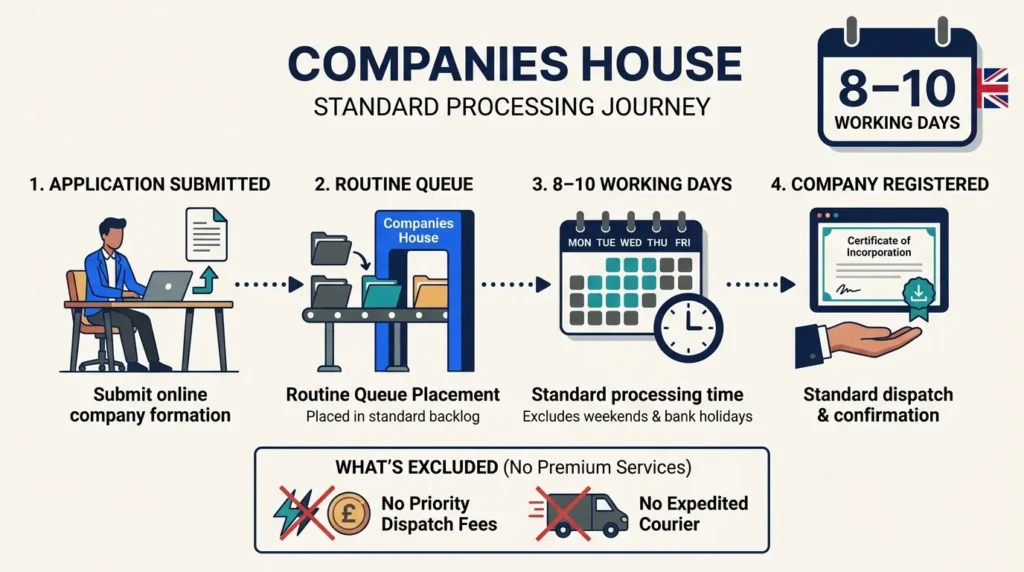
Standard queues process thousands of routine filings sequentially. Administrative backlogs lengthen dispatch times during peak financial reporting periods. Companies House reviews annual accounts and confirmation statements before printing the official paper copy. Postal delivery adds another 2 to 4 working days to the total receipt time. Directors choose standard delivery when international partners grant flexible grace periods for document submission. This budget-friendly option suits long-term corporate planning where deadlines remain weeks away.
How Does the Express Service Accelerate Delivery?
Express service expedites document generation within 24 to 48 hours by placing applications into priority review queues at Companies House and utilizing tracked electronic or courier delivery.
Priority queues bypass standard administrative delays through dedicated processing channels. Companies House staff prioritize urgent requests immediately upon electronic submission. Digital copies arrive via secure email within one business day. Physical copies dispatch via priority next-day courier services to domestic or international addresses. Businesses facing sudden regulatory audits or rapid asset acquisitions rely on this expedited speed.
Which Factors Determine Your Speed Selection?
Four critical operational pressures dictate your speed selection: impending contract deadlines, overseas banking requirements, foreign regulatory audits, and international court proceedings.
Time-sensitive commercial tenders penalize late document submissions by disqualifying corporate bidders. Overseas banking institutions freeze corporate account applications if verification documents expire. Regulatory bodies impose strict filing windows during foreign corporate restructuring phases. International legal disputes require authenticated registrar proof within rigid judicial timelines. When evaluating these pressures, businesses often review insights found in How Long Does It Take to Get a Certificate of Good Standing? to gauge baseline administrative durations. Matching turnaround speeds to these external pressures eliminates operational bottlenecks.
How Do Costs Differ Between Standard and Express Options?
Standard processing incurs minimal government fees, whereas express delivery includes priority handling surcharges, courier tariffs, and expedited administrative overhead costs.
Government filing fees form the baseline cost for standard applications. Express tiers add priority service charges levied by Companies House. International courier fees escalate total expenses for physical overseas dispatch. Corporate finance departments balance these administrative costs against potential contract losses caused by slow delivery. Businesses prioritizing speed over cost optimization select expedited routes.
How Do You Finalise Your Turnaround Decision?
Final decisions emerge from balancing strict regulatory deadlines against administrative expenditure, ensuring your chosen timeline satisfies external compliance demands without unnecessary budget waste.
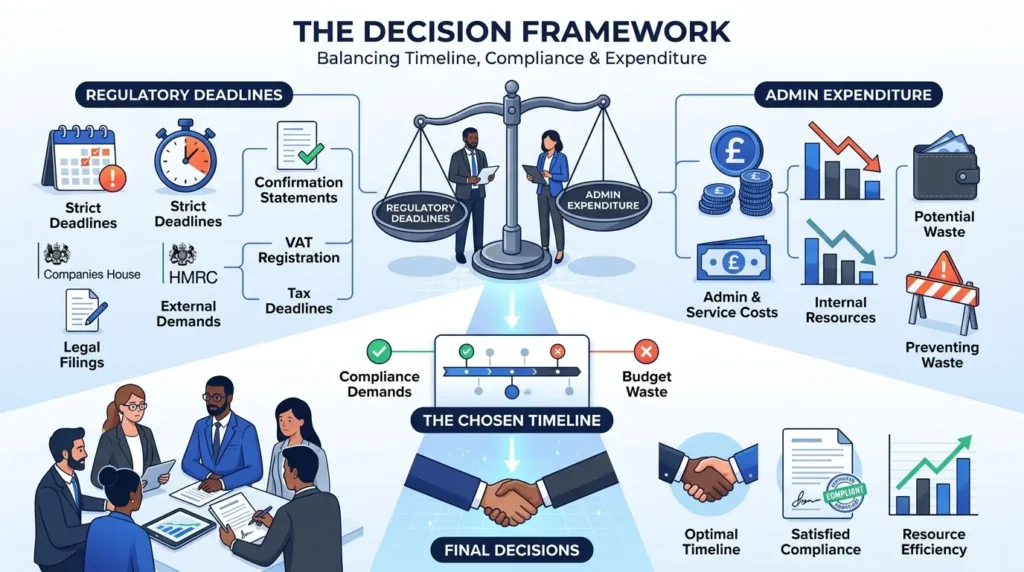
Strategic planning prevents emergency document requests during critical international expansions. Directors evaluate current Companies House processing capacities before submitting applications. Companies requiring immediate document dispatch should Get Same-Day Certificate of Good Standing Delivery With Form My Company to secure swift processing. Form My Company manages priority submissions directly through official channels. Aligning your operational schedule with proven dispatch speeds safeguards corporate compliance across global markets.
Explore More Certificate of Good Standing Guide,
How to Delegate Front-Office Operations Without Losing Control
Comparing the Top 5 UK Call Answering Providers for 2026
Frequently Asked Questions
What is included in a Certificate of Good Standing for a UK company?
A Certificate of Good Standing issued by Companies House confirms that a registered corporate entity has a continuous trading history and complies with all filing requirements. The document explicitly displays the official registrar seal, company registration number, incorporation date, and current compliance status. Form My Company assists businesses in securing this verified documentation for international expansion and overseas banking compliance.
How long is a Certificate of Good Standing valid for use?
Most international authorities, overseas banks, and regulatory bodies require a Certificate of Good Standing to be issued within the last 30 to 90 days. Because foreign institutions demand fresh validation of corporate status, expired documents are routinely rejected during compliance audits. Form My Company helps directors order up-to-date certificates to satisfy these strict overseas validity windows.
Can a dissolved or struck-off company obtain a Certificate of Good Standing?
Companies House exclusively issues Certificates of Good Standing to active corporations that have maintained all statutory filing obligations, such as annual accounts and confirmation statements. Entities facing strike-off action or formal dissolution proceedings cannot qualify until their active administrative status is fully restored. Form My Company provides guidance on resolving compliance gaps before ordering your corporate status documentation.
Why do overseas banks require a UK Certificate of Good Standing?
International financial institutions mandate a Certificate of Good Standing to authenticate a foreign parent company’s legal legitimacy during corporate bank account opening procedures. This document proves to compliance officers that the business operates legally within the UK framework and remains free of liquidation notices. Form My Company streamlines this verification process for businesses establishing international commercial accounts.
Do I need a notarised or apostilled Certificate of Good Standing for international use?
Foreign authorities often require a Certificate of Good Standing to undergo legalisation via an apostille or consular notarisation before accepting it for official overseas administrative filings. This authentication confirms the validity of the official registrar signature for foreign courts and government agencies. Form My Company manages the entire document acquisition process to ensure your corporate records meet global regulatory standards.