
Standard delivery processes a Certificate of Good Standing within four to five working days using regular postal dispatch, while Express delivery prioritizes official processing to issue and dispatch authenticated documents via expedited courier within twenty-four hours.
What Is a Certificate of Good Standing in the UK?
A Certificate of Good Standing is an official document issued by Companies House that confirms a UK company is properly registered, fully compliant with filing requirements, and continuously operational without facing liquidation or legal dissolution procedures.
Official corporate records maintained by Companies House track statutory compliance across all UK corporate entities. A Certificate of Good Standing acts as verifiable proof that an enterprise fulfills every ongoing legal duty under the Companies Act 2006. The document confirms that the company maintains its legal standing by filing required confirmation statements and annual financial accounts on time.
Financial institutions, international trade partners, and regulatory bodies demand this document during official verification checks. When corporate entities open offshore bank accounts or register foreign branches, overseas authorities authenticate corporate legitimacy using these official records. The physical certificate contains key registration details, including the official company name, registration number, incorporation date, and a legal confirmation statement from the Registrar of Companies.
Corporate entities maintain statutory compliance by submitting accurate legal filings. Requesting a Certificate of Good Standing ensures business leaders can easily demonstrate operational legitimacy to commercial partners. Ensuring every corporate officer remains actively appointed safeguards continuous business operations during official auditing procedures.
How Does Standard Delivery Process Corporate Certificates?
Standard delivery processes official corporate certificates through routine administrative queues at Companies House, taking four to five working days before dispatching hard-copy documents via regular Royal Mail postal services to specified delivery addresses.
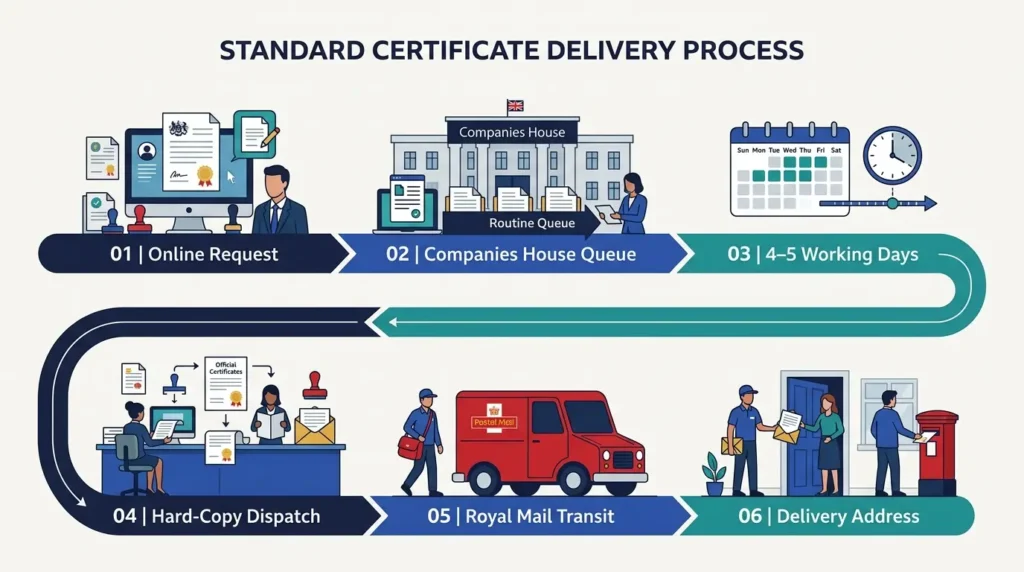
Standard processing follows regular administrative workflows within government registry offices. When an organization submits a standard request, administrative staff review company records in chronological order. Registry officers verify that all confirmation statements and annual accounts remain up to date. They ensure no active dissolution proceedings exist against the business entity.
Once registry officials approve statutory data, government printing facilities generate the physical certificate. Standard administrative processing typically requires four to five working days to complete document generation. Postal teams then transfer the document to second-class or first-class postal networks for final physical transit.
This method suits routine corporate administrative tasks without strict legal deadlines. Businesses planning routine internal audits, scheduled vendor onboarding, or non-urgent record updates choose standard processing. Standard fulfillment minimizes administrative costs while securing official government documentation.
How Does Express Delivery Accelerate Document Issuance?
Express delivery accelerates document issuance by placing the application into a priority queue at Companies House, guaranteeing same-day document production and dispatch via tracked overnight courier services within twenty-four hours.
Express processing prioritizes administrative review above standard queuing workflows. When corporate applicants request express processing, government registry officers immediately validate company filings. Dedicated registry teams authenticate compliance records, confirm active corporate status, and print the official document within hours of application submission.
Once generated, the official certificate bypasses routine mail handling. Courier teams pick up the authenticated paperwork directly from government facilities. Tracked courier logistics deliver physical documentation directly to business offices or international regulatory addresses.
Fast processing eliminates operational delays during urgent commercial transactions. Enterprises completing cross-border acquisitions, time-sensitive foreign bank registrations, or urgent international bidding tenders rely on express timelines. Rapid execution protects corporate deals from failing due to missing statutory proof.
What Are the Key Processing Timelines for Each Service?
Standard delivery requires five to seven total business days for complete physical receipt, whereas Express delivery completes processing, authentication, and physical courier delivery within one to two working days globally.
| Delivery Feature | Standard Delivery | Express Delivery |
| Registry Queue Priority | Standard Sequential Queue | Immediate Priority Queue |
| Government Processing Time | 4 to 5 Working Days | Same-Day (Under 24 Hours) |
| Transit Method | Royal Mail Standard Post | Tracked Express Courier |
| Total Turnaround Time | 5 to 7 Business Days | 1 to 2 Working Days |
Timelines directly impact commercial scheduling and legal compliance windows. Standard workflows rely on variable postal timelines that introduce unexpected delays during peak shipping periods. Businesses utilizing regular shipping must account for additional transit days when submitting documents to foreign authorities.
Express workflows operate on guaranteed turnaround metrics. Immediate electronic processing coupled with private courier networks ensures predictable delivery schedules. Overseas authorities receiving urgent corporate documentation process regulatory submissions faster when delivery dates remain precise.
When executives evaluate corporate expansion timelines, comparing operational speeds reveals critical differences. Business leaders can learn how to choose the fastest way to obtain a Certificate of Good Standing to align document fulfillment with strict corporate deadlines.
How Do Security and Tracking Features Compare?
Standard delivery utilizes un-tracked regular postal channels with basic location monitoring, while Express delivery provides continuous end-to-end GPS tracking, signature verification on receipt, and dedicated chain-of-custody protocols for sensitive legal documents.
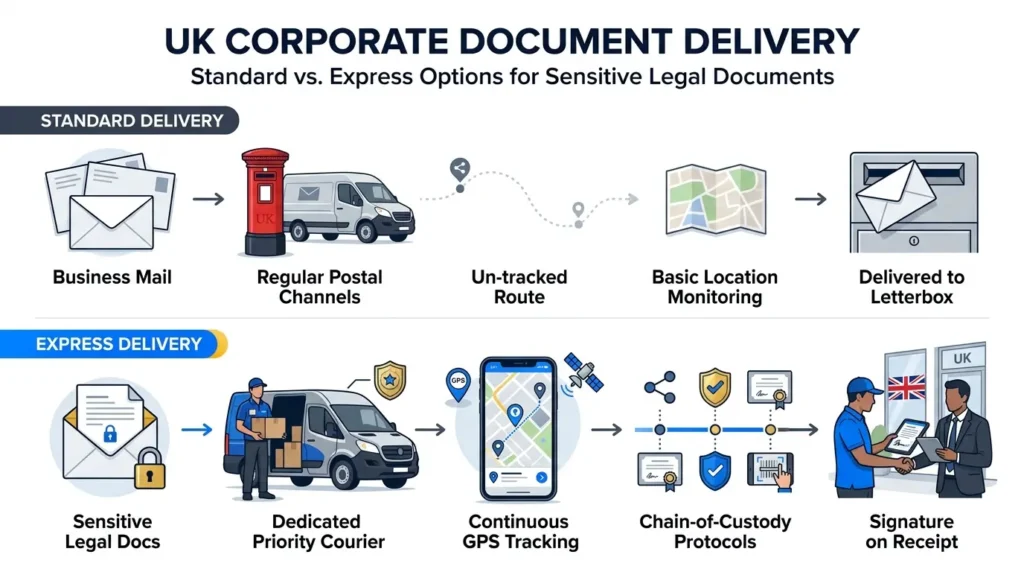
Document security remains essential when handling official legal credentials. Standard mail systems distribute packages through public sorting facilities alongside regular consumer mail. While standard services prove reliable for routine correspondence, physical packages lack real-time transit visibility. Lost packages require complete re-issuance from registry offices, causing significant operational delays.
Express fulfillment incorporates enhanced security protocols tailored for high-value legal paperwork. Courier services scan package barcodes at every transport node, sending real-time tracking updates to corporate administrators. Direct handoffs ensure sensitive corporate details remain secure throughout transit.
Signature verification rules mandate that only authorized recipients accept the physical delivery. Dedicated couriers prevent lost documentation, mitigating identity theft risks and legal exposure. Overseas deliveries benefit from specialized customs clearance protocols, preventing administrative impoundment at international borders.
When Should a Business Choose Express Over Standard Delivery?
A business should choose Express delivery when facing imminent contract deadlines, securing international financing, opening foreign bank accounts, or fulfilling urgent court orders that require immediate legal proof of corporate standing.
Selecting the correct delivery tier depends on commercial urgency and legal consequences. Standard fulfillment works well when project schedules allow two weeks of preparation time. Non-urgent compliance reviews, internal record keeping, and prospective partner evaluations do not require rapid turnaround times.
Express fulfillment becomes mandatory during high-stakes commercial events. Foreign financial institutions require recent proof of good standing before approving corporate lending facilities. Delaying document submission risks missing legal closing windows, costing companies significant business opportunities.
Cross-border expansion plans often require foreign branch registrations within tight statutory limits. International regulatory agencies reject outdated filings, requiring rapid document delivery. Executives can buy an express Certificate of Good Standing from Form My Company to secure fast legal documentation and prevent costly operational delays.
How Do Verification Requirements Impact Delivery Speed?
Verification requirements impact delivery speed because incomplete corporate filings, outdated director details, or unpaid registration fees trigger mandatory administrative holds at Companies House before document processing can begin.
Government registrars enforce strict statutory checks before issuing corporate certificates. Registry systems verify three core data sets: active director registers, registered office address details, and current filing histories. When corporate registers detect missing confirmation statements, administrative officers freeze the document generation process.
Express processing cannot bypass underlying compliance failures. If a company fails to submit required financial accounts, Companies House rejects the application regardless of chosen delivery speed. Resolving compliance flags requires filing updated corporate accounts or legal notices, adding days to processing schedules.
Pre-application auditing ensures seamless document delivery. Reviewing corporate registers prior to submission eliminates administrative holds. Companies maintaining accurate statutory records secure immediate approval during both standard and expedited processing workflows.
How Does Form My Company Streamline Certificate Processing?
Form My Company streamlines certificate processing by reviewing statutory records for compliance errors, submitting priority applications directly to Companies House, and managing expedited courier dispatch for fast global delivery.
Managing corporate filings requires exact compliance knowledge and speed. Form My Company verifies corporate registry status before application submission, identifying missing filings that could cause administrative delays. Direct digital links to government systems allow swift application processing without manual errors.
Dedicated compliance specialists oversee every stage of the certificate fulfillment lifecycle. Form My Company coordinates with official registrars to accelerate document printing and legal verification. Express courier logistics ensure authenticated legal paperwork arrives safely at your target destination.
Professional corporate services eliminate administrative friction for busy executives. Relying on expert document management allows business leaders to focus on core operational growth while maintaining total statutory compliance.
Explore More Certificate of Good Standing Guide,
How Long Does It Take to Get a Certificate of Good Standing?
How to Make Your Small Business Look Like a Global Corporation
Frequently Asked Questions
How long does it take to get a Certificate of Good Standing in the UK?
Standard processing by Companies House typically takes four to five working days plus postal transit time. However, using an expedited service through Form My Company allows businesses to receive an express Certificate of Good Standing within 24 hours via tracked courier delivery.
What information is included on a Certificate of Good Standing?
A Certificate of Good Standing confirms a company’s official name, registration number, incorporation date, and active standing under the Companies Act 2006. It explicitly verifies that all required confirmation statements and annual accounts are up to date and that no liquidation or dissolution proceedings exist.
Why do banks require a Certificate of Good Standing?
Financial institutions require a Certificate of Good Standing during compliance audits to verify that a UK corporate entity is legally registered and fully compliant with government filing duties. Form My Company assists businesses in obtaining this authenticated document to satisfy regulatory requirements when opening business bank accounts or securing international credit lines.
Can a dissolved company obtain a Certificate of Good Standing?
No, Companies House only issues a Certificate of Good Standing to active UK companies that are fully up to date with their statutory filings. If a business has outstanding accounts or faces striking-off procedures, those legal issues must be resolved before requesting the document.
How do I order a Certificate of Good Standing for my business?
You can order an official Certificate of Good Standing directly online by submitting your company registration details for registry verification. Form My Company reviews your corporate standing, submits the application to Companies House, and manages priority dispatch to ensure rapid delivery of your authenticated document.