
Choosing the fastest way to obtain a Certificate of Good Standing requires selecting digital processing options, verifying company filing compliance upfront, and ordering directly through an official UK Companies House registered agent that provides express same-day dispatch services.
What Factors Determine the Speed of Obtaining a Certificate of Good Standing?
The speed of obtaining a Certificate of Good Standing depends on the delivery method, government filing status, and whether the document requires legalisation, apostille certification, or physical dispatch rather than digital transmission.
Processing times vary across administrative channels in the United Kingdom. Standard government issue times range from 3 to 10 working days for basic paper documents. Companies House requires all statutory confirmation statements and annual accounts to be fully up to date before issuing official documentation. Any outstanding filings or administrative delays at Companies House automatically suspend document generation.
Selecting an electronic PDF delivery option reduces turnaround times significantly compared to traditional postal methods. Digital certificates arrive within hours when requested through dedicated corporate service providers. Overseas regulatory compliance often demands physical apostille certificates. Legalisation by the Foreign, Commonwealth & Development Office adds 2 to 5 business days to the total fulfillment window.
Prior compliance checks eliminate unnecessary submission rejections. Directors must ensure that registered office address records match official registers precisely. Company officers who audit their public registry profile before submitting requests avoid administrative holds. Selecting same-day processing services accelerates official verification and guarantees immediate queue placement.
How Does Express Processing Compare to Standard Delivery Timelines?
Express processing delivers an official Certificate of Good Standing within 3 to 24 hours via digital download, whereas standard delivery requires 4 to 10 business days through postal channels.
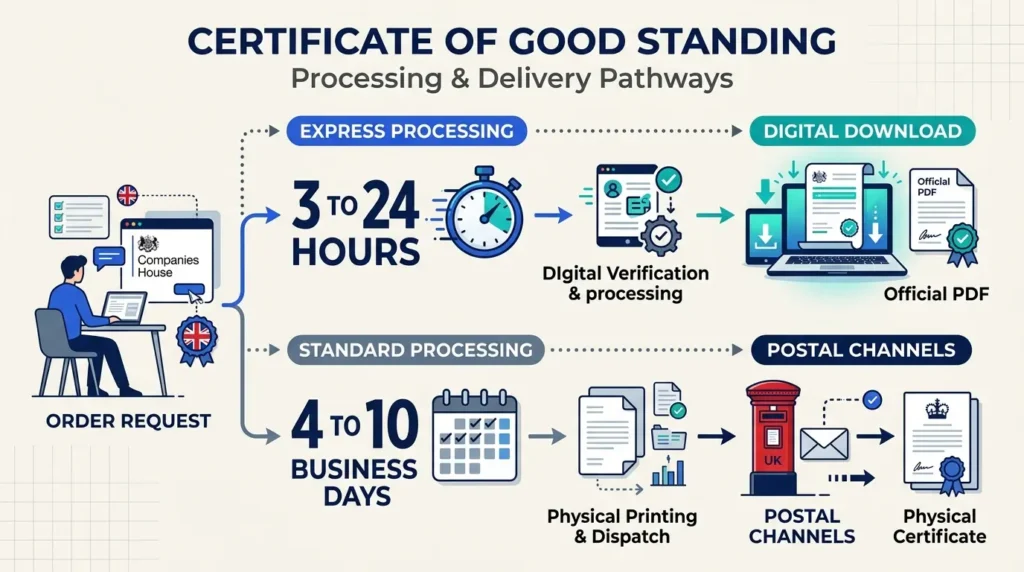
| Processing Option | Turnaround Time | Delivery Format | Priority Queue Placement |
| Standard Government Order | 5–10 Business Days | Physical Postal Mail | Standard Processing Queue |
| Express Agent Submission | 3–24 Hours | Electronic PDF / Priority Mail | Priority Expedited Queue |
| Apostille Expedited Service | 2–4 Business Days | Stamped Hard Copy | Priority Legalisation Queue |
Time-critical corporate transactions require rapid document retrieval. Financial institutions, international trade partners, and legal entities frequently impose strict compliance deadlines. Standard postal distribution introduces unpredictable shipping delays across national and international mail networks. Electronic fulfillment eliminates physical transit times entirely.
Service providers maintain direct API connections with official registry databases. Direct digital integration enables immediate retrieval once Companies House approves the application. Entities evaluating their turnaround requirements can explore the differences between standard and express Certificate of Good Standing delivery options to select the correct fulfillment speed.
Express workflows prioritize document queue validation. Registry officials process expedited requests before handling standard administrative queues. Corporate buyers receive certified electronic copies directly in their inbox. Expedited physical copies ship using tracked overnight courier networks for maximum security.
What Common Obstacles Delay Official Document Issuance?
The most common obstacles delaying document issuance include overdue annual accounts, unfiled confirmation statements, pending registry updates, and incorrect corporate registration numbers.
Unfiled annual returns trigger immediate administrative holds at Companies House. The corporate registry rejects applications automatically if a company defaults on statutory filing obligations. Directors must submit overdue financial statements before requesting official certificates. Resolving compliance defaults adds 48 to 72 hours to total processing duration.
Incorrect company registration details cause manual review delays. Entering mismatched corporate names or inaccurate registration numbers stalls automated processing workflows. Staff members must manually verify details when automated database queries fail to return exact matches. Precision during the application submission process prevents avoidable manual intervention.
Pending officer changes create compliance synchronization gaps. Updating director appointments, secretary details, or registered office addresses requires formal processing time. Requesting certificates while registry updates remain pending causes information mismatch errors. Organizations must wait until Companies House confirms registry updates before placing document orders.
How Can Businesses Streamline the Document Request Process?
Businesses can streamline document requests by verifying public registry compliance, preparing corporate details in advance, and ordering directly through specialized corporate services.
Conducting a preliminary registry audit prevents order rejections. Corporate secretaries verify that the target company remains active, solvent, and fully compliant on public records. Checking statutory filing status takes less than 2 minutes via online portal tools. Proactive verification ensures seamless application approval.
Preparing official details accelerates order completion. Applicants require three core data points: exact registered company name, 8-digit registration number, and required certificate specifications. Specifying required custom disclosures—such as director names, secretary details, or shareholder capital—upfront prevents re-issuance requirements.
Utilizing dedicated corporate agents bypasses standard bureaucratic delays. Form My Company coordinates document applications directly with regulatory systems to eliminate administrative bottlenecks. Choosing an established corporate provider ensures rapid turnaround for time-sensitive legal requirements. Companies can obtain an official Certificate of Good Standing online to meet immediate commercial compliance deadlines.
What Specific Information Belongs on an Express Certificate?
An express certificate contains statutory verification statements, active company status confirmations, director details, and registered address disclosures.
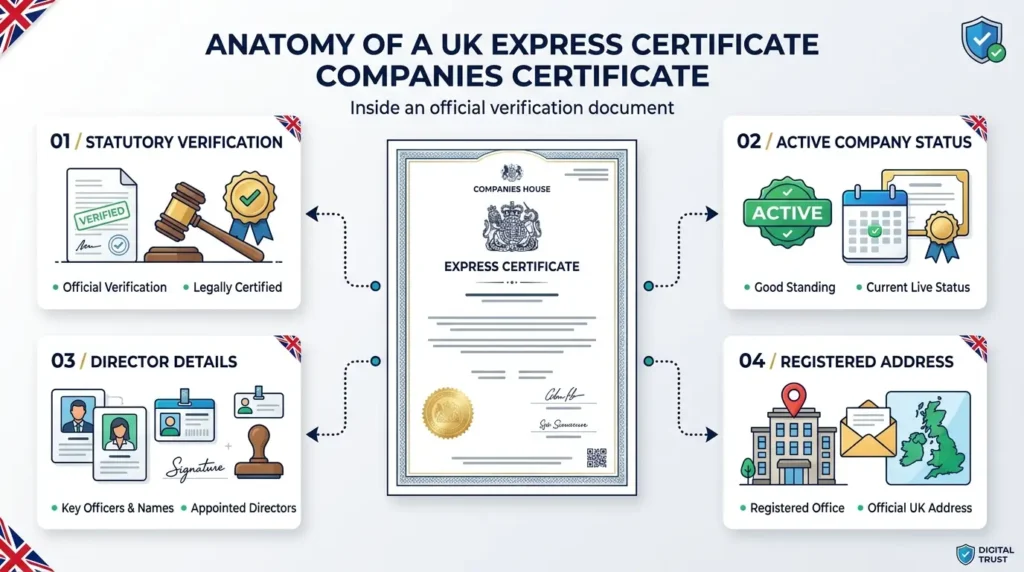
Standard certificates confirm basic corporate standing under UK company law. The document verifies that a company operates continuously without pending dissolution proceedings. Registry officers authenticate that all required annual returns and accounts exist on public record. Financial partners accept this standard document for routine compliance reviews.
Custom disclosures expand the scope of official documentation. Applicants include specific details based on third-party requirements:
List current active directors and secretaries
Disclose registered office address details
Verify issued share capital structures
Confirm specific corporate object clauses
Including unnecessary custom disclosures increases manual verification time at the registry. Applicants should request only the specific details mandated by foreign banks, courts, or regulatory bodies. Streamlining requested clauses allows registry officers to generate electronic certificates faster.
Why Is Direct Digital Issuance the Recommended Route for SMEs?
Direct digital issuance is the recommended route for SMEs because it eliminates postal delays, provides immediate PDF delivery, and meets global legal verification standards.
Small and medium enterprises frequently operate under tight contractual deadlines. Opening overseas bank accounts, securing international commercial loans, or entering foreign tenders requires prompt legal documentation. Waiting weeks for paper delivery risks missing critical business opportunities. Digital issuance guarantees document availability within hours.
Electronic certificates feature embedded cryptographic signatures. Modern regulatory bodies accept digitally signed PDFs as legally valid originals. Cryptographic verification ensures document integrity and prevents unauthorized alterations. Recipients verify authenticity instantly by checking regulatory digital signatures.
Digital fulfillment lowers administrative costs for expanding businesses. SMEs save on international courier fees and urgency surcharges associated with physical document transport. Storing verified electronic copies in corporate repositories simplifies future compliance audits. Digital workflows provide superior speed, lower costs, and complete security.
To secure urgent fulfillment, management teams can buy an express Certificate of Good Standing from Form My Company for direct, priority processing. Direct corporate service integration ensures rapid turnaround without administrative delays. Form My Company delivers official compliance documentation efficiently to support business growth.
Explore More Certificate of Good Standing Guide,
The Direct Link Between Fast Call Answering and Customer Loyalty
Comparing the Top 5 UK Call Answering Providers for 2026
Frequently Asked Questions
What is a Certificate of Good Standing in the UK?
A Certificate of Good Standing is an official document issued by Companies House that confirms a UK company is properly registered, actively operating, and compliant with all statutory filing requirements. Third parties like foreign banks, lenders, and regulatory bodies use this document to verify that a business has no pending dissolution or legal defaults. Businesses can request an official Certificate of Good Standing through Form My Company to provide verified proof of corporate compliance.
How long does it take to get a Certificate of Good Standing?
Standard processing by Companies House typically takes 3 to 10 business days for physical postal delivery. However, choosing express electronic delivery through Form My Company allows businesses to receive an official digital PDF copy within 3 to 24 hours. Delivery times may vary if the company requires additional legalisation, such as an apostille stamp for international use.
Why do banks require a Certificate of Good Standing?
Financial institutions require a Certificate of Good Standing to complete Know Your Customer (KYC) checks and confirm that a company is legally active and compliant before opening a commercial bank account. It proves that all statutory filings, annual accounts, and confirmation statements are up to date with Companies House. Ordering a Certificate of Good Standing via Form My Company ensures businesses meet strict banking compliance deadlines promptly.
What are the requirements to obtain a Certificate of Good Standing?
To obtain a Certificate of Good Standing, a UK company must have at least one active individual director and ensure that all annual accounts and confirmation statements are fully filed with Companies House. Any outstanding compliance defaults or pending administrative strikes will prevent the registry from issuing the document. Form My Company assists businesses by reviewing public registry status prior to filing to prevent administrative processing delays.
Can a Certificate of Good Standing be legalised with an apostille?
Yes, a Certificate of Good Standing can be legalised with an apostille certificate from the Foreign, Commonwealth & Development Office (FCDO) for international validity. Legalisation is required when submitting corporate documents to foreign government agencies, international courts, or overseas banks operating outside the UK. Form My Company provides combined express request and apostille legalisation options to streamline overseas business compliance.