
Certificate of Good Standing prices vary between providers because processing speeds, official Companies House statutory fees, administrative handling charges, and international legalisation requirements create different cost structures across corporate service agencies.
What Statutory Fees Base the Cost of a Certificate of Good Standing?
Statutory fees set by Companies House establish the baseline cost because official government charges apply to every document order regardless of which corporate service provider submits the application.
Companies House enforces standard statutory fees for issuing official corporate status documents. Standard paper processing takes four working days and incurs a fixed government fee. Same-day expedited government processing increases this statutory fee significantly. Official registry fees form the unalterable foundation of total document pricing. Corporate service providers add administrative margins onto these baseline government costs. Providers operating with higher overheads charge elevated service fees above statutory minimums. Wholesale pricing structures allow high-volume agencies to absorb small margins while maintaining competitive end-user rates. Pricing differences begin with how agencies package these base government charges into final commercial rates.
How Does Processing Speed Affect the Final Purchase Price?
Processing speed affects the final purchase price because urgent same-day submissions require priority queuing, dedicated agent handling, and elevated government submission fees compared to standard four-day turnarounds.
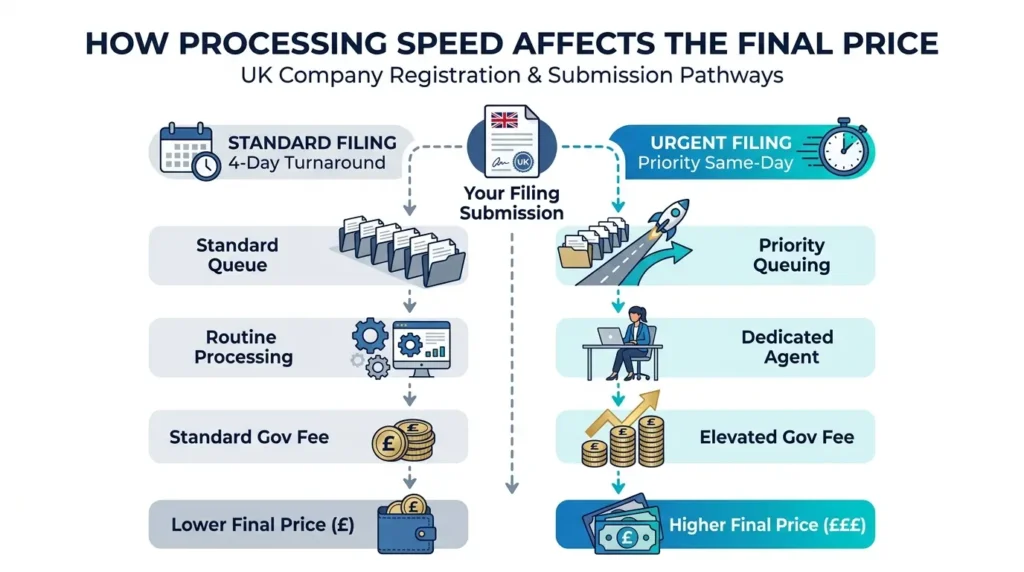
Submission timelines dictate total service fees across commercial formation agencies. Standard processing involves queued batch submissions that process through Companies House within four business days. Priority processing requires immediate manual intervention by dedicated compliance agents. Dedicated agents fast-track document preparation to meet strict same-day registry deadlines. Expedited service tiers account for manual labor allocations and higher statutory priority charges. Ordering urgent legal documentation requires higher operational overhead from third-party corporate providers. Fast turnarounds suit urgent corporate transactions, international banking applications, and cross-border commercial tenders. Slower turnarounds suit routine annual compliance reviews where time constraints do not apply. Choosing standard delivery reduces administrative fees for non-urgent corporate filings.
Why Do International Legalisation Services Increase Document Costs?
International legalisation services increase document costs because adding an Hague Apostille certificate or embassy attestation requires official Foreign Office processing fees, physical courier transit, and specialized legal handling.
Overseas authorities require verified legalisation before accepting official UK corporate records. Foreign registries reject standard UK certificates without an Hague Apostille certificate attached. The Foreign, Commonwealth & Development Office charges individual statutory fees for every legalised document. Commercial providers coordinate document physical transit between official government departments in London and Milton Keynes. Legalisation increases total costs due to mandatory courier fees and official diplomatic stamps. Embassy attestation adds extra costs when submitting records to non-Hague Convention countries. Specialized legal couriers handle physical documents to prevent loss during international transit. Agencies bundle physical handling, diplomatic fees, and embassy administration into comprehensive legalisation packages. Understanding international compliance requirements prevents unnecessary spending on unneeded legalisation services. Evaluating whether to handle requests independently or hire experts helps clarify cost structures, which becomes clear when comparing DIY Companies House requests vs using a certificate provider.
What Administrative Extras Drive Up Corporate Provider Fees?
Administrative extras drive up corporate provider fees because providers add charges for identity verification, physical express courier dispatch, compliance reviews, and digital PDF delivery.
Corporate service providers build distinct operational features into their baseline pricing tiers. Digital PDF copies cost extra when agencies charge separate electronic delivery fees. Anti-money laundering compliance checks require identity validation software that incurs third-party data verification costs. Identity verification services validate director credentials using official UK compliance frameworks. Physical document dispatch using DHL or Royal Mail Special Delivery adds trackable logistics charges. Manual document reviews by qualified corporate secretaries prevent application rejections at Companies House. Certified true copies require additional solicitor attestation fees prior to registry submission. Unbundling administrative services creates lower initial prices but higher final checkout totals. Fully inclusive packages display higher upfront costs but eliminate hidden post-application charges.
How Do Provider Support Levels Impact Service Pricing Tiers?
Provider support levels impact service pricing tiers because agencies offering dedicated account managers, phone consultation, and error-prevention checks maintain higher operational staffing overheads.
Direct access to compliance specialists increases operational delivery costs for corporate service agencies. Automated online portals process orders without human intervention, maintaining lower overhead expenditures. Phone support options require trained corporate paralegals to answer technical registry queries. Expert agents review director details, company numbers, and active filing statuses before order submission. Pre-submission audits reduce filing rejections caused by overdue confirmation statements or missing accounts. High-support agencies guarantee submission accuracy, covering re-filing costs if errors occur during application processing. Low-cost automated providers pass filing risk entirely back to the ordering client. Dedicated customer service infrastructure creates sustainable price differences between automated portals and full-service corporate firms.
How Can Businesses Choose the Right Certificate Package Value?
Businesses can choose the right certificate package value by matching required turnaround speeds, legalisation needs, and support levels directly against immediate commercial transaction deadlines.
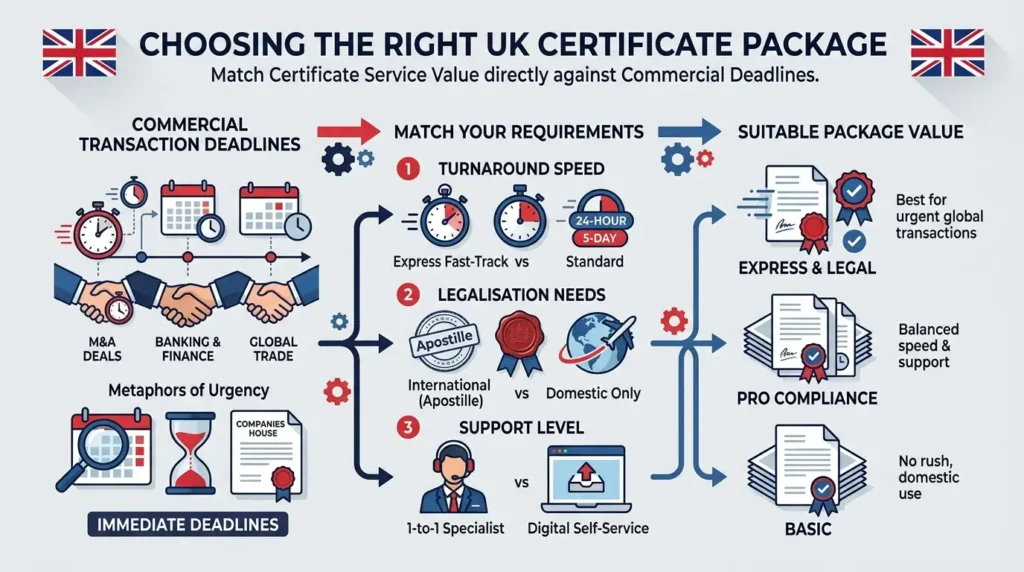
Matching commercial requirements to correct service tiers prevents overpaying for unnecessary add-ons. Cross-border banking applications demand fully legalised physical certificates with expedited handling. Internal compliance audits require standard digital certificates obtained through regular submission timelines. Assessing legal requirements eliminates expenses on international apostilles when domestic banks accept standard registry originals. Selecting transparent service providers ensures all statutory charges and delivery fees appear clearly upfront. Companies needing guaranteed accuracy choose professional services to secure official corporate proof efficiently. Organizations can obtain an official Certificate of Good Standing to verify valid UK registry status and active filing compliance. When urgent business deals depend on rapid verification, corporate leaders can request a fast-track Certificate of Good Standing with Form My Company to streamline registry approvals. Form My Company manages official filings directly with Companies House to deliver accurate legal documentation on schedule.
How Does Form My Company Provide Clear Certificate Pricing?
Form My Company provides clear certificate pricing by offering fully inclusive service packages that combine statutory fees, rapid turnaround options, and expert review into transparent upfront rates.
Hidden statutory surcharges complicate financial budgeting for expanding UK businesses. Clear fee structures display statutory government charges alongside administrative fulfillment fees prior to payment. Direct submission protocols eliminate intermediate broker markups, keeping client costs competitive. Integrated compliance checks verify company standing before processing applications through official registry channels. Professional administrative handling prevents costly document rejections and administrative processing delays. Clear operational workflows allow businesses to select precise processing tiers matching specific commercial timelines. Form My Company delivers reliable corporate documentation that satisfies bank compliance departments, foreign registries, and legal advisors worldwide.
Explore More Certificate of Good Standing Guide,
What Is the Difference Between Standard and Express Certificate of Good Standing Delivery?
How Long Does It Take to Get a Certificate of Good Standing?
Frequently Asked Questions
What is a Certificate of Good Standing in the UK?
A Certificate of Good Standing is an official Companies House document that verifies a UK registered company is up to date with its required statutory filings and remains active on the official register. Corporate service providers like Form My Company obtain this document to prove legal existence and administrative compliance to external parties. It confirms that a business has continuously submitted its annual accounts and confirmation statements without defaulting.
Who can issue an official Certificate of Good Standing?
Only legal registrar authorities like Companies House can officially issue a Certificate of Good Standing for UK companies. Licensed corporate formation agents, including Form My Company, facilitate the application process by verifying company details and submitting fast-track requests directly to the registry on behalf of business owners. This service ensures the resulting official document meets necessary registry standards and legal guidelines.
How long does it take to get a Certificate of Good Standing?
Standard processing for a Certificate of Good Standing through Companies House typically takes four to five working days. However, using expedited fulfillment options from Form My Company allows businesses to receive same-day or 24-hour electronic and physical document turnaround. Processing times can extend if international legalisation, such as an Hague Apostille certificate, is required for foreign official use.
Why do banks require a Certificate of Good Standing?
Financial institutions require a Certificate of Good Standing during corporate account opening or compliance reviews to ensure a company is legally active and compliant with UK statutory regulations. Presenting this official registry document verified by Form My Company proves that the business is not facing strike-off proceedings or liquidation. It serves as essential corporate verification for risk assessment and anti-money laundering compliance framework audits.
Do I need an Apostille for my Certificate of Good Standing?
An Apostille certificate is required if you plan to present your Certificate of Good Standing to foreign government authorities, overseas banks, or international registries outside the UK. The Hague Apostille authenticates the official Companies House signature and legal status for legal recognition in foreign jurisdictions. Form My Company arranges Hague Apostille legalisation and diplomatic embassy attestation alongside standard certificate procurement.