
Directly requesting a Certificate of Good Standing from Companies House costs less initially, but professional certificate providers handle verification, speed up processing, and prevent document rejections. A certificate provider ensures compliance with foreign authorities, banks, and legal institutions.
What Is the Difference Between DIY Companies House Requests and Using a Provider?
DIY requests require applicants to submit orders directly through Companies House, while certificate providers handle validation, submission, legalisation, and international delivery. Providers review corporate records before filing to prevent processing delays and administrative rejections.
Companies House acts as the official registrar of companies in the United Kingdom. Direct requests through the official portal cost £20 for standard paper delivery. Standard orders process within ten working days. Direct orders suit businesses that require standard official documentation without tight deadlines or legalisation requirements. DIY applicants manage every step of the ordering process independently.
Certificate providers deliver end-to-end document management services. Providers verify that corporate filings remain fully up to date before submitting application requests. Professional services identify missing confirmation statements, outstanding accounts, or director discrepancies prior to filing. Identifying discrepancies beforehand prevents automatic order cancellations by Companies House. Certificate providers also arrange Apostille legalisation through the Foreign, Commonwealth & Development Office (FCDO).
Submitting incorrect information directly to Companies House causes order cancellations. Companies House does not refund administrative fees for invalid submissions. Certificate providers offer speed, administrative accuracy, and international document compliance. Business owners select providers to avoid administrative errors and secure guaranteed processing times.
How Does Processing Speed Compare Between DIY Requests and Certificate Providers?
Standard DIY submissions through Companies House take ten working days to process, whereas certificate providers access fast-track services that issue official documents within 24 hours.
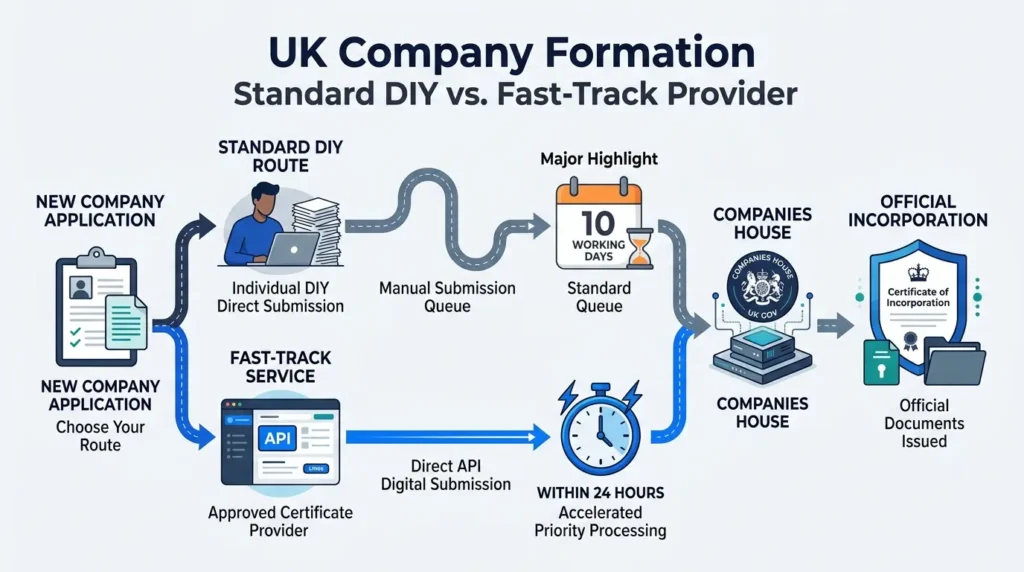
Companies House processes standard orders in chronological order. Peak filing periods increase standard processing times beyond ten working days. Postal delivery adds two to five additional business days for UK addresses. Overseas delivery times vary between one and three weeks. Direct applicants cannot expedite an order once submitted through the standard portal.
Professional certificate providers offer same-day and 24-hour fast-track options. Providers submit order requests through dedicated administrative channels. Fast-track processing guarantees document retrieval within target timeframes. Certificate providers send digital PDF copies immediately upon issuance. Rapid digital delivery allows businesses to meet urgent commercial deadlines.
Time-sensitive corporate transactions require fast document turnarounds. Cross-border acquisitions, bank account openings, and legal tenders operate on strict schedules. Standard ten-day delays disrupt international business expansion plans. Using a fast-track workflow secures official documentation without operational interruptions.
What Are the Cost Differences Between Direct Requests and Professional Services?
Direct Companies House orders cost £20 for standard delivery, while professional certificate providers charge higher fees to cover expedited handling, document verification, and legalisation.
Evaluating document acquisition costs requires analyzing both direct fees and indirect operational expenses. DIY requests appear cost-effective on initial review. A direct standard request costs £20, while a direct same-day request costs £50. Direct pricing excludes document legalisation, embassy attestation, and courier delivery costs. Ordering individual services separately increases overall procurement costs.
Professional certificate providers bundle administrative, verification, and logistics costs into unified packages. When comparing expenses, business owners often ask Why Do Certificate of Good Standing Prices Vary Between Providers? to understand the service components included in different pricing structures. Provider packages include document preparation, official registrar fees, legalisation, and tracked courier shipping. Bundled pricing eliminates unexpected administrative fees during international transactions.
| Service Feature | Direct Companies House (DIY) | Professional Certificate Provider |
| Standard Processing Time | 10 Working Days | 24 to 48 Hours |
| Document Legalisation (Apostille) | Not Included | Included / Optional |
| Pre-Filing Compliance Audit | No | Yes |
| International Courier Delivery | Standard Mail Only | Express Tracked Courier |
| Digital PDF Copy Sent | Additional Step | Included Instantly |
Delaying critical business transactions creates significant financial risk. A delayed corporate certificate stalls bank account activations and foreign branch registrations. Investing in professional certificate management mitigates costly operational delays.
Why Do International Authorities Prefer Provider-Managed Certificates?
International authorities require foreign corporate documents to feature Apostille certificates, embassy legalisation, and verified notarisation, which professional providers systematically manage.
Foreign banks, regulatory agencies, and legal institutions enforce strict document authentication standards. The Hague Convention of 1961 governs international document validation. Foreign authorities reject standard UK corporate documents that lack official Hague Apostilles. Direct applicants must submit issued certificates to the FCDO independently. Direct FCDO legalisation adds three weeks to total processing times.
Professional providers streamline the legalisation chain into a single workflow. Providers collect issued certificates directly from Companies House and transfer them immediately to legalisation authorities. Expert teams handle solicitor verification, FCDO attestation, and foreign embassy legalisation. Managing the complete legalisation sequence eliminates transport delays and administrative errors.
Foreign compliance officers reject corporate filings containing minor discrepancies. Certificate providers verify that director details, registered office addresses, and filing histories match official UK registers perfectly. Ensuring exact data alignment guarantees document acceptance across overseas jurisdictions.
What Common Risks Occur When Submitting DIY Requests?
DIY applicants frequently face document rejections due to overdue confirmation statements, unpaid registrar fees, incorrect company details, or unfiling of annual accounts.
Companies House automatically rejects document requests for non-compliant companies. A company must maintain active registration status and up-to-date filings to qualify for certification. Overdue annual accounts or confirmation statements block certificate issuance immediately. Direct applicants often submit orders without verifying company filing statuses, leading to instant rejections.
Common DIY submission errors include:
Submitting requests for dissolved or dormant companies
Omitting required custom notes regarding director details or capital structure
Selecting incorrect delivery methods for international destinations
Failing to request necessary legalisation stamps prior to dispatch
Resolving rejections through direct channels requires correcting corporate records, paying outstanding penalties, and re-submitting new orders. This re-application process adds weeks to corporate timelines. Certificate providers perform comprehensive compliance checks prior to order placement, preventing avoidable administrative failures.
How Does a Certificate Provider Ensure Document Compliance?
Certificate providers review official UK corporate registers, verify director appointments, audit filing histories, and structure specific document notes required by receiving authorities.
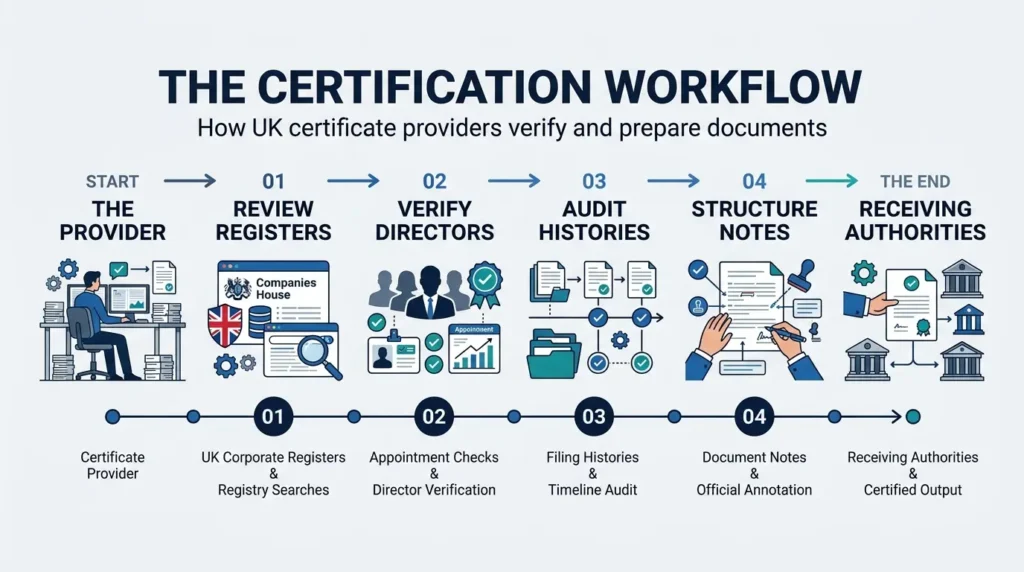
Professional document managers review every client file against live Companies House records. Providers ensure that annual accounts, confirmation statements, and officer details remain completely accurate. If corporate filings require updates, providers notify business directors before ordering the certificate. Pre-filing audits eliminate the primary cause of administrative document rejections.
Receiving entities frequently demand specific disclosures on the face of the certificate. Foreign banks often require explicit details regarding company directors, secretaries, shareholders, and registered office addresses. Direct applicants often miss these custom requirements during ordering. Certificate providers customize order specifications to match specific institutional demands.
Working with an expert provider guarantees legal compliance across all domestic and international use cases. Businesses seeking reliable corporate documentation rely on a specialized Certificate of Good Standing service to navigate complex filing requirements without operational friction. Professional oversight delivers legal security for critical corporate expansion projects.
Which Option Suits Your Business Requirements?
Direct requests suit non-urgent, domestic administrative tasks, whereas professional providers suit urgent commercial transactions, foreign bank applications, and legalisation requirements.
Selecting between a DIY request and a professional service depends on transaction urgency, destination country, and compliance requirements. Small domestic businesses with simple requirements and flexible schedules benefit from direct ordering. The £20 standard direct option provides an affordable solution when official documentation is required for routine internal audits or standard UK vendor checks.
Organisations facing strict commercial deadlines require professional service intervention. Foreign corporate registrations, international tenders, joint ventures, and bank account setups demand fast turnarounds and certified legalisation. Attempting DIY management for complex international transactions increases the risk of missed deadlines and rejected filings.
Businesses secure fast, accurate document issuance by choosing dedicated corporate service professionals. You can Request a Fast-Track Certificate of Good Standing With Form My Company to streamline legalisation, eliminate filing errors, and accelerate international business operations. Professional providers manage administrative complexities so executives can focus on scaling core business activities.
Direct DIY requests through Companies House provide a low-cost solution for non-urgent domestic documentation. However, standard direct processes introduce risks of delays, administrative rejections, and multi-step legalisation challenges. Professional certificate providers deliver complete document verification, rapid fast-track processing, and integrated Apostille legalisation. Form My Company manages the entire compliance and procurement workflow, ensuring corporate documents meet international legal standards quickly and reliably.
Explore More Certificate of Good Standing Guide,
How to Choose the Fastest Way to Obtain a Certificate of Good Standing
Standard vs Express Certificate of Good Standing: Which Turnaround Should You Pick?
Frequently Asked Questions
How do I get a Certificate of Good Standing from Companies House?
To obtain a Certificate of Good Standing, an active UK company must be fully compliant with its statutory filings, including up-to-date confirmation statements and annual accounts. Businesses can apply directly through Companies House or submit an order via Form My Company for pre-filing compliance checks, fast-track processing, and automated document delivery.
How long does it take to get a Certificate of Good Standing in the UK?
Standard processing directly from Companies House takes approximately 10 working days, with additional time required for physical delivery. By utilizing the expedited Certificate of Good Standing service from Form My Company, UK entities can secure official digital verification copies within 24 to 48 hours.
Do foreign authorities accept a standard UK Certificate of Good Standing?
International banks, courts, and overseas regulatory agencies typically require an official Hague Apostille stamp on foreign company documents. Form My Company manages the complete legalisation workflow, coordinating directly with the Foreign, Commonwealth & Development Office (FCDO) to ensure international acceptance of your Certificate of Good Standing.
What information appears on a Certificate of Good Standing?
The document confirms continuous company existence, active registration status, and full compliance with UK filing obligations. Upon request through Form My Company, customized details can be included on the Certificate of Good Standing, such as director appointments, secretarial details, share capital breakdowns, and registered office addresses.
Why would Companies House reject a Certificate of Good Standing application?
Companies House automatically rejects applications for entities with overdue confirmation statements, unfiled annual accounts, or insufficient active directors. Ordering through Form My Company mitigates rejection risks by conducting a pre-filing corporate registry audit before submitting the final Certificate of Good Standing request.