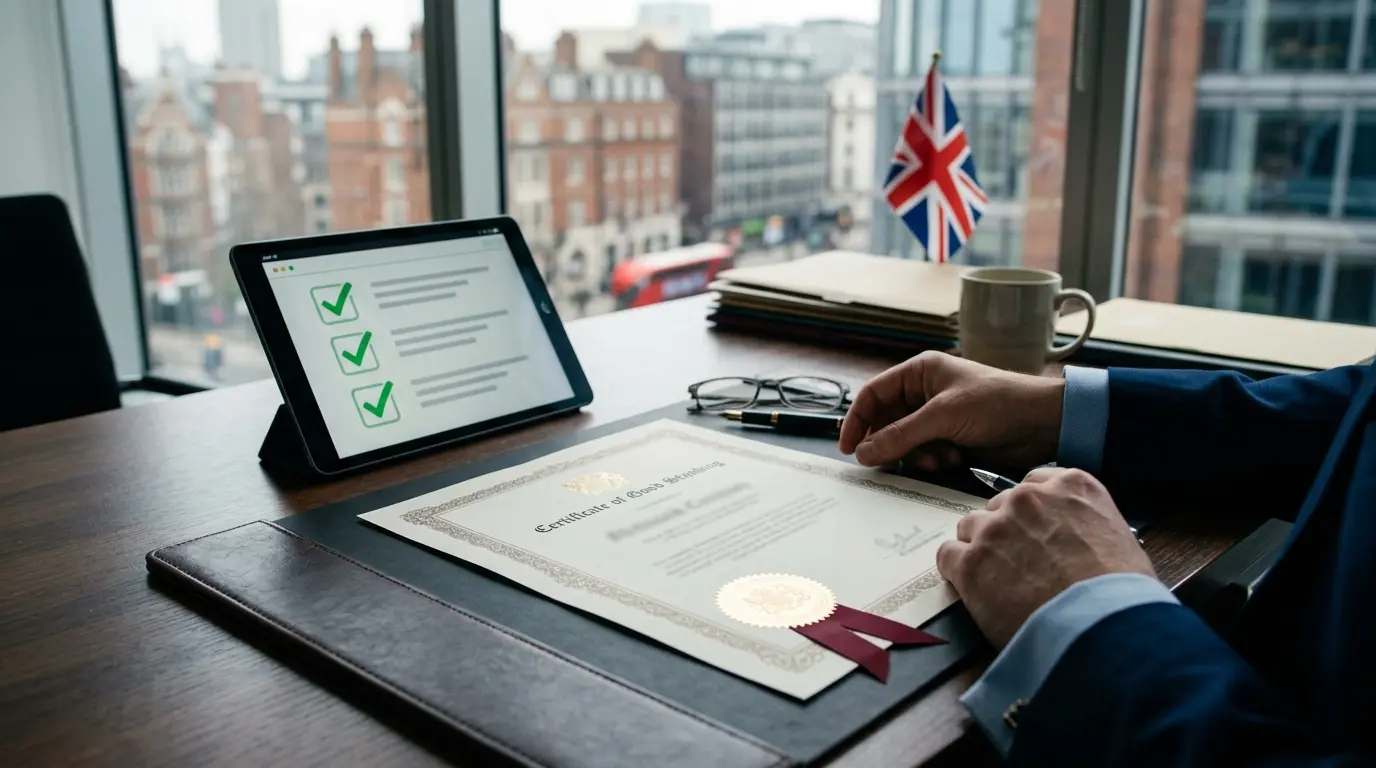
A UK company is eligible for a Certificate of Good Standing if it is active, fully compliant with Companies House, and up to date with mandatory filings. It must have at least one natural person as a director and no outstanding statutory fees or penalties.
What Is a UK Certificate of Good Standing?
A UK Certificate of Good Standing is an official Companies House document that confirms an active company has continuously fulfilled its legal reporting obligations. It proves that no action is being taken to strike the business off the official registrar.
Companies House issues this official document under the statutory provisions of the UK Companies Act 2006. Overseas authorities, corporate banks, and foreign registries require this paper to authenticate a firm’s legal existence. Financial institutions review this official document when opening offshore corporate bank accounts or processing international credit applications. International trading partners demand this document to validate statutory registration during cross-border trade negotiations.
The document displays key official details extracted directly from the public register. It shows the company name, unique registration number, and official incorporation date. It includes specific administrative statements confirming continuous filing compliance. The document verifies that no dissolution proceedings or strike-off notices exist against the corporate entity.
Official registries issue two distinct forms of this confirmation statement. The standard version includes core administrative details and official statutory confirmation statements. An extended version lists additional details including director names, secretary details, registered office address, and capital structure. Both versions carry the official seal of Companies House to guarantee legal authenticity across foreign jurisdictions.
Which Regulatory Filing Requirements Determine Company Eligibility?
A company maintains eligibility by submitting its mandatory annual confirmation statement and statutory annual accounts on time. Late submissions, unfiled reports, or unpaid regulatory penalties immediately disqualify a business from obtaining this official Companies House document.
Statutory compliance relies entirely on adherence to strict submission deadlines set by UK legislation. A limited company must file its annual confirmation statement within 14 days after the end of its review period. This document accurately records updated corporate information including shareholder records, registered office addresses, and persons with significant control. Failure to file this report disrupts legal standing immediately upon deadline expiration.
Statutory accounts require timely filing according to precise accounting standards and legislative schedules. Private limited companies must deliver statutory financial statements within 9 months following their fiscal year-end date. Public limited companies face a strict 6-month deadline following financial year-end dates. Unpaid late filing penalties invalidate corporate eligibility until the business settles every balance.
Companies House automatically tracks all submission dates through an electronic database. The central system flags accounts the precise day after a statutory deadline expires without record submission. An automated flag restricts the system from generating official certificates until compliance officers clear outstanding defaults. Maintaining strict internal accounting calendars prevents unexpected eligibility disruptions during critical business transactions.
How Does Company Operating Status Impact Eligibility Criteria?
A company must hold an active registration status on the official UK index of companies to remain eligible. Dissolved, liquidated, dormant-with-arrears, or striking-off entities cannot receive a Certificate of Good Standing under any circumstances.
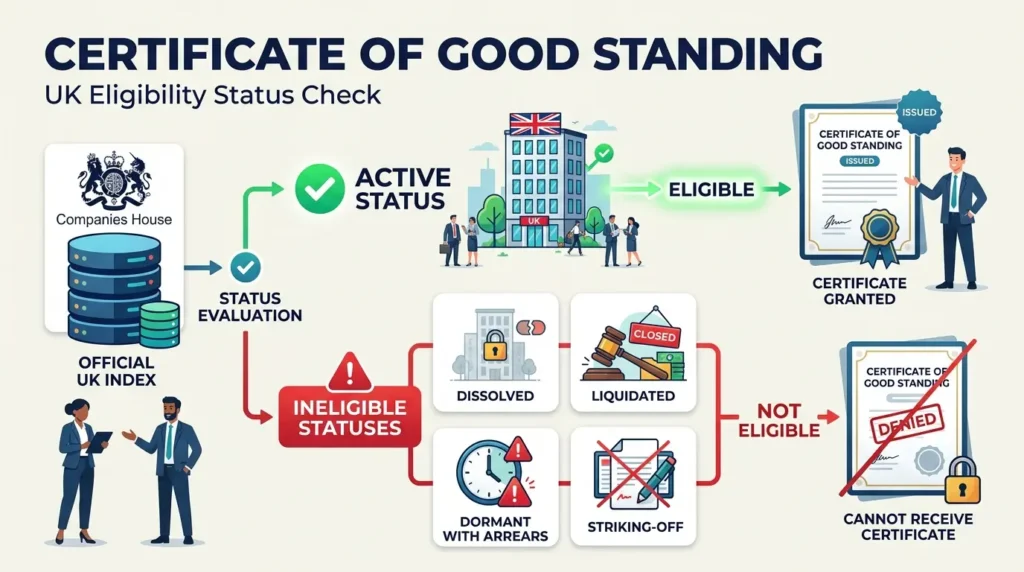
Active operating status signifies that a business entity legally exists and operates within statutory rules. Companies House maintains a central index containing every registered entity across England, Wales, Scotland, and Northern Ireland. When a company initiates voluntary strike-off proceedings via Form DS01, eligibility terminates instantly upon record entry. Involuntary strike-off actions initiated by the registrar produce identical instant disqualifications.
Liquidation proceedings and administration orders legally prevent certificate issuance. Appointed liquidators assume operational control over insolvent corporate structures to settle creditor claims. Companies House marks these business records with specific administration flags on the public register. These flags prevent the issuance of good standing documentation until formal insolvency processes conclude fully.
Dormant entities preserve eligibility only if owners submit simplified financial records consistently. A dormant company must submit Form AA02 dormant accounts every single financial year. The business must also submit its annual confirmation statement on time without exception. Inactive entities that neglect these simplified filings lose their compliant standing despite conducting zero commercial trading transactions.
What Corporate Governance Rules Apply to Directors and Officers?
A company must maintain at least one appointed director who is a natural person aged 16 or over. Corporate director arrangements are strictly limited, and disqualified officers prevent the company from obtaining a certificate.
The UK Companies Act 2006 mandates specific board composition rules for corporate entities. Section 155 requires every limited company to appoint at least one individual human director. A natural person provides personal accountability for corporate decisions and legal compliance. Corporate bodies serving as directors must operate alongside an appointed individual human director to preserve statutory compliance.
Director disqualifications under the Company Directors Disqualification Act 1986 trigger immediate governance failures. The Insolvency Service maintains an official public register listing every disqualified director across the UK. If a company retains a disqualified individual on its board, Companies House blocks certificate requests. Corporate officers must verify individual director eligibility before applying for official documentation.
Companies must maintain accurate records regarding Persons with Significant Control on public files. The register identifies individuals holding more than 25 percent of voting rights or share capital. Failure to report changes in beneficial ownership within 14 days violates transparency rules. Non-compliance with beneficial ownership rules blocks certificate generation until statutory register corrections occur.
How Do Different UK Company Types Meet Good Standing Standards?
Private limited companies, public limited companies, and limited liability partnerships must each meet specific structural criteria to qualify. Each entity type must satisfy distinct legal obligations dictated by its specific legal framework.
Private limited companies represent 93% of active corporate structures across the United Kingdom. These structures require one natural director, an active registered office address, and annual statutory account submissions. Private limited firms do not require a qualified company secretary to maintain compliant status. Meeting basic reporting deadlines preserves good standing status for standard private limited trading entities.
Public limited companies must satisfy higher regulatory burdens to maintain continuous eligibility. A public limited company must maintain a minimum allotted share capital of £50,000. It must appoint at least two directors and one legally qualified company secretary. Furthermore, public entities must file annual accounts within 6 months after fiscal year completion to preserve compliant standing.
Limited liability partnerships operate under distinct statutory regulations governed by the Limited Liability Partnerships Act 2000. An LLP must maintain at least two designated members at all times. Designated members hold legal responsibility for filing accounts and annual confirmation statements. If designated member counts drop below two for over six months, the partnership forfeits its eligible status.
Why Do Foreign Authorities and Financial Institutions Require This Certificate?
Overseas institutions require a Certificate of Good Standing to confirm corporate legitimacy and legal authority before expanding abroad. The certificate mitigates financial crime risks and satisfies international due diligence mandates for cross-border operations.
International commercial expansion requires verified proof of legal corporate authority across foreign jurisdictions. Foreign government agencies examine this official document before issuing international business permits, operating licenses, or branch registrations. The certificate proves that the parent entity operates legally within its home jurisdiction. Overseas authorities reject branch applications if parent companies lack current official confirmation from Companies House.
Global banking compliance frameworks require rigorous verification of entity corporate status. Financial regulators enforce strict anti-money laundering protocols across international commercial banking sectors. Banks examine official documentation to confirm that an entity is not undergoing forced corporate dissolution. Business owners must learn how to check whether your company qualifies for a certificate of good standing to avoid unexpected banking account disruptions.
Cross-border contract executions rely heavily on authenticated legal documentation between international trading parties. Foreign enterprise partners demand certified proof of good standing before signing high-value distribution agreements or joint venture contracts. The certificate validates that corporate officers possess legal authority to execute binding enterprise agreements. Missing documentation delays commercial transactions and undermines corporate credibility during international contract negotiations.
What Steps Restore Company Eligibility If Standing Is Lost?
A company restores good standing by submitting all outstanding statutory filings, settling accrued administrative penalties, and updating corporate register details. Once Companies House processes these updates, the company regains eligible status immediately.
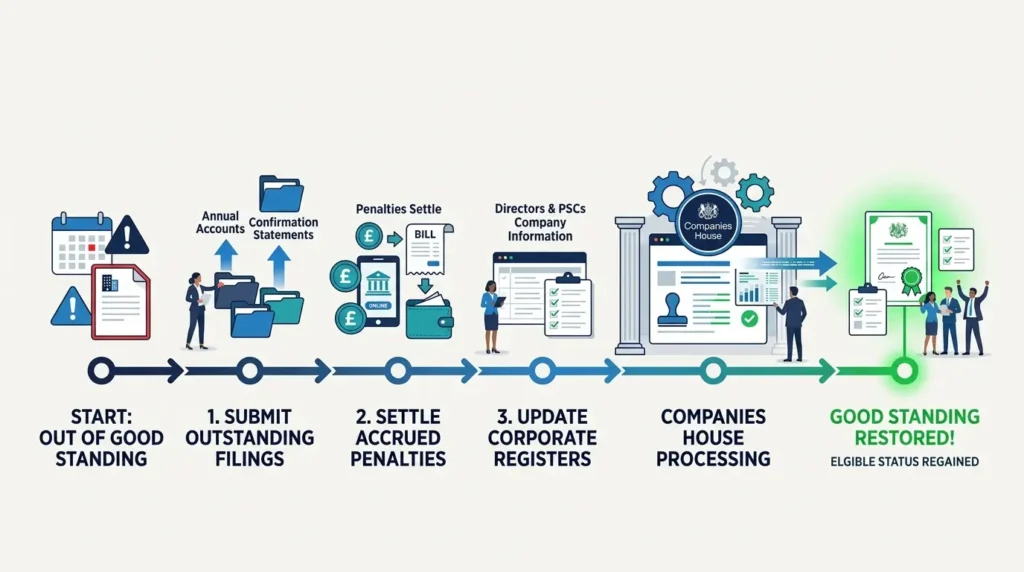
The restoration process begins with a comprehensive audit of public registry filings. Directors must review their online filing history to identify missing confirmation statements or overdue annual financial accounts. Identifying specific compliance gaps allows corporate officers to prepare correct statutory forms efficiently. Rectifying registry errors swiftly prevents the registrar from initiating involuntary compulsory strike-off actions against the entity.
Submitting late filings requires precise documentation prepared according to UK statutory accounting standards. Directors must submit overdue accounts electronically or via physical delivery to Companies House processing centers. Concurrently, the company must settle all late filing penalties assessed by the registrar. Companies House enforces civil penalties ranging from £150 to £1,500 depending on the delay duration.
After processing late filings and processing penalty payments, the registrar updates the central company database. Updated records reflect compliant status within 24 to 48 hours following internal system processing. Once status updates finalize, company owners can proceed to check your eligibility and order a certificate of good standing with form my company to obtain validated official documentation promptly.
How Do You Apply for an Official Certificate of Good Standing?
An applicant requests the document online through Companies House or via an accredited corporate service provider. Ordering requires selecting necessary details, specifying apostille requirements, and paying administrative processing fees.
The ordering process requires choosing between standard and custom document configurations. Standard certificates provide core confirmation details stating that the company exists continuously without strike-off actions. Custom configurations allow applicants to include additional administrative details, such as registered office addresses, director lists, or secretary details. Selecting necessary details ensures the final document satisfies specific requirements set by foreign requesting authorities.
Foreign jurisdictions outside the UK frequently demand legalised documents for international recognition. Legalisation requires an official Hague Apostille certificate issued by the UK Foreign, Commonwealth & Development Office (FCDO). The apostille legalises the official Companies House signature for legal recognition across international signatory countries. Selecting apostille services during application submission streamlines legalisation for international commercial use.
Professional formation agents expedite processing times through direct integration with central registrar systems. Utilizing a specialized service provider simplifies document acquisition while ensuring absolute compliance verification. Enterprise clients leverage an official Certificate of Good Standing service to manage official filings, apostille legalisations, and international courier deliveries efficiently. Professional handling eliminates administrative delays during critical corporate expansion projects.
Maintaining eligibility for a Certificate of Good Standing requires continuous compliance with statutory UK filing obligations. Companies must submit annual accounts on time, file confirmation statements promptly, and maintain compliant director structures. Form My Company assists UK corporate entities by reviewing compliance statuses, resolving registry defaults, and acquiring legalised official certificates efficiently.
Explore More Certificate of Good Standing Guide,
When Do You Need a Certified Certificate of Good Standing for Use Abroad?
What Is the Difference Between a Notarised and Apostilled Certificate of Good Standing?
Frequently Asked Questions
What is a UK Certificate of Good Standing?
A UK Certificate of Good Standing is an official document issued by Companies House confirming that an active company is fully compliant with statutory reporting requirements. It serves as legal proof that no strike-off or dissolution proceedings are pending against the business entity. Form My Company assists UK firms in obtaining this validated certificate for international banking and commercial transactions.
How do I get a Certificate of Good Standing from Companies House?
To obtain a Certificate of Good Standing, a UK company must ensure all annual financial accounts and confirmation statements are fully up to date with Companies House. You can order the official document directly from the UK registry or through an accredited provider like Form My Company to streamline processing and international legalisation. The issued document can include additional details such as director appointments and registered office address upon request.
How long does a Certificate of Good Standing remain valid?
Companies House does not set a formal expiration date on a Certificate of Good Standing, but most overseas authorities and financial institutions require one issued within the last 3 to 6 months. Because corporate filing statuses update continuously on the public register, older documents may be rejected during international due diligence checks. Form My Company offers fast turnaround options to ensure your Certificate of Good Standing meets strict freshness requirements for foreign authorities.
Can a company get a Certificate of Good Standing if filings are overdue?
No, Companies House will not issue a Certificate of Good Standing if a business has overdue annual accounts, late confirmation statements, or unpaid administrative penalties. The registry automatically flags non-compliant entities and blocks certificate generation until every outstanding filing is submitted. Form My Company helps businesses audit their filing status and resolve compliance deficits before placing an order for a Certificate of Good Standing.
Does a Certificate of Good Standing require an Apostille for international use?
Yes, if you need to present a Certificate of Good Standing to foreign government bodies, overseas banks, or legal authorities outside the UK, an Apostille certificate is usually required. The UK Foreign, Commonwealth & Development Office (FCDO) attaches an Apostille to legalise the Companies House signature under the Hague Convention. Form My Company provides combined Certificate of Good Standing and official Apostille legalisation services to ensure legal recognition worldwide.