
A Companies House listing is a record, not a recommendation. If you’re searching the british business register to check a supplier, customer or company name, remember that an entry shows information filed with the registrar. It can’t prove that a business is financially sound or trustworthy.
Checking the official record is a useful first step, but it’s not always clear which search tool to use or what terms such as “active” and “filing history” mean. This guide explains how to find a UK company through Companies House on GOV.UK and how to interpret the details you find.
You’ll learn what a company number identifies, how to read status labels and filings, and what the public record can’t tell you. We’ll also cover why the register is under greater scrutiny in 2026, including changes introduced under the Economic Crime and Corporate Transparency Act. Use the record as a starting point for due diligence, not as a verdict on a business.
Key Takeaways
- Use the official Companies House search to look up companies and LLPs. Not every trading business has a register entry.
- Search by company number where possible, or use the exact legal name to narrow down the right record.
- Review the company’s status, registered office address, officers and filing history to understand what appears on its record.
- Treat the british business register as a source of information, not proof of a company’s reliability or financial health.
- If you’re planning a new venture, distinguish researching an existing company from forming a new legal entity.
What is the British business register, and who appears on it?
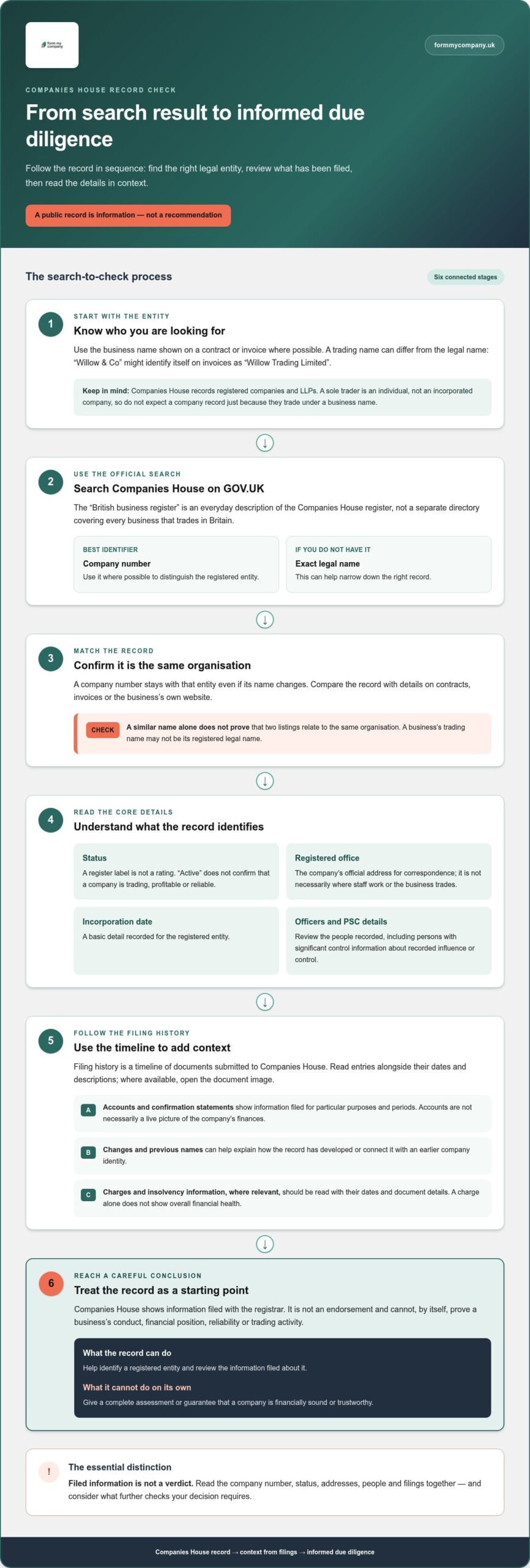
Searching for the british business register usually means looking up a business on the official Companies House register. Companies House is the UK registrar for incorporated companies and limited liability partnerships (LLPs), and makes much of the information filed about them publicly searchable. “British business register” is an everyday description, not the formal name of a separate register or a directory covering every business that trades in Britain.
That distinction matters. A private directory may include sole traders, partnerships and other organisations, using information gathered from different sources. A Companies House entry is a public record associated with a registered legal entity. It helps you identify the entity and review information filed with the registrar, but it is not an endorsement or guarantee of the business’s conduct, financial position or trading activity.
In short: the Companies House register is a public record of registered companies and LLPs. It helps people identify those entities and review information filed about them.
Which businesses can you find on the Companies House register?
Registered companies and LLPs can have searchable records, including private limited companies and other incorporated company types. A sole trader runs a business as an individual, rather than as an incorporated company. You shouldn’t expect to find a sole trader as a company record simply because they trade under a business name.
A business’s trading name can also differ from its legal name. For example, a shopfront might display “Willow & Co”, while its invoices identify “Willow Trading Limited”. Search the legal name if you know it, then compare the record with details on contracts, invoices or the business’s own website. A similar name alone doesn’t prove that two listings relate to the same organisation.
Who uses a British business register search?
Founders can check whether a name is already associated with a registered entity. Customers and suppliers may use a search to identify the company behind a brand before entering a business relationship. Researchers can examine filed records to understand an entity’s basic structure and history. In each case, start with the name shown on a contract or invoice, rather than relying only on a familiar trading name.
- Founders: separate research into an existing company from setting up a new legal entity.
- Customers and suppliers: compare the registered name with the details provided by the business.
- Researchers: use official filings as a source of information, not as a final judgement.
For details about people recorded as having significant control, the persons with significant control register is a related part of company information. For broader background on the registrar’s history, functions and types of registered entities, see the Companies House Wikipedia article. Use Companies House records to establish what has been filed, then consider what further checks your decision requires.
What information does a British business register record show?
A company record brings together different types of filed information. The fields and level of detail can vary, so read each item in context rather than assuming every record contains the same documents. The GOV.UK company information service explains how to access available company details and documents.
How to understand a company’s basic details
The company number is the clearest identifier for a registered entity. It remains with that entity if its name changes, so use it to distinguish companies with similar names. The record also shows the registered office address, incorporation date and current status. A registered office is the company’s official address for correspondence. It isn’t necessarily where staff work, customers visit or the business trades day to day.
Read the status label as information about the company’s position on the register, not as a rating. “Active” doesn’t confirm that a company is trading, profitable or reliable. Other labels can indicate a different legal or filing position. Review the record and relevant filings to understand a label in context, rather than drawing conclusions from the word alone.
How filings and persons with significant control fit in
The filing history is a timeline of documents submitted to Companies House. It can include accounts, confirmation statements, changes to company details and other filings. Select an entry to read its description and, where available, view the document image. Previous names can help connect a current record with an earlier company identity. Accounts show information reported for a particular period, not necessarily a live picture of the company’s finances.
A record may also show charges, which relate to security registered against company assets, or insolvency information where relevant. Read entries alongside their dates and document details. A charge alone doesn’t show the company’s overall financial health, and the presence or absence of an item isn’t a complete assessment. The information available can differ between companies and filing histories.
Persons with significant control (PSC) information relates to people or relevant entities with significant influence or control over a company. It gives a view of recorded ownership and control, but should be read as part of the wider company record. If you’re looking at PSC details as part of company administration, the persons with significant control register service relates to this area.
A filed record shows what has been submitted to Companies House. It doesn’t, by itself, mean every detail has been independently verified. Use the record to guide your next checks, and consult current Companies House guidance if you need to confirm what a field or document means. If you’re planning a new venture, Form My Company provides company formation support to help you move from research to registration.
How to search the British business register and find the right company
Start with the official Companies House search service rather than a general web search or commercial directory. You can reach the register through the Official Companies House website. Searching with specific details makes it easier to distinguish businesses with similar names and inspect the right record directly.
- Choose the best search term. If you have the company number, use it first. It identifies a specific registered entity and is usually more precise than a name. Otherwise, enter the exact legal company name shown on an invoice, contract or formal correspondence.
- Refine a name search if needed. If the exact name returns no result, try a distinctive part of it. A trading name may differ from the registered name, and punctuation or endings such as “Limited” can affect the results.
- Compare possible matches. Check each result’s company number, registered office address and status. Similar names don’t mean the records relate to the same business. Compare more than one detail with the information you already have before choosing a result.
- Open the record and review it. Read the company overview, then look through its filing history and relevant document images. Check dates and descriptions, not just the latest entry, before deciding what the record shows.
Search by company name, number or officer
A company number is the clearest search term if it’s available, particularly when several businesses have near-identical names. For a name search, use the legal name where possible. If that fails, try a distinctive word rather than a broad term such as “services”. An officer search can help you check an individual’s recorded connection to a company, but a shared name alone may not identify the right person.
Narrow results and keep track of changes
If the results are too broad, use Companies House’s advanced company search to narrow them down. Once you’ve found a likely match, compare the registered office details and status with your source documents, then confirm the company number on the record itself. This cross-check is particularly useful when a brand name and legal company name don’t match exactly.
The official service also offers email alerts for updates to a company’s record. Alerts can help you spot new filings or changes, but they’re a prompt to review the underlying entry, not an assessment of what the change means. Keep the company number with your notes so you can return to the correct record later.
A british business register search is a useful first check, not a final verdict. If your research leads you to set up a separate company, Form My Company provides formation support to help with the registration process.
How to interpret register results without mistaking them for a guarantee
A Companies House record shows information filed about a registered entity. It isn’t an official endorsement, a credit check or a complete picture of how a business operates. Treat the British business register as a starting point: compare relevant details and filings, then decide whether further checks are needed for your purpose.
What a register entry can and cannot tell you
An “active” status describes the company’s position on the register. It doesn’t show that the company is currently trading, financially reliable or delivering good products and services. Similarly, an address identifies the registered office, not necessarily the company’s trading premises. Read filed information as information submitted to Companies House, not proof that every statement has been independently verified.
| Register field | What it shows | What it doesn’t prove |
|---|---|---|
| Company status | The company’s recorded position on the register. | That it is trading, solvent or dependable. |
| Registered office | The official address recorded for the company. | That staff or customers are based there. |
| Accounts | Financial information filed for a stated period. | The company’s current financial position or future prospects. |
| Officers and PSC details | People or entities recorded in relevant company roles or as having significant control. | A complete assessment of who makes every business decision. |
| Filing history | Documents submitted and recorded, with dates and descriptions. | That the filings tell the whole story behind a change or event. |
When to review filings or seek another source
Open document images when a summary entry doesn’t answer your question. Compare relevant filings across dates and check that names, numbers and periods relate to the same entity. The right next check depends on why you’re searching: assessing a supplier, carrying out research and monitoring a company may each call for different evidence. Don’t give one field or label more weight than it can support.
Requirements also change. For current identity-verification and filing rules, use Companies House guidance rather than relying on an older explanation. Identity verification applies to directors and people with significant control, and the process and timing can depend on the person’s role and circumstances.
Keep your conclusion proportionate: record what the register says, note what remains unanswered, and use relevant additional sources before making a decision. If you’re moving from company research to setting up a new entity, Form My Company offers formation support for that next step.
What to do after a British business register search
Your next step depends on why you searched. You might be checking a company before a business relationship, monitoring an existing record or preparing to launch a venture of your own. Use the register to answer a specific question, then decide whether you need further information or action.
If you are researching an existing company
Note the company number, registered name and details relevant to your enquiry. This makes it easier to return to the correct record, especially if names are similar or the business uses a different trading name. Be specific about what you’re checking, such as a recent change, a particular filing or the identity of the legal entity behind a brand.
Open relevant document images rather than relying only on the record summary. For example, if you’re reviewing a change in company details, check the filing and its date to understand what was submitted and when. If the matter is ongoing, official email alerts can help you follow updates. Check current Companies House guidance when you need to understand a filing or requirement, as processes and requirements can change.
If you are preparing to start a UK company
Searching for an existing company and registering a new legal entity are separate tasks. A register search can help you research names and understand how existing entities appear, but it doesn’t create your company. When you’re ready to form a new venture, decide which type of entity suits your plans and follow the appropriate formation process.
Keep the process straightforward: search the official register, match the company number and details, review the filings relevant to your question, then choose the next step that fits your purpose. This helps you use the british business register as a source of information without treating a listing as a verdict on a business.
Explore company formation support when you’re ready to move from research to setting up your new company.
Turn your research into a confident next step
A register search can help you make a better-informed decision, but its value depends on how you use what you find. Be clear about the question you need answered and what information would help you decide how to proceed. If something remains uncertain, identify the next relevant source rather than treating a listing as the final word.
If your focus has shifted from an existing business to creating your own, treat that as a separate project. The british business register helps you research registered entities; forming a company is the next step in building a new one. Form My Company provides formation support for limited companies, LLPs and PLCs, including the Digital Package.
When you’re ready to take that step, explore company formation support from Form My Company.
Frequently Asked Questions
Is the Companies House register free to search?
Yes, you can search the online Companies House register and view public company information without paying. This can help with an initial check before you decide whether to review specific filings or documents. Accessing public information is different from any separate service that may involve a fee, such as ordering a formal document or certificate. Check the current Companies House service details for the latest information.
Can I search for a business using its company number?
Yes. Enter the company number in the official search to find the matching registered entity directly. This is especially useful when you’re checking a business with a common name or want to avoid selecting a similarly named company. Compare the result with the number shown on a contract, invoice or other business document. If the numbers don’t match, check that you have the correct record before relying on it.
Can I find a dissolved company on the British business register?
Yes, dissolved companies can usually be found in Companies House search results, with their record showing that they’re no longer active on the register. A dissolved entry can be useful when checking an old contract, tracing a previous company name or researching a past business relationship. Note the dissolution status and dates, and don’t assume the entity can still trade as a registered company. For historical questions, review the relevant filings too.
Does a Companies House record prove that a business is trustworthy?
No. A record shows that information about a registered entity appears on the public register, but it isn’t a trust rating or a guarantee of financial health, product quality or good conduct. If you’re considering a purchase or contract, use the record to verify the entity’s details, then assess evidence relevant to your decision. For example, an active status alone can’t tell you whether a company can meet a particular order.
Why can’t I find a business on the Companies House register?
The business may trade under a name different from its registered legal name, or it may be a sole trader rather than an incorporated company. Try searching a distinctive part of the name, or check an invoice or contract for the legal entity’s name and company number. Check the spelling and whether the business is registered as an LLP. A missing result alone doesn’t establish that a business is operating improperly.
Can I search the register by a director’s name?
Yes, Companies House search tools allow searches by officer name. This can help you check a person’s recorded role across companies, but take care with common names. Compare the result with other details, such as the company name and appointment information, before deciding whether it refers to the person you mean. An officer search helps locate register entries; it doesn’t, by itself, explain the person’s responsibilities or current involvement in a business.
What is the difference between a company register and a business directory?
A company register is an official record of entities registered with the relevant registrar, including information filed about them. A business directory is generally a listing service that helps people discover businesses and may cover sole traders and other organisations as well as companies. Directory details can be compiled from different sources, so the entries serve a different purpose. Use Companies House to check a registered company’s record, not as a complete directory of every UK business.