
Could a virtual address give your business a more professional image and also be suitable for Companies House? Not necessarily. A virtual address can serve different purposes, and the label alone doesn’t tell you what you can use it for.
It’s easy to confuse a virtual address with a virtual office or registered office, especially when you’re deciding how business post should be handled and whether your home address will appear on public records. The distinctions matter. Since 4 March 2024, a UK company’s registered office must be an appropriate physical address where documents can be delivered and their receipt acknowledged. A general business address doesn’t automatically meet that requirement.
This guide explains what a virtual address can and can’t do, how it compares with a registered office and virtual office, and what to consider about mail handling. You’ll also learn how your intended use affects the right choice, whether you’re forming a company or simply want a separate business address. By the end, you’ll have a practical way to choose an option that fits without committing to office space you don’t need.
Key Takeaways
- A virtual address can support business correspondence or a separate business presence without requiring a conventional office.
- Match the virtual address service to its intended use. A general business address isn’t automatically suitable as a registered office.
- Understand the difference between a registered office and a director’s service address before entering details on company records.
- Review how the service handles post and check current Companies House requirements before using an address for company records.
- Use a simple checklist to decide whether a registered office address service or virtual office service better fits your needs.
What is a virtual address, and what can a UK business use it for?
A virtual address is an address a business uses without occupying a conventional office. It can give a founder business details separate from home, support a distinct business identity or provide an address for correspondence. The phrase covers different services, so focus on what you need the address to do rather than relying on its label.
For example, a consultant working from home might want separate business details, while a small online business may need an address without permanent premises. An overseas entrepreneur may also be looking to establish a UK business presence. An address service alone doesn’t establish eligibility to form a company or satisfy every organisation’s requirements.
Address use and post handling are separate considerations. An address-focused service doesn’t automatically include receiving, forwarding or managing mail. Similarly, a postal address isn’t automatically a registered office. If you plan to use an address for company records, assess it against the relevant Companies House requirements rather than assuming any business address will qualify.
How is a virtual address different from a virtual office?
These terms are used in different ways. A virtual address describes the address element, but the term alone doesn’t tell you whether post is received or what happens to it. A virtual office is a broader business-service category, although inclusions vary. The general virtual office overview describes the concept. For a business decision, focus on the specific service purpose and terms.
Separate your needs into clear questions: Do you need an address for business correspondence, a formal company record or customer-facing details? Do you need mail handling, or just an address? Your answers help distinguish an address service from a postal service or wider office support. Form My Company’s business address service is an option for address-focused needs.
Who might benefit from a virtual address?
A virtual address may suit founders who want to keep home and business details separate, or small businesses that work remotely and don’t need permanent premises. It can also be relevant to overseas entrepreneurs seeking a UK business presence, although using an address doesn’t automatically meet every formation, banking or tax requirement.
Start by identifying the day-to-day purpose. A home-based designer might want separate business details, while an online retailer may be more concerned with how correspondence is handled. A business planning to enter an address on formal records has a different requirement. Write down the intended use, then match it to the service type. This keeps the decision focused and helps distinguish a professional business presence from a physical office, without assuming every service includes the same support.
Virtual address, registered office or director service address: what is the difference?
These address terms aren’t interchangeable. A virtual address is a broad description, while a registered office and a director’s service address have specific company-record purposes. Before choosing, identify whose address you need and what it must do.
| Address type | Whose address? | Purpose and typical use | Legal point to verify |
|---|---|---|---|
| Virtual or business address | Used by a business | May provide separate business details for correspondence or customer-facing use. | The label alone doesn’t establish that it can be used for company records or that post handling is included. |
| Registered office | The company’s official registered address | Used for formal company communications and recorded at Companies House. | Must meet current Companies House rules, including the appropriate-address and jurisdiction requirements. |
| Director’s service address | An individual company officer | An address associated with that director for company records and official communications to them. | Check current Companies House requirements for recording an officer’s service address. |
What does a registered office address do?
A registered office is the company’s official address for specified company communications. It isn’t simply a general business address or another name for any virtual address. Under current Companies House rules, it must be an appropriate physical address where documents can be delivered to someone acting for the company and delivery can be acknowledged. A PO Box alone doesn’t qualify. The address must also be in the same UK jurisdiction where the company is registered: England and Wales, Scotland or Northern Ireland.
Before entering an address on company records, review the official registered office address requirements in the UK. Assess the address and service against this formal purpose. The words “virtual address” alone don’t establish that it’s suitable.
How does a director service address differ?
A director’s service address belongs to an individual officer, not to the company as a whole. It’s distinct from the registered office, which is recorded for the company, and from an ordinary business address used for general correspondence. A company may therefore have an official registered office while its directors have their own service addresses. Treat each record as a separate requirement rather than assuming one address covers every purpose.
For a general business-address need, Form My Company’s business address service is a relevant option. If you need an address for a company’s official record, Form My Company also provides a registered office address service. Assess the intended use against current Companies House rules, and match each service to the record or correspondence it needs to support.
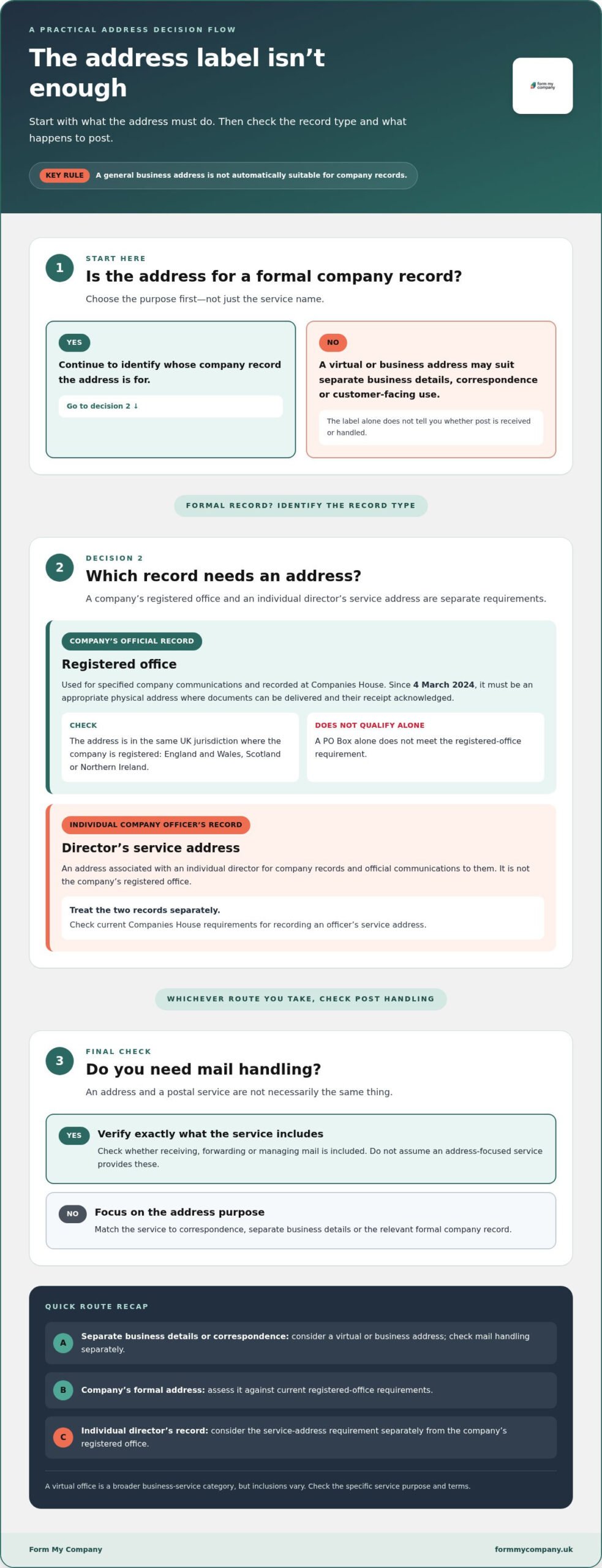
Which virtual address option fits your business and its day-to-day needs?
Start with the task, not the service name. An address for company registration has a different purpose from one used on customer-facing materials or for ordinary correspondence. You may also need occasional workspace, which is separate from having an address. A virtual address can support some of these aims, but permitted uses and service features depend on the specific service.
| Your situation | Likely priority | Question to resolve |
|---|---|---|
| You’re forming a limited company | A registered office address | Does this address and service meet current Companies House requirements for your company? |
| You work from home and want separate business details | A business address | Where will you use the address, and does the service support that use? |
| You need an address for routine correspondence | A correspondence address and a clear post plan | How will post be received and managed under the service terms? |
| You need somewhere to meet or work occasionally | Workspace, not just an address | Do you need a room or office, and what arrangements does that service provide? |
Keep address needs separate from office needs. Your business may need a formal address but have no reason to use workspace. Conversely, you might need a room for a meeting without changing the address used for business records. Form My Company offers virtual office services as a distinct service category. Consider the purpose you’ve identified and the relevant service terms before choosing.
What should a start-up consider before choosing?
Set your main priority first: keeping your home details separate, receiving official company correspondence or presenting a professional business presence. Then consider how you expect post to reach you and what the service terms say about handling it. Don’t assume a particular method is included. Choose for your current needs, and consider whether changes to your team, customer contact or company administration could mean reviewing the arrangement later.
What changes for an overseas founder?
A UK address may form part of a business presence, but the address alone doesn’t settle whether you can form a company or meet other requirements. Keep the address decision separate from questions about residency, immigration, tax and banking. Each may involve different rules or acceptance criteria. If you’re planning a UK company, assess formation requirements alongside the address purpose, and verify current official guidance before using an address for a formal record.
Use the table to identify what the address must do, then compare that purpose with the service’s permitted use and terms. If you need an address for both official company records and day-to-day correspondence, treat these as separate requirements rather than assuming one arrangement covers both. This helps you choose the address or workspace support your business actually needs.
How to assess a virtual address before using it for your business
Before using a virtual address, check that it fits its intended purpose. A clear review helps you distinguish company records from ordinary correspondence, understand what happens to post and avoid assuming one arrangement covers every need. Use these four steps to make your decision.
- Define the use. List every place you plan to use the address, such as company records, business correspondence or customer-facing details. Identify which purposes are essential.
- Identify the address type. Decide whether you need a registered office, a general business address, a director’s service address or another arrangement. If you also need somewhere to work or meet, treat that as a separate office requirement.
- Review the service terms. Read the permitted uses, restrictions and procedures for receiving and handling correspondence. Check how changes to the arrangement or address details are managed.
- Record the decision. Note the address type, intended uses, relevant terms and official requirements you’ve checked. Keep this with your company administration so you can review it if your needs change.
For any address entered on company records, check the latest official requirements before submitting details. A service’s name or description alone doesn’t establish that it meets the rules for your intended use.
Which questions should you resolve first?
Map the address to the places it will appear. Will you use it on company records, correspondence, invoices or customer-facing materials? Then decide whether you need an address service, office facilities or both. Keep separate any rules set by a bank, regulator or contract. Acceptance for one purpose doesn’t guarantee acceptance for another.
What should you review in the service terms?
Check the service’s stated purpose and restrictions before signing up. Understand how it describes the receipt and handling of correspondence rather than assuming post will be forwarded, scanned or stored in a particular way. Look for instructions on updating your details if the service or your business arrangements change. These practical points help you judge whether the arrangement fits your day-to-day operations.
Quick check: Define the use, identify the address type, review the terms, then record your decision. This is a practical checklist, not legal advice. Verify official requirements for your specific use.
Once you’ve identified your address needs, explore Form My Company’s address services to find the relevant service category for your business.
Explore Form My Company’s virtual office and address services
Once you know what the address needs to do, choose the service category that matches. Form My Company provides virtual office services and a registered office address service. These address different business needs: decide whether you want a business presence or an address for a company’s official records. One doesn’t automatically cover the other.
When might a virtual office service be relevant?
A virtual office service may suit you if you want an address-based business presence without conventional office premises. Start with your intended use. You might want business details separate from your home address or an address to use in business communications. The term “virtual office” can cover different arrangements, so focus on the service’s stated purpose and terms rather than assuming particular mail, call-answering or workspace features are included.
Consider how the service fits your day-to-day needs. Wanting to present business details separately from your home address is different from needing a registered office for company records. Form My Company’s virtual office service is the relevant category for an address-based business presence. Match its terms to your intended use.
When might a registered office address service be relevant?
If you need an address for a company’s registered office, use a registered office address service. This is distinct from a general business address or virtual office service, even if your business needs more than one. Before using an address on company records, check current Companies House requirements and make sure the proposed use aligns with them. The service category doesn’t replace checking the rules that apply to your company.
Form My Company provides a business address service for address needs. Consider the service alongside your intended purpose and current official requirements. Keep separate needs, such as handling routine correspondence or arranging workspace, in view rather than assuming they’re part of an address service.
Keep the decision practical: choose virtual office services for an address-based business presence, or explore the registered office address service for company records. If you need both, assess each purpose separately. Explore the virtual office service or business address service that best matches your next step.
Choose an address that supports your next step
Make your address decision part of a wider plan for your business. The right arrangement should fit what you need now, while leaving room to review your setup as the business develops. If you’re establishing a UK business from overseas, consider the address alongside your formation plans and any separate requirements that apply to your circumstances.
Form My Company supports UK and overseas entrepreneurs seeking a UK business presence, with virtual office and registered office address services for different needs. Use the distinction to guide your next step: explore a virtual office for a business presence, or a registered office address service for company records. A virtual address is most useful when its purpose is clear and matched to the right service.
Ready to move forward? Explore Form My Company’s business services and choose the option that fits your plans. A clear decision can help you take the next step without committing to office space you don’t need.
Frequently Asked Questions
Can I use a virtual address as my company’s registered office?
Yes, if the address and service meet current Companies House requirements for a registered office. The label “virtual address” alone isn’t enough to establish that. Before filing, confirm that the address is in the correct UK jurisdiction for your company and meets the rules for receiving and acknowledging delivery of documents. Keep the service details with your company records so you can refer to them if the address arrangement changes.
Is a virtual address the same as a virtual office?
No, not necessarily. “Virtual address” generally describes an address used for business purposes, while “virtual office” can refer to a broader service category. Providers may use these terms differently, so look at the specific service rather than relying on its name. If you need somewhere to meet clients as well as business address details, for example, check whether workspace is part of the arrangement or a separate requirement.
Can I use a virtual address for HMRC and business correspondence?
It depends on the purpose and the rules that apply. For routine business correspondence, check that the service permits the intended use and understand how post is handled. HMRC requirements can differ by business type and tax matter, so don’t assume an address suitable for general correspondence will be accepted for every HMRC record. A sole trader, for example, should check HMRC’s current address requirements for Self Assessment before submitting details.
Do I need a physical office if I have a virtual address?
Can an overseas founder use a UK virtual address?
An overseas founder can explore a UK address service as part of establishing a business presence, but the address alone doesn’t determine whether they can form a UK company. Formation eligibility, immigration status, tax arrangements and banking each raise separate questions. Check the relevant current requirements for your circumstances before relying on an address for a formal purpose. Form My Company supports overseas entrepreneurs establishing a UK business presence.
What happens to post sent to a virtual address?
What happens depends on the service terms. Post may be received or managed in different ways, but don’t assume forwarding, scanning, collection or notification is included. Before using the address, find out which types of correspondence the arrangement covers, how you’re expected to receive it and what happens if delivery is attempted. This matters particularly for time-sensitive company or tax correspondence, where missed post could affect your next steps.