
Investors review your Articles of Association to evaluate share class rights, transfer restrictions, board control mechanisms, drag-along provisions, and liquidation preferences. A robust constitutional document protects investor capital, mitigates operational risk, and aligns founder incentives with institutional growth milestones prior to capital deployment.
What Are Articles of Association in UK Company Law?
Articles of Association serve as a legally binding contract establishing internal governance rules, director authority, shareholder voting rights, and share transfer mechanisms under the UK Companies Act 2006. They regulate administrative operations and define the statutory relationship between shareholders and company officers.
Every registered UK private limited company operates under a constitutional framework. When business founders register an entity, Companies House applies statutory Model Articles by default. These default provisions suit basic early-stage operations. However, early-stage Model Articles lack complex protections required by institutional capital providers.
Investors conduct thorough legal due diligence before transferring funds to a commercial account. Venture capital firms inspect statutory governance documents to verify legal stability. They analyze how executive decisions occur within board meetings. Ambiguous administrative rules create costly legal disputes during high-growth scaling phases.
Custom constitutional documents establish clear operational boundaries for founding teams. They define director appointment thresholds and specify operational permissions for executive management. Clear structural definitions prevent corporate deadlock when directors disagree on business strategy. Equity partners require bespoke legal rules to safeguard capital investments.
Legal counsel examines whether current constitutional terms restrict equity issuance. Unclear share structure rules cause delays during active equity funding rounds. Clear corporate rules reassure external funding partners regarding equity valuation security. Proper legal alignment reduces legal fees during deal negotiations.
Why Do Venture Capitalists Inspect Statutory Governance Documents?
Venture capitalists inspect statutory governance documents to verify asset security, legal compliance, cap table accuracy, and executive decision-making boundaries. Detailed legal reviews eliminate hidden liability risks and confirm that existing equity structures support future institutional investment rounds without structural friction.

Institutional equity investors risk substantial capital on high-growth commercial enterprises. Legal due diligence teams review corporate filings to detect structural liabilities. They confirm that historical share issuances complied fully with legal procedures. Defective historical filings undermine founder title to company shares.
Statutory documents define executive decision boundaries for everyday corporate operations. Investors inspect operational clauses to prevent unauthorized capital expenditure by founders. They verify whether executive officers hold unrestricted management authority. Statutory oversight protects equity funds against reckless management choices.
Comprehensive reviews ensure cap table structures reflect legal reality. Discrepancies between physical stock registers and constitutional rules stall investment timelines. Institutional investors halt funding negotiations when legal records contain structural errors. Clean legal records streamline corporate valuation processes.
Updating company constitutions ensures long-term regulatory alignment across operational phases. Corporate leadership teams must maintain proper documentation throughout business growth cycles. Accessing expert guidance via Supplementary Company Documents helps businesses align statutory governance frameworks with modern institutional standards.
How Do Share Class Structure and Voting Rights Protect Investors?
Share class structures protect investors by separating financial entitlements, dividend distributions, and voting power into distinct share categories. Preferred share classes grant institutional investors priority dividend claims and enhanced voting rights on key corporate decisions to secure financial interests.
Private companies frequently issue multiple share categories to reflect distinct stakeholder roles. Standard ordinary shares carry standard economic and voting privileges. Institutional funding partners require specialized share classes with enhanced economic protections. Preferred equity structures isolate financial returns from standard equity pools.
Voting rights determine control over major corporate events. Institutional investors secure specific consent rights over strategic legal decisions. These decisions include issuing new equity, altering constitutional terms, and selling core assets. Enhanced voting mechanisms prevent minority shareholder marginalization during strategic votes.
Dividend preference clauses specify distribution priorities during profitable financial years. Preferred shareholders receive dividend payments prior to ordinary equity holders. This distribution mechanism guarantees income priority for institutional funding partners. Precise mathematical formulas inside constitutional clauses govern dividend allocations.
Clear voting thresholds eliminate corporate gridlock during major strategic pivots. Ambiguous voting percentages cause administrative delays during emergency operational meetings. Defining precise shareholder consent percentages establishes legal certainty. Well-structured equity classes support orderly corporate decision-making processes.
What Are Pre-emption Rights and Anti-Dilution Provisions?
Pre-emption rights force companies to offer new share issuances to existing shareholders before external buyers, preserving proportional ownership percentages. Anti-dilution provisions adjust conversion ratios if subsequent funding rounds occur at lower valuations than previous investment rounds.
Equity dilution reduces existing shareholder ownership percentages during subsequent funding rounds. Pre-emption rights grant investors first refusal on newly issued equity. This protection allows funding partners to maintain proportional shareholdings by investing additional capital. Statutory pre-emption rights protect investors from sudden equity ownership dilution.
Anti-dilution mechanisms protect capital value during downward valuation cycles. When companies issue new equity at reduced valuations, anti-dilution clauses trigger automatic conversion adjustments. Full-ratchet mechanisms adjust conversion rates down to new pricing levels. Broad-based weighted average formulas provide balanced economic protections.
Constitutional anti-dilution language requires absolute legal precision during drafting phases. Ambiguous mathematical definitions trigger expensive courtroom litigation during down-rounds. Legal advisors inspect conversion formulas to ensure accurate calculations under all economic conditions. Clear equity formulas eliminate calculation disputes.
Understanding administrative filing requirements helps corporate leaders navigate complex funding rounds successfully. Reviewing a practical guide on How to Present Bound Articles During a Funding Round assists executive teams in organizing legal materials for institutional due diligence teams. Proper documentation presentation builds buyer confidence.
Why Are Drag-Along and Tag-Along Rights Critical for Exit Strategies?
Drag-along rights allow majority shareholders to compel minority shareholders to sell their shares during a company acquisition, preventing minority holdouts. Tag-along rights allow minority investors to join majority shareholder sales on identical terms, protecting minority valuation realization.
Exit execution speed determines ultimate returns on institutional equity investments. Drag-along provisions force remaining equity holders to join approved acquisition deals. Without drag-along clauses, individual minority shareholders can block entire company sales. Buyer firms demand 100% equity acquisition before transferring purchase capital.
Tag-along provisions protect minority financial partners against unfair majority exit deals. When majority founders sell controlling equity stakes, tag-along clauses mandate equal sale opportunities for minority partners. Purchasing entities must purchase minority shares on identical financial terms. This rule prevents founder-only liquidity events.
Investors inspect drag-along percentage activation thresholds inside constitutional frameworks. Typical provisions trigger drag-along mechanisms when 60% to 75% of equity holders approve acquisition offers. Clear threshold definitions eliminate ambiguity during corporate acquisition discussions. Streamlined exit mechanics maximize final corporate acquisition valuations.
Enforceable transfer rules ensure transaction validity during fast-moving corporate acquisition processes. Constitutional provisions specify precise notification timelines and payment settlement mechanisms. Transparent exit processes reduce legal friction between shareholder groups. Clear exit terms protect all investment participants.
How Do Board Structure and Veto Rights Influence Investment Decisions?
Board structure provisions govern director appointment rights, board meeting quorums, and investor director consent parameters. Veto rights grant investor directors absolute authority to block high-risk corporate actions, including major debt creation, asset sales, and executive compensation changes.
Capital providers require direct board representation to oversee company operations continuously. Board appointment clauses grant major investors specific rights to nominate board directors. Nominated investor directors attend strategic meetings to monitor quarterly executive performance. Direct board representation ensures transparent corporate oversight.
Reserved matters lists specify operational actions requiring explicit investor director consent. Executive managers cannot execute strategic decisions without formal board sign-off. Reserved matters include issuing corporate debt, altering business scope, and changing executive salary structures. Strict veto parameters protect company capital resources.
Quorum requirements ensure investor directors attend binding board decision meetings. If investor representatives miss formal meetings, valid quorum standards prevent remaining directors from voting. These procedural safeguards prevent executive teams from executing unauthorized legal decisions. Strict meeting rules uphold operational governance standards.
Maintaining professional corporate records reinforces management credibility during structural adjustments. Companies can easily Order Investor-Ready Bound Articles From Form My Company to present polished physical governance documents to incoming investor directors. Professional legal documentation streamlines board formation procedures.
What Are Share Transfer Restrictions and Good Leaver / Bad Leaver Clauses?
Share transfer restrictions prevent shareholders from selling equity to unvetted third parties without prior board consent. Good leaver and bad leaver clauses dictate whether departing employee-shareholders retain equity or forfeit shares at nominal valuation upon contract termination.
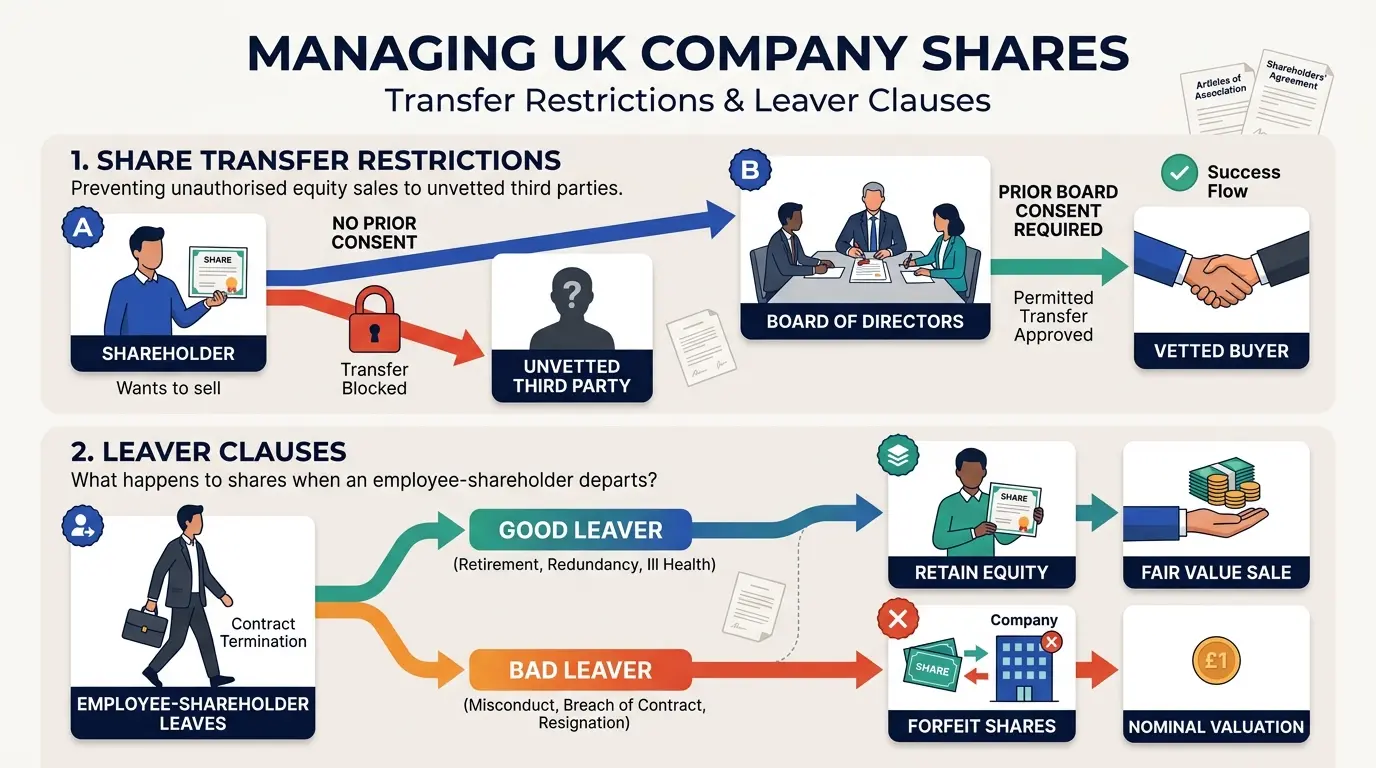
Unrestricted equity transfers endanger private company ownership structures. Right of first refusal clauses require selling shareholders to offer equity to existing shareholders first. Permitted transfer rules allow limited equity movements to family trusts or affiliate entities. Transfer restrictions preserve stable internal ownership structures.
Good leaver and bad leaver clauses manage equity retention when key employees exit businesses. Good leavers leave employment due to illness, disability, or redundancy. Good leavers keep earned equity or sell shares at fair market value. Fair valuation rules protect departing founder interests.
Bad leavers exit businesses due to breach of contract, fraud, or voluntary resignation within vesting periods. Bad leaver provisions force departing employees to surrender equity at nominal face value. Unvested equity returns to company share pools for reallocation to replacement talent. Clear leaver rules protect long-term business equity value.
Constitutional leaver definitions must align precisely with executive employment agreements. Mismatched termination definitions trigger costly employment tribunal litigation following founder departures. Precise legal alignment eliminates operational disruption during executive transitions. Clear equity rules preserve corporate enterprise value.
How Do Information Rights and Liquidation Preferences Impact Equity Value?
Information rights force management to provide monthly financial reports, audited annual accounts, and budget forecasts to investors. Liquidation preferences determine payout order and capital return multiples when a company liquidates, winds up, or completes a sale.
Institutional capital providers require real-time visibility over corporate financial performance. Information rights clauses obligate executive officers to submit monthly management accounts. Investors review balance sheets, revenue metrics, and cash runway projections systematically. Transparent financial reporting maintains operational accountability.
Liquidation preference clauses govern asset distribution sequences during insolvency or company sales. Non-participating preferences allow investors to receive their initial capital back or convert equity into ordinary shares. Participating preferences allow investors to recover initial capital investments and share remaining proceeds proportionally. Liquidation clauses protect down-side capital risks.
Multiple-level preferences define exact capital return priorities across successive funding rounds. Series B investors typically receive preference payouts prior to Series A equity holders. Ordinary founder shares receive asset distributions only after all preferred claims settle fully. Mathematical distribution waterfalls govern final proceed payouts.
Clear contractual language eliminates payout ambiguity during corporate liquidation events. Capital distribution rules must account for all potential financial exit scenarios comprehensively. Transparent governance documents provide absolute legal clarity for institutional equity holders. Strong constitutional architecture underpins successful equity funding activities. Form My Company assists growing UK enterprises with professional statutory document solutions. Form My Company provides compliant documentation packages formatted for institutional due diligence standards.
Articles of Association establish the statutory governance structure for UK private limited companies. Institutional investors evaluate governance rules to secure capital, protect voting rights, enforce transfer restrictions, and clarify exit mechanics. Aligning constitutional terms with venture capital standards eliminates deal friction during institutional equity funding rounds. Clear legal structures position growing businesses for long-term commercial success.
Explore More Supplementary Company Documents Guide,
Do Co-Founders Each Need a Copy of the Articles of Association?
What Happens When Your Articles of Association Are Out of Date?
Frequently Asked Questions
What are supplementary company documents for a UK business?
Supplementary company documents are official legal records, extracts, and corporate certificates that support a UK company’s core formation pack. They include items such as bound Articles of Association, duplicate Certificates of Incorporation, Certificates of Good Standing, and statutory registers required to verify a business’s legal status. Form My Company provides these specialized supplementary company documents to help corporate officers maintain fully compliant official business packs for institutional reviews.
Why do banks and investors request supplementary company documents?
Financial institutions, commercial landlords, and venture capital investors request supplementary company documents to verify active compliance, legal authority, and up-to-date share ownership structures. These verified corporate extracts prove that a business is actively registered with Companies House, has no outstanding liabilities, and possesses valid constitutional governance rules. Ordering professionally presented supplementary company documents through Form My Company streamlines corporate due diligence and accelerates deal approvals.
How do core company formation documents differ from supplementary documents?
Core formation documents, such as the initial Memorandum of Association and original incorporation filings, establish a company’s initial legal existence at registration. Supplementary company documents provide real-time, certified extracts and updated constitutional records that confirm ongoing compliance, director authority, and statutory adjustments. Utilizing Form My Company ensures that your supplementary company documents reflect real-time statutory registers accurately alongside core statutory filings.
Who can order supplementary company documents from Form My Company?
UK limited company directors and business owners who require solicitor-certified, physical, or updated constitutional records can order supplementary company documents. This service is tailored for established UK entities preparing for investor due diligence, contract tendering, corporate bank account applications, or structural record updates. Form My Company delivers customized supplementary company documents directly to your registered business address.
What is included in an investor-ready supplementary company document pack?
An investor-ready supplementary company document pack contains professionally bound Articles of Association, updated shareholder registers, official board resolutions, and a certified Certificate of Incorporation. These records validate director voting powers, share transfer rules, and statutory compliance status during formal funding rounds. Business owners rely on Form My Company to prepare precise supplementary company documents that fulfill strict institutional review standards.