
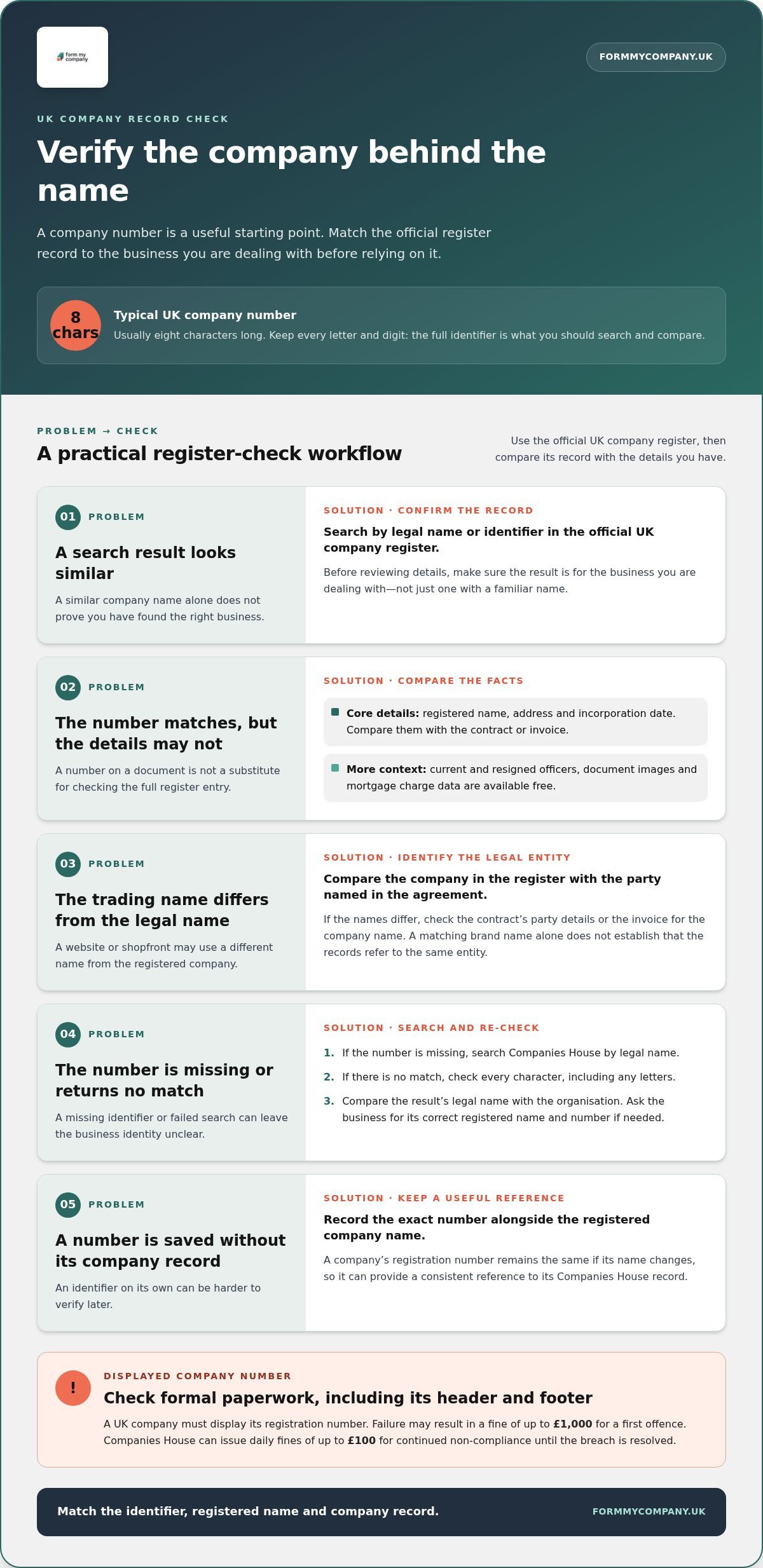
To verify a UK company, search its commercial registration number in the public company register and compare the result with the company’s details. A typical UK company number is eight characters long. You can view its registered address, incorporation date, officer details and document images for free.
The number is a useful starting point, but it does not verify everything. Check that the company name and other details match the business you are dealing with, and review the register record rather than relying only on a number printed on a document.
This guide explains how to find a company’s registration details online, recognise common number formats and read a registration certificate. It also explains what the register contains and how checking it can help confirm that you are dealing with the right business.
Key Takeaways
- Search a company’s public register entry and compare its registered address, incorporation date and officer details with the information you have.
- Use the number’s format as a clue: a typical UK company registration number is eight characters long, though prefixes and suffixes can indicate different register categories.
- Look through official company documents for the identifier, then compare the certificate details with the register record.
- Understand what the register records so you can use it to check a business’s identity and registration information.
- Choose a company structure before starting a formation application, as the right registration route depends on whether you’re forming a company or an LLP.
Online commercial registration data lookup
Search the official UK company register, then compare its records with the business details you have. Use these steps to check the identifier and supporting information.
Search online registration data
Search the company’s legal name or identifier in the official UK company register. Confirm that the result is for the right business before reviewing its records. Free information includes its registered address, incorporation date, current and resigned officers, document images and mortgage charge data. Compare these details with the contract or invoice. A similar name alone does not prove that you have found the right company.
- Review the full record, not just the search result heading. Check the company name, registered address and incorporation date against the details provided by the business. Officer information and filed documents can add useful context. For example, a document image may help identify the legal entity that submitted a filing. Keep the company name and record details together while comparing them.
- Use the register to distinguish a company from a trading name. A website or shopfront may use a different name from the company’s registered name. Compare the legal entity in the agreement with the Companies House record. If they differ, look for the company name in the contract’s party details or invoice. A matching brand name alone does not prove that the records refer to the same entity.
Check where the number is displayed
Check official company documents and business communications for the identifier. Inspect the header and footer of formal paperwork, where registration details may appear. A UK company must display its registration number; failure may result in a fine of up to £1,000 for a first offence. Companies House can issue daily fines of up to £100 for continued non-compliance until the breach is resolved.
Handle a missing or invalid number
If the company number is missing, search Companies House by legal name. If a supplied number returns no matching record, check every character, including any letters. Then compare the result’s legal name with the organisation you are dealing with. A typing error or different legal name may explain the mismatch. Ask the business for its correct registered name and number, then search again before relying on the details.
- Note the exact identifier and the company record it matches. This is useful when entering supplier details into an internal system or preparing a contract. Record the registered name alongside the number instead of saving the number alone. If the business later changes its name, its registration number remains the same, giving you a consistent reference to its Companies House record.
CRN formats and prefixes
A UK company registration number is typically eight characters long. It identifies a Companies House record, not a tax account or business activity. Use these steps to understand its format and check the related details.
- Check the full number, including any letters. Some UK company registration numbers contain digits only, while others may include letters. Some Companies House identifiers include prefixes or suffixes instead. Copy the whole reference from the certificate or document, then search it exactly as printed. Leaving out a letter can prevent a match or lead you towards the wrong record.
- Read a suffix as a clue to the organisation’s register category. Numbers ending in R include societies registered under the Co-operative and Community Benefit Societies Act 2014 before 1 August 2014. The suffix RS identifies a society in Scotland registered under that Act before 1 August 2014. These identifiers help distinguish record types; they don’t describe the organisation’s current activity.
- Look for NF at the beginning of a number. This prefix identifies an overseas company registered in Northern Ireland before 1 October 2009. The reference relates to that registered entity, rather than automatically identifying every branch or trading name associated with it. Check the corresponding Companies House record and compare the legal name before deciding which organisation the number identifies.
- Keep company identifiers separate from tax references. A company registration number is different from a VAT number or Unique Taxpayer Reference. Each relates to a separate administrative record, so do not substitute one for another when completing a form. A certificate or invoice may show several references. Read the label beside each and use the identifier that matches the form’s purpose.
- Compare an unfamiliar format with the official Companies House record. Prefixes and suffixes can help explain why a number differs from a standard example, so check the full reference against the relevant record. Check its name and registered details, particularly if paperwork refers to a branch or uses a trading name. For separate VAT registration support, see VAT registration assistance.
The typical length is 8 characters, but length alone is not enough to establish that a reference belongs to the intended company. Retain every character and use the matching Companies House record to verify the legal entity before relying on it.
Commercial Registration certificate details
Use the certificate alongside the official register, not instead of checking the company record. These steps connect the document and its identifier to the correct legal entity.
- Find the registration number on the certificate or related official paperwork. The identifier may appear in a document header or footer, so check both. If you are starting with a paper file, look for documents issued when registration was completed. Company officials receive a registration certificate after completion, which you can compare with the company’s register entry.
- Match the certificate’s company identifier to the official record. The number identifies a company and distinguishes it from other companies. Enter the full identifier in the register, then compare the result with the company named on the document. If a certificate names one business but the register returns another, the document is not evidence for the returned company.
- Compare the legal name carefully, including its wording and legal form. For example, a certificate for an LLP should not be treated as a record for a similarly named limited company. The company number links the document to a particular registered entity, while a familiar trading name alone may not identify it. Use the register result to resolve differences in naming.
- Use available register documents to add context to the certificate. UK company records include document images that can help you compare filed paperwork with the document in hand. Check for consistency in the company identifier and name. A certificate image can help with document comparison, but the key check is whether the identifier matches the official company record.
- Distinguish proof of registration from proof of current activity. A certificate issued after registration confirms that the process was completed, but it does not answer every question about the company today. Check the linked register entry for current details. For a business transaction, compare the certificate with the entity named in the contract, invoice or other official paperwork.
- Keep the document and register result together in your records. Note the legal entity named on the certificate and preserve the identifier exactly, including any letters. If the certificate and register appear inconsistent, search again using the full number and legal name. This helps distinguish a transcription error from a document linked to a different entity.
Definition and purpose of a commercial register
- A commercial register is an official record of businesses operating in a country. In the UK, Companies House keeps company records. In other countries, a government department, Chamber of Commerce and Industry or another organisation may manage the national register. The arrangement depends on the country and company type. First identify which national register holds the business’s record.
- Use the register to distinguish a legal entity from a trading name. A company’s registered name and identifier point to its specific record, while its shopfront or website may use another name. For example, compare the legal name on a contract with the Companies House entry to identify the registered organisation linked to the agreement.
- Use public records to see what information the register holds. The register can contain details about legal entities and individuals, and UK company records include officer information and filed documents. These records help you identify an organisation and review its recorded details. Read each document in context: a filed document relates to a particular company and filing.
- Check the register when you need to verify a business’s recorded identity. Search by legal name or registration identifier, then compare the result with the paperwork you received. This is useful before entering company details into a contract or supplier record. A register entry helps identify the entity, but does not replace checks of any licences or permissions relevant to its activities.
- Treat the register as a reference point, not a complete picture of every business relationship. Compare its information with the company’s certificate, contract and other official documents. If the company type or legal name differs between records, identify which entity each document describes. This comparison can help prevent linking a payment, agreement or enquiry to the wrong organisation.
Do sole traders and partnerships have a Companies House registration number?
- Identify the business structure before searching Companies House. A sole trader is an individual trading personally, not a company registered under that structure. An ordinary partnership is also distinct from a limited company. Neither should be assumed to have a Companies House company registration number just because it uses a business name or has tax records.
- Check whether the partnership is an LLP. A limited liability partnership is a registered legal structure with a Companies House registration number. That number identifies the LLP’s record, not each partner. For example, check a contract naming an LLP against the LLP’s own register entry, rather than a partner’s personal details or another business with a similar name.
- If the structure is unclear, search Companies House using the entity’s legal name. Compare the result with contracts, invoices and other business documents. A matching trading name alone does not establish that the entity is a limited company or LLP. Look for the legal form in the paperwork, then check that the register describes the same organisation.
- Do not treat a tax identifier as a company number. A sole trader or partner may have identifiers for tax administration, but these serve a different purpose from a Companies House registration number. If a form asks for a company number, first establish whether the named business is a registered company or LLP. Entering a personal or tax reference in that field can misidentify the organisation.
- Use records that match the business structure. If a sole trader has no Companies House company entry, the absence of a company number does not by itself show that the person is trading unlawfully. Similarly, a partnership’s business name may not appear as a company record. Confirm the legal party from the agreement and supporting documents before relying on a register search.
- Choose a registered structure if you need a Companies House record for a new venture. An LLP is one route for partners who want an incorporated structure; its registration details belong to the LLP itself. Compare the structure with how the business will be owned and operated, then review the company formation packages if you’re ready to start a formation application.
Form My Company: Digital Package
Form My Company helps new business owners choose a formation route and register an eligible UK business. If you are ready to move from checking company records to setting up your own company, consider the Digital Package. Other options include the Digital & Print Package and Entrepreneurs Choice Package.
For partners forming an LLP, Form My Company offers Limited Liability Partnership (LLP) Formation. Choose the structure that fits how you plan to organise the business, then select the relevant package or formation service. Once registration is complete, use the issued company details to identify the new entity in future records.
Explore Form My Company’s formation options or get in touch to discuss your next step.
Take the next step towards setting up your business
Checking another organisation’s details can prompt a useful question: which structure suits your plans? Before starting an application, consider how you intend to run the business and whether to establish a company or an LLP. The commercial registration number is assigned to the registered entity, so choose the structure before focusing on its identifier.
Form My Company offers the Digital Package, Digital & Print Package and Entrepreneurs Choice Package for company formation. Consider which package suits the way you want to manage your formation documents. If you are setting up with partners, its Limited Liability Partnership (LLP) Formation option is designed for that structure.
Take time to settle your structure and gather the information needed for the application. When you’re ready to move forward, contact Form My Company about registration support. A clear next step can make getting your business started feel much more manageable.
Frequently Asked Questions
Why verify a company’s registration?
Verify the details to make sure a contract or payment relates to the intended legal entity. A similar trading name may belong to a different organisation, so compare the registered company name with the party named in your paperwork. For example, before adding a supplier to your records, confirm that the register entry and agreement identify the same business. This can help prevent administrative errors and misdirected correspondence.
Do dormant companies still have CRNs?
Yes. A dormant company that remains registered keeps its company number; dormancy does not give it a new identifier. The number continues to distinguish that company’s register record from those of other entities. If you are reviewing an old agreement, search the number and compare the current registered name. The company may have changed its name since the agreement was made, but its number stays the same.
Where can I find my CRN?
Look on your incorporation certificate or in company documents issued after registration. If you cannot find the paperwork, search the company’s legal name in Companies House records and match the result to your business. Copy the full identifier, including any letters, into your records. If you operate as a sole trader, you will not have a Companies House company number for that trading structure.
What is a commercial registration number in the UK?
In the UK, this usually means a company registration number, the identifier assigned to a company’s Companies House record. It identifies the registered entity, not its owner, trading activity or tax account. For example, a limited company’s number is different from its VAT number and Unique Taxpayer Reference. Use it to find the company record, not as a substitute for a tax reference.
Where can I find a UK company’s registration number?
Check the company’s incorporation certificate or search its legal name in Companies House records. If your paperwork uses a trading name, use the agreement or invoice to identify the legal company behind it, then search for that name. This is especially useful when a brand name differs from the registered name. Compare the returned company details before using the number in your own documents.
How do I verify a UK company registration number on Companies House?
Enter the full number in Companies House search, then compare the result’s legal name with the organisation you intend to deal with. If the name differs, search for the company’s current name too. A company keeps the same number after changing its name, so a mismatch may reflect a name change rather than an incorrect identifier. Check the associated record before relying on either detail.
How do I register a company and get a company number in the UK?
Choose the legal structure, prepare the incorporation details and submit the registration application to Companies House. After registration, company officials receive a certificate and the company’s identifier. Form My Company offers the Digital Package, Digital & Print Package and Entrepreneurs Choice Package for company formation. Choose an option that suits your formation needs, then organise the information required for the application.