
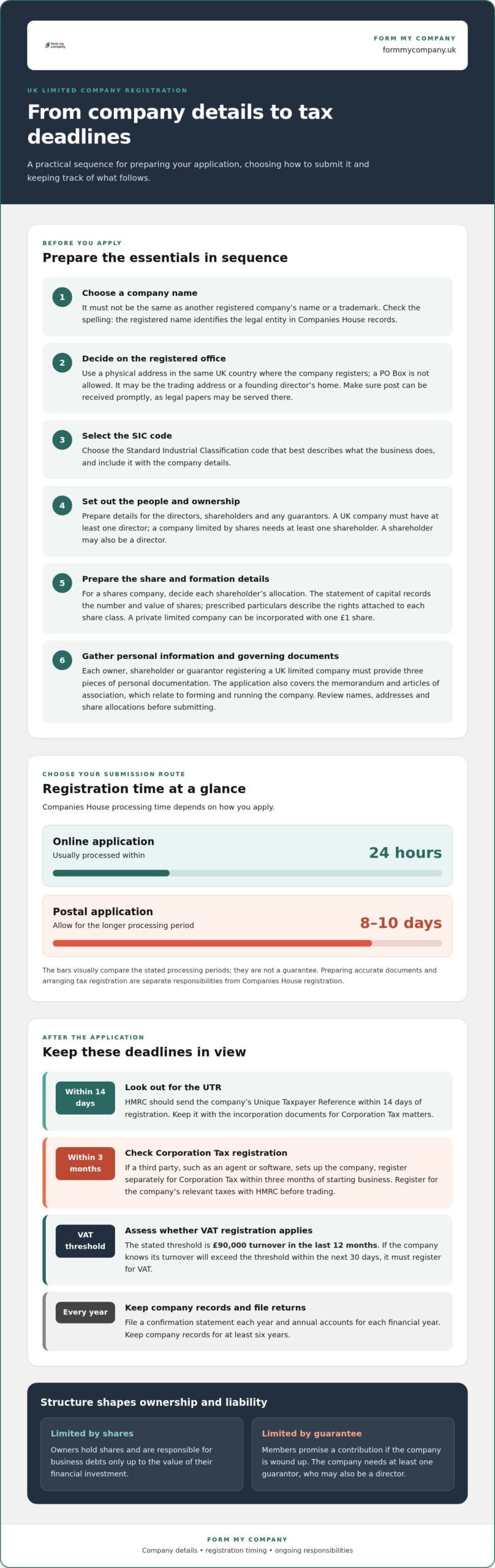
The paperwork is only part of the decision: choosing between a private and public company matters too. To set up a limited company, you’ll need company details, a registered office address, a SIC code, governing documents and personal information for the people involved. Online registration usually takes 24 hours, while a postal application takes 8 to 10 days.
It’s understandable to focus first on which documents to gather. But your choice of company type also shapes how the business is structured, so understand the options before you apply.
This guide covers the information and documents you’ll need, the role of the memorandum and articles of association, and the differences between private and public limited companies. You’ll also learn what to expect from registration and how long it can take, so you can prepare and move forward with confidence.
Key Takeaways
- Prepare the company details, registered office address and information about its directors and shareholders before applying.
- Allow for different registration times depending on whether you apply online or by post.
- Understand how shares, the statement of capital and prescribed particulars set out ownership when you register.
- Compare private and public limited companies, and choose a name that meets registration requirements.
- Learn what the memorandum and articles of association say about forming and running the company.
How long does it take to register a new company?
An online application to register a UK company is usually processed within 24 hours. Postal applications take 8 to 10 days. Companies House registration is one step; preparing accurate documents and arranging tax registration are separate responsibilities.
These are registration fees, not the cost of preparing your company documents.
To set up a limited company in the UK, choose its structure and name, prepare the required details and apply to Companies House. You’ll also need a registered office address and a SIC code, then complete any relevant tax registrations.
- Choose a company name. Select a name that is not the same as another registered company’s name or a trademark. Check its spelling before preparing the application, because the registered name identifies the legal entity in Companies House records.
- Decide on the registered office. The address must be a physical address in the same UK country where the company registers, and cannot be a PO Box. It can be the trading address or a founding director’s home. Make sure post can be received promptly, as legal papers may be served there.
- Select the SIC code. Companies House requires a Standard Industrial Classification code to identify the company’s activities. Choose the code that best describes what the business does. Include it with the company details so the registration application is complete.
- Prepare the application documents. Gather the details for directors, shareholders and the registered office. The application also covers the memorandum and articles of association, which relate to forming and running the company. Review names and addresses carefully before submitting.
- Submit the application to Companies House. Online applications usually register within 24 hours. Postal applications take 8 to 10 days. Choose the route that suits your timeline, and allow for the longer postal processing period if sending paper documents.
- Plan Corporation Tax registration. Register for the company’s relevant taxes with HMRC before trading. If a third party, such as an agent or software, sets up the company, register separately for Corporation Tax within three months of starting business to avoid penalties.
- Watch for the UTR. HMRC should send the company’s Unique Taxpayer Reference within 14 days of registration. Keep it with the incorporation documents, as it is used for Corporation Tax matters.
- Check whether VAT registration applies. HM Revenue & Customs sets the VAT registration threshold at £90,000 in turnover in the last 12 months. If the company knows its turnover will exceed the threshold within the next 30 days, it must register for VAT.
Do I need to supply any documents for a UK limited company?
Prepare details of the directors, shareholders, share ownership and company structure for the formation application. A UK company must have at least one director.
- Choose the company structure. A private limited company can be limited by shares or by guarantee. For a shares company, owners hold shares. For a guarantee company, members promise a contribution if the company is wound up. Choose the structure that reflects how members participate and the company’s purpose.
- Appoint the directors. Record each director’s details for the registration. Directors manage the company and have responsibilities under the Companies Act 2006. They must act in the best interests of the company as a whole, rather than prioritising personal interests.
- Decide who owns the shares. A company limited by shares needs at least one shareholder, who may also be a director. Decide each shareholder’s allocation before applying. For example, one person can hold all issued shares, or several people can divide them between themselves.
- Set the share structure. A private limited company can be incorporated with one £1 share. The statement of capital records the company’s share capital, including the number and value of shares. Prescribed particulars describe the rights attached to each share class. Set these details to match the ownership arrangement you have chosen.
- Consider liability and guarantees. In a shares company, owners are responsible for business debts only up to the value of their financial investment. A guarantee company needs at least one guarantor, who may also be a director. Its members agree to contribute the guaranteed amount if the company is wound up.
- Gather the personal information. Each owner, shareholder or guarantor registering a UK limited company must provide three pieces of personal documentation. Organise the details for each person before completing the application, and make sure the proposed share allocations match the statement of capital.
- Plan ongoing filings. Track the company’s financial year end and annual confirmation statement. Keep accounting and company records organised for the six-year retention period. A confirmation statement filing service can help with this recurring Companies House responsibility.
What type of company should I choose?
Choose a structure that fits your business activities, ownership and funding plans. Then select a company name that clearly distinguishes the business.
- Start with the business activity. The type of work can affect how a business pays tax and obtains funding. Write down what the company will do and how it expects to fund its work. Use that description when selecting its SIC code, which identifies the company’s activities during registration.
- Compare the available structures. A private limited company is the common choice: more than 95% of new businesses registering with Companies House choose one. That figure gives context, not a reason to select it automatically. Consider whether the company will be limited by shares or by guarantee, or whether another structure better fits its purpose.
- Match ownership to the structure. A company limited by shares has shareholders who own shares. A company limited by guarantee has guarantors instead. Consider who will own or participate in the business and how that arrangement should be recorded. Your choice shapes the formation details and the governing documents.
- Consider private or public status. Public limited companies require more share capital, directors and shareholders than private limited companies. A private limited company has no minimum share capital requirement. Factor in the people and capital available, alongside the company’s plans, before choosing its status.
- Shortlist and check the company name. A UK company’s registered name cannot be the same as another registered company’s name or a trademark. Compare your preferred name against both before preparing the application. Check the exact spelling and wording, not only whether the name sounds distinctive.
- Separate the registered name from any trading name. A business can prominently display a trading name, but company paperwork must still show the limited company’s name, company number and registered office address. For example, invoices using a brand name must also include those legal company details.
- Align the remaining setup details. Select a registered office address and a SIC code that fit the company being formed. Appoint the directors and settle share ownership before submitting the application. Consider how the company’s transactions will be handled separately from personal finances.
Memorandum and articles of association
Prepare both governing documents for incorporation. The memorandum records the agreement to form the company; the articles set out how it will be run.
Prepare the memorandum and articles of association
First, understand what each document does. The memorandum of association is a statement signed by all shareholders agreeing to register the company. The articles of association set out the rules for running it, agreed by directors and shareholders. Together, they record the company’s formation and provide a framework for internal decisions.
Make sure the proposed shareholders agree to register the company. Then review the articles against the planned ownership and management arrangements. For example, if there are several shareholders, make sure everyone understands that the articles set out the rules for running the company. The memorandum and articles serve different purposes, so don’t treat them as interchangeable.
Before agreeing to the articles, think through the practical decisions they cover. Directors and shareholders should understand which document records the agreement to form the company and which sets its operating rules. Align these documents with the share or guarantee structure chosen for the business.
Include articles in the incorporation
Include the memorandum and articles in the incorporation application. The application involves the company’s memorandum and articles of association. When you register online with Companies House, the memorandum is created automatically. It confirms the shareholders’ agreement to register, while the articles set out the rules directors and shareholders agree to follow.
Before submitting, make sure the details in the application fit the documents. The names and roles should reflect the proposed company, and all shareholders should agree to the memorandum. Read the articles carefully rather than assuming they simply repeat the formation details. They govern how the company is run, so directors and shareholders need a shared understanding of their rules.
Keep both documents with the company’s incorporation records. They give directors and shareholders a reference point for decisions later. For example, consult the articles when considering how the company should be managed, rather than relying on an informal understanding. A separate business bank account is useful for running the company, but the memorandum and articles have a different purpose: recording formation and setting internal rules.
Use the documents as practical references, not just application paperwork. Reaching agreement at incorporation gives directors and shareholders a shared starting point for the company’s governance. Review both documents before submitting the application, and resolve any differences in expectations before registration.
Private versus public limited companies
Choose between private and public company status by considering your funding plans, ownership and ability to meet the requirements. Public limited companies have higher requirements for share capital, directors and shareholders than private limited companies.
- Start with the company’s purpose. Write down what the business will do, who will own it and how it may seek funding. The appropriate structure depends partly on the type of work. It can also affect how tax is paid and how the business gets funding, so weigh these points before choosing.
- Consider a private limited company. A private limited company is a separate legal entity from its owners and directors. The company, rather than its owners personally, is responsible for its own obligations. A private limited company has no minimum share capital requirement, which can suit a business that does not need the additional capital and people required for public status.
- Assess whether public status fits. A public limited company requires more share capital, directors and shareholders than a private limited company. Consider whether the business has the people and capital to support that structure. Do not choose public status simply because the company may grow: assess the actual funding plan and the responsibilities involved.
- Compare the company route with sole trader status. A sole trader and a limited company are different business structures. The choice can affect how tax is paid and how the business gets funding. A private limited company exists separately from its owners and directors; use that distinction when considering how ownership and company responsibilities should be arranged.
- Factor in Corporation Tax. UK limited companies must pay Corporation Tax on all of the company’s profits. Consider this company-level tax responsibility as part of the structure decision. Don’t assume that being legally separate means there are no ongoing duties: company directors remain responsible for managing the company and meeting its filing requirements.
- Make a decision against practical criteria. Compare the proposed work, ownership, available capital and the people prepared to serve as directors and shareholders. If the business plan relies on a larger capital base and more participants, assess whether public status suits those needs. If not, a private limited company may be the more proportionate structure.
- Record the choice before incorporation. Once you decide, make sure the company name and registration details reflect the selected structure. Align the ownership plan and governing documents with the company’s status. This gives directors and shareholders a clear basis for running the business and meeting its responsibilities.
Once you’ve decided which structure fits your plans, use these criteria to compare formation options.
Form My Company: Digital Package
Form My Company can help you move from choosing a company structure to preparing its registration through the Digital Package. It’s a practical next step if you’ve settled on a private limited company and want a digital formation option. If you’d prefer printed documents, consider the Digital & Print Package. Entrepreneurs Choice Package and Limited Liability Partnership (LLP) Formation are also available for different formation needs.
Choose the package that fits your preferred format and business structure. The Digital Package is an option when you’re ready to proceed with digital company formation. If you’re still weighing up the details, first review your company type, ownership and governing documents.
To take the next step, contact Form My Company or visit formmycompany.uk.
Turn your company decision into a clear next step
If you’re ready to set up a limited company, Form My Company offers the Digital Package, Digital & Print Package and Entrepreneurs Choice Package. Compare these formation options and choose the one that fits your preferences and your business’s stage.
Take the next step when you’re ready. Contact Form My Company to discuss your company formation. Starting a business involves important decisions, but you can approach them one at a time. With your structure chosen and details prepared, you’re ready to move forward with confidence.
Frequently Asked Questions
What’s the difference between a limited company and a sole trader?
A limited company is a separate legal entity from its owners and directors, whereas a sole trader is a different business structure. This affects how the business is organised, taxed and funded. For example, company profits belong to the company, which pays Corporation Tax on its profits. Consider the structure and responsibilities you’re prepared to take on, as well as how you plan to run and fund the business.
How many shares does a company need?
A UK private limited company can be incorporated with one share, and there’s no minimum share capital requirement. One founder could hold one share, for example, or several shareholders could divide the shares between them. Decide how ownership will be split before registration. The statement of capital records the share structure, and prescribed particulars describe the rights attached to each share class.
Is it possible to form a dormant company?
Yes. A UK limited company can remain dormant after registration if it isn’t ready to trade. This may suit someone who wants to establish a company before starting business activity. Dormant status doesn’t remove the company’s filing responsibilities. Keep records organised and plan for ongoing reporting, even if the company hasn’t started trading.
What documents will I receive after forming a new company?
The documents you receive depend on the package you choose. Form My Company’s Digital Package includes a digital certificate of incorporation, memorandum and articles of association, share certificates and a company register. It also includes the company’s HMRC UTR and web authentication code. These records help you keep ownership information together and provide company details when arranging business banking.
What is Company Formation?
Company formation is the process of registering a business as a company with Companies House. Once incorporated, the company exists as a legal entity separate from its owners and directors. Registration records key details, including the company name, address, activities and people involved. Formation establishes the company, but doesn’t itself take care of later tax registrations, trading decisions or ongoing filing responsibilities.
What information and documents are needed to register a UK limited company?
Prepare a proposed company name, registered office address, SIC code, director details and ownership information. You’ll also need the company’s governing documents and, for a company limited by shares, its share structure. Each owner, shareholder or guarantor registering a UK limited company must provide three pieces of personal documentation. Gather information for each person separately so names and roles match throughout the application.
How do I choose and check a company name in the UK?
Shortlist a name that clearly identifies your business, then check it against registered company names and trademarks. A UK company’s registered name cannot be the same as another registered company’s name or a trademark. Decide whether you’ll also use a trading name. If so, company paperwork must still show the limited company’s legal name, company number and registered office address.
What are the rules for appointing directors and shareholders to a UK limited company?
A UK company needs at least one director, and a company limited by shares needs at least one shareholder. The same person may fill both roles. Companies House states that a director must be at least 16 years old. Before appointing people, agree who will manage the company and who will own shares. Record each person’s role accurately in the registration details.