A limited company is not automatically the better choice. It may suit a business that needs a separate legal identity, wants to limit shareholders’ liability and is prepared to meet company filing duties. The benefits of registering a limited company in the UK include a clearer distinction between personal and business finances, although directors can still face personal liability in certain circumstances. If simpler administration is a priority, sole trading may be a better fit.
It is sensible to weigh potential protection and growth options against the extra administration. The right structure depends on how you plan to run the business, take money from it and share ownership.
This guide compares limited companies with sole traders and partnerships, explains how tax and funding considerations differ, and outlines key filing responsibilities. Use it to assess whether incorporation fits your plans or another structure better suits your next steps.
Key Takeaways
- Weigh the separation between personal and business liability against the extra responsibilities that come with incorporation.
- Compare sole trading, partnerships and limited companies by how you’ll share ownership, manage profits and plan for future growth.
- If your total taxable turnover for the last 12 months goes over £90,000, HM Revenue & Customs requires you to register for VAT.
- Consider how a company structure may support investment, while remembering that funding options depend on the business and its plans.
- Plan for company accounts, tax returns and confirmation statements before incorporating, so you understand the ongoing filing duties.
When should I change from a sole trader to limited company?
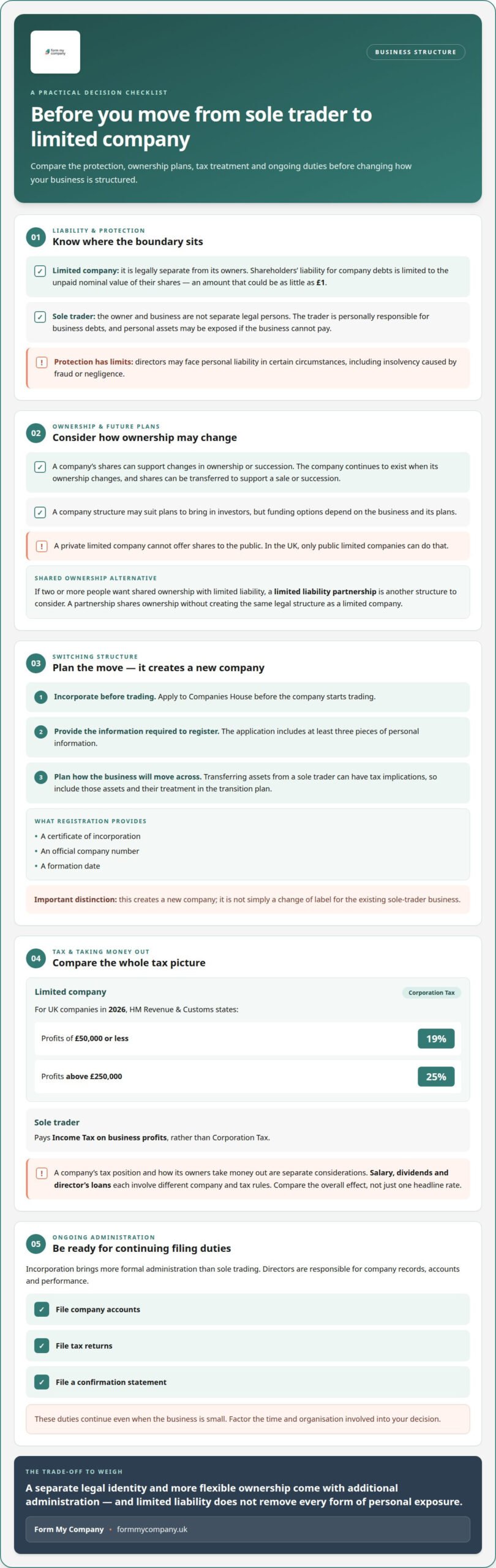
Consider changing when personal exposure or ownership plans make a company structure a better fit. To register, apply to Companies House before trading and provide at least three pieces of personal information; the company receives a certificate of incorporation, an official company number and a formation date.
Limited liability and personal asset protection
A limited company is legally separate from its owners, so shareholders’ liability for company debts is limited to the unpaid nominal value of their shares. That amount could be as little as £1. The benefits of registering a limited company in the UK can therefore include separating company liabilities from shareholders’ personal assets, unlike sole trading.
This separation is not absolute. Directors may face personal liability in certain circumstances, including insolvency caused by fraud or negligence. Consider the company’s legal structure and your responsibilities as a director before relying on limited liability to protect personal assets.
Sole trader liability and responsibility
A sole trader and the business are not separate legal persons. The trader is personally responsible for business debts, so personal assets may be exposed if the business cannot pay a supplier. Unlike a limited company shareholder, a sole trader has no liability limit based on unpaid share value.
For example, if a sole trader cannot pay a supplier’s invoice, the trader remains responsible for the debt. The benefits of registering a limited company in the UK may matter more as business commitments grow, but incorporation does not remove every form of personal exposure.
Compare each structure with the risks and responsibilities your business actually faces. A trader with significant supplier commitments may value the company’s separate legal identity. Someone who prioritises simplicity may prefer sole trading, while accepting personal responsibility for business debts.
| Option | Liability | Personal assets | Key consideration |
|---|---|---|---|
| Limited company | Shareholder liability is limited to unpaid share value | Generally separate from company debts | Directors retain responsibilities and may face liability in specific circumstances |
| Sole trader | The trader is personally responsible for business debts | May be exposed to business liabilities | The owner and business are not separate legal persons |
Choose a limited company if separating the company’s liabilities from shareholders’ personal assets is central to your plans. Also account for directors’ responsibilities and the limits of that protection.
Incorporation compared with sole trading and partnerships
Limited companies, sole traders and partnerships differ in ownership, tax treatment and administration. Compare how each structure handles profits and assets, and whether it supports your plans to bring in investors.
Switching from sole trader to limited company
Consider switching when a separate company structure better fits your trading plans, ownership arrangements or potential investment. A sole trader operates personally; a limited company is a distinct legal entity, and its shares can support changes in ownership or succession.
To switch, incorporate the company before it starts trading, then plan how the business will move across. Transferring assets from a sole trader can have tax implications, so include those assets and their treatment in your transition plan. This creates a new company; it is not simply a change of label for the existing sole-trader business.
Corporation Tax and sole-trader taxes
A limited company must pay Corporation Tax on its profits. For UK companies in 2026, HM Revenue & Customs states the rate is 19% on profits of £50,000 or less, and 25% on profits above £250,000.
Sole traders pay Income Tax on business profits, rather than Corporation Tax. A company’s tax position and the way its owners take money out are separate considerations: salary, dividends and director’s loans each involve different company and tax rules. Compare the overall effect, not just one headline rate.
Disadvantages and risks of incorporation
Incorporation brings more formal administration than sole trading. Directors are responsible for company records, accounts and performance, while the company must file accounts, tax returns and a confirmation statement. These duties continue even when the business is small, so factor the time and organisation involved into your decision.
Limited liability has boundaries. Directors may face personal liability in certain circumstances, including insolvency caused by fraud or negligence. Company profits are not simply the owner’s personal money: withdrawals need a proper route, such as salary, dividends or a director’s loan.
A partnership allows shared ownership without creating the same legal structure as a limited company. Partners share business responsibilities and profits under their arrangement; a limited company owns its assets as a separate entity. If two or more people want shared ownership with limited liability, a limited liability partnership is another structure to consider.
Company shares can make ownership changes more practical. A limited company continues to exist when its ownership changes, and shares can be transferred to support a sale or succession. This may suit a business seeking investors, although a private limited company cannot offer shares to the public. In the UK, only public limited companies can do that.
Choose based on the trade-offs: sole trading suits a personally run business, while incorporation separates the company’s identity and supports share-based ownership. Compare tax treatment, asset transfers and filing duties before switching.
Corporation tax and potential tax efficiencies
A limited company pays Corporation Tax on its profits, while owners must consider how they take money out. Compare the company’s tax position with your personal income and plans for retaining profits or funding growth.
Salary and dividends
A director may take money from a company as salary, dividends or a director’s loan, with the appropriate records and tax treatment for each. Salary is subject to National Insurance, while dividends are not. Dividends can only be paid from available company profits, so they are not simply a substitute for salary whenever an owner wants cash.
HM Revenue & Customs sets the UK dividend allowance at £500 for the 2026/27 tax year. Above that allowance, the 2026/27 dividend tax rates are 10.75% for basic-rate taxpayers, 35.75% for higher-rate taxpayers and 39.35% for additional-rate taxpayers. Your personal tax band affects the result.
Corporation Tax and tax planning
For UK companies in 2026, HM Revenue & Customs sets Corporation Tax at 19% on profits of £50,000 or less, and 25% on profits above £250,000. These thresholds matter when forecasting company profits, but the headline rate alone doesn’t show the owner’s total tax position. Consider company tax and personal tax together.
Plan around the business’s expected profits, cash needs and timing of withdrawals. Retaining profit can leave funds available for business costs or future investment, while paying it out as dividends affects the owner’s personal tax position. Record salary, dividends and any director’s loan properly instead of treating withdrawals as informal transfers.
VAT is a separate consideration from Corporation Tax. According to HM Revenue & Customs, if your total taxable turnover for the last 12 months goes over £90,000 (the VAT threshold), you must register for VAT. A company can also register voluntarily before reaching the threshold, which may allow it to reclaim VAT on business expenses.
VAT registration affects what the company charges customers and the VAT it accounts for on eligible purchases. For example, a business selling mainly to VAT-registered customers may weigh VAT recovery differently from one selling directly to consumers. Consider taxable turnover, customer mix and VAT on business expenses, rather than Corporation Tax rates.
Incorporation can offer tax-planning flexibility because company profits and an owner’s personal income are treated separately. It does not automatically mean a lower tax bill: profits, salary, dividends, personal tax bands and business spending all affect the outcome. Compare the combined effect before setting up or changing how you take money.
Access to investment and growth funding
A limited company can seek funding through borrowing, investment or retained profits. Its separate legal identity and share structure can help define who owns the business and how new capital might support growth. The right route depends on whether you want to repay finance, share ownership or fund plans from company income.
A business loan lets a company borrow without issuing shares, so the lender does not become an owner through the loan. The company must manage repayments and record the borrowing in its financial records. For example, a business planning to buy equipment can compare the expected cost and repayment commitment with the income the equipment may generate.
Investment through shares works differently. Investors provide capital in exchange for an ownership stake, which can mean sharing future profits and decision-making. Before issuing shares, consider how the investment changes ownership, what rights attach to each share and how the company will record the transaction. Make sure the arrangement fits the company’s growth plans and existing owners’ intentions.
The Enterprise Investment Scheme (EIS) and Seed Enterprise Investment Scheme (SEIS) are UK tax-advantaged schemes for companies raising capital by issuing shares. They may be relevant when seeking investment, but do not replace the need to define the share offer and investors’ rights. Consider them alongside the amount sought and how the funds will be used.
Public share offers involve a specific structural distinction: in the UK, only public limited companies can offer shares to the public. A private limited company can issue shares privately, but cannot raise capital through a public offer. The choice between private and public company structures matters if your plans depend on raising funds from the public.
Compare funding routes against practical questions:
- Borrowing: Will projected company income support the repayments?
- Shares: What ownership and decision-making rights will investors receive?
- Retained profits: Can the company fund its plans without taking on borrowing or new shareholders?
- Public investment: Does the funding plan require a public limited company?
Keep funding separate from personal income. Money invested in the company belongs to the company, while salary and dividends are ways owners may take money out under company and tax rules. Income Tax can apply to personal income, so consider the effect on owners as well as the company’s funding position.
Use annual plans and financial records to connect funding with a defined purpose, such as buying equipment, hiring staff or entering a new market. A limited company may offer more ways to structure investment, but each route brings different ownership, repayment and record-keeping consequences. Choose an option that supports the company’s next stage while accounting for those trade-offs.
Companies House and HMRC filing obligations
Incorporation creates ongoing filing and record-keeping responsibilities for the company and its directors. Budget time for submissions to Companies House and HM Revenue & Customs, as well as for keeping accurate accounts.
Statutory accounts and filing requirements
A limited company must file company accounts and tax returns, although those submissions serve different purposes. Companies House receives the accounts and company information, while HM Revenue & Customs handles the company’s tax obligations. Directors are legally responsible for company records, accounts and performance, so they need oversight of accurate financial information.
Keep records of financial transactions, outstanding debts, share transactions and shareholder-vote results. These records help explain the accounts and document company decisions. If a director receives a salary, PAYE returns may be needed; a VAT-registered company may also need to submit VAT returns.
Ongoing filing fees
These are registration charges, not a guide to the cost of meeting ongoing accounting or tax responsibilities. Ongoing filing requirements depend on which submissions apply to the company, such as accounts, a confirmation statement and tax returns.
Companies House requires a confirmation statement to check that the information it holds about the company is correct. Treat it separately from accounts: the statement confirms company details, while accounts report financial information. Keep company records organised so both types of filing can be prepared accurately.
Some company information is publicly available through Companies House, including directors’ names, service addresses and annual accounts. This makes accurate records important beyond tax reporting. A limited company must also include its registered number and registered office address on business letters, its website and order forms.
A company can remain dormant after registration without starting to trade, but dormancy does not remove its filing responsibilities. Company accounts and a confirmation statement remain relevant because the business continues to exist as a registered entity. Keep a clear record of its dormant status to distinguish it from an active company with trading income or expenses.
Build a simple filing routine: record transactions as they happen, retain details of company decisions and organise accounts information for Companies House and HM Revenue & Customs. If the company pays a director a salary, include payroll information in its records. If it is VAT-registered, keep the information needed for VAT returns.
Plan the records and submissions as part of running the company, not as a task to handle only at year-end. A missed detail, such as an outstanding debt or share transaction, can affect the accuracy of company information. Use the confirmation statement filing service when you need support submitting that Companies House update.
Form My Company
Form My Company can help when you have decided which structure fits your business. Its formation packages include Digital, Digital & Print and Entrepreneurs Choice options for establishing a limited company. If shared ownership and a partnership structure are more suitable, Limited Liability Partnership (LLP) Formation is also available.
Choose your structure with the responsibilities in mind: incorporation involves ongoing company records and filings, as well as decisions about ownership and funding. Form My Company supports the formation process, while this guide helps you assess the wider tax and operational considerations. Contact Form My Company to discuss your company formation needs.
Choose a structure that supports your next stage
Let the business you want to build guide your decision. The benefits of registering a limited company in the UK matter most when its structure supports your plans for ownership, growth and future changes. Before taking the next step, decide what you want the business to make possible and which responsibilities you are prepared to manage.
Once you have chosen a limited company, Form My Company can help you move from that decision to formation. Its options include the Digital Package, Digital & Print Package and Entrepreneurs Choice Package. Consider which package suits your formation needs, then take the next step when you are ready.
If you’d like support with setting up your company, contact Form My Company. A clear structure gives you a practical starting point for building the business you have in mind.
Frequently Asked Questions
What is a company registration?
Company registration incorporates a business as a legal company with Companies House. The application records details such as the company name, registered office, directors and shareholders. Once registered, the company receives a certificate of incorporation, company number and formation date. For example, a founder can use the company number to identify the incorporated business in formal correspondence and company records.
What are the benefits of setting up a limited company?
A limited company gives a business its own legal identity, distinct from its owners. This can create a clear structure for bringing in shareholders, transferring ownership or planning succession. It also separates company finances from owners’ personal finances, subject to the limits of liability and directors’ duties. Weigh these advantages against the ongoing responsibility to maintain company records and complete filings.
What are the main benefits of registering a limited company in the UK?
The main advantages include a separate legal identity, share-based ownership and limited shareholder liability. This structure can suit founders who expect to share ownership or plan for changes in who owns the business. For example, issuing shares can formalise an investor’s ownership stake. A limited company also has ongoing reporting duties, so weigh the structure against the level of administration you are prepared to manage.
How does limited company status protect owners from personal liability in the UK?
Limited company status may provide some separation between company debts and shareholders’ personal finances, but it does not remove every risk. This means company debts are not automatically the shareholders’ personal debts. The protection is not absolute: a director may face personal liability in certain circumstances, including insolvency caused by fraud or negligence. The distinction matters most when assessing business commitments, personal guarantees and each owner’s role in company decisions.
How are UK limited companies taxed compared with sole traders, including Corporation Tax and dividend tax?
A company pays Corporation Tax on its profits, while a sole trader pays Income Tax on business profits. For UK companies in 2026, HM Revenue & Customs sets Corporation Tax at 19% on profits of £50,000 or less, and 25% above £250,000. The 2026/27 dividend allowance is £500, according to HM Revenue & Customs. Dividend tax above it depends on the individual’s tax band.
How does a UK limited company compare with being a sole trader or forming a business partnership?
A sole trader owns and runs the business personally, while a limited company is a separate legal entity with shareholders and directors. A partnership lets people share business ownership and responsibilities, but does not have the same company structure. An LLP is another shared-ownership option and must have at least two members. Compare decision-making, liability and administration before choosing a structure.
Can UK limited company directors take a salary and dividends, and what are the rules?
Yes. A director can receive a salary, dividends or a director’s loan, but each must be recorded and handled under the relevant company and tax rules. Salary is subject to National Insurance; dividends are not. Dividends must come from available company profits, and personal dividend tax may apply above the allowance. Keep the company’s accounts and payment records clear instead of treating withdrawals as informal transfers.