
Value Added Tax is a consumption tax assessed on product and service transactions across the United Kingdom supply chain, requiring businesses meeting specific revenue thresholds to collect payments on behalf of Her Majesty’s Revenue and Customs.
The UK tax system functions through a multi-stage collection mechanism where registered business entities charge tax on taxable supplies, reclaim input tax paid on business expenditures, and remit the net difference through mandatory digital submissions.
Why Do UK Businesses Need to Understand the Value Added Tax Framework?
Commercial entities operating within the United Kingdom economy must understand statutory tax frameworks to maintain legal compliance, avoid severe financial penalties, and accurately manage corporate cash flow.
Operating a commercial enterprise requires strict adherence to statutory tax compliance measures. Business operators must monitor financial turnovers continuously because missing statutory registration obligations triggers retrospective financial liabilities. HMRC enforces strict monetary penalties for late registrations and inaccurate reporting. Corporate financial health depends on accurate tax accounting because mismanagement drains operating capital.
Understanding tax structures allows companies to optimize pricing models effectively. Companies recover operational costs by reclaiming input tax on allowable business expenses. Proper record keeping ensures smooth quarterly submissions through Making Tax Digital software. Managing tax obligations professionally protects corporate reputation and prevents disruptive regulatory audits.
Many enterprises utilize professional operational guidance when managing complex corporate responsibilities. Companies often streamline administrative workflows by acquiring supplementary company documents to maintain verified corporate records. Administrative clarity reduces compliance errors during tax assessments.
How Does the UK Tax Registration Threshold Function for Commercial Entities?
Commercial enterprises must register for UK Value Added Tax when their taxable turnover exceeds ninety thousand pounds within any rolling twelve-month period or when they expect to exceed this financial limit within thirty days.
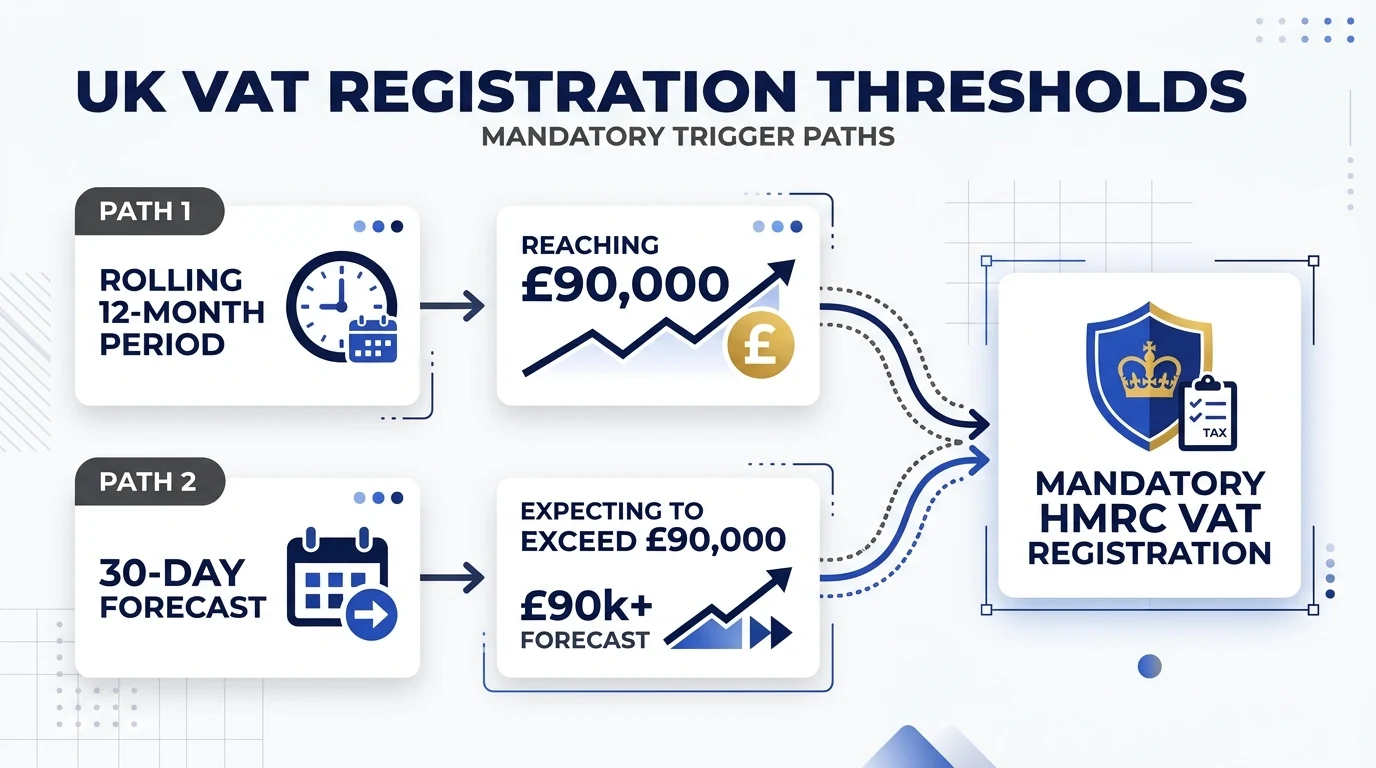
Monitoring rolling turnover requires continuous monthly calculation of total taxable sales. Business owners calculate gross revenue from all standard-rated, reduced-rated, and zero-rated supplies. Companies approaching the statutory revenue limit must prepare for mandatory digital registration. Failing to register within thirty days of breaching the threshold results in immediate financial penalties issued by tax authorities.
Businesses operating below the statutory limit may register on a voluntary basis. Voluntary registration allows startups to reclaim input tax on business expenditures before generating taxable revenue. Enterprises selling business-to-business supplies often choose voluntary registration to enhance corporate credibility. Corporate accountants evaluate commercial supply chains before determining optimal registration timing.
Business leaders planning registration timelines often review strategic guides detailing how to determine the exact moment your business must register for VAT. Strategic timing prevents retrospective tax debts and protects early-stage cash reserves. Accurate timing aligns corporate growth milestones with statutory regulatory obligations.
What Are the Different Tax Rates and Supply Classifications in the UK?
The United Kingdom economy applies three primary tax classifications consisting of the standard rate at twenty percent, the reduced rate at five percent, and the zero rate or exemption status at zero percent.
The standard rate applies to the vast majority of goods and services sold within the domestic market. Standard-rated items include professional consulting, clothing, electronics, and standard corporate services. Businesses calculate twenty percent of the net supply value when issuing commercial invoices to clients.
The reduced rate applies to specific domestic fuel supplies, energy-saving materials, and children’s car seats. This reduced tier supports specific social and economic policy objectives established by Parliament.
The zero rate applies to essential items including most staple foods, books, newspapers, and children’s clothing. Zero-rated supplies remain taxable at zero percent, allowing businesses to reclaim input tax on related expenditures. Exempt supplies, such as insurance and financial services, exclude tax entirely, meaning businesses cannot reclaim input tax on associated costs.
How Do Businesses Calculate, Recover, and Remit Tax Payments?
Registered commercial entities calculate net tax liabilities by subtracting total recoverable input tax paid on eligible business purchases from total output tax collected on customer sales.
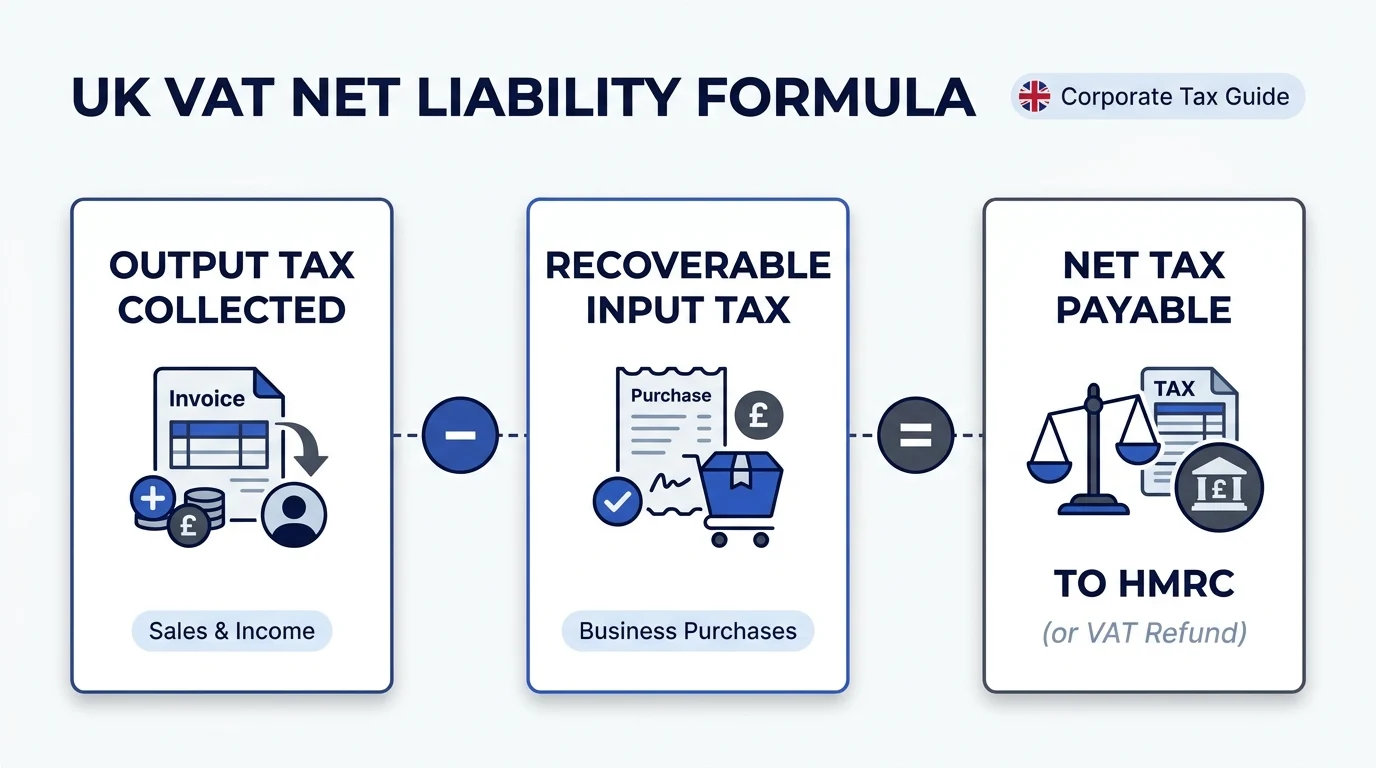
Corporate accounting software records every commercial transaction systematically. Output tax accumulates whenever a registered enterprise sells taxable goods or services to customers. Input tax accumulates whenever the enterprise purchases operational supplies, office equipment, or professional services from other registered vendors.
Businesses submit digital returns to HMRC every three months through compatible accounting software. Making Tax Digital mandates digital record keeping and electronic submission protocols for all registered enterprises. If output tax exceeds input tax during a specific quarter, the enterprise pays the net balance to HMRC. If input tax exceeds output tax, HMRC issues a direct financial refund to the corporate bank account.
Complex corporate structures require meticulous documentation to support input tax recovery claims. Companies maintain comprehensive audit trails including valid tax invoices, purchase orders, and bank statements. Maintaining accurate records ensures seamless tax clearance during formal government inspections.
Why Is Professional Guidance Essential for Complex Corporate Compliance?
Navigating statutory tax requirements demands precise execution, deep regulatory knowledge, and rigorous administrative oversight to protect startup longevity and maintain operational compliance.
Launching a new commercial venture involves navigating intricate administrative frameworks. Founders face numerous compliance hurdles when establishing corporate structures and tax accounts. Regulatory errors during the formative startup phase generate cascading financial liabilities. Engaging specialist corporate services eliminates administrative guesswork and secures regulatory standing.
Form My Company delivers expert structural assistance designed for modern entrepreneurs. Why Using Form My Company’s Expert VAT Registration Assistance is Essential for Your Startup highlights how professional oversight accelerates business launch timelines. Expert registration assistance ensures accurate data submission, prevents costly procedural delays, and establishes robust compliance foundations from day one.
Form My Company provides comprehensive corporate packages tailored to growing enterprises. Form My Company assists founders with statutory compliance, document filing, and regulatory alignment. Form My Company empowers entrepreneurs to focus on core business growth while technical compliance experts manage statutory obligations.
The United Kingdom Value Added Tax system governs commercial consumption through structured registration thresholds, distinct rate classifications, and rigorous digital reporting mechanisms. Understanding these regulatory frameworks ensures sustained corporate compliance and financial accuracy across all business operations. Form My Company delivers comprehensive professional solutions that simplify statutory compliance for growing commercial enterprises.
Explore More Supplementary Company Documents Guide,
What Do Investors Look for in Your Articles of Association?
What Are the Share Transfer Rules in Articles of Association?
Frequently Asked Questions
What are supplementary company documents and why does a UK business need them?
Supplementary company documents include vital corporate records like certificates of incorporation, updated articles of association, and share certificates that verify a company’s legal standing. Form My Company provides these essential corporate files to help businesses comply with UK regulatory frameworks and successfully open corporate bank accounts.
How do I order supplementary company documents for my UK startup?
You can order official supplementary company documents directly through corporate formation providers like Form My Company by selecting the required certificates from your account dashboard. The requested records are officially authenticated and delivered digitally or in hard copy to support your ongoing compliance needs.
Are supplementary company documents required for opening a UK business bank account?
UK high-street banks and digital financial institutions routinely request certified supplementary company documents, such as memorandum updates and director registers, to verify corporate identity during onboarding. Providing these authentic records through Form My Company streamlines your bank account application and speeds up identity verification.
What is the difference between a certificate of incorporation and supplementary company documents?
A certificate of incorporation acts as the primary birth certificate of a company, whereas supplementary company documents encompass broader regulatory records including share allocations and statutory registers. Form My Company supplies both primary certificates and supplementary files to ensure your corporate binder remains fully comprehensive.
Can Form My Company update my supplementary company documents when company details change?
When your business undergoes structural changes such as a change of registered office address or director appointments, Form My Company updates your supplementary company documents to reflect the latest Companies House filings. Maintaining up-to-date corporate documentation ensures your enterprise remains fully compliant with UK statutory requirements.