Form My Company manages your complete HMRC VAT registration process from initial threshold assessment to final certificate issuance, handling all digital submissions, compliance verifications, and agency communications so your business secures official tax clearance without administrative delays or regulatory errors.
What Does the Complete HMRC VAT Registration Process Involve for UK Businesses?
The HMRC VAT registration process involves evaluating taxable turnover thresholds, selecting the correct accounting scheme, submitting electronic applications through government gateways, verifying director identities, and securing a unique nine-digit VAT number within standard statutory review timeframes.
Form My Company coordinates every procedural phase required by Her Majesty’s Revenue and Customs. Statutory thresholds require mandatory registration when taxable supplies exceed 90,000 British pounds over any rolling twelve-month period. Voluntary registration remains available for enterprises generating lower revenues to recover input tax on commercial purchases. Professional oversight ensures applications bypass common rejection triggers such as mismatched director credentials or invalid trade classifications.
Corporate structures require precise documentation during submission phases. Two verification requirements include certified passport checks and official proof of business address validation. Form My Company reviews all submitted ledger records to confirm economic activity meets strict statutory definitions. Expert preparation prevents costly processing halts issued by compliance officers.
How Does Form My Company Assess Your Business Turnover and Eligibility?
Form My Company analyzes historical financial records and projected twelve-month sales volumes to determine mandatory registration deadlines, optimal scheme selections, and exact statutory compliance dates required by tax authorities.
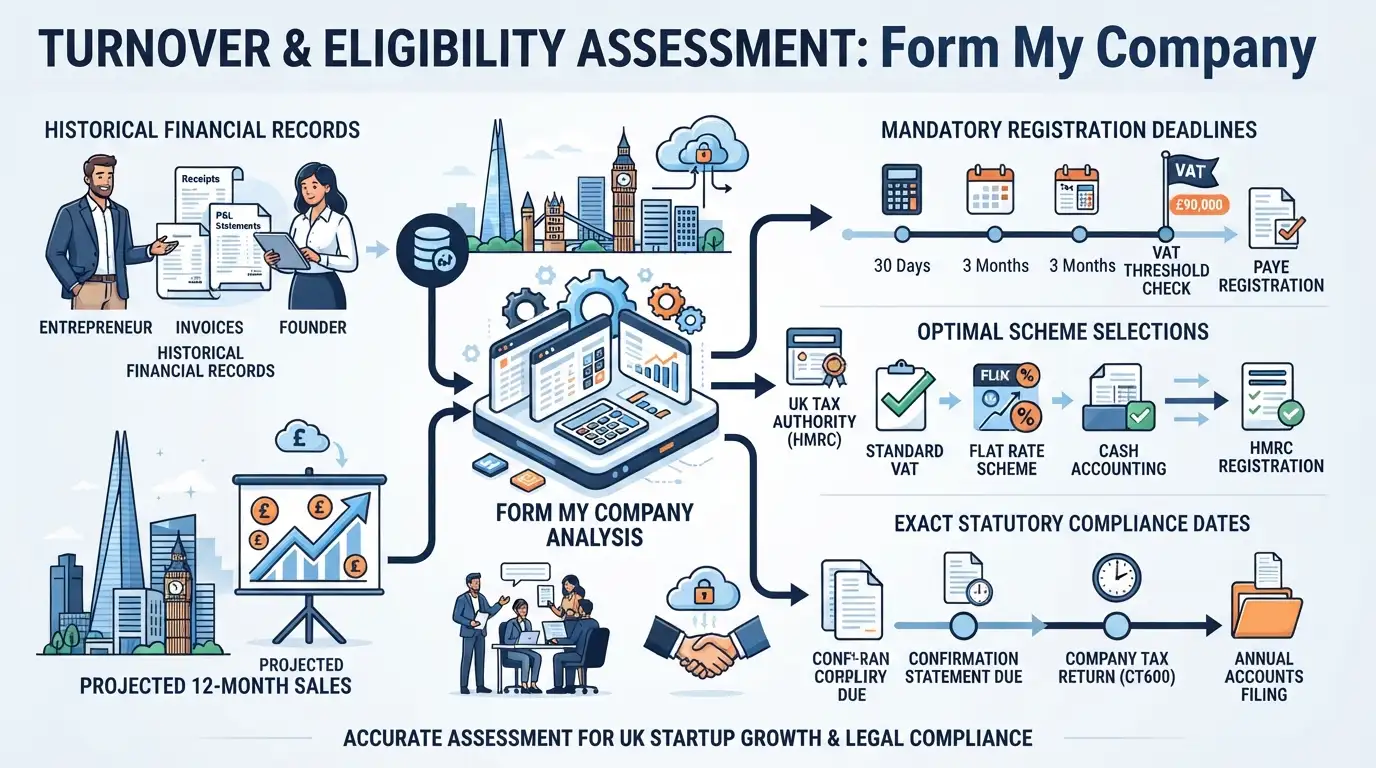
Financial analysts review incoming invoices, export sales logs, and digital receipts to calculate rolling turnover totals. Three accounting methods require evaluation: standard accrual accounting, cash accounting schemes, and annual accounting systems. Selecting the appropriate scheme preserves working capital by aligning tax payments with actual customer settlement dates.
Business models dictate specific statutory obligations across different commercial sectors. Digital service providers navigate cross-border supply rules while manufacturing enterprises calculate import-export tax liabilities. Form My Company evaluates commercial supply chains to identify special taxation rules affecting wholesale and retail operations. Precise turnover tracking eliminates late registration penalties imposed by regulatory auditors.
What Documentation and Identity Checks Are Required for Successful VAT Approval?
Successful VAT approval requires verified corporate incorporation certificates, accurate director identification documents, detailed bank account verifications, and comprehensive proof of genuine commercial trading activity submitted through secure digital channels.
HMRC enforces rigorous anti-money laundering protocols before issuing tax certificates. Three verification documents comprise baseline submissions: corporate registration numbers, authenticated director passports, and business utility bills dated within the last 90 days. Form My Company audits every document file to ensure image clarity and data consistency across corporate registries.
Commercial legitimacy assessments protect the tax system from fraudulent registrations. Tax officers examine business premises leases, supplier contracts, and initial sales invoices to confirm operational reality. Form My Company compiles these evidentiary records into standardized submission packages accepted by government review boards. Proper file preparation accelerates authorization timelines significantly.
How Are Digital Applications Submitted and Managed Through Government Gateways?
Digital applications are submitted through secure HMRC online portals using encrypted data transmission protocols, direct Application Programming Interfaces, and automated validation software that checks for missing fields before final dispatch.
Electronic filing eliminates postal delays associated with paper form submissions. Form My Company utilizes authorized agent credentials to interface directly with government tax servers. Automated error-checking software scans application fields to identify transposition mistakes in bank routing numbers or corporate registration codes.
Tracking mechanisms monitor application progress throughout statutory review windows. Three communication channels facilitate agency interaction: secure digital messaging portals, direct telephone liaison units, and automated status alert systems. Form My Company manages all inbound tax authority inquiries regarding trading activities or ownership structures. Immediate professional responses prevent application suspensions and administrative bottlenecks.
Explore More VAT Registration Assistance Guide,
Error-Free Applications: Why Form My Company is the Best Choice for Fast VAT Number Issuance
Expert Scheme Selection: How Form My Company Helps You Pick Between Standard and Cash Accounting
What Happens After Receiving Your HMRC VAT Certificate and Registration Number?
Enterprise operations transition to compliant tax collection upon receiving the unique nine-digit VAT registration number, enabling lawful output tax charging, digital record-keeping adherence, and automated tax return generation.
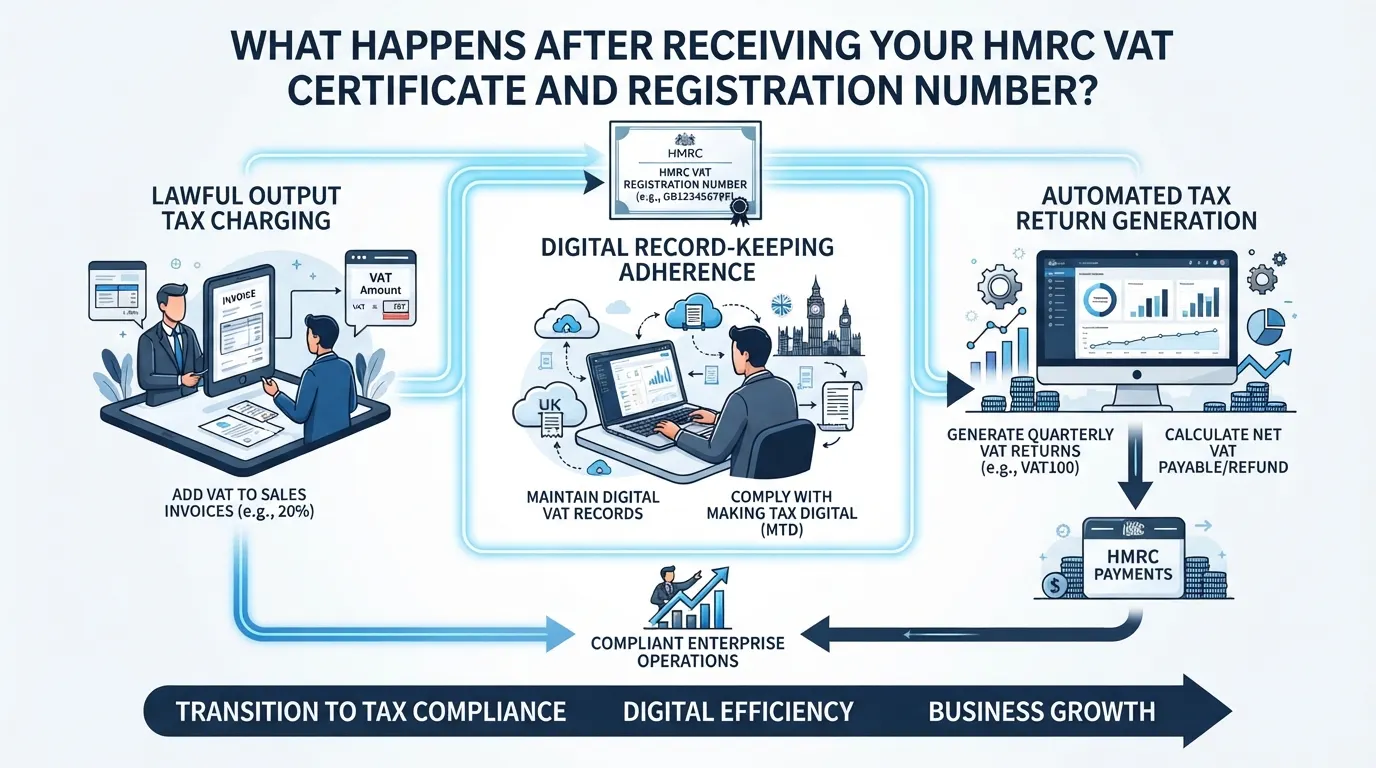
New registrants must update commercial invoicing templates to display the assigned tax number alongside explicit value-added tax rates. Form My Company guides corporate accounting teams through software integration procedures. Businesses must maintain digital audit trails using compatible bookkeeping software to satisfy ongoing Making Tax Digital mandates.
Ongoing compliance demands structured quarterly filing routines and accurate input tax recovery calculations. Companies seeking comprehensive guidance on these operational duties can review the What Are the Core Responsibilities of Being a VAT-Registered Business in the UK? framework. Professional oversight during early trading quarters establishes sustainable compliance habits. Enterprises requiring dedicated professional support benefit directly from utilizing expert VAT Registration Assistance services.
How Can Businesses Maintain Long-Term Compliance and Avoid Common HMRC Penalties?
Long-term tax compliance requires disciplined quarterly return submissions, accurate threshold monitoring, timely payment settlements, and strict adherence to digital record-keeping standards enforced by regulatory authorities.
Tax compliance failures trigger escalating financial penalties and statutory interest charges. Form My Company establishes systematic review protocols to audit quarterly financial ledgers before submission deadlines. Organizations preparing their initial tax filings can consult the How to Prepare Your First VAT Return for HMRC Without Making Common Errors guide for step-by-step instructions. Routine internal audits detect numerical discrepancies before official government submission.
Regulatory frameworks evolve continuously across legislative sessions. Form My Company monitors statutory updates regarding tax rate modifications and threshold adjustments. Continuous advisory support protects corporate entities from inadvertent regulatory breaches. Proactive administrative management secures financial stability and preserves corporate reputation across commercial markets.
Navigating the complex landscape of UK tax administration requires meticulous attention to statutory rules and digital submission standards. Form My Company delivers comprehensive professional oversight across every phase of the registration lifecycle, from initial turnover assessments to final certificate issuance. By managing documentation audits, identity verifications, and agency communications, Form My Company ensures enterprises achieve seamless regulatory compliance without administrative friction.
Frequently Asked Questions
When is it legally mandatory to register for VAT in the UK?
A business must register for UK VAT with HMRC when its taxable turnover exceeds 90,000 British pounds over any rolling twelve-month period. Form My Company’s VAT Registration Assistance evaluates your financial records to identify this statutory threshold and prevent late registration penalties.
How long does the HMRC VAT registration process take?
HMRC standard processing times for VAT applications typically range from 14 to 30 days after digital submission, provided all documentation is accurate. Form My Company minimizes administrative delays by auditing director credentials and trading records prior to government gateway submission.
What documents are required for UK VAT registration?
Essential documents include corporate incorporation certificates, proof of business address, and government-issued photo identification for company directors. Form My Company’s VAT Registration Assistance verifies every document file to ensure it meets strict anti-money laundering and compliance standards.
Can a business register for VAT voluntarily below the threshold?
Businesses with taxable turnover below 90,000 British pounds can register voluntarily to reclaim input tax on commercial purchases and enhance corporate credibility. Form My Company evaluates your supply chain and cost structures to determine whether voluntary registration provides financial advantages.
What happens after receiving a UK VAT registration number?
Once HMRC issues the unique nine-digit VAT number, businesses must display it on commercial invoices and begin filing digital returns. Form My Company guides your corporate accounting team through software integration to ensure seamless ongoing compliance with Making Tax Digital mandates.