
Virtual receptionists provide small businesses with professional call handling, appointment scheduling, and client support at a fraction of full-time staff costs, enhancing credibility without overheads. They integrate seamlessly with company formation and compliance needs, freeing entrepreneurs to focus on growth. For UK startups, this service projects a polished image vital for Companies House compliance and client trust from day one.
In the competitive UK small business landscape, first impressions through professional communication are non-negotiable, especially during company formation when establishing credibility with stakeholders like banks, investors, and HMRC. A virtual receptionist trained professionals answering calls on your behalf using your company name delivers 24/7 availability, call screening, and message relay without the expense of an in-house team. This service aligns perfectly with lean business structures, supporting directors and shareholders by handling routine enquiries while you navigate VAT registration, PAYE setup, and registered office obligations.
As remote work persists in 2026, virtual receptionists bridge the gap between solopreneurs and established firms, ensuring no call goes unanswered during critical growth phases. From tech startups in Cambridge to consultancies in Manchester, businesses leverage this to scale efficiently. This post details 10 compelling reasons, grounded in practical UK business contexts, to adopt virtual receptionists for sustained success.
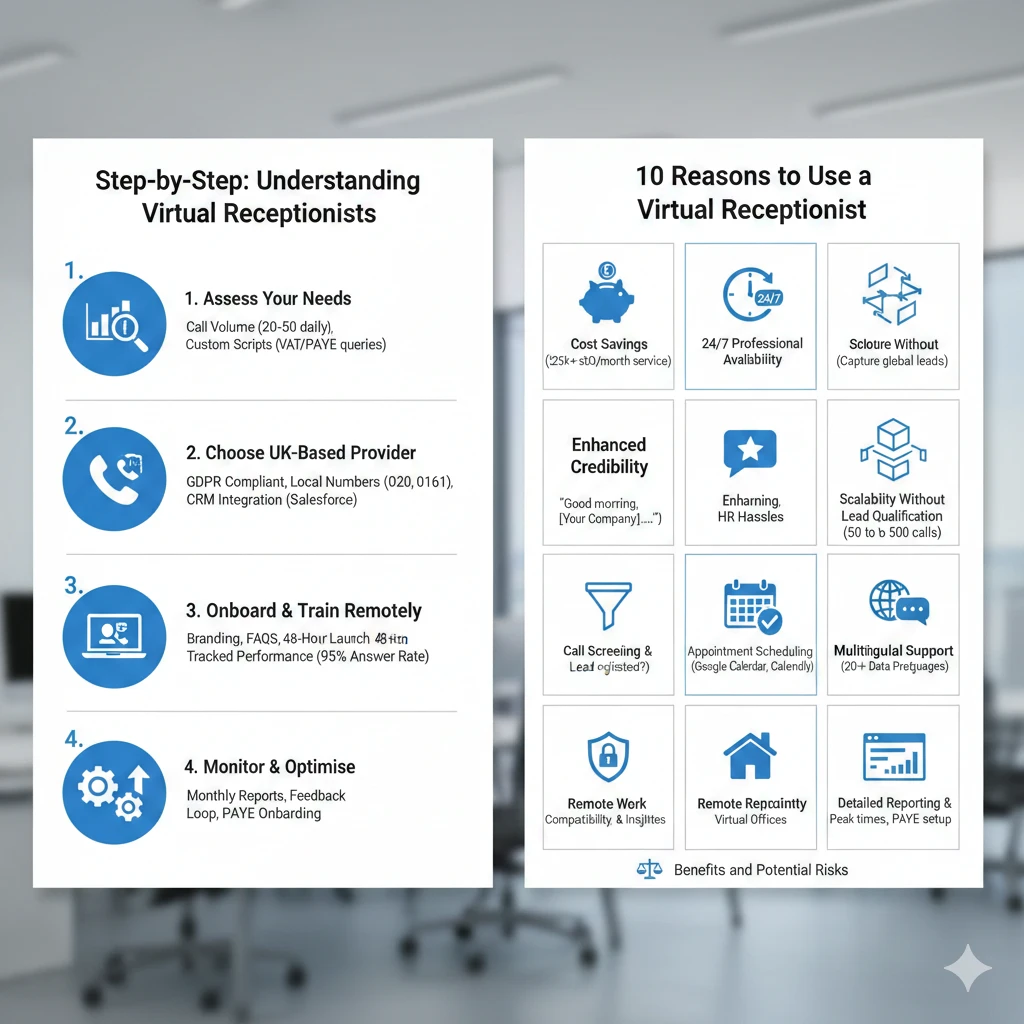
Step-by-Step: Understanding Virtual Receptionists
Implementing a virtual receptionist involves a straightforward process tailored to your operations.
1. Assess Your Call Volume and Needs
Begin by analysing incoming calls: customer support, sales leads, or compliance queries from Companies House. Small businesses average 20-50 calls daily; virtual services scale accordingly, customising scripts for VAT/PAYE enquiries or director availability.
2. Choose a UK-Based Provider
Select providers compliant with GDPR and UK telephony regulations, offering local numbers (020 London, 0161 Manchester). Integration with CRM tools like Salesforce ensures seamless data flow for shareholder communications.
3. Onboard and Train Remotely
Provide branding guidelines, FAQs on company structure, and escalation protocols. Launch within 48 hours, with performance tracked via dashboards showing answer rates (target 95%) and conversion metrics.
4. Monitor and Optimise
Review monthly reports on call handling, integrating feedback to refine services—essential for PAYE onboarding or investor calls.
10 Reasons to Use a Virtual Receptionist
Here are the top reasons, each with real-world implications for UK small businesses.
Reason 1: Cost Savings Over Full-Time Staff
Hiring a receptionist costs £25,000+ annually (salary, NI, pension), plus workspace. Virtual services start at £200/month for unlimited calls, yielding 80% savings. For a post-formation startup, this preserves cash for Companies House fees and VAT thresholds.
Reason 2: 24/7 Professional Availability
Missed calls cost £200-£400 in lost leads; virtual teams cover evenings/weekends, capturing global enquiries. A London e-commerce firm regained 30% leads via overnight handling during peak seasons.
Reason 3: Enhanced Credibility and Branding
Answering “Good morning, [Your Company], Sarah speaking” instils trust, vital for bank account openings requiring professional facades. Directors avoid personal number exposure on public registers.
Reason 4: Scalability Without HR Hassles
Scale from 50 to 500 calls seamlessly—no recruitment during growth spurts. Ideal for shareholder-funded expansions or PAYE staff hires.
Reason 5: Call Screening and Lead Qualification
Receptionists filter spam, qualifying leads (e.g., “Are you VAT-registered?”) before director handover, boosting efficiency by 40%.
Reason 6: Appointment Scheduling Integration
Sync with Google Calendar or Calendly for instant bookings, reducing no-shows by 25%. Perfect for compliance meetings or investor pitches.
Reason 7: Multilingual Support for Diverse Markets
UK providers offer 20+ languages, aiding exporters hitting VAT export thresholds. A Manchester importer closed £100k deals via Spanish-speaking reception.
Reason 8: Compliance with Data Protection Laws
GDPR-compliant handling protects client data, mirroring registered office services for Companies House mail.
Reason 9: Remote Work Compatibility
Supports hybrid models; integrate with virtual offices for full remote compliance setups.
Reason 10: Detailed Reporting and Insights
Analytics reveal peak times, top queries (e.g., PAYE setup), informing strategic decisions.
Benefits and Potential Risks
Virtual receptionists unlock efficiency, but balance with caveats.
Key Benefits
Streamlined operations allow focus on core activities like company formation filings. Improved customer satisfaction scores rise 35%, per industry benchmarks, fostering loyalty. Flexibility suits seasonal businesses, with no long-term contracts.
Example: A Bristol consultancy used virtual reception to manage 200% call surge post-VAT registration, securing three enterprise clients.
Potential Risks
Script rigidity may miss nuanced queries; over-reliance erodes personal touch. Data breaches from subpar providers threaten GDPR fines (£17.5m max).
Legal and Compliance Considerations
UK laws shape implementation.
GDPR and Telecoms Regulations
Providers must secure call recordings (consent obtained), aligning with PECR for marketing calls. For regulated sectors (finance), FCA-compliant scripts ensure adherence.
Integration with Corporate Compliance
Virtual numbers qualify as correspondence addresses for directors, complementing registered offices. HMRC accepts for PAYE notifications; log calls for audit trails.
Business structures benefit: Ltd companies project scale; sole traders gain legitimacy.
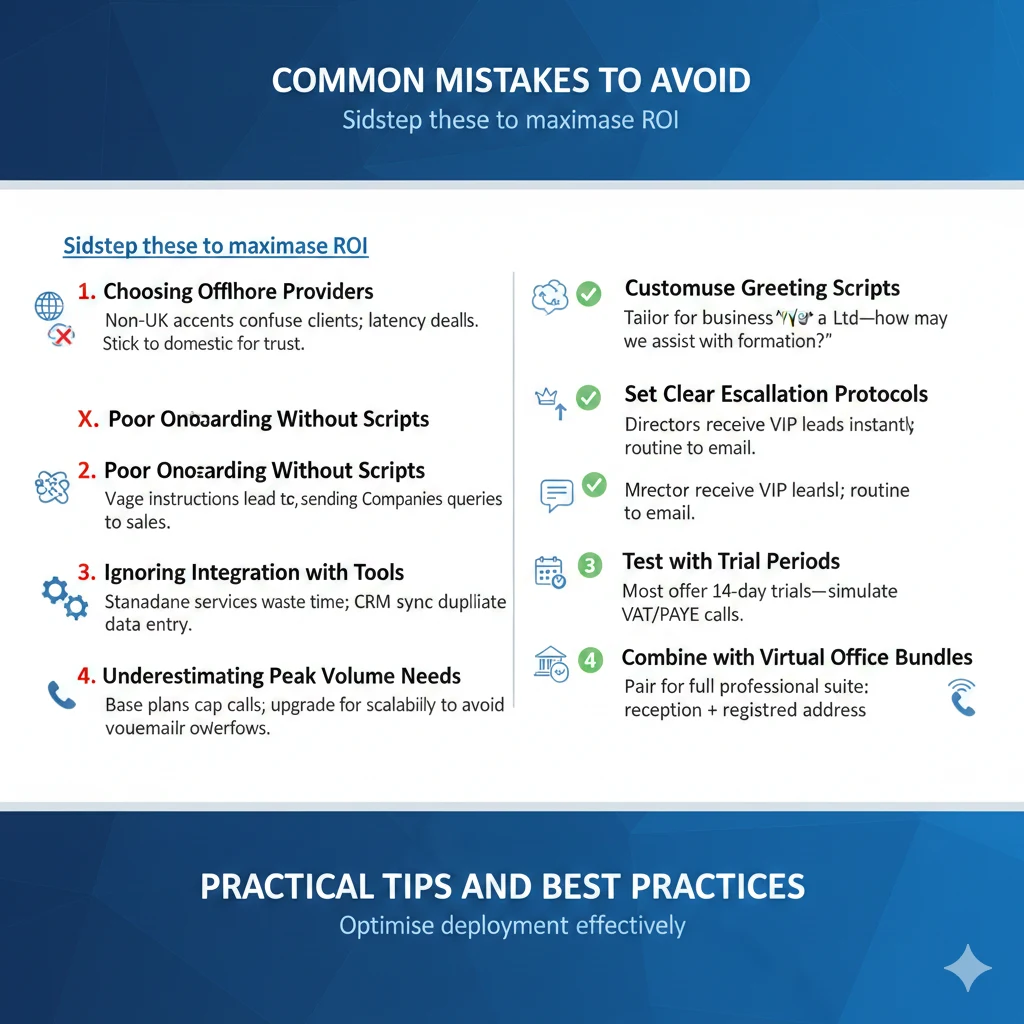
Common Mistakes to Avoid
Sidestep these to maximise ROI.
1. Choosing Offshore Providers
Non-UK accents confuse clients; latency delays calls. Stick to domestic for trust.
2. Poor Onboarding Without Scripts
Vague instructions lead to misroutes, e.g., sending Companies House queries to sales.
3. Ignoring Integration with Tools
Standalone services waste time; CRM sync prevents duplicate data entry.
4. Underestimating Peak Volume Needs
Base plans cap calls; upgrade for scalability to avoid voicemail overflows.
Practical Tips and Best Practices
Optimise deployment effectively.
1. Customise Greeting Scripts
Tailor for business stage: “We’re a new Ltd company how may we assist with formation?”
2. Set Clear Escalation Protocols
Directors receive VIP leads instantly; routine to email.
3. Test with Trial Periods
Most offer 14-day trials simulate VAT/PAYE calls.
4. Combine with Virtual Office Bundles
Pair for full professional suite: reception + registered address.
Virtual receptionists deliver 10 transformative reasons for small businesses: cost efficiency, scalability, and compliance synergy. They elevate your operation from fledgling startup to credible entity, supporting company formation through growth.
If you’re ready to register your company with confidence, Form My Company provides fast, fully online company formation with expert compliance support. From virtual receptionists and registered offices to VAT & PAYE registration, our specialists handle it all. Get started today and let our team manage the details while you focus on growing your business.
Frequently Asked Questions
How does a virtual receptionist help with Companies House compliance?
They handle statutory mail queries routed to your registered office, ensuring timely responses without personal exposure.
What are typical costs for UK small businesses?
£150-£500/month based on volume; far below £2,000+ in-house equivalent, reclaimable via VAT.
Can they manage VAT or PAYE enquiries?
Yes, with scripted responses escalating complex issues, maintaining professionalism.
4. Is call data secure under GDPR?
Reputable providers encrypt recordings, obtain consent, and delete per retention policies.
How quickly can I set up the service?
24-48 hours, with numbers ported seamlessly for existing lines.