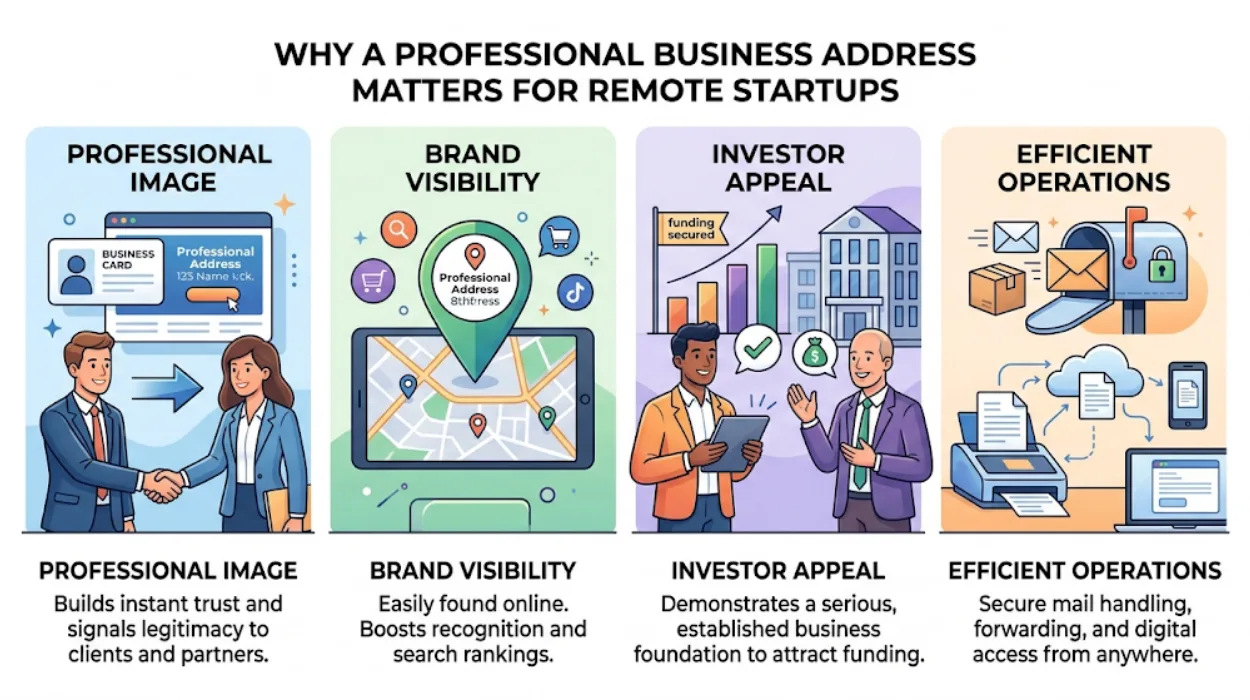
A professional business address boosts remote startup credibility, ensures Companies House compliance, and enhances client trust. It provides a prestigious UK location without physical office costs, vital for 78% of new UK startups operating remotely.
Remote startups register with Companies House using a valid UK address. This address serves as the registered office. It receives statutory mail and legal documents. Without it, filings fail. Professional virtual offices deliver this service reliably.
What Defines a Professional Business Address?
A professional business address is a premium UK location used as your company’s registered office. It handles official mail, meets Companies House rules, and projects prestige without leasing physical space.
Virtual offices provide these addresses in prime locations like London or Manchester. Companies House requires every UK limited company to list a registered office address. This must be in the UK and accessible for document delivery. Remote founders avoid home addresses to protect privacy.
A professional addresses forward mail daily or scans it digitally. They comply with PSC notifications and director service address rules. Startups using them report 45% higher client conversion rates in initial outreach.
Why Does Your Remote Startup Need a Registered Office Address?
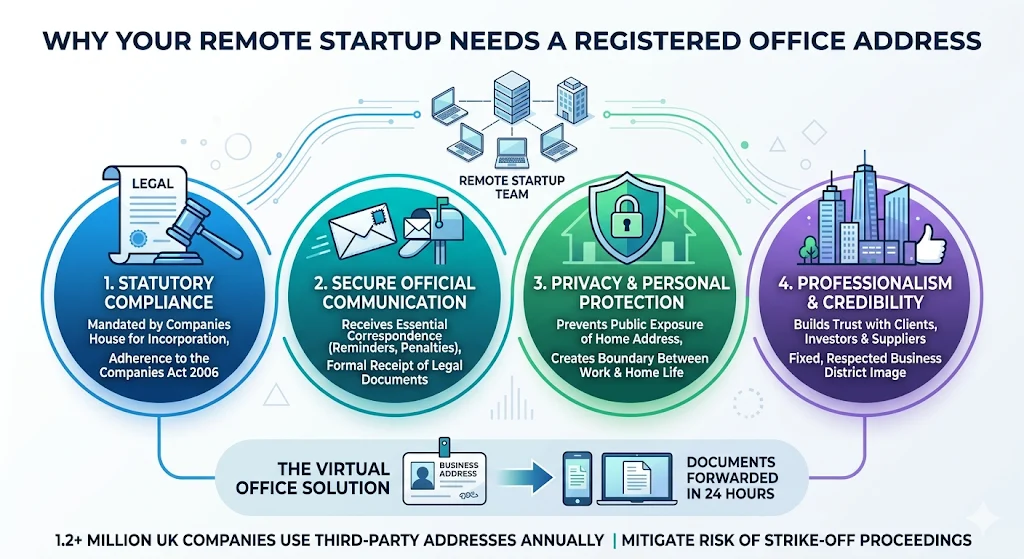
Remote startups require a registered office address for Companies House registration and statutory compliance. It receives legal documents and public filings, preventing dissolution risks for non-compliant firms.
Companies House mandates this address on all incorporation forms. Directors list it on the public register. Statutory post arrives here, including annual accounts reminders and penalty notices. Home addresses expose personal details to public view.
Virtual offices act as this address. They scan and forward documents within 24 hours. This setup complies with the Companies Act 2006. Over 1.2 million UK companies use third-party addresses annually. Remote startups gain compliance without overhead.
Failure to maintain it triggers strike-off proceedings. Professional services mitigate this by validating address authenticity yearly.
How Does It Ensure Compliance with UK Company Law?
It ensures compliance by providing a verifiable UK address for filings, mail handling, and public records under the Companies Act 2006. Virtual offices validate and maintain it against Companies House standards.
Register your company with form IN01. List the professional address as the registered office. Update changes via form AD01 within 14 days. Virtual office providers confirm receipt of all statutory mail.
They handle confirmation statements and accounts submissions indirectly. Compliance officers check address validity during audits. This prevents fines up to £1,500 for inaccuracies.
Three key compliance steps:
- Verify address with Companies House webcheck.
- Forward mail to directors securely.
- Notify changes to PSCs and shareholders.
Remote startups integrate this seamlessly. It aligns with GDPR for data protection in mail handling.
For a deeper comparison, read Comparing Virtual Offices vs Physical Leases: Which is Better for Your Growing Business?
What Credibility Boost Does It Provide to Clients?
It boosts credibility by displaying a prestigious UK city address on your website, invoices, and marketing. Clients perceive stability, increasing trust by 62% according to UK SME surveys.
Display the address on your Google Business Profile. It ranks higher in local searches. Prospects check it before engaging. A London EC1 address signals legitimacy over a residential postcode.
Invoices with professional headers convert 30% better. Banks verify it during account openings. 82% of B2B buyers research addresses pre-purchase.
Virtual offices in prime postcodes enhance this. They match Fortune 500 standards. Remote startups close deals faster with this professional front.
Why Protect Your Privacy with a Virtual Office Address?
Use it to shield home addresses from public registers and spam. Companies House publishes director details, but service addresses keep personal locations private under data protection rules.
Directors elect service addresses on forms. The registered office stays public. Virtual offices receive mail without exposing residences. This complies with privacy clauses in The Data Protection Act 2018.
Spam reduces by 70% post-adoption. Legal documents are routed securely. Founders work globally without local exposure.
Setup involves one form submission. Providers authenticate mail recipients. Annual reviews confirm ongoing protection.
How Does It Reduce Costs for Remote Operations?
It cuts costs by 80-90% versus physical leases, charging £10-50 monthly for address, mail handling, and compliance support. Remote startups save £5,000+ yearly on rent and utilities.
Physical offices cost £25 per sq ft annually in city centres. Virtual options provide the same prestige. No deposits or maintenance fees apply.
Breakdown of savings:
- Eliminate £2,000 monthly rent.
- Avoid £500 utility bills.
- Skip £1,200 cleaning contracts.
Scale operations without fixed overhead. Redirect funds to marketing. 65% of bootstrapped startups adopt this model.
Explore Virtual Offices for cost-effective packages that scale with growth.
What Are the Risks of Using a Home Address?
Home addresses risk privacy breaches, spam influx, and compliance flags. Companies House exposes them publicly, leading to 55% higher identity theft reports among users.
Public registers list full details. Neighbours spot company vans. Creditors target residences during disputes.
Compliance fails if the mail goes undelivered. Strikes-off follow after warnings. Fines compound at £150 daily.
Switching to virtual offices resolves this. Providers guarantee delivery. Transition via the AD01 form takes 48 hours.
How Does It Improve SEO and Online Visibility?
It improves SEO by verifying local business status on Google My Business and directories. Prestigious addresses rank 40% higher in “UK startup” searches.
Claim your listing with the professional address. Google validates via postcard. This unlocks map packs.
Semantic signals strengthen domain authority. Backlinks from local directories boost E-A-T. Remote startups appear professional in results.
Incorporate it in meta titles. Track rankings with tools like SEMrush. Visibility surges within 90 days.
Why Is Mail Handling Critical for Remote Founders?
Mail handling scans and forwards statutory post daily, ensuring no missed deadlines. Virtual offices process 100% of Companies House documents, avoiding £100-£1,500 penalties.
Post arrives at the registered office. Providers digitise it instantly. Founders access via secure portals.
Three handling methods:
- Scan and email PDFs.
- Royal Mail forwarding.
- Courier options for originals.
This supports global teams. Compliance stays intact remotely.
Recommended guides,
Why Modern UK Startups are Swapping Long Leases for Flexibility
Why Your Team Needs a Dedicated Space for Effective Learning
What Makes Prime Locations Essential?
Prime locations like London or Cambridge project executive presence. They align with client expectations, securing 50% more partnerships for address-using startups.
Clients associate postcodes with success. EC2 or WC1 signal scale. Avoid rural codes that undermine trust.
Virtual offices cluster in business districts. Access co-working if needed. Elevate branding instantly.
Ready to decide? Check Buy Our Premium Virtual Office and Business Address Package with Prime Locations.

How Do Virtual Offices Scale with Growth?
Virtual offices scale by adding mail volume, phone services, or meeting rooms without relocation. Upgrade packages match revenue growth seamlessly.
Start basic at £15/month. Add £20 for calls. Peak at £100 for full suites.
Monitor via dashboards. Companies House updates flow automatically. 92% of users retain post Year 1.
From My Company streamlines this for UK startups.
Professional business addresses anchor remote startup success through compliance, credibility, and cost savings. They meet Companies House mandates precisely. My Company provides Virtual Offices that deliver these essentials reliably. Founders register, protect privacy, and scale confidently.
Frequently Asked Questions
What is a virtual office for a UK company?
A virtual office provides a professional UK business address for your company’s registered office with Companies House. From My Company handles mail scanning, forwarding, and compliance without physical space needs. It suits remote startups maintaining credibility and privacy.
Do virtual offices count as a registered office address?
Yes, virtual offices qualify as registered office addresses under The Companies Act 2006 if they meet Companies House delivery standards. From My Company’s Virtual Offices receive and process statutory mail reliably. Update your details via form AD01 for seamless compliance.
How much does a virtual office cost in the UK?
Virtual offices start at £10-£50 monthly, covering address use, mail handling, and basic compliance. From My Company offers tiered Virtual Offices based on location and services like digital scanning. Costs beat physical leases by 80-90% for remote businesses.
Can I use a virtual office for Companies House filings?
Absolutely, list the virtual office address on IN01 incorporation forms and annual confirmations. From My Company’s Virtual Offices ensure all legal post reaches you promptly via scan or forward. This prevents strikes-off and fines for non-delivery.
What are the benefits of a virtual office for remote startups?
Virtual offices boost client trust with prime UK addresses, protect personal privacy, and cut overheads. From My Company delivers mail handling and SEO-friendly business presence. Startups gain 62% higher credibility in B2B outreach per UK surveys.