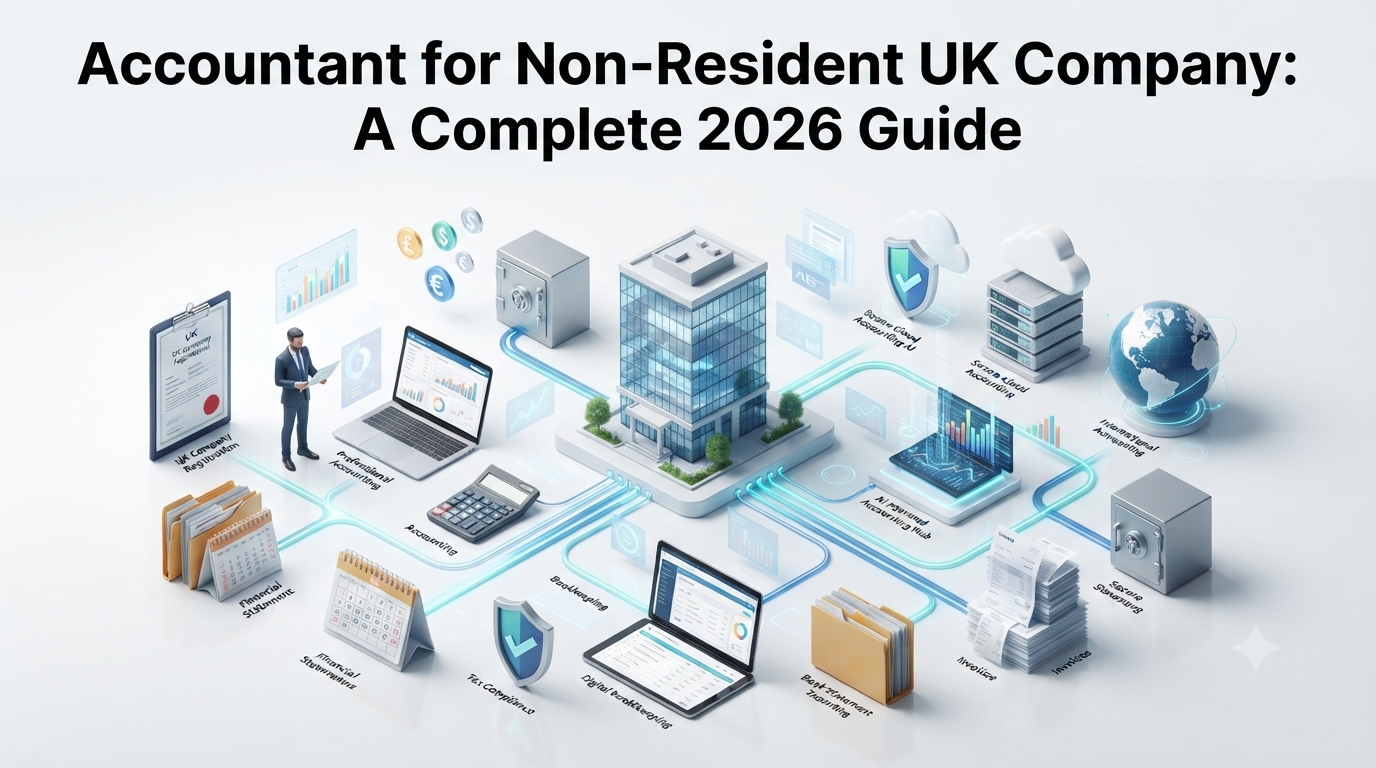
Accountant for Non-Resident
If you own a UK company as a non-resident, working with a qualified UK accountant is essentially standard practice rather than optional. UK Corporation Tax, VAT return filing, payroll if applicable, ongoing bookkeeping, and coordination with HMRC are technical areas where DIY typically leads to costly mistakes. A good UK accountant becomes one of your most important ongoing UK business partners, handling everything from monthly bookkeeping through annual tax returns to strategic tax planning. At Form My Company, we’re an Authorised Corporate Service Provider (ACSP) handling UK company formation, addresses, VAT registration, and Companies House compliance. We work closely with qualified UK accountants who handle the ongoing tax and financial side. This guide explains everything non-residents need to know about finding and working with a UK accountant for their UK company.
Why Non-Resident UK Company Owners Need an Accountant
Working with a qualified UK accountant is essential for several reasons:
UK tax complexity. Corporation Tax, VAT, PAYE, and other UK taxes have technical rules requiring expertise.
Making Tax Digital compliance. All VAT-registered businesses must use MTD-compatible software with correct processes.
Ongoing bookkeeping. Transaction categorisation, monthly reconciliations, and financial records.
Annual accounts preparation. Statutory accounts for Companies House and HMRC.
Corporation Tax returns. Annual filings with HMRC.
VAT return filing. Quarterly compliance with MTD.
PAYE if applicable. Real Time Information filings for any employees.
Cross-border considerations. Where UK and home country tax interact.
Regulatory changes. UK tax rules evolve regularly.
Cash flow planning. Managing UK working capital.
Strategic tax planning. For growing businesses.
HMRC correspondence. Handling any queries or notices.
Time zone bridging. UK-based professionals accessible during UK hours.
Language and technical clarity. Explaining UK-specific requirements clearly.
For non-resident owners, a qualified UK accountant is essentially the single most important ongoing business partner alongside your ACSP.
What a UK Accountant Actually Does for Non-Resident Companies
A comprehensive UK accountant for a non-resident UK company typically handles:
Ongoing Bookkeeping
Transaction recording. All business transactions in accounting software.
Bank reconciliation. Monthly reconciliation with bank statements.
Sales categorisation. By customer, product, or service line.
Expense categorisation. For Corporation Tax deductibility.
Multi-currency transactions. For international businesses.
Marketplace reconciliation. Amazon, eBay, Shopify data.
Payment processor reconciliation. Stripe, PayPal, others.
Payroll integration. If PAYE applies.
Cloud accounting. Xero, QuickBooks, or FreeAgent typically.
Regular reporting. Monthly management accounts.
VAT Return Filing
Quarterly VAT returns. Filed through MTD-compatible software.
Making Tax Digital compliance. All records digital.
Output VAT calculation. VAT charged on sales.
Input VAT reclaim. VAT paid on business expenses.
PVA (Postponed VAT Accounting). For imports.
VAT scheme optimisation. Whether standard, Flat Rate, or others suit your business.
HMRC communications. For VAT-related queries.
Timeliness. Meeting quarterly deadlines.
Corporation Tax
Annual Corporation Tax return. CT600 filed with HMRC.
Corporation Tax calculation. At current rates (25% main, 19% small profits).
Corporation Tax planning. For efficient tax outcomes.
Cash flow for tax. Ensuring funds available for payment.
Group considerations. For businesses with UK group companies.
International considerations. Where cross-border tax applies.
HMRC agent authorisation. So accountant can act on your behalf.
Statutory Accounts
Annual accounts preparation. Full accounts for Companies House.
Full accounts vs abbreviated. Depending on company size.
Statutory disclosures. As required.
Director’s report. Where required.
Auditor coordination. If audit is required.
Coordination with Companies House filing. Within statutory deadlines.
Historical comparability. For year-on-year analysis.
PAYE and Payroll
PAYE registration. With HMRC.
Monthly payroll processing. For any employees including directors on salary.
Real Time Information (RTI). Filed with HMRC each pay period.
PAYE payments. Managed and paid.
P60s and P45s. Year-end and leaver documents.
Pension auto-enrolment. If applicable.
Employer NIC. Calculated and paid.
Payroll software. Compliant systems.
Cross-Border Tax Coordination
Home country tax. Understanding your personal tax situation.
Double tax treaties. Between UK and your country.
Transfer pricing. For international group companies.
Withholding tax considerations. On dividends or other payments.
Foreign Tax Credit. In your home country.
Coordination with your home country accountant. For consistency.
International structure planning. For growing businesses.
Strategic Planning
Tax planning. For efficient business operations.
Cash flow forecasting. For business planning.
Growth planning. For expanding businesses.
Exit planning. For business sale or closure.
Investment planning. For business investment.
Group planning. For multi-entity structures.
Ongoing business advisory. Beyond just compliance.
For most non-resident-owned UK companies, this comprehensive scope is what makes an accountant essential.
Qualifications and Standards to Look For
Not every accountant is equal. Key qualifications:
UK Chartered Qualifications
ICAEW (Chartered Accountants). Members qualified as ACA, followed by FCA for fellows. Traditional prestigious qualification.
ACCA (Chartered Certified Accountants). International accountancy qualification, ACCA followed by FCCA for fellows. Widely respected.
CIMA (Chartered Global Management Accountants). ACMA followed by FCMA. Focus on management accounting.
AAT (Association of Accounting Technicians). Not a full chartered qualification but recognised.
For UK company accountancy, ACA, ACCA, or CIMA qualifications are the standard professional benchmarks.
Tax-Specific Qualifications
CIOT (Chartered Institute of Taxation). CTA qualification. Specialist tax expertise.
ADIT (Advanced Diploma in International Tax). For international tax specialism.
ATT (Association of Taxation Technicians). Practical tax qualifications.
HMRC agent authorisation. Allows the accountant to act on your behalf with HMRC.
For non-resident owners with cross-border considerations, tax-specific qualifications add significant value.
Regulatory Membership
Professional body membership. Ensures ongoing professional standards.
Professional indemnity insurance. For error protection.
AML compliance. Under UK anti-money laundering rules.
Ongoing professional development. Required by professional bodies.
Ethical standards. Enforced by professional bodies.
For non-resident owners, working with regulated qualified professionals is essentially standard practice.
What to Look For in an Accountant for Non-Resident UK Companies
Beyond qualifications, specific factors matter:
Experience with Non-Resident Clients
How many non-resident clients they serve. Broader experience typically means broader expertise.
Cross-border tax expertise. Understanding UK and home country interactions.
International company structures. Group planning experience.
Multiple jurisdictions. For businesses in multiple countries.
Non-resident director experience. For personal tax coordination.
Sector Experience
E-commerce experience. For Amazon FBA, eBay, Shopify sellers.
International trade. For import/export businesses.
Digital services. For SaaS and online businesses.
Professional services. For consultants and service providers.
Specific industry expertise. Where regulated (financial services, healthcare).
Cross-border transaction expertise. For international operations.
Practice Structure
Solo practitioner vs firm. Solos may be more responsive; firms may have broader resources.
Cloud-based practice. Essential for non-resident clients (remote access).
Time zone coverage. For coordination across time zones.
Language accessibility. English competency, potentially multilingual.
Technology stack. Xero, QuickBooks, or FreeAgent expertise.
Integration capabilities. With banks, payment processors, marketplaces.
Response times. Especially for non-residents in different time zones.
Communication and Support
Regular communication. Not just at year-end.
Deadline management. Proactive reminders.
Clarity in explanations. UK-specific concepts explained clearly.
Documentation. Clear meeting notes and email trails.
Accessible support. For questions during the year.
Escalation to specialists. Where needed.
Multi-year relationship. Longevity in the relationship.
Fees and Value
Fee transparency. Clear pricing without surprises.
Fee structure fit. Monthly retainer vs project-based vs annual.
Bundled services. Vs a la carte.
Value for money. For your specific business scale.
Growth pricing. How fees change as business grows.
Break clauses. Contract flexibility.
The right accountant depends on your specific situation. Match strengths to needs.
Fees for Non-Resident UK Company Accountancy
Fees vary significantly by scope and provider:
Basic Compliance Package
Typical scope. Annual accounts, Corporation Tax return, basic support.
Typical fee range. £600 to £1,500 per year for very small businesses.
Best for. Dormant companies, very small businesses, minimal transactions.
Standard SME Compliance
Typical scope. Ongoing bookkeeping, VAT returns quarterly, PAYE, annual accounts, Corporation Tax return, monthly management accounts.
Typical fee range. £150 to £400 per month for small-to-medium businesses.
Best for. Active trading businesses with regular ongoing activity.
Cross-Border Complex Compliance
Typical scope. Standard SME plus cross-border tax planning, multi-jurisdictional coordination, international structure advice.
Typical fee range. £300 to £1,000+ per month for complex situations.
Best for. Growing businesses with cross-border complexity.
Specialist Areas
Marketplace sellers. Often bundled with accounting software (A2X, etc.).
International trade. Additional customs and international tax expertise.
High-growth startups. Investment reporting and strategic planning.
Regulated sectors. Sector-specific compliance.
One-Off Projects
Transfer pricing analysis. For international companies.
Tax investigations. HMRC enquiries.
Restructuring. For business changes.
Due diligence. For sales or acquisitions.
Various. As needed.
For most non-resident-owned UK companies, ongoing SME compliance at £150 to £400 per month is typical. Cross-border complexity adds cost but adds value.
Coordination with Your ACSP
The accountant and ACSP relationship:
ACSP handles Companies House work. Formation, addresses, confirmation statements, director changes, PSC filings, identity verification.
Accountant handles HMRC work. Corporation Tax, VAT, PAYE, and tax planning.
Coordination on interactions. Between statutory and tax matters.
Registered office correspondence. ACSP handles Companies House mail; accountant handles HMRC mail.
Statutory register maintenance. ACSP handles registers; accountant advises on tax implications.
Financial data flow. Between accounting software and Companies House filings.
Shared documentation. For consistency across advisers.
Regular communication. Where the ACSP and accountant coordinate.
Client at the centre. Both advisers serving the client’s interests.
Efficient teamwork. Reducing duplicated work.
For non-resident owners, having one ACSP handling Companies House and one qualified accountant handling ongoing tax and financial work is essentially the standard setup.
Common Accountancy Mistakes for Non-Resident UK Companies
A few issues come up regularly:
Choosing on price alone. Cheap accountants often miss important cross-border considerations.
Not seeking cross-border expertise. Missing UK-home country tax interactions.
Poor bookkeeping. Retrospective reconstruction is expensive.
Missing deadlines. VAT quarterly, PAYE monthly, Corporation Tax annually all have deadlines.
Not integrating with your business systems. Manual data entry errors.
Ignoring Making Tax Digital. For VAT compliance.
Missing home country tax implications. UK compliance is only half the picture.
Poor communication frequency. Only interacting at year-end.
No sector expertise. For specialised businesses.
Not planning ahead. Only reactive.
Missing tax planning opportunities. For cash flow and tax optimisation.
Not coordinating with ACSP. Missing consistency in statutory matters.
Professional support significantly reduces these risks.
Coordinating with Home Country Advisors
For non-resident owners:
Home country tax accountant. For your personal tax situation.
UK accountant. For UK company tax matters.
Coordination between them. For treaty considerations.
Withholding tax handling. On dividends or salary paid.
Foreign Tax Credit. In your home country.
Double tax treaty benefits. Where available.
Multi-currency planning. For business and personal.
Regulatory reporting. In both jurisdictions.
Personal residency planning. Where relevant.
Cross-border succession planning. For long-term structures.
For material cross-border situations, having qualified advisers in both jurisdictions coordinated is essential.
Choosing Between Solo Practitioners and Firms
Different types of accountants suit different needs:
Solo Practitioners
Advantages. Direct personal relationship, often more responsive, competitive pricing.
Disadvantages. Limited backup, potentially narrower expertise, dependency on individual.
Best for. Small-to-medium businesses with straightforward needs.
Typical size. 1-3 person firm.
Suitable client size. Turnover up to £500,000 to £2M.
Small Firms
Advantages. More backup, broader expertise, sector specialisation possible.
Disadvantages. Less individual attention potentially, higher costs.
Best for. Growing SMEs with more complex needs.
Typical size. 5-30 person firms.
Suitable client size. Turnover £500,000 to £10M.
Medium and Larger Firms
Advantages. Comprehensive expertise, backup, specialist departments (tax, corporate finance, audit).
Disadvantages. Higher costs, potentially less personal service.
Best for. Established larger businesses, complex international structures.
Typical size. 30+ people.
Suitable client size. Turnover £5M+.
Specialist Accountancy Firms
Advantages. Deep sector expertise (e-commerce, international trade, specific industries).
Disadvantages. Higher costs, may lack general business advisory.
Best for. Businesses in specific sectors.
Suitable client size. Varies by specialism.
Choose the right size firm for your specific business needs and complexity.
When to Change Accountants
Sometimes accountant relationships don’t work out:
Consistent deadline missing. Repeated late filings.
Poor communication. Slow responses, unclear explanations.
Lack of proactive advice. Only reactive.
Missing cross-border expertise. Where relevant to your business.
Rising fees without value. Fee increases not matched by service increases.
Loss of key contact. When your key person leaves the firm.
Business changes. Growth requiring more sophisticated support.
Sector shifts. Where you need sector-specific expertise.
Trust issues. For any reason.
Regulatory concerns. Professional standing.
Changing accountants is a real business decision. Planning the transition properly matters.
How to Change Accountants
Give appropriate notice. Per your engagement letter.
Coordinate handover. Historical records and current position.
Update HMRC authorisation. For agent access.
Update software access. Transfer to new accountant.
Update Companies House if needed. For registered office or service address if provided by old accountant.
Clear final invoices. For work in progress.
Structured onboarding. With new accountant.
Ongoing continuity. For seamless compliance.
A smooth transition prevents compliance gaps.
How Form My Company Fits with Your Accountant
Form My Company is an Authorised Corporate Service Provider (ACSP) working alongside qualified UK accountants to serve non-resident owners of UK companies. Our role in the accountant relationship:
We handle Companies House work. Formation, addresses, confirmation statements, PSC filings, director changes, identity verification.
Accountant handles HMRC work. Corporation Tax, VAT, PAYE, tax planning.
We coordinate with your accountant. For consistency across statutory and tax matters.
We introduce you to qualified accountants. From our network where you don’t already have one.
We coordinate on VAT registration. Working with your accountant on VAT setup and ongoing filings.
We support ongoing operations. As your accountant handles ongoing tax work.
We ensure statutory continuity. So Companies House and HMRC records align.
We provide UK correspondence address. For both statutory and tax correspondence.
We bundle services in packages. With ongoing coordination assumed.
For your ongoing tax and financial work, we recommend working with a qualified UK accountant. Form My Company handles the Companies House side of your UK compliance while your accountant handles the ongoing tax and financial work.
Get Professional UK Accountancy Support Today
For non-resident owners of UK companies, working with a qualified UK accountant is essential rather than optional. The right accountant becomes one of your most important ongoing UK business partners, handling everything from bookkeeping through statutory accounts to strategic tax planning. Form My Company can help establish your UK company and handle Companies House compliance, while working alongside a qualified UK accountant for the ongoing tax and financial work. Get in touch today about your UK company formation, and let us introduce you to qualified accountants for the ongoing work.
Frequently Asked Questions
Why do non-resident UK company owners need an accountant?
UK tax and financial compliance is technical, ongoing, and mistakes are expensive. Working with a qualified UK accountant handles Corporation Tax, VAT return filing, PAYE, ongoing bookkeeping, and cross-border tax coordination. For most non-resident-owned UK companies, this is essentially standard practice.
What qualifications should I look for?
UK chartered qualifications: ACA (ICAEW), ACCA, or CIMA are the standard professional benchmarks. For tax-specific expertise, CTA (Chartered Institute of Taxation) or ADIT (international tax). HMRC agent authorisation should be in place for the accountant to act on your behalf.
How much does UK accountancy cost for non-resident companies?
Ongoing SME compliance typically £150 to £400 per month for small-to-medium businesses. Cross-border complexity or specialist expertise adds cost. Dormant company work can be as low as £600 per year. Complex international structures may exceed £1,000 per month.
What does an accountant handle for my UK company?
Ongoing bookkeeping, VAT return filing, Corporation Tax return, PAYE if applicable, annual accounts preparation, HMRC coordination, and strategic tax planning. Some also provide broader business advisory.
Can Form My Company handle my ongoing tax and accounting?
No. We’re an Authorised Corporate Service Provider (ACSP) handling UK company formation, addresses, VAT registration, and Companies House compliance. Ongoing tax and financial work (bookkeeping, VAT filing, Corporation Tax, PAYE) is genuinely a qualified accountant’s role. We work closely with qualified UK accountants and can introduce you to appropriate specialists.
Should I choose a solo practitioner or a firm?
Depends on your business size and complexity. Solo practitioners often work well for small businesses with straightforward needs. Small firms suit growing SMEs. Larger firms suit established businesses with complex international structures.
How do I coordinate my accountant with my ACSP?
Different advisers handle different aspects of UK compliance. The ACSP handles Companies House and address services; the accountant handles HMRC and tax matters. Coordination between them ensures consistency. Many non-resident UK company owners have one ACSP and one accountant working together.
Can I use my home country accountant?
Home country accountants typically don’t have UK-specific expertise. For UK company compliance, a UK-qualified accountant is essential. Your home country accountant handles your personal tax; the UK accountant handles the UK company tax. Coordination between them is important for cross-border matters.