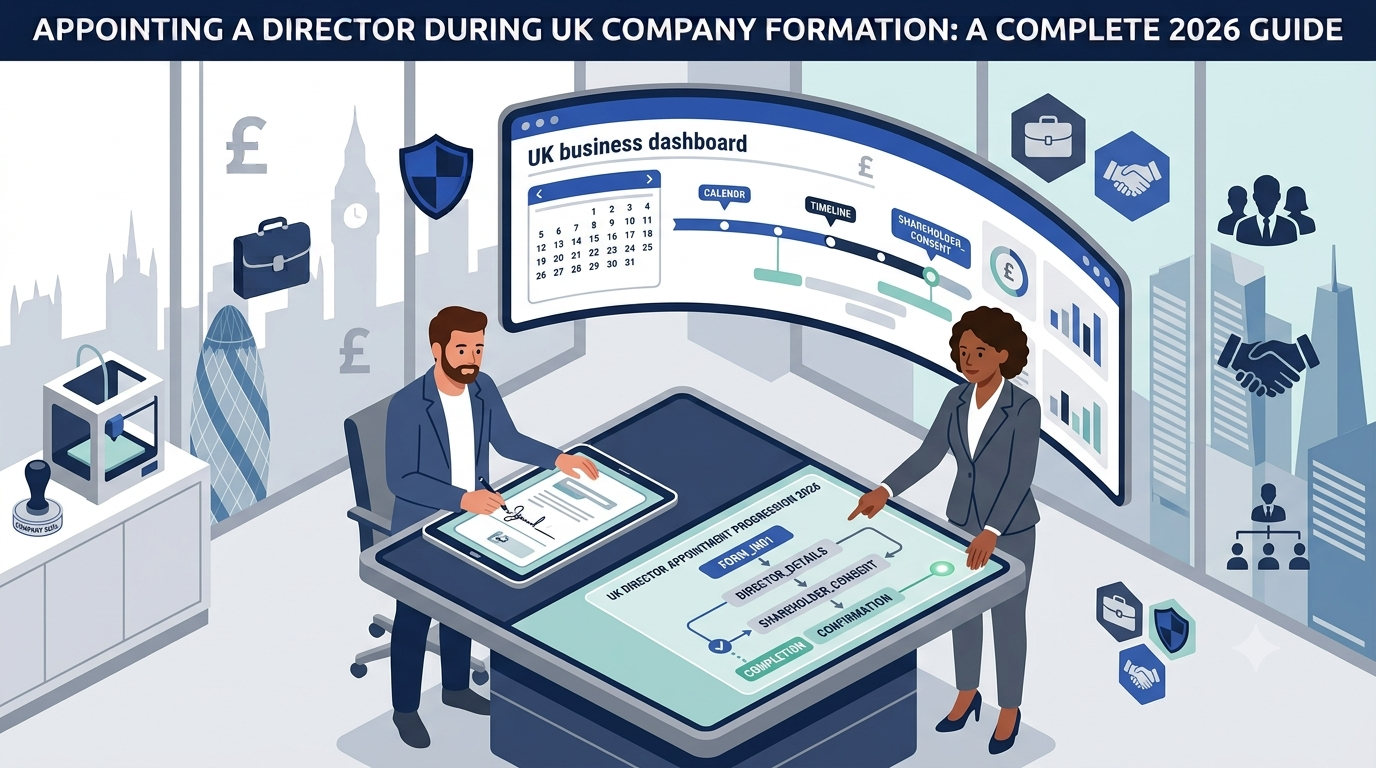
Appointing a Director
Every UK limited company needs at least one director, and the way you appoint them at formation shapes how your company runs from day one. Under recent Companies House reforms, appointing a director now involves not just filling out forms but also completing mandatory identity verification. At Form My Company, we help founders appoint directors correctly during formation, whether you’re setting up as a sole director or bringing together a founding team. This guide explains exactly how director appointment at formation works, what’s required, and how to get it right first time.
Why Director Appointment at Formation Matters
The directors you appoint at incorporation become the people legally responsible for running your company from the moment it exists. Their names, service addresses, and identity verification statuses all become part of the Companies House public record. Getting the appointment right at formation:
- Establishes clear legal responsibility. From the first day of trading, your directors have the duties and liabilities set out in the Companies Act 2006.
- Sets up the public record correctly. Corrections and changes later on can be time-consuming and, in some cases, raise questions from Companies House or banks.
- Enables banking and other applications. Business bank accounts, payment gateways, and marketplace registrations often check director details against Companies House. Consistency matters.
- Meets ECCTA identity verification requirements. Every appointed director must complete identity verification, and this is now a legal precondition for acting as a director.
Doing this properly at the point of formation is far simpler than fixing issues after the fact.
Who Can Be a Director of a UK Company?
UK law is generous about who can serve as a director. The main requirements are:
- At least 16 years old. Directors must be 16 or over.
- Not disqualified. You must not be an undischarged bankrupt or a disqualified director, unless you have court permission.
- Not otherwise legally prevented. Some specific circumstances (like certain court orders) can prevent someone from acting as a director.
- Beyond these, UK law is deliberately open:
- No residency requirement. Directors can live anywhere in the world.
- No nationality requirement. Any nationality is fine.
- No professional qualification requirement. You don’t need a specific degree, licence, or accreditation.
- Individuals only for the mandatory director. Every UK company must have at least one director who is a natural person (an actual individual). Additional directors can be corporate entities, though corporate director rules have tightened under the ECCTA.
This openness is why the UK is such a welcoming environment for founders from all over the world.
How Many Directors Should You Appoint?
The legal minimum is one, and for most new companies, that’s exactly what’s needed at formation. A sole director setup keeps decision-making simple and administration light, which suits freelancers, contractors, consultants, and single-founder small businesses. Additional directors can always be appointed later as the company grows.
For companies formed by founding teams, appointing multiple directors from the start reflects the actual leadership structure. Just keep in mind that each additional director means:
- Another set of statutory duties and personal liabilities
- Another identity verification (IDV) to complete
- Another public record with service address
- More potential for board disagreement if the company grows
Many founding teams choose to have all co-founders as directors from day one; others appoint just one or two directors initially with additional roles clarified through the shareholder agreement.
What Information You Need to Appoint a Director
For each director you’re appointing at formation, you’ll need:
- Full legal name. As it appears on their official identity documents.
- Date of birth. For Companies House records.
- Nationality. For the public record.
- Occupation. A short description of what they do.
- Country of residence. For statutory records.
- Service address. The address that will appear publicly. This can be anywhere in the world, and doesn’t have to be the same as their home address (which stays private).
- Residential address. Held privately by Companies House. Not publicly viewable unless it’s used as the service address.
- Identity verification. Completed either directly with Companies House via GOV.UK One Login, or via an Authorised Corporate Service Provider (ACSP) like Form My Company.
Preparing this information for each director in advance makes the formation process much smoother.
Understanding the Director’s Service Address at Formation
The service address is worth focusing on, because it’s where a lot of privacy considerations get handled.
Your service address is your director-level correspondence address. It appears on the public register alongside your name. It doesn’t have to be:
- Your home address
- A UK address (though most non-residents choose a UK one for professional appearance)
- The same as your company’s registered office (though it can be)
Many founders use a professional UK service address to keep their personal home address off the public record. If you’re forming with our Non-Residents package, a UK service address in Bolton BL1 is included, so this is handled for you at appointment.
The ECCTA Identity Verification Requirement
This is one of the most important changes to director appointment in recent years. Under the Economic Crime and Corporate Transparency Act (ECCTA), identity verification became mandatory for all UK company directors and PSCs at Companies House from 18 November 2025.
For appointments at formation, this means:
- New directors must be verified before their appointment is filed. A new director being appointed on a new UK company incorporation needs to have their identity verified before their appointment is notified to Companies House.
- Acting without verification is a criminal offence. Companies House won’t accept certain filings from unverified directors, and companies risk penalties for allowing unverified directors to act.
- One verification covers your director and PSC roles. If you’re both a director and a PSC (common for sole director-shareholders), one verification satisfies both.
- Verification is generally a one-off exercise. Once you have your unique personal code, it stays with you across roles.
You can complete verification either directly with Companies House or through an ACSP. For non-residents especially, the ACSP route is often smoother because of experience with international ID documents. As an ACSP, Form My Company handles this as part of formation.
How Director Appointment Works at Formation with Form My Company
The process is fully online and straightforward:
Step 1: Choose Your Company Name
Pick a unique name for your business, and we’ll instantly check its availability with Companies House.
Step 2: Decide Your Director Structure
Decide who’s being appointed as director(s) at formation. For most single-founder businesses, this is just you as sole director. For teams, list every co-founder who’ll be a director from day one.
Step 3: Provide Director Details
For each director, supply the required information (full name, date of birth, nationality, occupation, country of residence, service address, and residential address).
Step 4: Complete Identity Verification
As an ACSP, we handle each director’s ECCTA identity verification remotely through our secure platform.
Step 5: We File Your Company
We submit the incorporation to Companies House with all directors properly appointed. Your Certificate of Incorporation and digital documents are typically issued within hours.
Step 6: You’re Ready to Act
Once your company is incorporated with verified directors in place, you can immediately start running the business, opening a bank account, and trading.
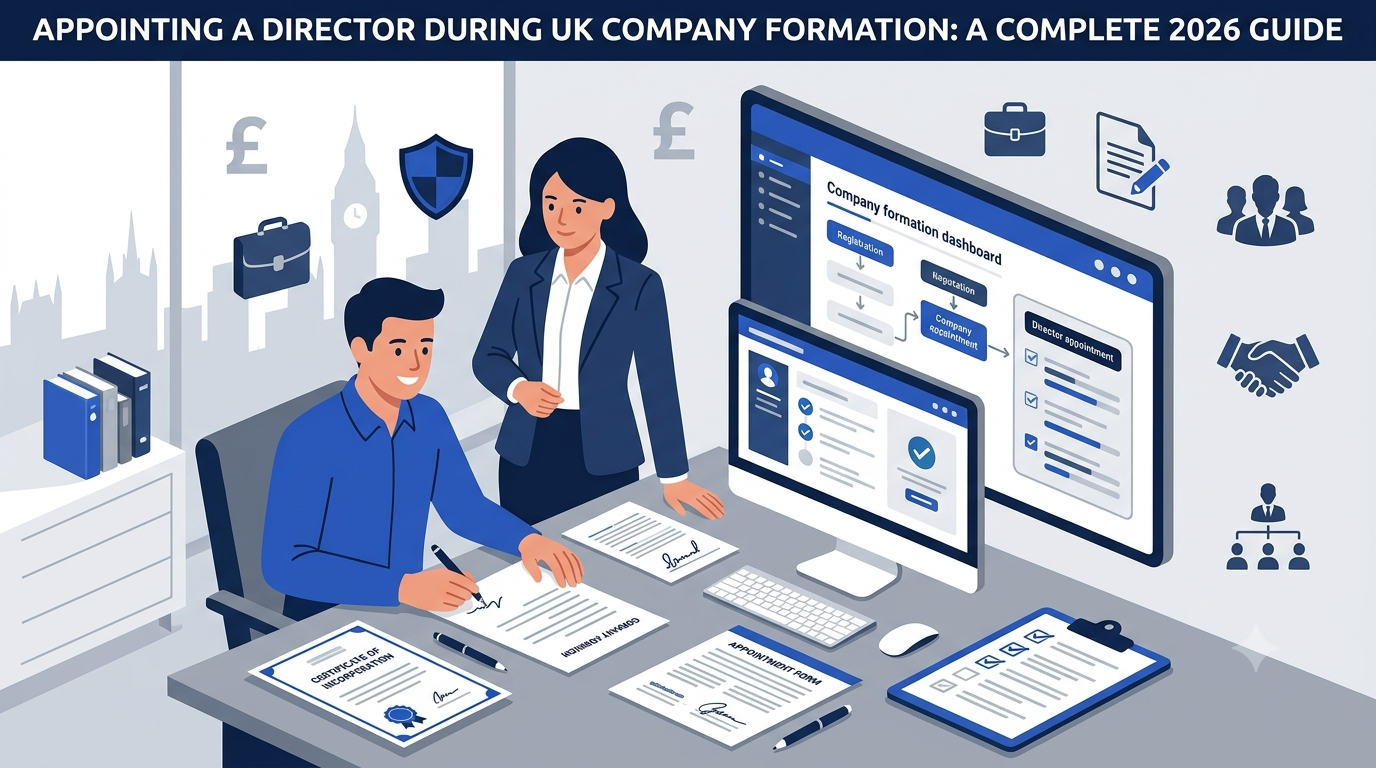
What Happens if You Need to Add or Change Directors After Formation
Company structures often change as businesses grow. If you need to appoint additional directors after formation, or if a director resigns, you can update Companies House at any time using the standard Companies House filing process, and any new director will need to complete identity verification before their appointment is filed.
We offer director appointment and resignation services as part of our ongoing support, so if your company’s structure changes, you don’t have to navigate the paperwork alone. This can also be useful if you want to formally record roles that were previously informal, such as promoting a long-standing employee to a directorship.
Common Mistakes to Avoid at Formation
A few issues come up regularly at director appointment, and they’re all preventable:
Mismatched names or details. Every element must match exactly across ID documents, Companies House records, and any supporting documents. Even a middle name inconsistency can slow things down.
Using a home address as service address. This puts your personal address on the public record. Use a professional service address instead if privacy matters.
Forgetting identity verification. IDV is not optional. Trying to file without it will fail.
Appointing too many directors upfront. More directors mean more compliance overhead. Only appoint people whose roles genuinely require it.
Overlooking the PSC declaration. If a director also owns more than 25% of the company, they must also be declared as PSC. Missing this creates compliance issues.
Poorly chosen occupation description. Something vague like “self-employed” gives Companies House and banks little information. A clear, specific description works better.
How Form My Company Helps
We handle the whole director appointment process at formation, including:
- Fast, correct UK company formation
- Proper appointment of one or more directors on your incorporation
- Compliant UK registered office address in Bolton BL1
- UK director’s service address to keep home addresses off the public register
- Identity verification (IDV) support as an ACSP for every director and PSC
- Ongoing support for director appointment, resignation, or changes after formation
This means whether you’re setting up as a sole director or forming with a founding team, every director is properly appointed, verified, and set up for compliant operation from day one.
Appoint Your Directors and Form Your UK Company Today
Appointing directors correctly at formation sets your UK company up for success. With clear roles, proper identity verification, and professional privacy in place, you can start trading confidently and stay compliant with Companies House from the start. With Form My Company, forming your company and appointing your directors is quick, transparent, and fully supported. Get started today.
Frequently Asked Questions
How do I appoint a director when forming a UK company?
You provide the director’s full details (name, date of birth, nationality, occupation, country of residence, service address, and residential address), complete identity verification for each director, and submit these as part of your incorporation filing with Companies House. We can handle the whole process for you.
How many directors does a UK company need?
At least one, who must be a natural person aged 16 or over. Most sole founders appoint just themselves as director at formation. Founding teams often appoint multiple directors to reflect their leadership structure.
Does a non-resident director need to complete UK identity verification?
Yes. Under the ECCTA, every UK company director must complete identity verification with Companies House, regardless of where they live. As an ACSP, we can complete verification remotely for non-resident directors.
What’s the difference between a director’s service address and their residential address?
The service address is the public correspondence address for the director, appearing on the Companies House register. The residential address is the director’s actual home, which is held privately by Companies House unless used as the service address.
Can I add more directors after my company is formed?
Yes. Directors can be appointed at any time after formation using standard Companies House filings. Any new director must complete identity verification before their appointment can be filed. We can handle appointment and resignation filings for you.
Do I need to appoint a company secretary as well as a director?
Not for a private limited company. Since 2008, private limited companies have not been required to appoint a company secretary, though you can still choose to appoint one if you want. Public limited companies (PLCs) do require a company secretary.
Can a director also be a shareholder?
Yes, and it’s very common. Many small businesses have a single person acting as both sole director and sole shareholder. That person is typically also declared as a Person with Significant Control (PSC), and one identity verification covers all these roles.