
To add a director to a company in the UK, check your Articles of Association, obtain the required approval, confirm the new director’s consent and identity verification, and notify Companies House using the appropriate appointment process. For an individual director, this generally involves Form AP01, which must be filed within 14 days of the appointment taking effect. Form My Company can help businesses manage director appointments and related company records.
Businesses add directors when bringing in a co-founder, appointing a senior employee, strengthening board expertise or planning a change in leadership. Although the process is manageable, each appointment must follow the company’s governing documents and current legal requirements. This guide explains how to add a director to a limited company, what information to prepare, how to handle identity verification and what to update after the appointment.
When Should You Add a Director to a Company?
A company may need to add a director at different stages of its development. Common reasons include:
- Appointing a co-founder: Formally bringing a business partner into the company’s leadership.
- Promoting an employee: Giving an experienced team member board-level responsibility.
- Expanding board expertise: Adding someone with relevant financial, operational, commercial or industry experience.
- Planning succession: Preparing for a founder or existing director to step back.
- Meeting business requirements: Responding to governance arrangements agreed with investors, lenders or other stakeholders.
- Supporting family business continuity: Appointing a family member as part of a planned management transition.
Before proceeding, decide whether the new director will also become a shareholder, employee or person with significant control. These are separate roles and may require additional steps.
What You Need Before Adding a Company Director
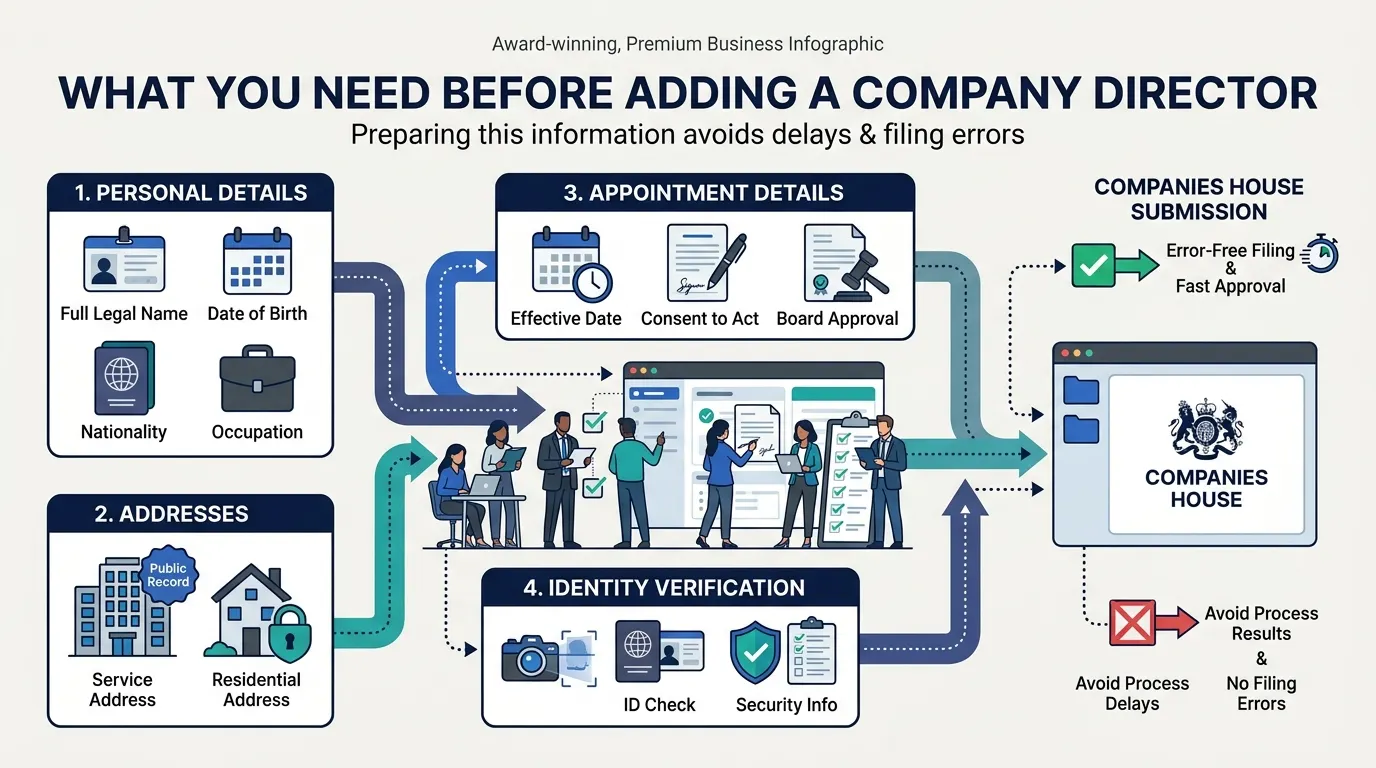
Preparing the necessary information before starting the appointment can reduce delays and filing errors.
Director Information and Documents
Gather the following details for the proposed director:
- Full legal name and any relevant former names.
- Date of birth.
- Nationality and country of residence.
- Business occupation, where required.
- Residential address and service address.
- Identity verification details and Companies House personal code, as applicable.
- Proposed appointment date.
- Confirmation that the individual consents to act as a director.
The service address is used for official correspondence and appears on the public register. A director’s residential address is generally held privately by Companies House, subject to the applicable disclosure rules.
Approval Under the Articles of Association
Review the company’s Articles of Association before making the appointment. These rules explain how directors are appointed and whether the decision must be made by the board, shareholders or another permitted route.
If a shareholders’ agreement applies, check it as well. It may contain additional approval requirements or restrictions. Record the decision appropriately in board minutes or a written resolution, and retain the relevant documents with the company’s records.
For more detail on the relationship between company rules and appointments, read our guide to the legal requirements and criteria for appointing a new company director.
How to Add a Director to a Limited Company: Step-by-Step Process
Step 1: Check the Appointment Rules
Start by confirming that the proposed appointment follows the company’s Articles of Association. Check who has authority to appoint the director, what approvals are required and whether any restrictions apply.
For example, a company’s articles may allow existing directors to appoint another director, while particular circumstances may require shareholder approval. Do not assume that every company follows exactly the same process.
Step 2: Approve and Record the Appointment
Obtain the required approval and record the decision. The documentation should identify the incoming director and establish the intended appointment date.
The new director must agree to act in that capacity. Keep a record of their consent and any relevant board or shareholder resolution.
Step 3: Complete Identity Verification
Companies House identity verification is now part of the director appointment process. The requirement began on 18 November 2025, with a transition period for existing directors and people with significant control.
A new director generally needs to complete verification through GOV.UK One Login or an Authorised Corporate Service Provider, where applicable. They must also provide the required Companies House personal code as part of the appointment filing.
The route available can depend on the individual’s circumstances and identity documents. Check the current Companies House identity verification guidance before submitting the appointment.
Step 4: Submit the Director Appointment Filing
For an individual director, Form AP01 is used to notify Companies House of the appointment. The filing requires the relevant company and director details, including the appointment date and address information.
Make sure the information matches the director’s records and identity verification details. Errors or inconsistencies can delay the process.
You can follow the official process through Companies House or use a company services provider to assist with preparing and submitting the information. For a more detailed explanation of the filing process, see our guide to appointing a director through Companies House.
Step 5: Meet the 14-Day Notification Deadline
The company must notify Companies House of the director’s appointment within 14 days of the appointment taking effect. Prepare the required information promptly so that verification and filing can be completed within the applicable deadline.
Keep confirmation of the submission and check the public company record after the filing has been processed. If you are unsure about the relevant date or filing requirements, consult current Companies House guidance.
Step 6: Update Company Records
Once the appointment has been made, review the company’s internal records and other business arrangements. Depending on the circumstances, this may include:
- Updating the company’s register of directors and related records.
- Reviewing the register of people with significant control and making any required separate notifications.
- Informing the company’s bank if its mandate or authorised signatories are changing.
- Updating employment and payroll records if the director will also be an employee.
- Reviewing insurance, contracts, delegated authorities and internal approval procedures.
- Completing separate share transfer or share allotment steps if the director is also receiving shares.
The Companies House appointment filing does not automatically update every third-party record or complete every related company change.
Can You Add a Director Without Giving Them Shares?
Yes. A director does not have to be a shareholder simply because they are appointed to the board. Directorship and share ownership are separate roles.
A business may appoint an experienced manager or independent board member without giving them an ownership interest. Equally, an existing shareholder may become a director if the appointment is properly authorised.
If the new director is also receiving shares, the company should handle that separately through the relevant share transfer or allotment process. The company should also assess whether the change affects its people with significant control information.
How to Add a Non-Resident Director to a UK Company
A person does not generally need to be a UK resident or British national to become a director of a UK limited company. However, the company must still follow the applicable appointment and identity verification requirements.
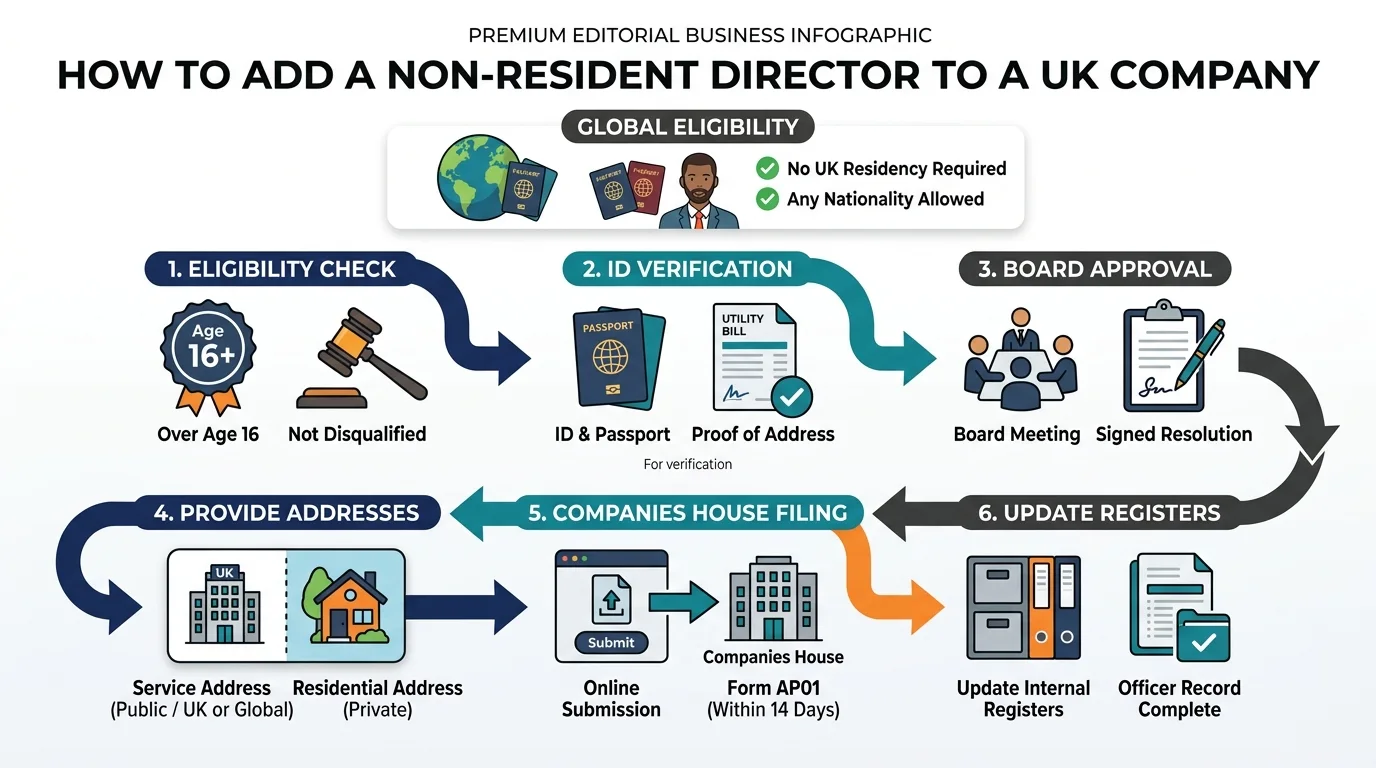
Before appointing a non-resident director, consider these points:
- Identity verification: Confirm the available verification route and the required Companies House personal code.
- Address details: Collect the required residential and service addresses.
- Company governance: Follow the same relevant approval procedures set out in the company’s articles.
- Banking arrangements: Check whether the company’s bank needs updated information or additional checks.
- International considerations: The appointment may have tax or reporting implications in the director’s country of residence, depending on the circumstances.
A professional service address may help keep a director’s home address off the public register when used appropriately. It does not replace the requirement to provide accurate residential address information to Companies House.
Common Mistakes When Adding a Director
A few avoidable errors can delay an appointment or leave company records incomplete.
Ignoring the Articles of Association: Check the appointment procedure and obtain the required approval before filing.
Leaving identity verification until the last minute: Allow time to complete the required checks and obtain the relevant personal code.
Submitting inaccurate details: Verify the director’s name, addresses, appointment date and other required information before filing.
Missing the notification deadline: The appointment must be notified within the applicable 14-day period.
Assuming shares are included: A directorship does not automatically transfer or issue shares.
Forgetting related records: Review the PSC position, bank mandate, employment records and internal company documentation where relevant.
Confusing individual and corporate directors: Different rules and filing procedures may apply. If your company is considering a corporate director, read our guide to whether a corporate entity can be a UK company director.
For further background on appointment forms and filing requirements, see our guide to director appointment forms and Companies House.
When Is Professional Support Useful?
Many straightforward appointments can be handled by a company’s directors or administrators, provided they understand the company’s rules and the filing requirements. Professional support may be useful where:
- The incoming director lives outside the UK.
- Several directors are being appointed at the same time.
- The appointment forms part of an investment or ownership change.
- Identity verification or personal-code requirements need clarification.
- The company’s articles or shareholders’ agreement contain specific approval provisions.
- The company is changing directors while also updating other company records.
Form My Company supports businesses with director appointment filings, identity verification and related administration. The appropriate service depends on the changes your company needs to make and whether the appointment is part of a wider board transition.
How Form My Company Can Help
Form My Company can help businesses prepare and manage director appointments, including the relevant filing and identity verification steps. Support may include preparing the appointment information, assisting with the applicable Companies House process and identifying related record updates.
If you need assistance with a director appointment, explore our Director Appointment and Resignation service. Review the service scope to confirm that it matches your company’s requirements.
Frequently Asked Questions
How do I add a director to a company?
Check the Articles of Association, obtain the required approval, confirm the individual’s consent, complete identity verification and submit the appropriate appointment filing to Companies House. For an individual director, Form AP01 is generally used, and the appointment must be notified within 14 days of taking effect.
What form is used to add a director to a limited company?
Form AP01 is used to notify Companies House of an individual director’s appointment. Different procedures may apply in cases involving corporate directors, so check the current official guidance for the company’s circumstances.
Does a new director need identity verification?
Yes. Identity verification is part of the Companies House requirements for directors. New directors must follow the applicable verification process and provide the required personal code for their appointment filing.
Can I add a director who lives outside the UK?
Generally, yes. UK residence is not usually required for a director of a UK limited company. The individual must still meet the applicable requirements, including identity verification, and the company must follow its normal appointment procedures.
Does adding a director automatically give them shares?
No. A director can serve without owning shares. If the company intends to transfer or issue shares to the new director, that requires a separate process.
How long does it take to add a director?
The overall time depends on how quickly the company obtains approval, the director completes identity verification and the filing is submitted and processed. Preparing accurate information in advance helps reduce avoidable delays.
Can I add a director without shareholder approval?
It depends on the company’s Articles of Association and any relevant shareholders’ agreement. The appointment must follow the rules that apply to that company.
Add a Director to Your Company with Form My Company
Adding a director helps a company adapt as its leadership, expertise and responsibilities change. Following the correct approval, verification and filing steps helps keep the company’s records accurate and supports good governance.
If you need help with the process, visit Form My Company’s Director Appointment and Resignation service to review the available support and take the next step.