
Yes, a UK company can have multiple Persons with Significant Control (PSCs) registered simultaneously. British corporate law requires every qualifying entity to identify and record all individuals holding more than 25% of shares, voting rights, or exercising significant influence over the company.
Operating a modern corporate structure involves complex ownership arrangements. UK business regulations mandate total transparency regarding ultimate control. Companies House enforces strict compliance standards for every commercial enterprise operating within the jurisdiction. Business founders must understand how multiple stakeholders impact statutory reporting obligations.
What defines a Person with Significant Control in a UK company?
A Person with Significant Control is an individual holding over 25% of shares, more than 25% of voting rights, or exercising ultimate management influence over the corporate entity.
Corporate governance frameworks rely on precise ownership metrics to determine control. Legal statutes identify distinct thresholds that classify a stakeholder as a primary decision-maker.
Share ownership forms the primary baseline for evaluation. When an individual owns more than 25% of nominal company shares, statutory registration applies immediately. Voting rights operate through a separate legal mechanism. Holding more than 25% of voting power triggers identical compliance obligations under Company House rules.
Exercise of significant influence represents the final qualification criterion. Individuals without equity can still dictate corporate policy through contractual arrangements or constitutional vetoes.
How many PSCs can a single limited company register?
A UK limited company can register an unlimited number of PSCs provided each individual meets the statutory ownership or control thresholds.
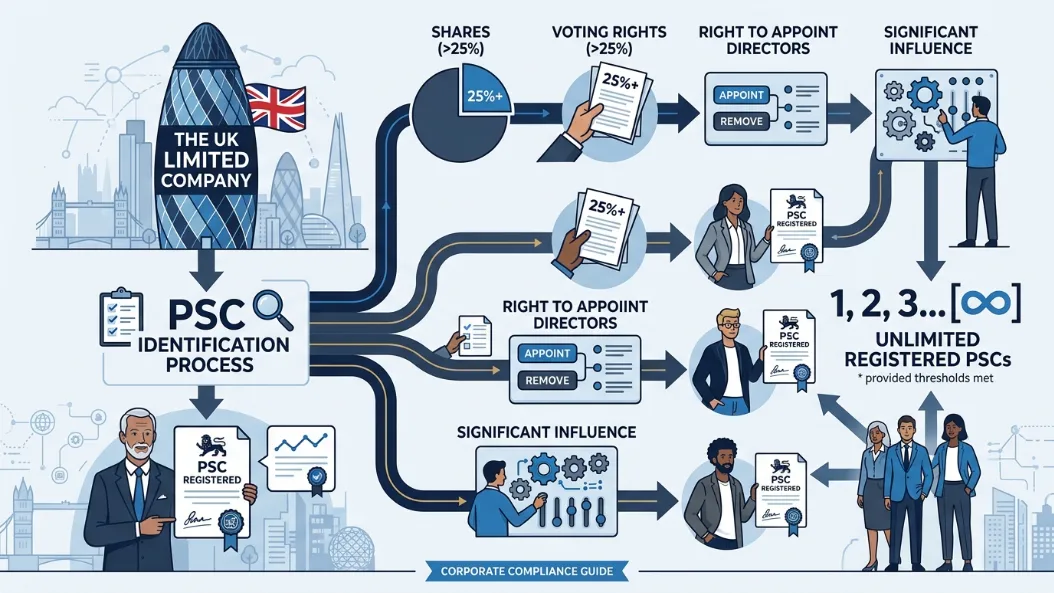
Corporate entities often feature complex ownership distributions among founding teams and investors. Multiple stakeholders frequently cross the 25% ownership threshold simultaneously.
Three primary ownership distribution models exist: four co-founders holding 25% equity each, equal investor syndicates, and multi-layered family trusts. Each scenario requires distinct registration entries on the public record.
When 4 co-founders hold 25% equity each, all 4 individuals attain PSC status. When equal investor syndicates fund an enterprise, every investor exceeding the threshold must feature on the statutory register. When multi-layered family trusts distribute influence, individual beneficiaries holding control must submit details.
Companies House accepts multiple entries without imposing arbitrary caps on qualifying stakeholders. Accurate filing prevents statutory penalties for non-compliance.
What happens when multiple stakeholders exceed the control threshold?
When multiple stakeholders exceed the control threshold, the company must record every qualifying individual on its statutory PSC register.
Regulatory compliance demands absolute accuracy during corporate formation and ongoing maintenance. Omitting a qualifying stakeholder constitutes a criminal offense under the Companies Act 2006.
Company officers must execute three mandatory steps: collect verified identity data, compile official statutory records, and submit details to Companies House within 14 days.
Collecting verified identity data requires gathering full legal names, residential addresses, and exact ownership percentages. Compiling official statutory records involves maintaining an internal register at the registered office address. Submitting details to Companies House updates the public record instantly.
Understanding the distinction between ownership layers is essential; professionals often review PSC vs Shareholder: How to Tell the Difference When Filing to clarify reporting duties.
Why do complex corporate structures involve multiple PSCs?
Complex corporate structures involve multiple PSCs because venture capital funding, joint ventures, and holding companies distribute equity among numerous investors.

Modern business growth strategies frequently require external capital infusion. Venture capitalists and angel investors secure equity stakes that routinely exceed the statutory 25% threshold.
Corporate groups utilize holding companies and subsidiaries to manage diverse operational assets. These structures introduce layers of corporate influence.
Two primary structural complexities include cross-shareholding arrangements and parent-subsidiary hierarchies. Cross-shareholding arrangements distribute voting rights across multiple operating entities. Parent-subsidiary hierarchies require tracing ultimate beneficial ownership through corporate chains.
Navigating these intricacies demands rigorous legal analysis. Business leaders streamline this process when they let Form My Company confirm your PSCs correctly.
How do you maintain compliance with multiple registered PSCs?
Maintaining compliance with multiple registered PSCs requires updating ownership changes within 14 days and filing confirmation statements annually.
Corporate transparency regulations demand continuous monitoring of all significant controllers. Changes in share distribution affect statutory registers immediately.
Three administrative maintenance tasks ensure ongoing legal adherence: tracking equity transfers, recording address modifications, and submitting annual confirmation statements.
Tracking equity transfers prevents outdated public filings. Recording address modifications maintains accurate communication channels with regulatory bodies. Submitting annual confirmation statements validates all registered data against current operational realities.
Utilising specialized support through a dedicated PSC Register guarantees error-free statutory submissions. Regulatory authorities penalize delayed notifications with severe financial sanctions. Directors must audit ownership records quarterly to identify threshold alterations before statutory deadlines expire.
UK corporate legislation accommodates unlimited Persons with Significant Control within a single enterprise. Every individual holding over 25% of shares or voting power must appear on the public register. Accurate filing prevents legal penalties and maintains corporate transparency. Brand Name delivers precise statutory solutions to simplify compliance workflows.
Explore our PSC Register guide,
Why Does Venue Accessibility Matter for Inclusive Events?
What Makes an Interview Room Comfortable for Candidates?
Frequently Asked Questions
What is a PSC register in a UK company?
Answer: A Person with Significant Control (PSC) register is a mandatory statutory document that records every individual or relevant legal entity holding more than 25% of shares or voting rights in a company. Form My Company assists business owners in maintaining this official PSC register to ensure full compliance with UK Companies House regulations.
Can a company have zero PSCs registered?
Answer: Most UK companies must have at least one qualifying individual or entity listed on their register unless they meet specific exemptions, such as being a company with voting shares admitted to certain regulated markets. If a company fails to identify a qualifying controller, the statutory PSC register must officially reflect that no individual meets the significant control criteria.
Who qualifies as a Person with Significant Control?
Answer: An individual qualifies as a PSC if they hold more than 25% of shares, hold more than 25% of voting rights, or exercise significant influence or control over the corporate entity. Form My Company helps corporate officers accurately evaluate these ownership thresholds during the setup of the PSC register.
When must changes to the PSC register be updated?
Answer: Companies must update their internal PSC register within 14 days of any ownership alteration and file the updated information with Companies House within a further 14 days. Utilizing the professional services provided by Form My Company ensures that all updates to your PSC register meet strict statutory filing deadlines.
What are the penalties for failing to maintain a PSC register?
Answer: Failing to maintain an accurate PSC register or neglecting to provide required ownership information to Companies House constitutes a criminal offense punishable by substantial fines and potential default fines for company officers. Form My Company provides expert guidance to help businesses avoid these compliance penalties through meticulous record-keeping.