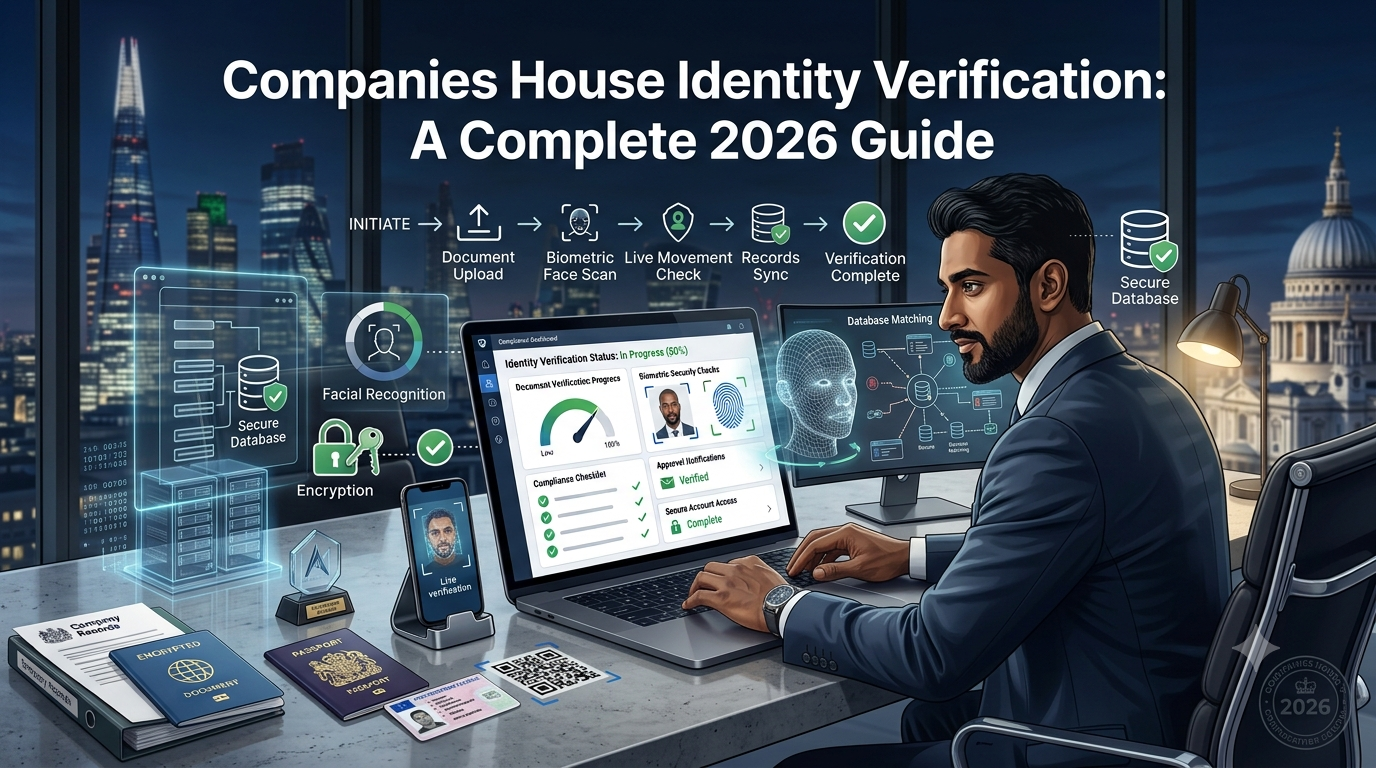
Companies House Identity Verification
Companies House identity verification is one of the most significant changes to UK company law in decades. Under the Economic Crime and Corporate Transparency Act (ECCTA), every director, Person with Significant Control (PSC), and LLP member of a UK company must verify their identity with Companies House. This isn’t optional, it isn’t limited to new companies, and it applies just as much to non-residents as UK-based directors. At Form My Company, we’re an Authorised Corporate Service Provider (ACSP), and we help directors and PSCs meet the requirement whether they’re forming a new company or already in role. This guide explains everything you need to know about Companies House identity verification in 2026.
What Is Companies House Identity Verification?
Companies House identity verification (often called IDV) is a legal requirement introduced under the ECCTA to confirm that the people listed as directors, PSCs, and LLP members of UK companies are real, verified individuals. The goal is to tackle fraud, disguised ownership, and misuse of corporate structures by putting reliable identity checks at the heart of UK company law.
Once verified, an individual receives a unique personal code confirming their verified status. This code stays with them across all their UK company roles, present and future, so they generally don’t need to re-verify for each new appointment.
Verification was voluntary from 8 April 2025, then became mandatory for all UK company directors and PSCs at Companies House from 18 November 2025. Enforcement continues to expand through 2026.
Who Needs to Verify?
Identity verification applies to:
- Directors of UK limited companies. Every director of a UK company, whether the company is active or dormant.
- Persons with Significant Control (PSCs). Anyone who owns or controls more than 25% of shares or voting rights, or who exercises significant influence over the company.
- Members of LLPs. Members of Limited Liability Partnerships, including designated members.
- Filing agents at Companies House. People filing on behalf of companies must be verified themselves.
- Shadow directors. People who habitually direct the company from behind the scenes, even without formal appointment, are included.
There are limited exemptions for national security or the prevention of serious crime, but for the overwhelming majority of directors and PSCs, verification is a legal obligation.
Why This Change Happened
The ECCTA was designed to tackle serious economic crime, disguised ownership, and misuse of UK company structures. Before the reforms, Companies House operated largely as a passive filing service where anyone could be listed as a director, sometimes with fictitious details.
By requiring verified identities:
The register becomes more reliable. Companies, banks, investors, and the public can trust that names on the register are real people.
- Fraud becomes harder. Fake director appointments, used in shell company scams and identity theft, become much more difficult.
- Beneficial ownership is genuinely transparent. Combined with PSC disclosure, verification means the people who actually own and control companies are known and confirmed.
- Companies House gains enforcement power. With verification data, Companies House can pursue offenders more effectively.
The changes were part of a wider modernisation that also gave Companies House expanded powers to query filings, investigate suspicious structures, and strike off companies formed on a false basis.
The Two Verification Routes
There are two ways to complete Companies House identity verification, and both give you the same verified status:
Route 1: Direct verification with Companies House.
You verify directly with Companies House using the GOV.UK One Login service. This is done either:
- Through the One Login app on a mobile device
- In-person at a UK post office (which is free but only practical for UK residents)
Route 2: Verification through an Authorised Corporate Service Provider (ACSP).
An ACSP is a regulated corporate services firm authorised under the ECCTA to verify identities on behalf of Companies House. They handle the verification, confirm it to Companies House, and issue you your unique personal code.
Both routes produce the same “verified” status, but they suit different situations.
Which Route Should You Choose?
For most UK-resident directors with a standard biometric passport, direct verification works well. It’s typically free (unless you use the paid post office route in some circumstances) and reasonably fast through the app.
An ACSP is often the smoother choice when:
- You’re a non-resident. International passports and unusual document types are handled more reliably through ACSPs, whose compliance teams have experience with a wide range of IDs.
- You have edge cases in your documents. Name changes, old passport formats, or minor mismatches can trip up the automated app. ACSPs can resolve these faster.
- You want combined services. ACSPs often bundle identity verification with company formation, ongoing compliance, and filings, so you don’t juggle multiple providers.
- You need faster resolution. ACSPs can typically process verifications in minutes and have direct support if issues come up.
- You need it as part of a bigger process. For example, verifying multiple directors alongside a company formation, or verifying a new director as part of a director change filing.
For non-residents especially, the ACSP route is usually the practical choice. As an ACSP, Form My Company handles identity verification remotely for directors and PSCs from anywhere in the world.
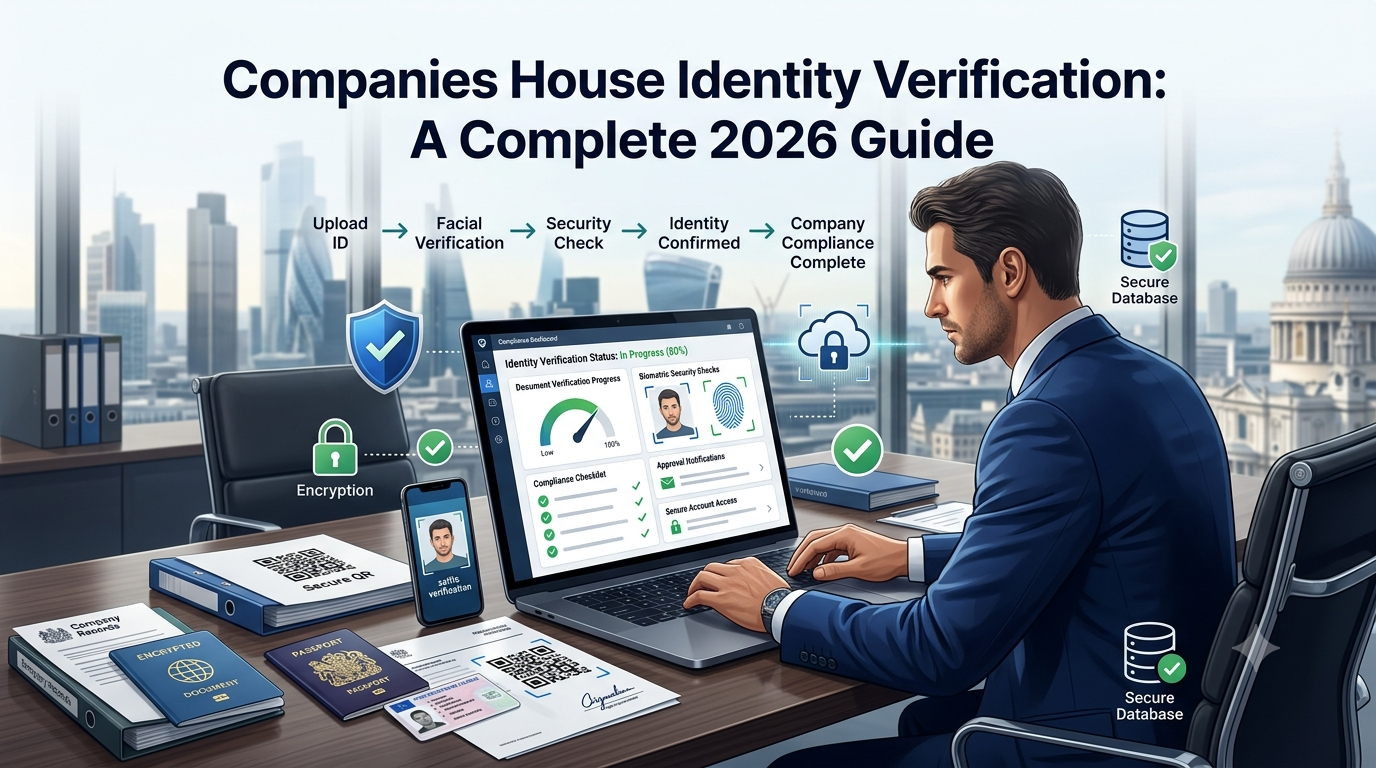
What You Need to Verify
Whichever route you take, you’ll generally need:
- A valid, in-date government-issued photo ID. A biometric passport is the most widely accepted document worldwide. UK driving licences and some national ID cards may also work depending on the route.
- Biometric verification. Usually a selfie or short video prompt through a mobile app, confirming you’re a real person matching your ID.
- Personal details. Your full legal name (matching your ID exactly), date of birth, and residential address (held privately, unlike your service address).
- Consistent information. Everything must match across your ID, any supporting documents, and your Companies House record. Mismatches are the single most common cause of verification delays.
For non-residents, having a good-quality biometric passport is usually sufficient. UK residents have more document options.
Deadlines and the Transition Period
The timing of when you need to verify depends on your situation:
- New directors and PSCs (from 18 November 2025). Anyone appointed as a director or newly meeting the PSC threshold on or after this date must complete verification before the appointment is filed. This applies to new companies at incorporation and to new appointments at existing companies.
- Existing directors and PSCs. Anyone in role before 18 November 2025 has a transition period to comply. Existing PSCs who aren’t directors of the same company generally need to verify by the 14th of their birth month (for example, if you were born in March, the deadline is 14 March 2026). Existing directors typically verify aligned with their next confirmation statement filing.
- Filing agents. People filing at Companies House must have their identity verified by spring 2026, which affects who can submit documents on your behalf.
- Ongoing. Beyond the transition period, verification becomes a routine part of company formation, director appointments, and Companies House interactions.
If you already have verification, your unique personal code stays with you across all UK company roles, so future appointments don’t usually require re-verification.
What Happens If You Don’t Verify
The consequences of non-compliance are significant and enforced:
- You can’t legally act as a director. Acting as an unverified director is a criminal offence under UK company law.
- Companies House filings can be blocked. Statutory filings can be rejected until verification is complete.
- Personal penalties. Fines of up to £30,000 per offence can apply, along with potential director disqualification for up to 15 years.
- Criminal sanctions. Deliberate evasion can lead to criminal prosecution, with Companies House now empowered to pursue this.
- Company strike-off risk. In serious cases, Companies House can begin strike-off proceedings against companies where directors haven’t complied.
- Practical disruption. Filings blocked because of unverified directors can cause knock-on issues with banking, contracts, and business operations.
These aren’t theoretical. Companies House is actively rolling out enforcement, and the enhanced powers under the ECCTA make consequences real.
What Verification Actually Involves
The process itself is designed to be quick, though careful preparation makes a real difference. Broadly:
- Prepare your ID and details in advance. Have your biometric passport ready, know your full legal name and residential address as they appear on your Companies House record, and make sure everything matches.
- Complete the verification steps. Whether directly or through an ACSP, you’ll go through document upload and biometric checks.
- Receive your unique personal code. Once verified, you get a personal code confirming your status.
- Update your Companies House record. The verification is reflected on your Companies House profile.
- Use your code for future appointments. If you take on new roles at other UK companies, your existing code satisfies the verification requirement.
Straightforward cases are often completed in minutes. More complex cases with document issues or unusual circumstances can take longer.
Common Issues and How to Avoid Them
A few problems come up regularly:
- Blurry ID photos. Follow the app or ACSP instructions carefully for lighting and angle.
- Name mismatches. If your Companies House record shows a slightly different name from your passport (an extra middle name, an old name, a punctuation difference), the verification can fail. Update your Companies House record first if needed.
- Expired ID. Check your passport is in date before starting.
- Legal name changes. If you’ve changed your name since being appointed, you may need to provide supporting documentation.
- Address mismatches. Your residential address at Companies House must match what you provide during verification.
- Unusual document types. National ID cards from countries not on the accepted list can create issues. A passport is usually a safer choice.
- Poor internet connection. Biometric verification depends on the app working reliably. Complete on a stable connection.
- Waiting until the deadline. Verification is usually quick but can occasionally have complications. Doing it well ahead of any deadline avoids stress.
Identity Verification and Non-Residents
For non-resident directors and PSCs, the same requirements apply, but a few practical points matter:
- No exemption for non-residents. UK law places no residency requirement on directors, but the verification requirement applies just as it does to UK-based directors.
- Biometric passport is essential. Most non-residents verify using their national passport. A biometric one is best.
- The ACSP route is usually smoother. For handling international documents, time zones, and edge cases.
- The verification is remote. You don’t need to visit the UK. As an ACSP, we handle non-resident verifications remotely through our secure platform.
No re-verification needed for each UK role. Once you have your unique personal code, it applies to all your UK company appointments.
For non-residents, planning verification alongside company formation, incorporation of a new UK entity, or a director appointment is usually the cleanest approach.
How Form My Company Helps
As an Authorised Corporate Service Provider (ACSP), we handle Companies House identity verification for directors, PSCs, and LLP members. Whether you’re forming a new company, being appointed to an existing one, or catching up as an existing director, we can:
- Complete your identity verification remotely, wherever you’re based
- Issue your unique personal code and confirm status to Companies House
- Handle verifications for multiple directors and PSCs in one process
- Bundle verification with company formation, director appointments, and ongoing compliance
- Support non-resident directors with international identity documents
- Coordinate with confirmation statement filings and other Companies House interactions
- Help you resolve any edge cases like name changes or unusual document types
For non-resident directors especially, our ACSP service is designed to make what can otherwise be a fiddly process feel simple.
Meet Your Identity Verification Requirement Today
Companies House identity verification is now a fundamental part of running a UK company, and the consequences of not meeting the requirement are real. Whether you’re a UK-based director or a non-resident owner running a company from abroad, getting verified promptly protects your ability to act as a director and keeps your company’s filings on track. With Form My Company, verification is quick, remote, and fully supported as part of our ACSP services. Get in touch today and meet the requirement without any complications.
Frequently Asked Questions
What is Companies House identity verification?
It’s a legal requirement introduced under the ECCTA that requires all UK company directors, PSCs, and LLP members to verify their identity with Companies House. It became mandatory on 18 November 2025 and is designed to tackle fraud and disguised ownership.
Who needs to verify their identity?
All UK company directors (including of dormant companies), Persons with Significant Control (typically anyone owning or controlling 25% or more), LLP members, filing agents, and shadow directors. There are limited exemptions for national security purposes.
What’s the difference between direct verification and using an ACSP?
Both routes produce the same verified status and issue you a unique personal code. Direct verification uses GOV.UK One Login (via the app or in-person at a post office). An ACSP handles the verification on your behalf, which is often smoother for non-residents or edge cases.
How long does verification take?
For straightforward cases with a valid biometric passport, verification through an ACSP is often completed within minutes. Direct verification through the One Login app is similarly quick. More complex cases with document issues can take longer.
Do non-residents need to verify?
Yes. There is no residency-based exemption. All directors and PSCs of UK companies must verify regardless of where they live. The ACSP route is often smoother for non-residents with international documents.
What happens if I don’t verify?
Acting as an unverified director is a criminal offence. You can’t legally act as a director, statutory filings can be blocked, and penalties include fines up to £30,000 per offence, director disqualification for up to 15 years, and potential criminal prosecution.
Do I need to verify separately for each UK company role?
No. Verification is generally a one-off exercise. Once you receive your unique personal code, it applies to all your UK company roles (director, PSC, LLP member) present and future.