
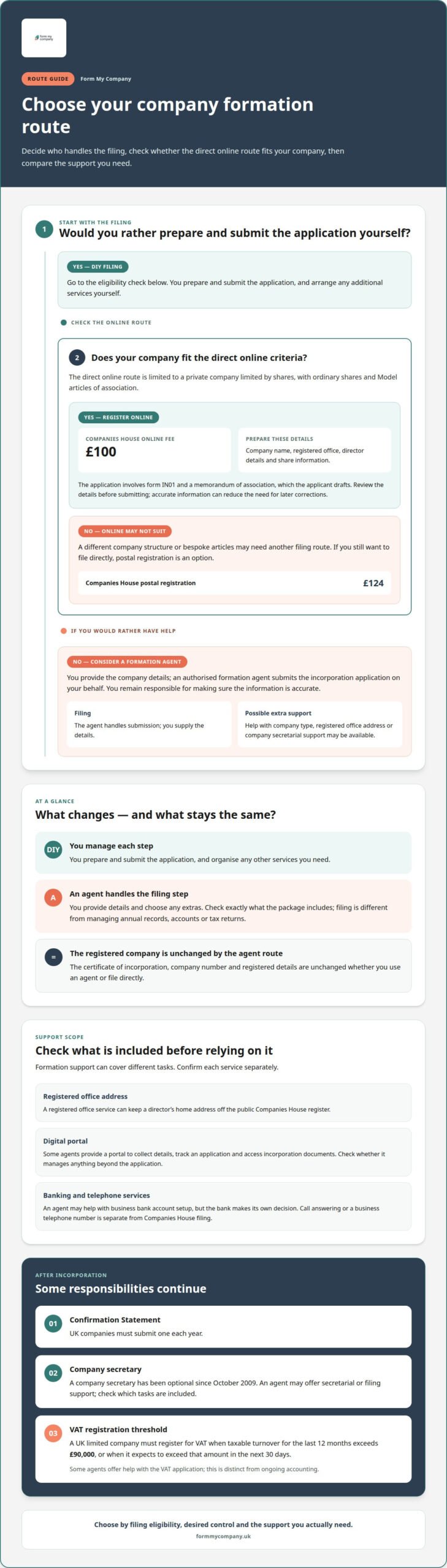
The DIY company formation vs using an agent decision isn’t just about who submits the paperwork. Registering a limited company online yourself costs £100, according to Companies House; an agent submits the incorporation application on your behalf and may provide additional support. Both routes lead to a company registered with Companies House, but the process and available options differ.
It’s reasonable to want to keep control of the details and avoid paying for help you don’t need. The right route depends on how confident you are completing the forms, whether you want support with setup, and which company structure you plan to register.
This guide explains what formation agents do and how to register directly with Companies House. Compare the routes on cost, speed, control and company structures to choose the approach that fits your plans.
Key Takeaways
- Decide whether you want to handle the incorporation details yourself or have an agent submit the application and support the setup.
- Compare the direct Companies House filing fee with the value of any extra help you need, rather than judging the routes on cost alone.
- Understand how online and postal applications differ in speed, and what can affect how quickly your company is incorporated.
- Choose a structure that fits how the business will operate, including whether a limited company or an LLP is the better route.
- Know which responsibilities continue after registration, including when VAT registration becomes necessary.
What does a company formation agent do?
A company formation agent prepares and submits an incorporation application to Companies House on your behalf. You provide the company details, including its proposed name, directors and share information; the agent enters and files them. This can reduce the form-filling you handle, but you remain responsible for ensuring the information is accurate.
Support can extend beyond registration. Formation services may include help choosing a company type, a registered office address or ongoing company secretarial support. A registered office service can keep a director’s home address off the public Companies House register. Compare each service separately so you know what the formation package includes and what you may need afterward.
Some agents use digital portals to collect company details, track an application and provide access to incorporation documents. This can keep the process and paperwork together. Check what the portal actually handles: submitting an application is different from managing annual records or providing advice on running the company.
Tax and filing responsibilities continue after incorporation. UK companies must submit a Confirmation Statement each year, and a company secretary has been optional since October 2009. An agent may offer secretarial or filing support, but that doesn’t mean every agent manages accounts or tax returns. Agree which tasks are included before relying on an agent to keep records up to date.
VAT registration is another separate step. HM Revenue & Customs says a UK limited company must register for VAT when its taxable turnover for the last 12 months exceeds £90,000, or when it expects to exceed that amount in the next 30 days. Some agents offer VAT registration assistance. That support can help with the application, but it’s distinct from ongoing accounting.
An agent may also help with business bank account setup, but the bank makes its own decision about opening an account. Telephone services are separate from Companies House filing. Call answering or a business telephone number can support daily operations, but don’t assume they’re included with incorporation. Compare each service against what your business needs.
The main difference is how much administration you handle yourself. Use this table to compare the routes:
| Option | Filing | Additional support | Control |
|---|---|---|---|
| DIY registration | You prepare and submit the application | You arrange any other services | You manage each step |
| Formation agent | The agent submits the application for you | May include address, secretarial or tax-registration support | You provide details and choose any extras |
Choose DIY if you’re comfortable preparing and filing the application. Consider an agent if you want help with submission or related setup tasks.
How do you register a company directly with Companies House?
Direct registration means you prepare and submit the application yourself rather than asking an agent to file it. A registered office is the company’s official address; a director’s service address is the address used for that director’s public contact details.
DIY registration through Companies House
For a straightforward private company limited by shares, start with the online application. Companies House says online registration costs £100. You’ll need to provide the company name, registered office, director details and share information. The application also involves form IN01 and a memorandum of association, which the applicant drafts. Direct online registration is limited to companies with ordinary shares and Model articles of association.
Review every detail before submitting. Accurate information can reduce the need for corrections later. The direct online route does not suit every structure or bespoke set of articles. If your plans fall outside its limits, another filing route may be needed.
Agent and direct registration routes
An authorised formation agent can access Companies House filing systems directly and submit the incorporation application for you. You supply the company details, but the agent handles the filing step. Direct registration gives you more control over preparing and entering the application yourself. The resulting company’s certificate of incorporation, company number and registered details are unchanged by using an agent.
Postal filing is another direct route. Companies House says postal registration costs £124. Compare that with its £100 online fee, then consider the extra work involved in preparing and sending the application. An agent can be useful when you want support with the submission or the setup process, rather than simply a way to lodge paperwork.
Companies House as registrar
Companies House is the UK government registrar. Its role is to process incorporation documents, not advise you on which business structure suits your plans. Direct registration gives you a way to submit the application, but not tailored business advice. A formation agent may offer help with company types or names alongside filing, depending on its services.
Consider the structure and application details before you start. Direct online registration is designed for private companies limited by shares using ordinary shares and Model articles. A different structure or articles may need another filing route. Choose according to the application’s eligibility and how much guidance you want, not just the filing method.
For a company that fits the online criteria, prepare the required details and submit directly. If you prefer assistance with the filing, consider company formation support as part of your next step.
Incorporation speed
A straightforward online application can take around 15-30 minutes to complete, but submission time and incorporation time are different. For a UK limited company, online registration is usually completed within 24 hours; postal registration takes 8-10 days.
To form a company, prepare its proposed name, registered office address, director and share details, and information for the persons of significant control (PSC) register. The name must be available. The application includes Companies House form IN01 and a memorandum of association, drafted by the applicant. These details and documents give Companies House the information needed to process incorporation.
Online filing is the faster route for a straightforward application. Postal filing adds delivery and processing time, so allow longer if you choose paper. An agent can often incorporate a new company within one day, while its online application may take only a few minutes to complete. An agent’s filing speed does not remove the need to supply accurate company details.
Preparation affects the overall timeline. Decide which structure you need and gather the relevant incorporation information before starting. Companies House processes incorporation documents as registrar; it does not advise on business structures. A formation agent can guide you on company types and documents, helping you understand the choices before filing. Clear, accurate details can also help avoid corrections later.
Incorporation is the start of the company’s filing responsibilities, not the end. A company must register for Corporation Tax with HMRC within three months of starting to trade. Its first accounts are due at Companies House 21 months after registration. After the first year, annual accounts are due nine months after the financial year end.
Plan for tax and annual filings alongside that first accounts deadline. Corporation Tax is payable nine months and one day after the end of each accounting period. The Company Tax Return is due 12 months after that period ends. A Confirmation Statement must also be submitted each year. These dates depend on different events, so keep the relevant start-of-trading, registration and accounting-period dates together.
For a faster route, submit online once the structure and details are ready. Choose postal registration if paper filing suits your needs and its longer timeline works for your plans. If you want guidance before filing, a formation agent can support the application, but accurate details are still essential.
Company structures including limited companies and LLPs
The structure you choose affects which incorporation route fits your plans. UK options include a private company limited by shares, a private company limited by guarantee, a limited liability partnership (LLP) and a public limited company (PLC). A formation agent can register these structures, while direct online registration is more limited.
For a small startup, a director will often also be a shareholder. That can make a private company limited by shares a natural structure to consider, especially if the founders expect to hold shares. Before filing, decide who the shareholders will be and how the share structure should reflect their intended involvement.
Give the share structure attention during incorporation, not as an afterthought. An agent may support more complex applications involving multiple share classes, overseas directors, group structures or industry-specific setups. These can involve more decisions than a straightforward company with one director who is also its shareholder. Direct online filing is limited to companies limited by shares with ordinary shares and Model articles.
Articles of association are another part of the decision. Direct online registration uses the standard Model articles, so consider whether they fit the company’s intended structure. If you’re weighing different share classes or a group arrangement, guidance before filing can help you understand the options and provide consistent application details. Companies House acts as registrar, not business adviser.
An LLP is a distinct structure to consider when the business is intended to operate as a limited liability partnership rather than a company limited by shares. A formation agent can register an LLP, whereas the direct online route for companies limited by shares does not cover every structure. Choose according to the structure the business needs, not simply which application looks shortest.
A company limited by guarantee and a PLC are also structures a formation agent can register. They differ from a private company limited by shares and an LLP, so decide on the structure before preparing incorporation documents. If the proposed setup includes several shareholders or share classes, let the intended ownership arrangement guide your choice.
Use this sequence to narrow the options:
- Identify whether the business is intended to be a limited company, an LLP or another listed structure.
- For a company limited by shares, decide who will hold shares and whether ordinary shares suit the plan.
- Consider whether the direct route’s Model articles fit, or whether the setup needs specialist guidance.
- Choose an agent when the structure or share arrangements call for support beyond a standard application.
The Companies House fee is only one part of the decision. First settle the structure, shareholders and articles; then choose a filing route that fits the application.
Company formation agents
A formation agent coordinates incorporation tasks; it does not change the company’s legal status. The agent submits the Companies House application using details you provide. Depending on the package, support may also include a registered office address, company documents or later filing assistance. Compare these tasks individually. The practical question in DIY company formation vs using an agent is how much administration you want help managing.
A package may combine several services, so look at what it includes rather than its label. One may focus on online incorporation; another may add printed documents or an address service. For example, a founder who wants to keep a home address private may value a registered office address. If you only need the application filed, you may not need that extra support.
Ask what support is provided after incorporation. Companies must submit a Confirmation Statement each year, and an agent may offer help with that filing. It is separate from forming the company. A registered office service does not automatically include accounts, tax returns or every Companies House deadline. List the specific tasks you want covered, then compare them with the package.
Agents can be useful when an application involves more than a straightforward setup. Examples include overseas directors, multiple share classes, group structures or industry-specific arrangements. An agent can help organise incorporation details and explain available structures. This may reduce your administrative work, but directors remain responsible for the information submitted on the company’s behalf.
Think of the agent as a filing partner, not a substitute for every professional service. Companies House processes incorporation documents as registrar; it does not provide business advice. An agent can help with formation choices, but ongoing accounting and tax work are separate services. In the DIY company formation vs using an agent decision, identify these boundaries before selecting a package, especially if you expect support beyond registration.
Use these steps to assess whether an agent’s package fits:
- List the incorporation tasks you want handled, such as preparing and submitting the application.
- Separate immediate needs, like a registered office address, from later filings.
- Establish whether Confirmation Statement assistance is included or available separately.
- For overseas directors or multiple share classes, consider whether application guidance would help.
- Keep responsibility for checking company details clear, even when an agent submits them.
DIY formation may suit a simple application you’re comfortable preparing. An agent may fit better when you need coordinated filing, an address service or help with a more involved structure. Explore company formation options to choose a route that matches your setup needs.
Form My Company
Form My Company offers formation packages to help you prepare and submit your application. The Digital Package and Digital & Print Package provide formation options, while the Entrepreneurs Choice Package offers another route. If you’re setting up a partnership, Form My Company also provides Limited Liability Partnership (LLP) Formation.
Choose Form My Company when you’ve settled on a structure and want support with the formation process rather than handling every filing step yourself. The right package depends on your chosen structure and the support you need.
Contact Form My Company to discuss your company formation and choose a suitable package.
Choose the formation route that fits your plans
Choosing between DIY company formation and using an agent comes down to how you want to manage the setup. Consider which information you’re comfortable preparing yourself and where support would help. Your preferred company structure and the level of assistance you want can guide the decision.
Form My Company offers the Digital Package, Digital & Print Package and Entrepreneurs Choice Package for company formation. Compare what each offers with the support you need, rather than choosing by package name alone. Once you’ve decided on the structure and filing approach, you can move ahead with greater clarity.
If you’re ready to discuss your formation needs, contact Form My Company. A clear next step can help you move from planning to setting up your business with confidence.
Frequently Asked Questions
Is it cheaper to register yourself or use an agent?
Registering yourself can cost less if you only need a standard filing and don’t need added support. Companies House charges £100 for online registration of a UK limited company. An agent may charge for handling the application or provide services alongside it, so compare the total cost with the specific assistance you need. A registered office address or ongoing filing support can change what offers better value for your circumstances.
What if I make a mistake during DIY registration?
If you spot an error, identify what information was submitted and whether it affects the company name, director details, registered office or share information. Review these fields before submitting to reduce the risk of later corrections. Keep a copy of the application and its confirmation for reference. An agent can handle the filing, but you still need to provide correct information.
When is DIY registration the better choice?
DIY registration may suit you if your company has a straightforward setup and you’re comfortable preparing its information. For example, a founder establishing a private company limited by shares with ordinary shares and Model articles may find direct online filing appropriate. You’ll choose the details and complete the application yourself. If your plans involve unusual share arrangements, consider getting guidance before submitting.
How do I register a UK limited company directly with Companies House?
Prepare the company name, registered office address, director and share details, and information for people with significant control. Complete form IN01 and provide the memorandum of association, which the applicant drafts. For a direct online application, the company must be limited by shares, have ordinary shares and use Model articles. Check that the details are accurate before submitting the application to Companies House.
How long does UK company formation take when applying directly or through an agent?
Online registration is usually completed within 24 hours, while postal registration takes 8-10 days. An agent can often incorporate a company within one day. These are processing timelines, not the time you may need to choose a structure and prepare information. Having the proposed name, director details and share arrangements ready can help you submit a complete application without avoidable delays.
What risks or mistakes should I consider when choosing a company formation agent?
The main risk is assuming a package covers tasks it does not include. Separate application filing from optional services such as a registered office address or later compliance filings. Check that the information reflects your intended directors, shareholders and share structure. An agent files on your behalf, but the details come from you, so clear and accurate instructions matter.
Can a UK company formation agent provide a registered office address and ongoing compliance services?
A formation agent may offer both a registered office address and support with ongoing filings, but these are distinct services. A registered office service can help keep a director’s home address off the public Companies House register. Ongoing assistance may include filing a Confirmation Statement, which companies submit each year. Review each task separately when deciding what support you need after incorporation.
When is it better to form a UK company yourself rather than use an agent?
Forming the company yourself may suit a founder who understands the application and wants to manage each filing step. A simple company with a clear ownership arrangement is generally easier to prepare than one involving multiple share classes or overseas directors. DIY means organising the information and submitting it directly. Consider Form My Company if help coordinating the formation process would be more useful than managing it alone.