
Certified company documents do not technically carry a legal expiration date under UK law, but banks, courts, and international authorities routinely reject certified copies older than three to six months to ensure corporate details remain current, accurate, and fully compliant.
Why Do Financial Institutions Reject Older Certified Company Records?
Financial institutions reject older certified company records because corporate structures, officer appointments, shareholdings, and registered office addresses change frequently, creating financial liability, fraud risks, and regulatory compliance failures for lenders during routine checks.
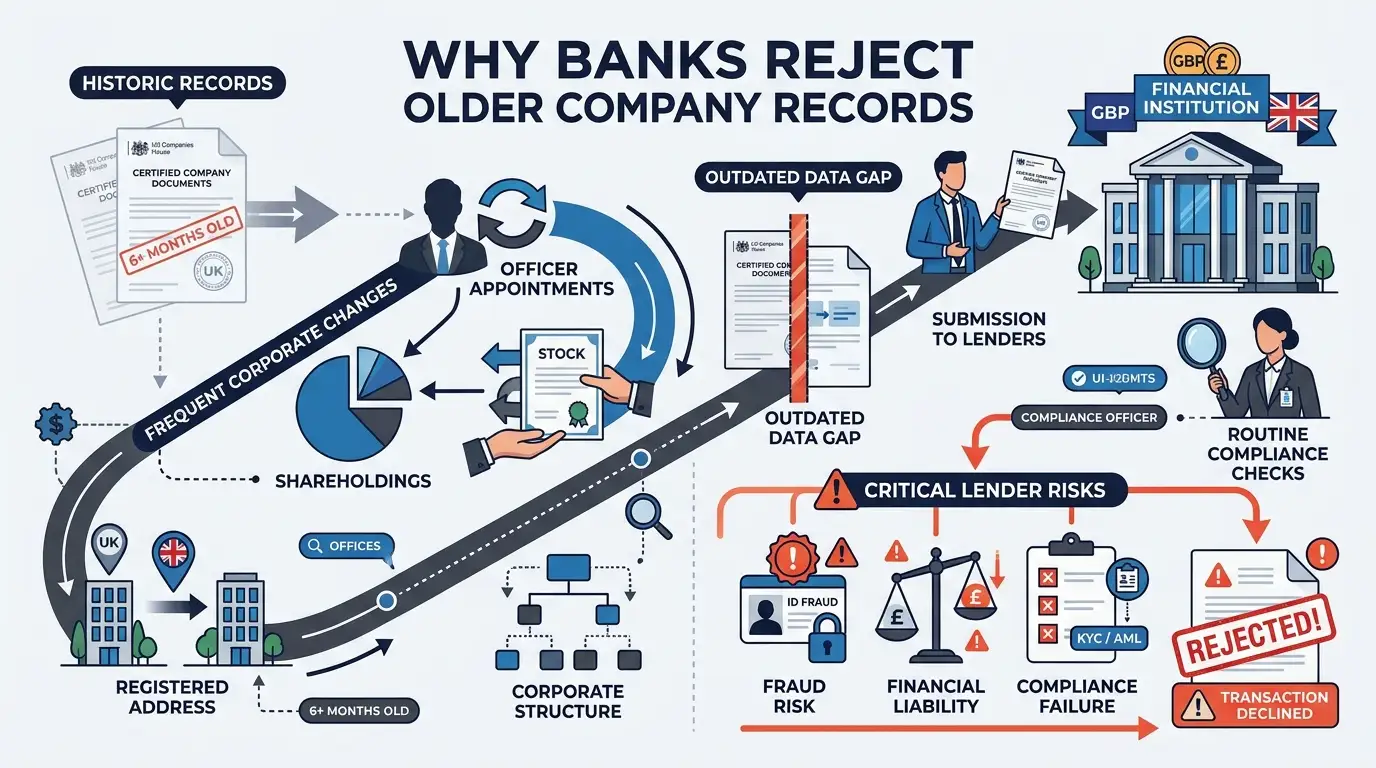
Banks operate under strict anti-money laundering regulations in the UK. Compliance officers require recent evidence of active corporate status. A certificate issued twelve months ago fails to prove present-day solvency or authority.
Changes to directorships occur without advance notice. Shareholding allocations transfer between investors during funding rounds. Older documents conceal these structural alterations from external risk auditors. Financial organizations require current proof before approving credit accounts or processing corporate transactions.
Underwriters verify corporate standing through recent official filings. Presenting outdated certification causes immediate application delays. Compliance departments flag older filings as high-risk documentation during initial screening phases.
Third-party verification platforms cross-reference corporate data instantly. Outdated certified records create discrepancies with active Companies House register records. Banks cancel pending account applications when verification checks detect conflicting data points.
Updating legal documentation prevents transaction halts during corporate financing. Accessing updated supplementary company documents ensures seamless verification during formal banking compliance reviews.
What Factors Cause Certified Corporate Documents to Become Stale?
Certified corporate documents become stale when legal changes occur, regulatory filing periods pass, international authorities set strict acceptance windows, or third-party verifiers demand recent proof of compliance and legal standing.
Corporate legal status fluctuates with each statutory submission. Shareholders alter capital structures by issuing or redeeming class shares. These corporate actions invalidate older certified statements of capital instantly.
Different jurisdictions enforce specific document age thresholds:
UK commercial banks enforce a ninety-day threshold for certified documents.
Foreign government agencies require certifications dated within thirty days for apostille processing.
UK civil courts demand certified extracts issued within sixty days of active trial proceedings.
Statutory filing deadlines trigger document updates automatically. Filing annual confirmation statements updates official public record data. Previous certified copies fail to reflect these newly submitted statutory details.
Officer resignations alter corporate legal representation immediately. Continuing to present certified copies listing former directors creates legal liability. Third parties reject documents that mismatch live registry database queries.
Certain corporate certificates reference specific operational periods. Certificates of good standing verify compliance on a single date. Relying on historical certificates creates regulatory exposure during official cross-border transactions.
Which Types of Certified Company Documents Need Frequent Renewal?
Certificates of incorporation, certificates of good standing, officer lists, articles of association, and statements of capital require frequent renewal because their underlying corporate data updates regularly through statutory filings.
A certificate of good standing serves as snapshot proof. Registrars verify compliance status at the exact moment of issuance. Lenders reject good standing certificates older than three months.
Statutory records requiring periodic re-certification include:
Certificates of incorporation confirming registered legal entity status
Certificates of good standing proving active compliance status
Register of directors identifying current legal company representatives
Articles of association defining internal governance rules
Statements of capital verifying total share issuance figures
Articles of association undergo amendments during corporate restructurings. Presenting outdated constitutional documents invalidates commercial contract executions. External solicitors verify current articles before completing cross-border mergers.
Statements of capital shift following investment allocations. Dilution events render historical share registers inaccurate. Financial auditors demand re-certified extracts showing precise modern share equity breakdowns.
Companies House records change constantly through electronic filing systems. Maintaining current certified extracts protects business transaction momentum. Entities review how often should you renew certified copies of company records to establish efficient corporate administration schedules.
How Do International Authorities Handle Outdated Certified Records?
International authorities reject outdated certified records during cross-border legalisation, notarisation, and apostille processing because overseas registries demand recently authenticated proof of active corporate existence.
Cross-border commercial activities require official document legalisation under the Hague Convention. Foreign embassies enforce strict acceptance windows for certified corporate records. Submitting older extracts results in immediate visa, branch, or trading license rejections.
Overseas banks verify legal identity before opening foreign merchant accounts. Foreign compliance officers require fresh certification stamped by legal professionals. Documents exceeding statutory age limits fail cross-border anti-money laundering checks.
International notarisation procedures require live verification of corporate authority. Notaries public check active registry records before affixing official seals. Historical documents fail verification if corporate officers changed recently.
Foreign land registries require current certified constitutional documents for property transactions. Stale filings halt international real estate acquisitions during title registration. Legal teams re-certify corporate files before completing overseas property purchases.
Regulatory bodies overseas demand recent documentation for joint venture approvals. Translation services require official fresh copies before certifying foreign language transfers. Delays in document re-issuance disrupt international expansion schedules significantly.
What Are the Consequences of Using Expired Certified Records?
Using expired certified records causes transaction delays, loan application rejections, failed contract executions, operational freezes, and regulatory compliance breaches that damage commercial partnerships and market reputation.
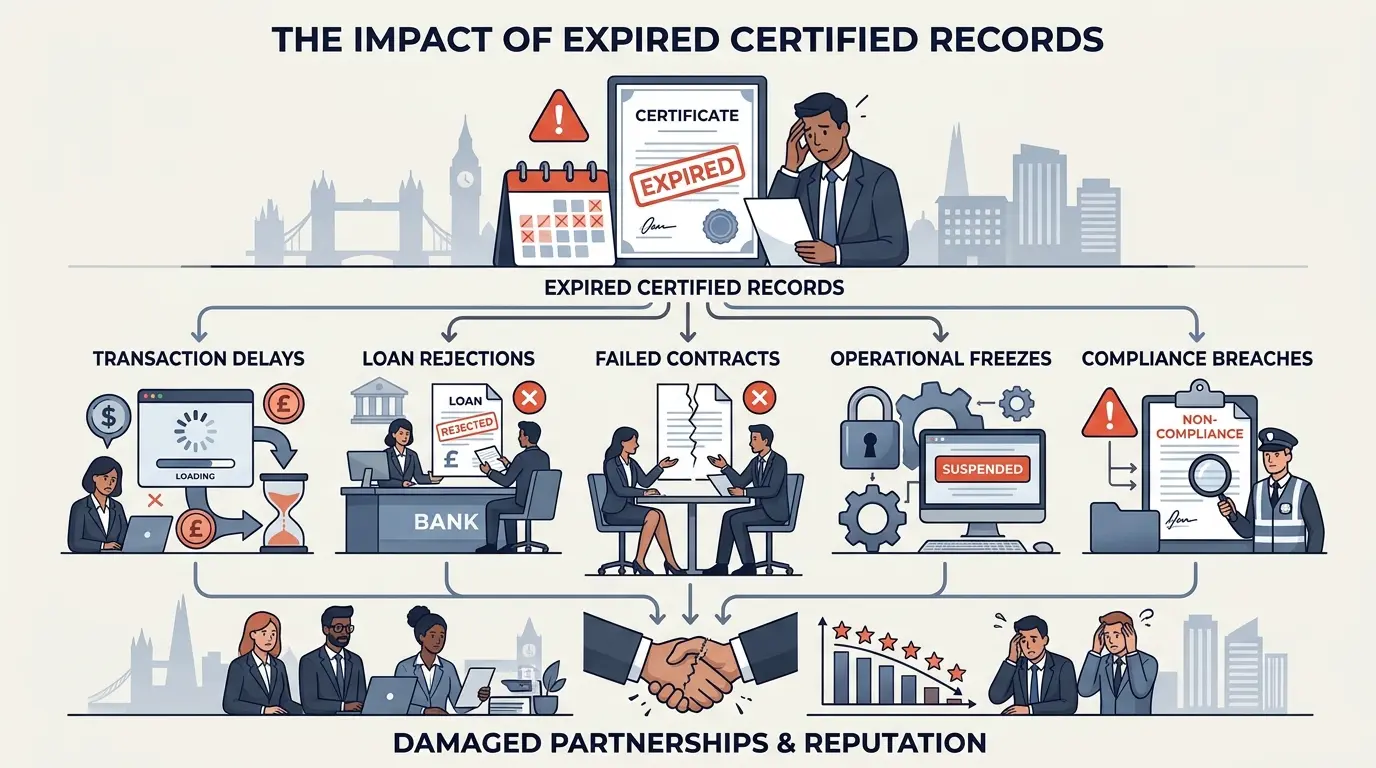
Transaction execution stalls when legal teams detect stale certified documents. Mergers and acquisitions pause while parties secure fresh certified extracts. Contract closing deadlines pass without execution, resulting in severe financial penalties.
Commercial lenders freeze loan disbursements upon finding outdated corporate records. Refinancing arrangements fail during final compliance checks. Mortgage underwriters reject commercial property applications containing stale certification stamps.
Corporate vendor onboarding processes stall unexpectedly. Procurement teams flag historical certified documents during vendor background checks. Companies lose competitive tenders due to administrative verification failures.
Regulatory authorities issue compliance warnings for invalid document usage. Presenting historical filings during official audits triggers comprehensive regulatory investigations. Fines accrue when corporations fail to produce valid legal records promptly.
Partnerships dissolve when operational delays block joint venture agreements. Securing updated documentation eliminates administrative friction during critical corporate deals. Smart management teams choose to renew your certified company documents with Form My Company to prevent unexpected operational downtime.
How Can Businesses Maintain Up-to-Date Certified Company Records?
Businesses maintain up-to-date certified company records by establishing scheduled document reviews, tracking statutory filing dates, utilizing professional document providers, and ordering fresh certified extracts before major financial transactions.
Corporate secretaries implement quarterly administrative audits. Audit teams review all physical and digital certified document repositories. Outdated certified copies are archived and replaced with freshly issued records.
Effective corporate document tracking strategies include:
Calendar automated alerts sixty days prior to major contract renewals.
Conduct pre-audit checks before launching institutional fundraising rounds.
Audit officer records immediately following directorship or address changes.
Direct communication with corporate registries speeds up document re-issuance. Professional corporate services procure certified extracts directly from Companies House. Automated procurement systems deliver legally verified records within twenty-four hours.
Maintaining digital certified copies alongside physical originals streamlines distribution. Third parties accept electronically certified PDFs bearing official digital seals. Secure cloud storage provides instant access during urgent legal reviews.
Proactive document management prevents commercial delays during major deals. Corporate officers maintain continuous compliance by monitoring statutory filing schedules. Form My Company assists organizations by providing official certified records efficiently.
Explore More Supplementary Company Documents Guide,
What Do Investors Look for in Your Articles of Association?
What Are the Share Transfer Rules in Articles of Association?
Frequently Asked Questions
What supplementary company documents do UK businesses most commonly need?
UK businesses frequently require supplementary company documents such as Certificates of Good Standing, Certified Copies of Incorporation, Certificates of Name Change, and official Articles of Association. These official filings are requested by banks, foreign governments, legal professionals, and financial auditors to verify a company’s legal status and corporate structure. Organizations can order these official registry extracts through Form My Company to satisfy compliance and verification requirements.
Why do banks require certified supplementary company documents?
Financial institutions require certified supplementary company documents to complete mandatory Anti-Money Laundering (AML) and Know Your Customer (KYC) checks before opening accounts or extending credit. These certified registry records prove active corporate standing, confirm current officer appointments, and verify registered office details directly against official records. Securing updated supplementary company documents via Form My Company ensures business verification processes move forward without unexpected delays.
What is the difference between an uncertified copy and a certified company document?
An uncertified copy is a standard record printed or downloaded from the public register for informal viewing, whereas a certified company document carries an official registry seal or official legal certification proving its authenticity. Courts, foreign registries, foreign embassies, and regulated institutions require certified versions to prevent fraud and ensure legal validity during corporate transactions. Form My Company provides official certified registry documents formatted specifically to satisfy stringent legal and administrative standards.
How do I get an apostille for supplementary company documents?
To obtain an apostille for supplementary company documents, the records must first be certified by Companies House or an authorized UK solicitor, then submitted to the UK Foreign, Commonwealth & Development Office (FCDO) for official legalisation. This legalisation process confirms the seal and signature on the corporate documents so foreign authorities and overseas institutions will accept them. Form My Company facilitates the retrieval and certification of supplementary company documents required for international use and apostille processing.
How long does it take to obtain certified supplementary company documents in the UK?
Standard processing for certified supplementary company documents through official registry channels typically takes three to five business days, while expedited same-day or next-day services are available for urgent corporate requirements. Processing times vary depending on whether physical seals, solicitor certification, or apostille legalisation services are required. Utilizing Form My Company helps streamline the ordering and delivery of certified corporate extracts directly to your business.