Documents Needed for VAT Registration
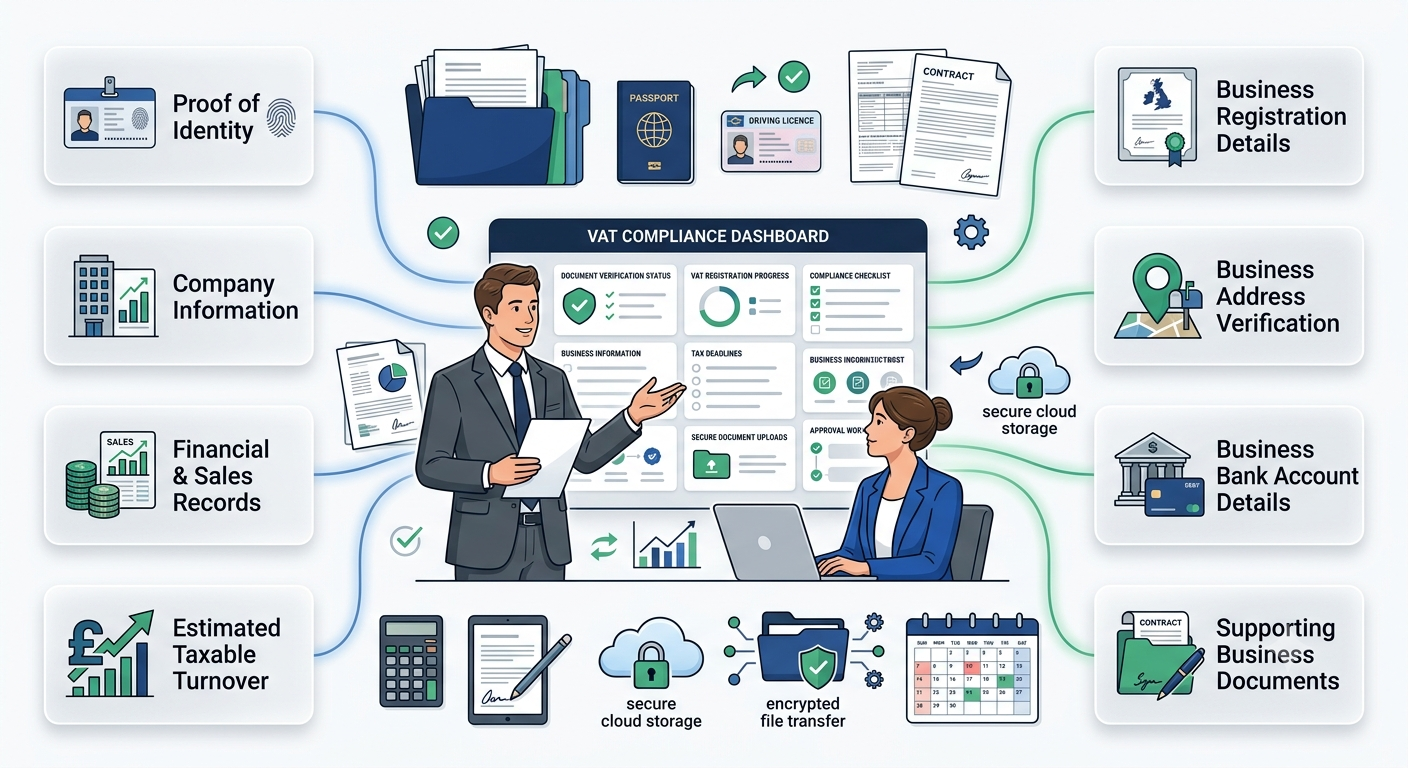
Getting your UK VAT registration approved quickly depends significantly on having the right documents ready before you start. Missing documents, mismatched details, or incomplete information can delay processing by weeks. HMRC processes VAT registration applications in 2 to 4 weeks for straightforward UK-based businesses and 4 to 8 weeks for non-resident sellers, but only when the application is complete and clean. At Form My Company, we help UK businesses register for VAT correctly, and one of the first things we do is confirm you have everything HMRC needs. This guide provides a complete checklist of documents needed for UK VAT registration in 2026.
Why HMRC Needs So Many Documents
Before jumping into the checklist, it helps to understand why HMRC asks for so much:
- Verifying your business exists and is legitimate. HMRC needs to confirm you’re a real business making real sales.
- Confirming who runs the business. Directors, owners, and beneficial owners all need to be identified.
- Understanding your business activity. So HMRC knows what VAT rules apply to your sales.
- Verifying your address and correspondence details. So HMRC can contact you and issue your VAT number.
- Confirming your bank account. For any VAT refunds and payment arrangements.
- Anti-money-laundering compliance. HMRC follows strict AML rules on new business registrations.
- Fraud prevention. Well-prepared documentation helps HMRC distinguish legitimate applications from fraudulent ones.
Complete, accurate documentation makes HMRC’s job easier and gets your application processed faster.
Core Documents Every Application Needs
Regardless of your business type or specific circumstances, HMRC needs certain fundamental information:
- Legal business name. Exactly as registered. For limited companies, this must match your Companies House record.
- Trading name (if different). How you present the business to customers.
- Business structure. Whether you’re a sole trader, partnership, limited company, LLP, or other structure.
- Business address. Your main business address, which can be the same as or different from your registered office.
- Contact details. Phone number and email for the primary business contact.
- Nature of business. A clear description of what you sell or provide.
- SIC codes. Standard Industrial Classification codes describing your business activities.
- Expected turnover. Both actual (last 12 months) and expected (next 12 months) VAT taxable turnover.
- Effective registration date. When you want VAT registration to take effect. Can be current or, in some cases, backdated.
- Bank account details. Your business bank account for VAT refunds and payments.
- VAT scheme preference. Standard accounting, Flat Rate, Cash Accounting, or Annual Accounting.
- Making Tax Digital confirmation. Confirming you’ll use MTD-compatible software for record-keeping and filing.
Having all of this ready in advance is the single biggest predictor of a smooth application.
Documents by Business Structure
Different business structures need different additional documents:
For Limited Companies
- Certificate of Incorporation. Proof of company registration with Companies House.
- Company Registration Number (CRN). Unique identifier from Companies House.
- Companies House record. Directors, PSCs, and registered office as they currently appear on the public register.
- Company bank account statement. Recent statement showing the company’s business account.
- Business bank account details. Sort code and account number for the company’s account.
- Details of all directors. Full names, dates of birth, and residency status.
- Details of all Persons with Significant Control (PSCs). Anyone owning or controlling 25% or more of the company.
- Shareholding information. Who owns what percentage of shares.
For Sole Traders
- Full personal name. As it appears on your legal identification.
- Date of birth. For HMRC records.
- National Insurance number. For UK residents.
- Unique Taxpayer Reference (UTR). If you have one (usually issued when you register with HMRC as self-employed).
- Personal address. Your home address as it appears on official records.
- Business address (if different). Where you conduct the business.
- Bank account details. Personal or business bank account you use for the sole trader activity.
For Partnerships
- Partnership Deed or Agreement. Documenting who the partners are and how the partnership operates.
- Full names of all partners. Individuals or entities.
- Details of all partners. Dates of birth, addresses, and identity documents.
- Nominated partner. The partner who will act on behalf of the partnership for HMRC purposes.
- Partnership bank account details. For VAT purposes.
- Partnership UTR. If already registered as a partnership with HMRC.
For LLPs
- Certificate of Incorporation. Proof of LLP registration with Companies House.
- LLP Registration Number. From Companies House.
- Details of all members. Full names, dates of birth, and other identifying information.
- Details of designated members. Members with specific compliance responsibilities.
- LLP Agreement. If requested by HMRC.
- LLP bank account details. For VAT purposes.
Identity Documents
For all applicants, valid identity documents are needed:
- Photo ID. Passport (most widely accepted), UK driving licence, or national identity card, depending on nationality.
- Proof of address. Recent utility bill, bank statement, or council tax document showing your residential address. Usually needs to be within the last 3 months.
- National Insurance number. For UK residents.
- Unique Taxpayer Reference (UTR). If you already have one from HMRC.
- Documents must be:
- Valid and in date. Expired IDs aren’t accepted.
- Clear and legible. Photocopies or scans must be readable.
- Consistent with each other. Names, addresses, and dates must match across documents.
- Not damaged. Torn or altered documents may not be accepted.
For non-residents, a biometric passport is usually the safest choice. National ID cards from some countries may not be accepted.

Business Activity Documentation
HMRC needs to understand what your business actually does:
- Business description. A clear paragraph explaining your products or services.
- SIC codes. Standard Industrial Classification codes. Choose the most accurate ones for your activities. You can find these at gov.uk.
- Website URL. If you have one, particularly important for online businesses.
- Product or service list. Examples of what you sell and typical prices.
- Customer base description. Who buys from you, whether individuals or businesses, and where they’re located.
- Sales channel details. Whether you sell direct, through marketplaces (Amazon, eBay, Etsy), or through other channels.
- Import and export information. If applicable, details of goods movements in and out of the UK.
- Sector-specific details. Some industries have specific VAT considerations that require additional documentation.
For online sellers and e-commerce businesses especially, HMRC often wants to see evidence of the business’s actual trading activity, so having your business website, marketplace listings, or product portfolio ready is helpful.
Financial Documentation
HMRC assesses your financial position through:
- Turnover information. Both historical (last 12 months) and projected (next 12 months).
- Expected VAT-related transactions. Estimated monthly sales and purchases.
- Bank account statements. Recent statements showing business activity or expected business activity.
- Accountant details. If you use an accountant, their details for HMRC to potentially contact.
- Business plan or projections. For new businesses, projected financial information helps HMRC understand your position.
- Previous returns. If you’ve previously been VAT registered, any relevant past filings.
For businesses with genuinely low turnover expected, HMRC may ask additional questions to verify the registration is justified. Having realistic, well-supported projections is important.
Documents for Non-Resident Sellers
Non-resident applicants need additional documentation:
- Business establishment details. Where your business is based, with proof of establishment (business licence, incorporation certificate, or equivalent).
- Home country tax registration. Details of your business’s tax status in your home country.
- Directors’ identity documents. Passports for all directors, plus proof of address.
- UK correspondence address. A UK address where HMRC can send correspondence. This can be a service provider’s address like Form My Company’s Bolton BL1 address if you’re using our Non-Residents package.
- UK bank account details. While possible to use a non-UK account, HMRC typically prefers UK bank details for VAT refunds.
- Fiscal representative details. In some cases, non-residents need a UK-based fiscal representative for VAT purposes.
- Stock location details. Particularly important for e-commerce sellers, showing where your inventory is stored (which affects UK VAT registration requirements).
- Marketplace seller status. If you sell through Amazon, eBay, or other UK marketplaces, evidence of your seller status.
- Additional documentation for specific circumstances. Depending on your business type, HMRC may ask for further evidence.
Non-resident applications often require more documentation and take longer to process, so preparation matters even more.
Documents for Specific Business Types
Some business types have specific documentation requirements:
E-Commerce Sellers
- Marketplace seller accounts. Evidence of Amazon, eBay, Etsy, or other marketplace seller status.
- Stock location details. Where inventory is held (particularly important for FBA and third-party fulfilment).
- Website and product listings. For sellers with their own e-commerce sites.
- Anticipated sales channels. Where you plan to sell.
- Cross-border activity. If selling into or from the UK from other jurisdictions.
Amazon FBA Sellers
- Amazon Seller Central account. Confirmation of your registered seller status.
- UK FBA inventory details. Evidence of stock in UK Amazon warehouses.
- Marketplace agreements. Any specific Amazon agreements or documentation.
- Historic sales data. For established sellers.
Property and Construction
- Details of property activities. Whether residential, commercial, or mixed.
- Construction industry scheme (CIS) details. If applicable.
- Domestic reverse charge considerations. For construction services subject to specific VAT rules.
Financial Services
- Regulatory authorisation. From FCA or PRA if applicable.
- Details of exempt activities. Since many financial services are VAT exempt.
Charities and Non-Profits
- Charity registration. With the Charity Commission.
- Governing documents. Constitution or articles.
- Trustee information. Details of all trustees.
Regulated Sectors
- Licences and authorisations. For businesses in regulated industries.
- Compliance documentation. As required for your specific sector.
Understanding your sector’s specific requirements ensures you gather the right documentation from the start.
Documents for Voluntary Registration
If registering voluntarily (below the £90,000 threshold), HMRC may want additional evidence:
- Business plan. Showing your business is genuine and trading.
- Expected turnover projections. Realistic estimates for the next 12 months.
- Evidence of trading activity. Invoices, contracts, or sales showing you’re actually in business.
- Reasons for voluntary registration. Some explanation of why you’re choosing to register (input VAT reclaim, business credibility, etc.).
- Financial commitments. Evidence that you’re operating as a real business, not just registered.
HMRC scrutinises voluntary registrations more carefully than mandatory ones, so being able to demonstrate genuine business activity matters.
Documents for Different Registration Scenarios
Different scenarios call for slightly different documentation:
- First-time UK registration. Full initial application documentation.
- Adding VAT to an existing UK company. Companies House record, existing tax details, and business documentation.
- Non-resident registering for the first time. Non-resident documentation plus establishment evidence.
- Reactivating a previous VAT registration. Previous registration details, reason for reactivation, and current business documentation.
- Group VAT registration. Additional documentation for corporate groups.
- Divisional registration. For businesses with multiple registrations.
- Making Tax Digital transition. Confirmation of MTD-compatible software.
Each scenario has its own specific document requirements, but the core checklist above covers most cases.
Documents That Cause Common Rejections
A few specific documents cause repeated issues:
- Mismatched names. Where the name on Companies House, ID documents, and other paperwork doesn’t match exactly. Even small differences cause problems.
- Old proof of address. Utility bills or bank statements older than 3 months are often rejected.
- Blurry or poor-quality photocopies. Documents that aren’t clearly legible cause delays.
- Missing signature or completion. Application forms that aren’t fully completed or signed.
- Wrong SIC codes. Vague or incorrect Standard Industrial Classification codes may prompt HMRC queries.
- Vague business descriptions. Descriptions that don’t clearly explain what the business does can slow processing.
- Missing bank details or wrong account. Bank information that doesn’t match the business or is incomplete.
Inconsistent information across the application. Where different parts of the application say different things.
Careful preparation and consistency across your documents avoids most of these issues.
How to Present Your Documents
For a smooth application:
- Organize digitally. Save all documents as clear PDF files with descriptive filenames.
- Ensure consistency. All documents should use the same version of names, addresses, and other details.
- Include supporting notes. Where documents need context, brief explanations help HMRC understand.
- Provide translations. Non-English documents typically need certified translations.
- Keep originals accessible. In case HMRC asks for additional copies or clarification.
- Update anything old. Refresh any document that’s more than 3 months old before submitting.
- Cross-check with your accountant. Someone familiar with UK tax can spot potential issues before you submit.
Professional preparation of your VAT registration application significantly reduces the risk of rejection or delay.
What Happens After You Submit
Once your documents and application are submitted:
- HMRC acknowledges receipt. You’ll get a confirmation, usually electronically.
- Processing begins. HMRC reviews your application against their criteria.
- Additional queries may arise. HMRC may ask for more information or documents.
- Decision issued. Typically within 2 to 4 weeks for UK-based, 4 to 8 weeks for non-residents.
- VAT number issued. Once approved, you’ll receive your VAT registration number and effective date.
- VAT4 certificate. Formal registration certificate.
- Update your business. Add your VAT number to invoices, website, and other business materials.
- Set up Making Tax Digital. With MTD-compatible software.
Preparation is what makes each of these steps go smoothly.
How Form My Company Helps
We help UK businesses gather the right documents and register for VAT correctly. As part of our compliance services, we can:
- Review your documentation. Ensuring you have everything HMRC needs before submitting.
- Prepare and submit your VAT registration on your behalf.
- Coordinate with Companies House compliance. For UK companies where Companies House documentation is needed.
- Support non-resident sellers. With the specific documentation requirements for overseas businesses.
- Provide UK correspondence address. As part of our Non-Residents package, essential for non-resident VAT applications.
- Advise on scheme choice. So you register under the right VAT scheme.
- Handle HMRC follow-up. If additional information is requested.
- Guide you on next steps. Making Tax Digital setup and preparing for your first return.
Whether you’re a UK-based business or an overseas seller, we help you gather what’s needed and get your registration approved as smoothly as possible.
Get Your VAT Registration Documentation Right Today
Having the right documents ready is the biggest factor in a smooth UK VAT registration. Whether you’re registering as a limited company, sole trader, partnership, or LLP, and whether you’re UK-based or non-resident, preparation matters. With Form My Company, we help you gather what’s needed and handle the whole registration process professionally. Get in touch today and let us make VAT registration as straightforward as possible.
Frequently Asked Questions
What documents do I need for UK VAT registration?
The core documents include your business’s legal name and structure, business address, contact details, expected turnover, bank account details, and identity documents for owners and directors. Additional documents depend on your business structure and circumstances.
Do sole traders need the same documents as limited companies for VAT registration?
No. Sole traders provide personal identification (name, date of birth, address, National Insurance number, and UTR if applicable). Limited companies provide Certificate of Incorporation, Company Registration Number, and additional documentation for directors and shareholders.
What documents do non-resident VAT applicants need?
Non-residents need business establishment evidence from their home country, passports for all directors, a UK correspondence address, business activity details, stock location information (for e-commerce), and potentially a fiscal representative depending on circumstances.
Do I need a UK bank account for VAT registration?
HMRC prefers UK bank accounts for refunds and payments, but non-UK accounts can be used in some circumstances. Having a UK business bank account makes ongoing VAT compliance easier.
How recent do documents need to be?
Proof of address documents (utility bills, bank statements) typically need to be within the last 3 months. Identity documents (passport, driving licence) need to be currently valid and in date. Certificates and registrations remain valid as long as they reflect current status.
What if my documents are in a language other than English?
HMRC typically requires certified English translations of non-English documents. This can add time to your application, so plan accordingly.
Can Form My Company help me gather the right documents?
Yes. As part of our VAT registration service, we help you understand exactly what HMRC needs for your specific business, review your documentation before submission, and handle the application process professionally.