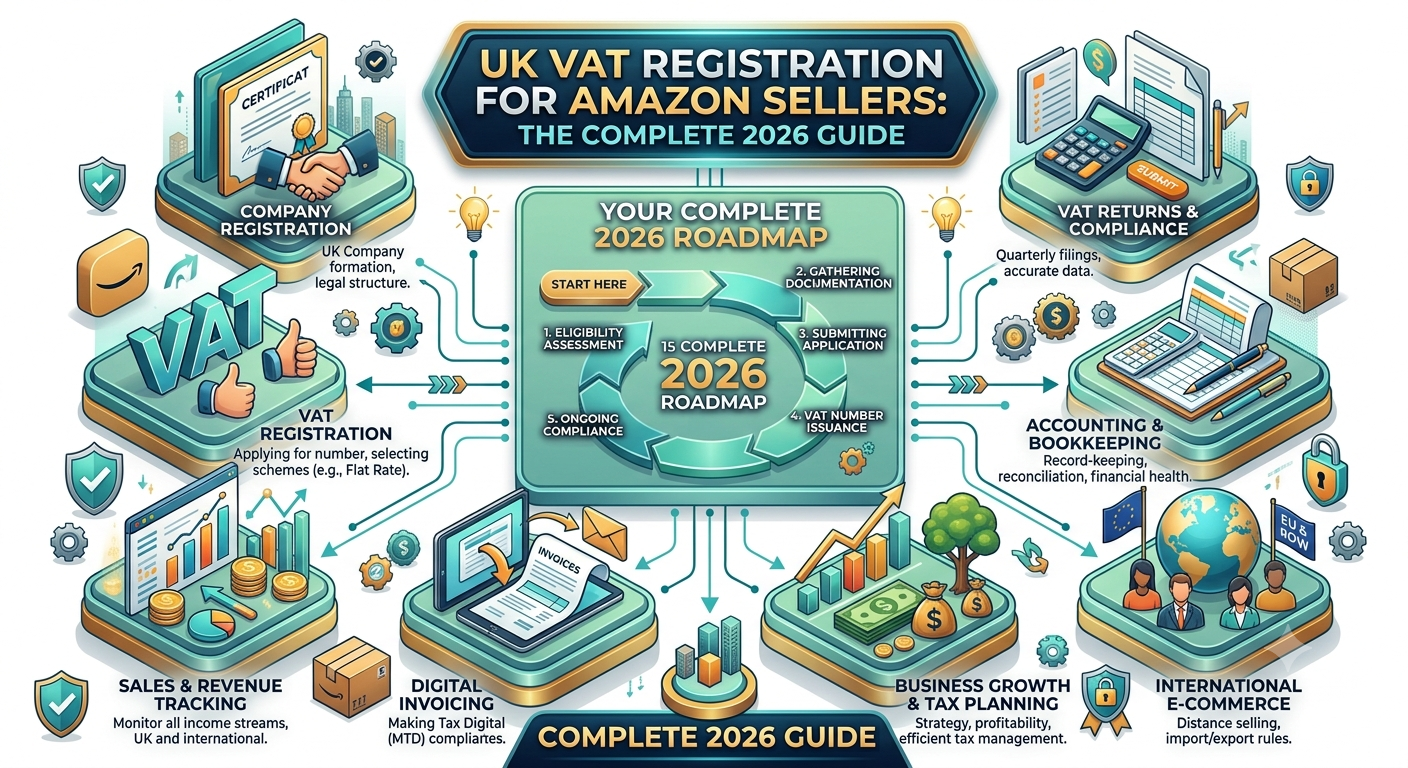
VAT Registration for Amazon Sellers
If you sell on Amazon UK, VAT registration is one of the most important compliance decisions you’ll make. Amazon sellers face a set of VAT rules that are more complex than most UK businesses, involving marketplace facilitator obligations, FBA stock location considerations, and specific rules for overseas sellers. Get it right, and you’re set up for smooth ongoing operations. Get it wrong, and you can face substantial back tax, penalties, and even suspension from Amazon. At Form My Company, we help Amazon sellers register for UK VAT correctly as part of our compliance services. This guide explains everything Amazon sellers need to know about UK VAT registration in 2026.
Why Amazon Sellers Have Distinct VAT Rules
Amazon sellers face specific VAT considerations that don’t apply to typical UK businesses:
- Stock location matters. Where your inventory is stored significantly affects VAT registration requirements. Storing goods in UK Amazon FBA warehouses often triggers registration.
- Marketplace facilitator rules. Amazon collects and remits VAT on certain sales, changing what you as the seller are responsible for.
- The £135 consignment value threshold. For overseas sellers, goods with a consignment value of £135 or less shipped to UK consumers have specific rules.
- Cross-border complexity. Selling on multiple Amazon marketplaces (UK, EU, US, and others) creates multi-jurisdictional VAT considerations.
- Non-resident seller obligations. Overseas Amazon sellers often can’t rely on the standard £90,000 threshold.
- Amazon compliance requirements. Amazon itself expects sellers to have correct VAT arrangements, and can suspend accounts for non-compliance.
These factors mean that VAT registration for Amazon sellers isn’t just about turnover. It’s about your business structure, stock location, marketplace choices, and specific selling model.
Do Amazon Sellers Need to Register for UK VAT?
Whether you need to register depends on several factors:
- UK-based Amazon sellers. Standard UK VAT rules apply. Registration is mandatory once your VAT taxable turnover exceeds £90,000 over any rolling 12-month period. Voluntary registration is possible below the threshold.
- Non-resident sellers with UK FBA stock. Registration is typically required from the first sale, regardless of turnover. Storing goods in UK Amazon warehouses is generally treated as making UK taxable supplies.
- Non-resident sellers using Amazon’s Global Selling. If you’re using Amazon.co.uk from another country without UK stock, you may still have VAT obligations depending on your setup.
- Sellers over the £135 consignment value. For goods shipped from abroad valued over £135 per consignment, different rules apply, often involving import VAT and duties.
- Sellers under the £135 consignment value. For goods £135 or less shipped from abroad to UK consumers, Amazon typically handles the VAT, but you may still need to register for other reasons.
- Business-to-business sales. B2B sales to UK businesses can fall outside marketplace facilitator rules, requiring the seller to be VAT registered.
For most non-resident Amazon sellers with UK stock, VAT registration is essentially mandatory rather than optional.
The Marketplace Facilitator Rules for Amazon
Amazon operates under UK marketplace facilitator rules for certain sales:
- Amazon collects VAT on qualifying sales. For goods with a consignment value of £135 or less sold by non-resident sellers to UK consumers, Amazon is responsible for VAT.
- Amazon acts as the deemed supplier. For these sales, Amazon is treated as the seller for VAT purposes, even though economically you’re the seller.
- Sellers don’t need to charge VAT on these sales. Because Amazon is doing it.
- But sellers may still need to register. Other sales (like B2B, higher-value goods, or sales through other channels) may still require the seller to be VAT registered.
- Amazon issues VAT invoices where applicable. So buyers can see the VAT they’ve paid.
Understanding what Amazon covers versus what you’re responsible for is essential. Assumptions that “Amazon handles everything” have led many sellers into VAT trouble.
Non-Resident Amazon Sellers and Stock in UK FBA
For non-resident Amazon sellers, using UK Fulfilment by Amazon (FBA) has specific VAT implications:
- UK FBA stock triggers UK VAT registration. Holding inventory in UK warehouses generally means you have UK taxable supplies from the first sale.
- Registration is required regardless of turnover. The £90,000 threshold typically doesn’t help non-resident sellers with UK FBA stock.
- Multiple UK warehouses count. Whether your stock is in one Amazon warehouse or spread across the UK network, the VAT position is the same.
- Even small amounts of stock trigger obligations. There’s no “de minimis” amount below which UK stock is ignored.
- Ongoing compliance follows. Beyond registration, you have quarterly VAT returns, Making Tax Digital compliance, and payment obligations.
- Amazon may check your VAT status. Amazon has been increasingly proactive about ensuring sellers have valid UK VAT registration where required, and can suspend accounts of sellers without correct registration.
For non-resident Amazon FBA sellers, VAT registration is typically one of the first things to arrange, ideally before your stock arrives in UK warehouses.
VAT Rules for Amazon Sellers by Selling Model
Different Amazon selling models have different VAT considerations:
- Amazon FBA UK. Stock stored in UK warehouses. Registration required from first sale for non-residents. UK-based sellers register at the standard threshold.
- Amazon FBM (Fulfilled by Merchant). You fulfil orders yourself from your own stock location. VAT rules follow the stock location. UK-based FBM sellers use the standard threshold. Non-resident FBM sellers shipping from abroad may register based on the £135 consignment rules.
- Amazon Global Selling into UK. Selling from another country’s Amazon account to UK customers. VAT rules depend on the goods, values, and where they’re shipped from.
- Amazon Multi-Channel Fulfilment. Using Amazon’s fulfilment for orders received through other channels. VAT rules apply based on the fulfilment location and customer type.
- Amazon Business (B2B sales). Sales to UK businesses may fall outside standard marketplace facilitator rules, meaning the seller often needs to be VAT registered to invoice correctly.
- Amazon Handmade, Amazon Custom, and other specialised programmes. Generally follow the same VAT rules as the underlying fulfilment method.
Understanding which model applies to your business is essential for correct VAT registration.
The £135 Consignment Value Rule Explained
Since Brexit, the UK operates a specific rule for imported goods sold to UK consumers:
Consignments valued £135 or less. VAT is charged at the point of sale, and the seller (or marketplace facilitator like Amazon) is responsible.
Consignments valued over £135. VAT is collected at import, along with any customs duties.
How consignment value is determined. The value of goods sold in a single transaction to a consumer, excluding shipping, insurance, and other charges.
Multiple items in one order. Amazon treats the aggregated order value.
Impact on non-resident sellers. For sellers shipping from abroad to UK consumers on Amazon:
- Goods £135 or less: Amazon typically handles VAT under marketplace facilitator rules.
- Goods over £135: You may need to consider import VAT, duties, and different registration requirements.
This threshold is one of the key tests for whether Amazon is handling VAT for you or whether you have direct obligations.

When to Register for VAT as an Amazon Seller
Timing matters. Consider registering for UK VAT when:
- Before shipping FBA stock to UK. For non-resident sellers, register before your stock arrives in UK warehouses, not after.
- Before launching on Amazon UK. For UK-based sellers, having VAT registration in place before launch avoids scrambling.
- When approaching the £90,000 threshold. For UK-based sellers, monitor turnover monthly and register within 30 days of crossing.
- When adding UK FBA to an existing setup. If you’ve been selling elsewhere and are adding UK FBA, register before stock arrives.
- When Amazon requests confirmation of VAT status. Amazon periodically checks seller compliance and may request confirmation.
- When transitioning between models. Moving from FBM to FBA, or from non-UK stock to UK stock, changes your VAT position.
- As part of business planning. VAT registration affects pricing, cash flow, and profit margins. Plan it into your overall business strategy.
Waiting until VAT registration is urgently needed often leads to compressed timelines and higher stress.
The Registration Process for Amazon Sellers
VAT registration for Amazon sellers follows the standard UK process, with specific considerations:
- Prepare business documentation. Legal name, business structure, UK company registration number if applicable, expected turnover, business activity description.
- Include Amazon-specific information. Details about your Amazon selling activities, fulfilment method, and where stock is (or will be) held.
- Submit through HMRC’s online service. Or through a VAT registration service acting on your behalf.
- HMRC processing. Typically 2 to 4 weeks for UK-based sellers, 4 to 8 weeks for non-resident sellers.
- HMRC may ask for additional information. Particularly for non-resident sellers or those with unusual circumstances.
- Receive your VAT number. Once approved, HMRC issues your VAT registration number.
- Update your Amazon seller account. Add your VAT registration number to your Amazon Seller Central profile.
- Update your invoicing. Comply with VAT invoice requirements and Making Tax Digital.
For non-resident sellers especially, professional handling of the registration process significantly smooths what can otherwise be a fiddly process.
VAT Scheme Considerations for Amazon Sellers
Different VAT schemes have different implications for Amazon sellers:
- Standard accounting. Most flexible, allowing full input VAT reclaim on business expenses. Suits most Amazon sellers.
- Flat Rate Scheme. Simpler bookkeeping but restricts VAT reclaim on most purchases. Less common for Amazon sellers because you typically have significant input VAT on stock, Amazon fees, and shipping.
- Cash Accounting Scheme. VAT accounted for on payments received/made rather than invoice dates. Can help cash flow but adds bookkeeping complexity.
- Annual Accounting Scheme. Fewer returns but requires monthly/quarterly payments. Less common for growing Amazon businesses.
Most Amazon sellers use standard accounting because it maximises input VAT recovery on stock and Amazon-related costs. Getting scheme choice right can materially affect your bottom line.
Common VAT Mistakes for Amazon Sellers
A few issues come up regularly:
- Assuming Amazon handles all VAT. Marketplace facilitator rules cover some sales but not all. B2B sales, higher-value goods, and sales outside marketplace facilitator arrangements often need seller VAT registration.
- Registering too late. Non-resident sellers often register after stock is already in UK warehouses, exposing themselves to back VAT.
- Choosing the wrong scheme. The Flat Rate Scheme, in particular, often doesn’t suit Amazon sellers well.
- Missing VAT on Amazon fees. Amazon charges VAT on many of its fees to UK-registered sellers. This VAT is typically reclaimable but needs correct accounting.
- Incorrect VAT rate application. Different products have different VAT rates. Getting this wrong on high-volume sales creates significant issues.
- Not updating Amazon Seller Central. After registering, your VAT number needs to be added to your Amazon profile. Missing this can cause Amazon compliance issues.
- Failing Making Tax Digital compliance. All VAT-registered businesses must use MTD-compatible software.
- Poor bookkeeping. Reconciling Amazon transactions requires care. Multiple transaction types, refunds, fees, and settlements need correct treatment.
- Ignoring cross-border sales. Selling on Amazon.de, Amazon.fr, or other EU marketplaces creates additional VAT considerations.
- Missing VAT on shipping. Whether shipping charges are VAT-inclusive or exclusive matters for compliance.
Professional support significantly reduces the risk of these errors.
VAT Return Filing for Amazon Sellers
Once registered, ongoing VAT compliance is a real ongoing workload for Amazon sellers:
- Quarterly VAT returns. Under Making Tax Digital, filed through MTD-compatible software.
- Amazon transaction reconciliation. Sales, refunds, fees, and settlements from Amazon need correct VAT treatment.
- Input VAT on Amazon fees. Reclaiming VAT on Amazon selling fees, FBA fees, and advertising costs.
- Cross-border considerations. For sellers on multiple marketplaces, coordinating VAT across jurisdictions.
- Bookkeeping software. Xero, QuickBooks, FreeAgent, or specialist Amazon accounting tools like A2X can automate much of the transaction handling.
- Ongoing accountant support. Most successful Amazon sellers work with accountants specialising in e-commerce for their ongoing VAT and tax compliance.
VAT registration is the start of the journey, not the end. Ongoing compliance support is usually essential.
How Form My Company Helps Amazon Sellers
We support Amazon sellers with UK VAT registration as part of our compliance services. We can:
- Assess your VAT position. Understanding your Amazon selling model, stock location, and specific circumstances.
- Prepare and submit VAT registration to HMRC on your behalf.
- Advise on scheme choice. Considering the specific needs of Amazon sellers.
- Coordinate with UK company formation. For sellers setting up a UK limited company alongside VAT registration.
- Support non-resident sellers. With the specific rules that apply to overseas Amazon sellers.
- Provide UK correspondence address. As part of our Non-Residents package, essential for non-resident VAT applications.
- Coordinate with Companies House compliance. So VAT registration fits with your wider UK compliance.
- Guide you on next steps. Including updating your Amazon Seller Central profile and preparing for Making Tax Digital.
- Point you toward specialist support. For ongoing VAT return filing and e-commerce accounting, we refer you to accountants who specialise in Amazon and marketplace sellers.
Whether you’re launching on Amazon UK, adding UK FBA to an existing setup, or bringing your business into full VAT compliance, we can help you get registered correctly.
Register for UK VAT as an Amazon Seller Today
VAT registration is a critical step for Amazon sellers, particularly non-resident sellers using UK FBA. Getting it right sets you up for smooth ongoing compliance and protects your Amazon selling privileges. With Form My Company, VAT registration for Amazon sellers is straightforward and fully supported. Get in touch today and let us handle the process while you focus on growing your Amazon business.
Frequently Asked Questions
Do Amazon sellers need to register for UK VAT?
Yes, in most cases. Non-resident sellers using UK FBA typically need to register from the first sale, regardless of turnover. UK-based sellers register once turnover exceeds £90,000 or voluntarily below that. Marketplace facilitator rules cover some sales but not all.
Does Amazon handle VAT for me as a seller?
Partially. Amazon collects VAT under marketplace facilitator rules for goods valued £135 or less sold by non-resident sellers to UK consumers. But B2B sales, higher-value goods, and sales through other channels often still require seller VAT registration.
Do I need to register for UK VAT if I use Amazon FBA UK as a non-resident?
Yes, typically from your first UK sale. Holding stock in UK FBA warehouses generally triggers registration requirements regardless of turnover. This should ideally be arranged before your stock arrives.
What is the £135 consignment value threshold?
For imported goods sold to UK consumers, consignments valued £135 or less have VAT charged at the point of sale (with Amazon typically handling this for marketplace sales). Consignments over £135 have VAT collected at import along with any customs duties.
Which VAT scheme is best for Amazon sellers?
Most Amazon sellers use standard accounting to maximise input VAT recovery on stock, Amazon fees, and other business expenses. The Flat Rate Scheme is generally not ideal for Amazon sellers because of the reclaim restrictions.
How long does VAT registration take for Amazon sellers?
Typically 2 to 4 weeks for UK-based sellers, 4 to 8 weeks for non-resident sellers. HMRC may ask for additional information, particularly for overseas Amazon sellers, which can extend timelines. Planning ahead is essential.
What happens if I don’t register for UK VAT when required as an Amazon seller?
You can face back VAT on sales, penalties, interest charges, and potentially Amazon account suspension. Amazon has been increasingly proactive about checking seller VAT status, and correcting non-compliance retrospectively is significantly more expensive than getting it right upfront.
Can Form My Company handle VAT registration for Amazon sellers?
Yes. We handle VAT registration for both UK-based and non-resident Amazon sellers, coordinate with UK company formation, provide UK correspondence addresses, and point you toward accountants who specialise in ongoing Amazon VAT compliance.