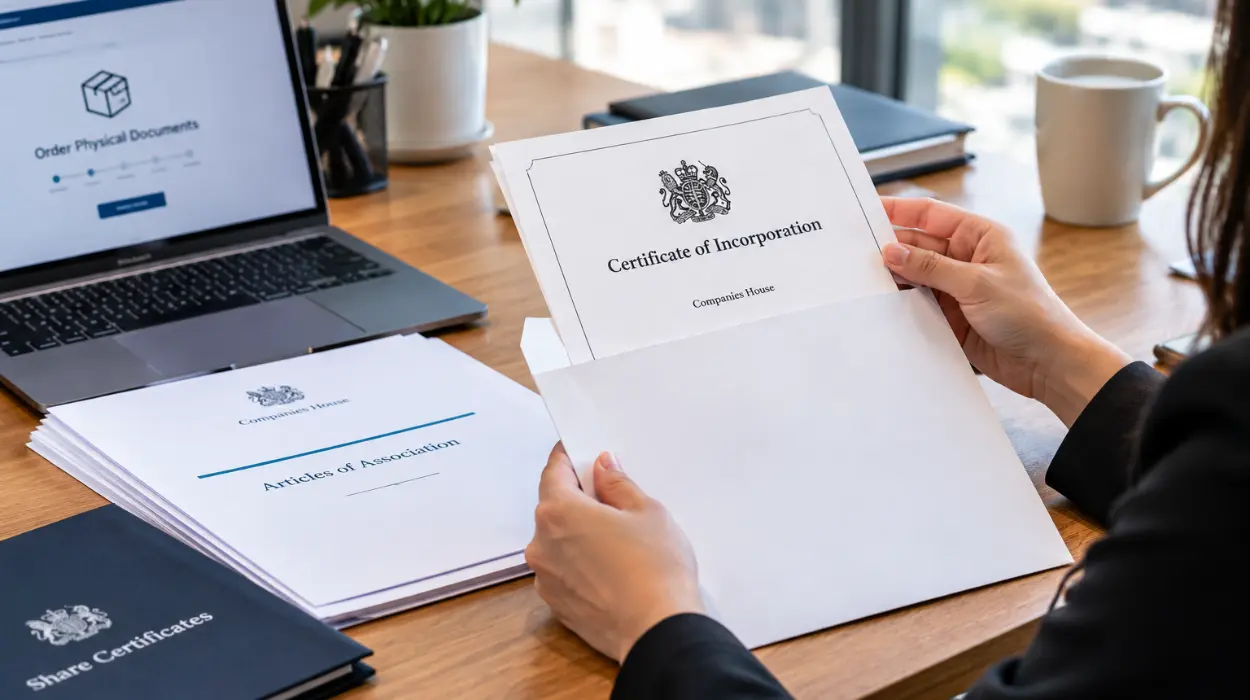
What if the official document you’ve just retrieved is actually the wrong one for your bank application? It’s a frustrating scenario that many entrepreneurs face when they realise their initial paperwork doesn’t cover every legal requirement. You know your company is registered, but proving its current health is a different matter entirely. Knowing exactly what is the difference between a Certificate of Good Standing and a Certificate of Incorporation? is the key to avoiding administrative delays and securing your next big contract.
We understand that complex legal terminology often feels like a barrier to your progress. It’s natural to feel uncertain about validity periods or which certificate carries the most weight during overseas expansion. This guide strips away that confusion by explaining the distinct roles of these two vital UK company documents. You’ll discover when to use one over the other and learn the most efficient way to obtain them. We’ve broken down the technical details into a clear path forward, ensuring you have the right proof of status exactly when you need it.
Key Takeaways
- Understand why a Certificate of Incorporation acts as your company’s birth certificate, providing conclusive evidence of your registration at Companies House.
- Learn how a Certificate of Good Standing proves your business is up-to-date with its filings and remains in a healthy, compliant state.
- Discover exactly which document you need to satisfy the requirements of banks, solicitors, and overseas authorities during expansion.
- Learn exactly what is the difference between a Certificate of Good Standing and a Certificate of Incorporation? so you can navigate complex administrative requests with confidence.
- Explore how to choose between digital and print packages to obtain the official proof of status your business requires.
Understanding Your Essential UK Company Documentation
Establishing business credibility involves more than just a professional website or a strong sales pitch. In the UK, trust is anchored in the official records held by Companies House. When you’re asked to prove your business’s legal standing, you might find yourself asking: what is the difference between a Certificate of Good Standing and a Certificate of Incorporation? This isn’t just a matter of semantics; it’s a practical question that determines whether your bank account is approved or your international expansion is delayed.
The Administrative Foundation of a Limited Company
Your company documents are the legal bedrock of your venture. They aren’t just paperwork to be filed and forgotten. They represent your company’s “personhood” in the eyes of the law. Maintaining an accurate public record is essential for transparency. It ensures that lenders, suppliers, and investors can verify your identity without hesitation. Most founders first encounter these requests during key growth milestones. You might need to provide supplementary company documents when securing a lease, applying for a business loan, or entering a formal partnership.
Why One Document Is Never Enough
A common point of confusion for new directors is the shelf-life of their registration papers. It’s helpful to view the certificate of incorporation as a business birth certificate. It provides conclusive evidence that your company was formed on a specific date. However, it tells a bank nothing about your current status. Whilst incorporation is a one-time event, compliance is an ongoing obligation. If you formed your company years ago, that original document doesn’t prove you haven’t been struck off since then.
In 2026, regulations have placed a higher premium on transparent corporate behaviour. Authorities now require proof that a company is up-to-date with its filings. This is where a Certificate of Good Standing becomes indispensable. It confirms your company is currently active and has met all its statutory requirements. The UK is rapidly moving towards digital-first verification, where stakeholders demand real-time data. Understanding this allows you to move with speed and accuracy, ensuring you never feel overwhelmed by the technicality of administrative requests. Having the right proof ready means you can focus on building your business instead of chasing missing paperwork.
The Certificate of Incorporation: Your Business Birth Certificate
The Certificate of Incorporation is the most fundamental document any UK limited company possesses. It serves as conclusive evidence that your business has been legally registered at Companies House. Unlike a passport or a driving licence, this document never expires. Even if you change your company name or directors later, the original certificate remains a permanent part of your corporate history. It marks the exact moment your business became a separate legal entity.
Many new directors find themselves confused by the various forms required during the early stages of growth. They often wonder, what is the difference between a Certificate of Good Standing and a Certificate of Incorporation? Essentially, whilst the incorporation certificate proves your business was born, the good standing certificate proves it is still healthy. You’ll receive your incorporation certificate immediately after your company is formed; you should keep it in a safe place for the duration of your business’s life.
What Information Is Displayed?
Every certificate follows a standard format to ensure legal clarity. It prominently features your Company Name and your unique Company Registration Number (CRN). This eight-digit code is your business’s primary identifier for life. You can verify these details at any time using the Companies House company information service. This public record ensures that your business details are transparent and accessible to those who need to verify your status.
The document also specifies the Registrar of Companies and the specific Act of Parliament under which the company is incorporated. It explicitly states the “type” of company, such as a Private Limited Company. These details are vital for legal precision. They tell the world exactly what kind of legal structure you have chosen for your venture. Amongst the various papers you will collect, this one carries the most historical weight.
Primary Use Cases for Incorporation Proof
You’ll need this document more frequently in your first year than at any other time. It’s the primary piece of evidence required for several essential setup tasks:
- Banking: High-street and digital banks require this to open your first business account.
- HMRC Registration: You’ll need the details from this certificate when registering for VAT or PAYE.
- Insurance: Providers use it to verify the legal entity they are covering.
- Premises: Landlords often ask for it before signing an initial lease agreement.
If you’re just starting out, choosing one of our comprehensive formation packages ensures you receive both digital and physical copies of this essential document right from the start. This allows you to meet these administrative requirements without any delay.
The Certificate of Good Standing: Proving Ongoing Compliance
A Certificate of Good Standing (COGS) is an official statement issued by the Registrar of Companies. It confirms that your business has been in continuous existence since its formation and remains compliant with all statutory filing requirements. Unlike the Certificate of Incorporation, which is a historical record of your company’s birth, the COGS acts as a “snapshot” of your company’s health at a specific point in time. It’s often the final piece of the puzzle when you’re asked: what is the difference between a Certificate of Good Standing and a Certificate of Incorporation?
Overseas authorities and international banks are particularly keen on this document. They need to know that your company hasn’t just been registered, but is actively managed and remains in good standing. To qualify for this certificate, your company must have a minimum of one individual director and a registered office address in the UK. It serves as a bridge of trust between your business and external stakeholders who require current, verified data.
What Does “Good Standing” Actually Mean?
The term “good standing” implies that your company is not currently the subject of strike-off action or liquidation proceedings. It confirms that all statutory documents, such as annual accounts and confirmation statements, have been filed on time. You can verify your company’s current filing status through the Companies House official company information service. If your records are behind, you won’t be able to secure this document until your filings are brought up to date.
Beyond basic compliance, you can request that the certificate includes additional details. This might include the names of directors, the registered office address, or even specific share capital information. This flexibility makes it a powerful tool for proving corporate transparency to potential partners or lenders. It removes the intimidation factor of complex administrative requests by providing a single, authoritative proof of your company’s current configuration.
The Validity Period and “Expiry” Myths
One of the most common misconceptions is that a Certificate of Good Standing lasts forever. Technically, the document doesn’t have an expiry date, but its practical utility is time-limited. Most financial institutions and legal bodies only accept certificates that are less than three months old. They want to ensure the information is current and that no negative changes have occurred since the document was issued.
Your eligibility for this certificate depends entirely on your filing behaviour. If you miss a Confirmation Statement deadline, Companies House will refuse to issue the certificate until the record is updated. Maintaining a clean filing record is the only way to ensure you can obtain this proof of status at a moment’s notice. It’s the primary reason why understanding what is the difference between a Certificate of Good Standing and a Certificate of Incorporation? is so vital for modern directors who value speed and administrative precision.
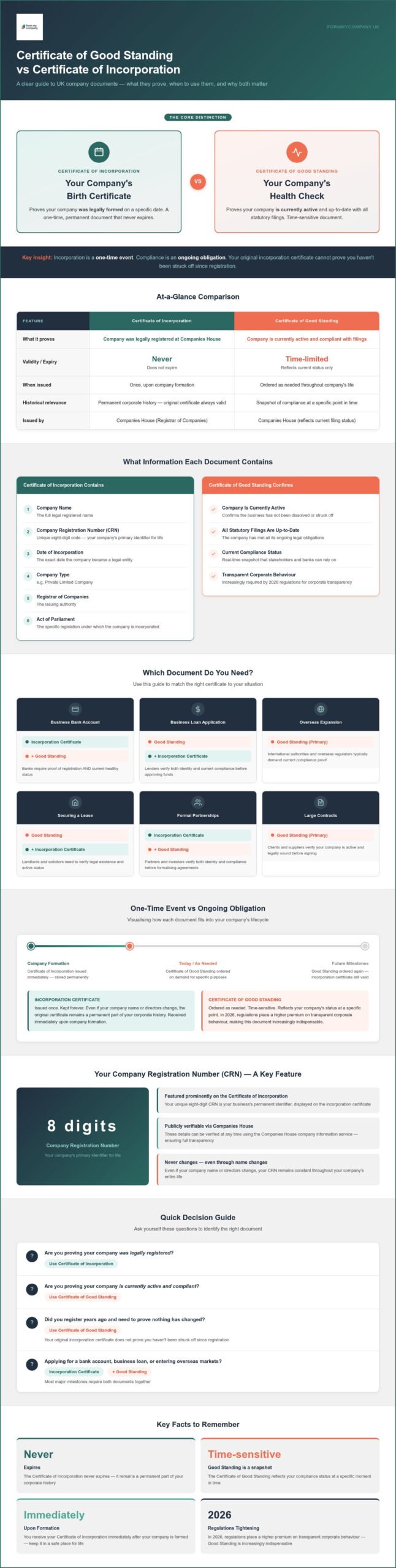
Certificate of Good Standing vs Certificate of Incorporation: Key Differences
To manage your business effectively, you must distinguish between your foundational records and your compliance records. Whilst they both originate from Companies House, they serve entirely different masters. If you are currently asking, what is the difference between a Certificate of Good Standing and a Certificate of Incorporation? the answer lies in the timeline they represent. One looks back at the moment of creation; the other looks at your status right now.
- Purpose: Incorporation provides evidence of legal creation, whilst Good Standing provides evidence of current corporate health.
- Frequency: You receive an Incorporation certificate once at birth. A Certificate of Good Standing is issued only upon request to provide a contemporary snapshot.
- Content: Incorporation details are static (CRN, date, name). Good Standing details are dynamic, confirming you aren’t currently facing strike-off action.
- Audience: Domestic banks and HMRC usually require incorporation proof. International partners and overseas regulators almost always demand a fresh Certificate of Good Standing.
When to Use Which Document?
The correct choice depends on the specific administrative hurdle you are facing. For instance, if you are setting up a UK branch of an overseas company, the foreign registry will likely demand a Certificate of Good Standing to prove the parent company is active. Conversely, when proving ownership to a potential investor, your original Certificate of Incorporation is the primary tool to verify your CRN and date of registration.
Renewing a high-value corporate contract often requires a blend of both. A partner might accept your incorporation papers as proof of identity but insist on a Good Standing certificate to ensure you haven’t missed recent filing deadlines. This dual requirement is common amongst large-scale organisations that prioritise risk management and transparent corporate behaviour. Having both ready demonstrates that you are an organised and reliable director.
Can One Replace the Other?
The short answer is no. An Incorporation certificate cannot prove current compliance because it contains no information about your recent filing history. It simply proves you existed at some point. Similarly, a Good Standing certificate is not a substitute for legal formation papers. It is a supplementary document that builds upon the foundation laid by your initial registration.
Most institutions require a “full picture” of your business. This means you should maintain a complete record of both your historical and current status. To ensure you are never caught off guard by a document request, we recommend keeping these essentials together in an official Company Pack. This ensures your foundational paperwork is always at your fingertips, allowing you to move with the speed and accuracy that modern business demands.
How to Manage and Order Your Official Company Certificates
Managing your corporate records shouldn’t be a source of stress. In 2026, the process for retrieving official documents is faster than ever, provided your filing history is clean. Before placing an order, always verify your current status on the public register. If you’ve missed a deadline, you’ll need to rectify it before Companies House will issue a fresh statement of health. Understanding what is the difference between a Certificate of Good Standing and a Certificate of Incorporation? helps you identify exactly which request to prioritise when a deadline looms.
Form My Company streamlines this procurement process by integrating directly with Companies House. We handle the heavy lifting, ensuring your documents are retrieved with speed and accuracy. This allows you to focus on your business growth whilst we manage the administrative precision required for your filings. We act as a reliable facilitator, stripping away the intimidation factor of these complex procedures.
Ordering Your Certificate of Good Standing
When you order a Certificate of Good Standing, you have the option to customise the information it displays. You might choose to include the names of your directors or your company secretary to satisfy a specific bank request. It’s vital to ensure your Registered Office Address is current before you begin. Any discrepancies between your actual business location and the public record can lead to delays or even the rejection of your application by third-party institutions.
Digital vs. Physical Documentation in 2026
The landscape of business verification has shifted towards instant digital access. Most UK institutions now prefer digital copies for speed. However, physical, embossed certificates remain the favourite for foreign trade and international expansion. If you are dealing with overseas authorities, you will likely require Apostilled Documents. This is a higher level of legalisation that confirms the signature of the government official who issued the certificate, making it acceptable amongst foreign regulators.
Organising your records effectively involves more than just holding on to your original birth certificate. You should regularly update your files with Supplementary Company Documents to provide a complete picture of your corporate health. This proactive approach ensures you’re always ready for a surprise audit or a sudden contract opportunity. By mastering the distinction between your foundational and compliance papers, you position your venture as a professional and trustworthy entity in the global market.
Secure Your Company’s Future with the Right Documentation
You now have a clear understanding of your business’s essential paperwork. Your Certificate of Incorporation remains the permanent record of your company’s birth, whilst your Certificate of Good Standing provides the vital snapshot of your current compliance. Knowing exactly what is the difference between a Certificate of Good Standing and a Certificate of Incorporation? ensures you’re prepared for any administrative request, whether you’re opening a local bank account or expanding into international markets.
Don’t let paperwork slow your momentum. Our direct integration with Companies House ensures fast document retrieval, backed by expert administrative support to guide you through every step. Whether you need an instant digital copy or a physical embossed version for official use, we have the right package for your needs. Order Your Official Certificate of Good Standing with Form My Company today and keep your focus on building your venture. You’ve done the hard work of starting up; let us help you stay compliant and confident as you grow.
Frequently Asked Questions
Can I get a Certificate of Good Standing if my company is dormant?
Yes, dormant companies can obtain a Certificate of Good Standing. Being dormant simply means your company has no significant accounting transactions. However, you must still file dormant accounts and annual confirmation statements on time to remain compliant. If your public record is up to date, Companies House will issue the certificate. This is often required when dormant parent companies need to prove their existence for group restructuring purposes.
How long does it take to receive a Certificate of Good Standing in the UK?
The turnaround time depends on the delivery method you choose. Standard paper certificates typically take several working days to arrive by post, whilst express services can expedite the process. Digital versions are often available much faster. If you require a physical, embossed document for international use, you should also factor in courier times. Form My Company integrates directly with Companies House to ensure your request is processed with maximum efficiency.
Do I need to renew my Certificate of Incorporation?
You never need to renew your Certificate of Incorporation. It is a permanent record of your company’s formation and remains valid for the entire life of the business. Whilst you might wonder what is the difference between a Certificate of Good Standing and a Certificate of Incorporation? in terms of validity, remember that incorporation is a historical fact. Only the “good standing” status needs periodic proof through new certificates to satisfy current compliance checks.
What happens if Companies House refuses to issue a Certificate of Good Standing?
A refusal usually indicates that your company is not up to date with its statutory filings. Companies House will not issue the document if your annual accounts or confirmation statements are overdue. To resolve this, you must file the missing documents immediately. Once the public register reflects your compliance, you can reapply. It’s a clear signal that your administrative precision needs attention before you can proceed with high-value contracts or banking applications.
Is a Certificate of Good Standing the same as a Letter of Authority?
No, these documents serve entirely different purposes. A Certificate of Good Standing proves your company is legally active and compliant with UK law. A Letter of Authority is a document where a director grants permission for someone else to act on the company’s behalf. Whilst both might be requested during complex negotiations, they aren’t interchangeable. Understanding what is the difference between a Certificate of Good Standing and a Certificate of Incorporation? helps you keep your foundational records separate from these operational permissions.
Can foreign nationals order these certificates for a UK company?
Yes, foreign nationals can order these official certificates for any UK registered company. Form My Company specialises in supporting international directors who need to establish or manage a British business presence. Whether you are based in Europe or further afield, you can access our digital and print packages to retrieve your documents. This is particularly useful for overseas expansion where physical, apostilled proof of status is often a mandatory requirement for foreign regulators.
Does the Certificate of Good Standing show who the shareholders are?
A standard Certificate of Good Standing does not automatically list shareholders, but you can request this information be included. When ordering, you can specify that you want details such as directors, secretaries, and share capital to be displayed. This flexibility allows you to tailor the document to meet the specific requirements of a lender or international partner. It provides a more detailed snapshot of your current corporate structure than the original incorporation papers issued at birth.
How much does it cost to get a replacement Certificate of Incorporation?
You can obtain a replacement Certificate of Incorporation through Companies House or a registered agent. Whilst we don’t quote specific fees, the cost typically varies depending on whether you require a digital download or an official certified copy on specialist paper. If you’ve lost your original “birth certificate”, it’s vital to secure a replacement quickly. Most banks and HMRC will require this proof of identity before they allow you to manage your business’s financial affairs.