

To register for PAYE in the UK, an employer generally needs to register with HM Revenue and Customs before the first payday, subject to HMRC’s registration rules and timing requirements. PAYE, or Pay As You Earn, is the system employers use to report employee pay and deductions, including Income Tax and National Insurance contributions.
Whether you are starting a limited company, hiring your first employee or beginning to pay yourself a director’s salary, understanding how to register for PAYE helps you establish the right payroll arrangements. This guide explains who needs to register, what information to prepare, how to register online, and where to get professional assistance.
If you want support with the application, Form My Company’s PAYE Registration Assistance service provides a commercial next step.
What Is PAYE Registration?
PAYE registration is the process of registering as an employer with HMRC so that your business can operate a PAYE payroll scheme when required. Once registered, you receive an employer PAYE reference and can fulfil the relevant payroll reporting and payment obligations.
PAYE applies to many businesses that employ staff or pay directors through payroll. The requirement depends on factors such as employees’ earnings, other jobs, pension income and benefits. Not every payment to a worker automatically requires PAYE registration, so employers should check the current HMRC criteria.
Registering correctly establishes the foundation for:
Reporting employee pay and deductions to HMRC.
Calculating and deducting Income Tax and employee National Insurance where applicable.
Paying employer National Insurance contributions where due.
Issuing payroll records and year-end documents.
Meeting Real Time Information reporting requirements.
Who Needs to Register for PAYE?
Employers should determine whether they need a PAYE scheme before their first payday. Registration requirements depend on the employee’s circumstances and the nature of the payments.
Limited Companies Employing Staff
A limited company generally needs to register for PAYE if it employs people whose circumstances trigger the employer registration requirements. Incorporating a company does not automatically mean that a PAYE scheme is required immediately.
A company with no employees receiving reportable pay may not need to register solely because it exists. Review the intended payroll arrangements before making an application.
Directors Receiving a Salary
Company directors can be employees for PAYE purposes. If a director receives a salary through payroll, the company should assess whether it must register and report the payments to HMRC.
Dividends are different from salary and are not processed through PAYE. If you are the sole director, read the guidance on whether a sole director needs PAYE to understand how your circumstances affect the requirement.
Sole Traders and Partnerships Hiring Employees
Sole traders and partnerships may need to register as employers when they hire staff and pay them in circumstances covered by HMRC’s rules. The obligation is not restricted to limited companies.
Before the first payday, establish whether the worker should be treated as an employee, what payroll records are required and whether PAYE registration is necessary.
When Does a New UK Limited Company Need to Register for PAYE?
A new UK limited company should assess its PAYE obligations when it plans to begin paying employees or directors. HMRC generally advises employers to register before the first payday, and an application cannot normally be made more than two months before the first payday.
For a more specific explanation, see when a new UK limited company needs to register for PAYE.
What Information Do You Need to Register for PAYE?
Preparing the correct business and payroll information before applying helps reduce errors and delays.
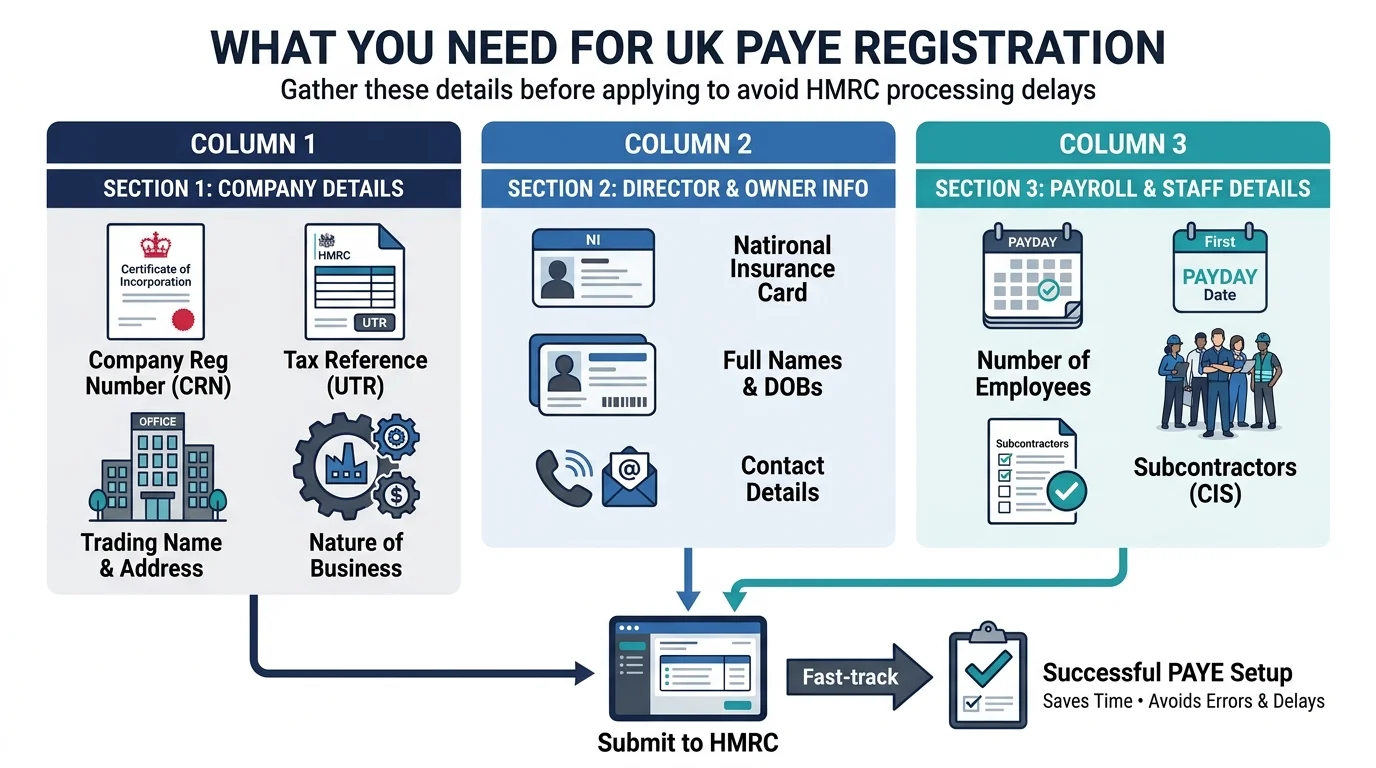
Depending on your circumstances, you may need:
Your business name and registered address.
Your Companies House registration number, if applicable.
The business structure and contact details.
The expected first payday.
The number of employees you expect to pay.
Information about directors and the person responsible for payroll.
Details of the business’s existing PAYE arrangements, if any.
Relevant personal and employment information needed to establish payroll.
Not every applicant will be asked for the same information. Follow the current HMRC application requirements rather than assuming every director must upload a passport, utility bill or bank statement.
What Is an Employer PAYE Reference Number?
An employer PAYE reference is the identifier HMRC assigns to an employer’s PAYE scheme. It is used in correspondence and payroll administration to identify the employer’s tax records.
It is different from an Accounts Office reference, which is used for employer payments to HMRC. You should keep both references securely and make sure they are entered correctly in your payroll software.
Read more about what an employer PAYE reference number is and why you need it.
How to Register for PAYE Online
Registering for PAYE online is the usual route for employers who want to establish a new payroll scheme. The application is made through the official GOV.UK employer registration service.
Step 1: Check Whether You Need an Employer Scheme
Review your planned employee payments, the first payday and any relevant employment circumstances. If you are uncertain whether a director’s salary or another payment triggers registration, check HMRC’s guidance before applying.
Step 2: Prepare Your Business Details
Gather the business information required for the application. Check your registered company name and number against Companies House records where applicable.
Confirm the expected first payday and the number of employees you plan to pay. Accurate information makes it easier to complete the form correctly.
Step 3: Apply Through GOV.UK
Use the official GOV.UK service to register as an employer. Follow the instructions and provide the requested information.
You may need to sign in or establish access to the relevant government services. Use the official application route rather than entering business information into an unverified third-party website.
Step 4: Submit the Application
Review the information carefully before submission. Errors in the business details, intended start date or other application fields can create unnecessary follow-up work.
Keep a record of your submission and any confirmation received from HMRC.
Step 5: Wait for Your PAYE Details
HMRC will process the application and provide the relevant employer references when registration is complete. Processing times can vary, so do not assume that every application will be approved within a fixed number of hours.
Allow sufficient time before the first payday and follow HMRC’s instructions if further information is requested.
Step 6: Set Up Your Payroll
Once the scheme is established, configure your payroll software or payroll service. Make sure employee details, tax codes, pay dates and relevant deductions are handled correctly.
Employers must submit the appropriate Full Payment Submission and other required reports in accordance with HMRC’s Real Time Information rules.
Can You Register for PAYE by Email?
Employers commonly register through the online GOV.UK service. An email should not be assumed to be an alternative application method unless HMRC specifically directs the employer to use it.
If you cannot complete the online application, consult the current GOV.UK guidance or contact HMRC to establish the appropriate route for your circumstances. Do not send sensitive employee or company information to an unverified email address.
Registering for PAYE Online vs Using an Agent
| Consideration | Registering yourself | Using an agent |
|---|---|---|
| Application | You complete the process | The agent assists according to the agreed service |
| Information | You gather and enter the details | You supply the required information to the agent |
| Cost | No separate agent service fee | Professional service fees may apply |
| Responsibility | You remain responsible for employer compliance | You remain responsible for meeting your legal obligations |
| Support | You use HMRC guidance | You may receive help with preparation and submission |
An agent can help with the application process, but professional assistance does not automatically guarantee HMRC approval or remove the employer’s responsibilities.
How Long Does PAYE Registration Take?
PAYE registration processing times vary. The time required depends on the application, the information supplied and whether HMRC needs further clarification.
Avoid relying on an unconditional promise of registration within 24–48 hours or same-day approval. Check the current HMRC guidance and allow enough time before your first payday.
To help avoid delays:
Confirm your company details before applying.
Use the correct expected first payday.
Check that the information entered is consistent.
Respond promptly if HMRC requests additional information.
Keep a record of your application and employer references.
Form My Company’s PAYE Registration Assistance service can help businesses that prefer professional support with the registration process.
What Happens After You Register for PAYE?
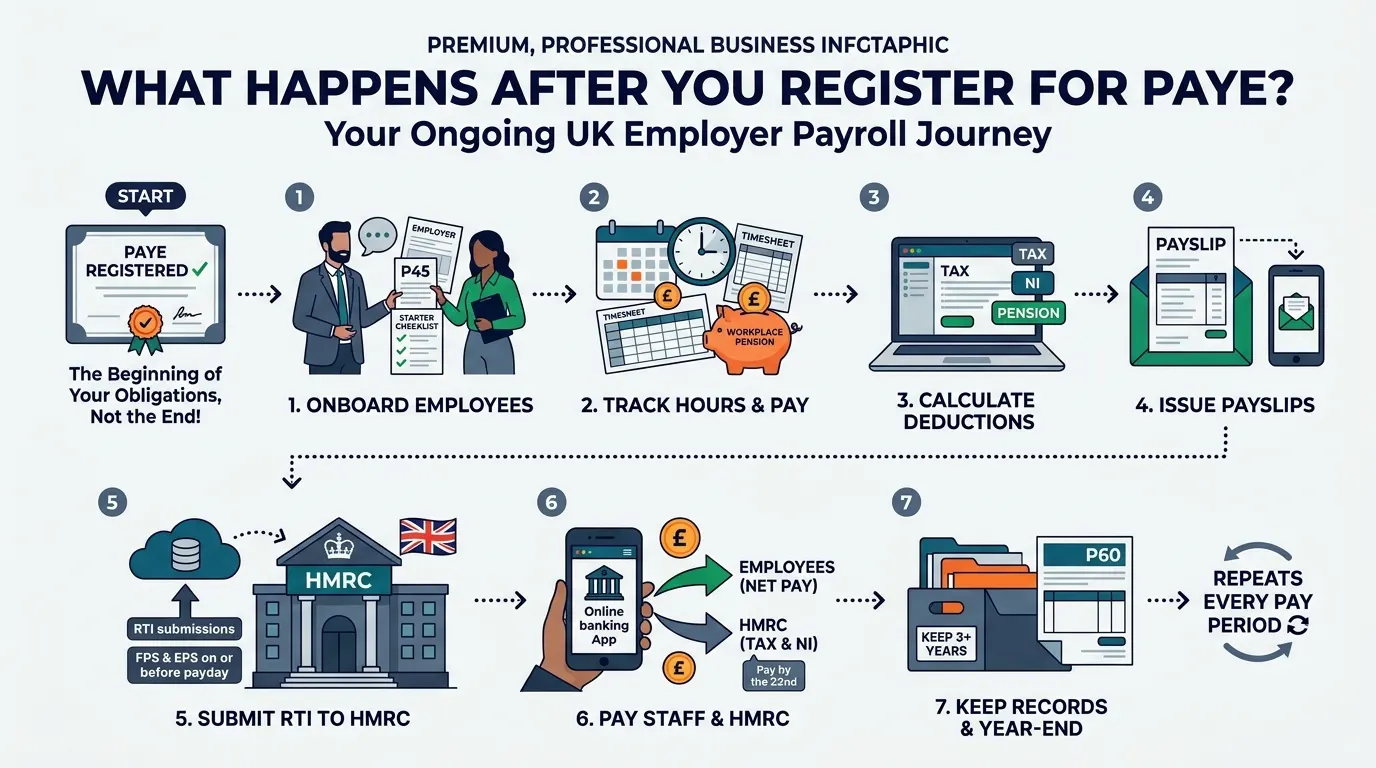
Registration is the beginning of your employer payroll obligations, not the end of them. Employers must operate payroll correctly and meet the reporting and payment requirements that apply to their circumstances.
Submit Payroll Reports to HMRC
Employers generally report employee payments and deductions through Real Time Information. A Full Payment Submission is normally sent on or before the date employees are paid, subject to the applicable reporting rules and exceptions.
Pay Tax and National Insurance
Employers must account for the amounts due to HMRC and pay them by the relevant deadlines. The applicable amounts depend on employee earnings, tax codes and National Insurance rules.
Maintain Payroll Records
Keep accurate records of employee pay, deductions, submissions and payments. Retain the information for the applicable statutory period and make it available when required.
Issue Employee Documents
Employers must provide the appropriate payroll documents, including payslips and relevant year-end forms where required. For example, eligible employees generally receive a P60 after the end of the tax year.
What Are Common PAYE Registration Errors?
Errors during registration or payroll setup can create delays and compliance problems. A careful review before submitting the application helps reduce avoidable issues.
Incorrect Business Details
Check the legal business name, company number and registered details before submitting the application. Where the business is a limited company, ensure the information matches the official records.
Choosing the Wrong Start Date
The intended first payday is an important part of the registration process. Enter a realistic date and ensure the application is submitted in line with HMRC’s timing rules.
Assuming Every Director Needs PAYE
A director’s position alone does not necessarily mean a company needs a PAYE scheme immediately. Assess the actual payments and applicable HMRC requirements.
Confusing PAYE and Other Employer References
Keep the employer PAYE reference separate from the Accounts Office reference. Both may be relevant to payroll correspondence and payments.
Delaying Payroll Setup
Receiving an employer reference does not automatically configure payroll software or complete employee reporting. Prepare your payroll process in advance and check that all necessary information is available.
For a deeper look at potential problems, read the hidden risks of incorrect PAYE registration for directors.
Is Your Business Ready to Register for UK Payroll?
Before registering, review whether your business has the information, processes and arrangements needed to operate payroll correctly.
A readiness check should cover:
Whether your planned payments require PAYE registration.
When the first payday is expected.
Whether business and employee details are available.
Who will run payroll and submit reports.
Whether you have selected suitable payroll software or an outsourced provider.
How you will monitor tax deductions, National Insurance and payment deadlines.
If you are still deciding whether to establish payroll, read five signs your business is ready to register for UK payroll.
How Form My Company Can Help You Register for PAYE
Form My Company provides PAYE Registration Assistance for businesses that want help navigating the employer registration process. Professional support can help you prepare the required details, review the application information and understand the next steps for setting up payroll.
The exact service scope, fees and processing arrangements should be confirmed before proceeding. HMRC retains responsibility for processing the registration and issuing the relevant references.
If you would rather receive help than manage the application alone, visit the PAYE Registration Assistance service to review the available support.
Frequently Asked Questions
How do I register for PAYE in the UK?
You can register through the official GOV.UK employer registration service. Prepare your business information, expected first payday and other requested details, then submit the application and follow HMRC’s instructions.
Can I register for PAYE online?
Yes. The online employer registration service is the standard route for most businesses establishing a new PAYE scheme. Use the official GOV.UK service and ensure your information is accurate before submission.
Can I register for PAYE by email?
Do not assume email is an accepted registration method. Start with the official online service and consult HMRC if you cannot use it or need an alternative process for your circumstances.
Who needs to register as an employer for PAYE?
Businesses generally need to register when they pay employees in circumstances covered by HMRC’s employer rules. The requirement can depend on earnings, other income and the nature of the payments. Check the current criteria before the first payday.
How long does it take to register for PAYE?
Processing times vary depending on the application and whether HMRC needs further information. Apply sufficiently early and check current GOV.UK guidance rather than relying on a guaranteed turnaround.
What is a PAYE reference number?
An employer PAYE reference identifies the employer’s PAYE scheme for payroll administration and HMRC correspondence. It is different from the Accounts Office reference used for employer payments.
Do I need PAYE if I am the only director of my company?
It depends on your circumstances and how you pay yourself. A director’s salary may require payroll reporting, while dividends are not processed through PAYE. Review the applicable HMRC rules before deciding whether to register.
What happens if I register late?
Late registration can create payroll and reporting complications and may lead to compliance issues if the employer fails to meet its obligations. Contact HMRC promptly if you have already started paying staff without completing a required registration.
Register for PAYE With Confidence
Registering for PAYE correctly helps establish compliant payroll arrangements and prepares your business to report employee payments to HMRC. Check the current requirements, gather the necessary information and allow sufficient time before your first payday.
If you need help preparing your application, explore Form My Company’s PAYE Registration Assistance service and confirm the service details before proceeding.