

Company director registration is an important part of keeping a UK company’s records accurate and compliant. If you are registering as a director of a company for the first time or a business needs to record a newly appointed director, you must follow the relevant appointment procedures and notify Companies House correctly.
The process involves confirming eligibility, obtaining the required approval, completing identity verification, preparing the necessary information and submitting the appropriate filing. This guide explains how to register a company director, what information is required and what to do after registration.
Who Can Register as a Company Director?
An individual can generally register as a company director if they are at least 16 years old and are not legally prohibited from holding the position. UK nationality and UK residence are not generally mandatory for an individual director of a UK company.
The company must also follow its articles of association and any applicable legal requirements when appointing the individual. Before starting the registration process, check that the appointment is properly authorised and that the proposed director meets the relevant eligibility criteria.
Age and Eligibility Requirements
The minimum age for an individual company director is generally 16. There is no general upper age limit, but a person must not be disqualified from acting as a director or subject to another applicable legal restriction.
Certain bankruptcy restrictions and court orders can affect eligibility. The company should check relevant restrictions before proceeding rather than relying only on the individual’s confirmation.
Minimum Number of Directors
A private limited company must have at least one director, and at least one director must be a natural person. A public limited company generally requires at least two directors.
If the company is appointing an additional director, it should review its articles of association and confirm that the appointment follows the applicable procedure.
Can Overseas Individuals Register as Directors?
Yes. An overseas individual can generally become a director of a UK company, provided the relevant eligibility, appointment and identity-verification requirements are met.
The company should ensure that the proposed director supplies accurate personal information and completes the applicable Companies House identity-verification process. Overseas applicants should check the accepted verification routes and filing requirements before submitting the appointment.
How to Register a Company Director with Companies House
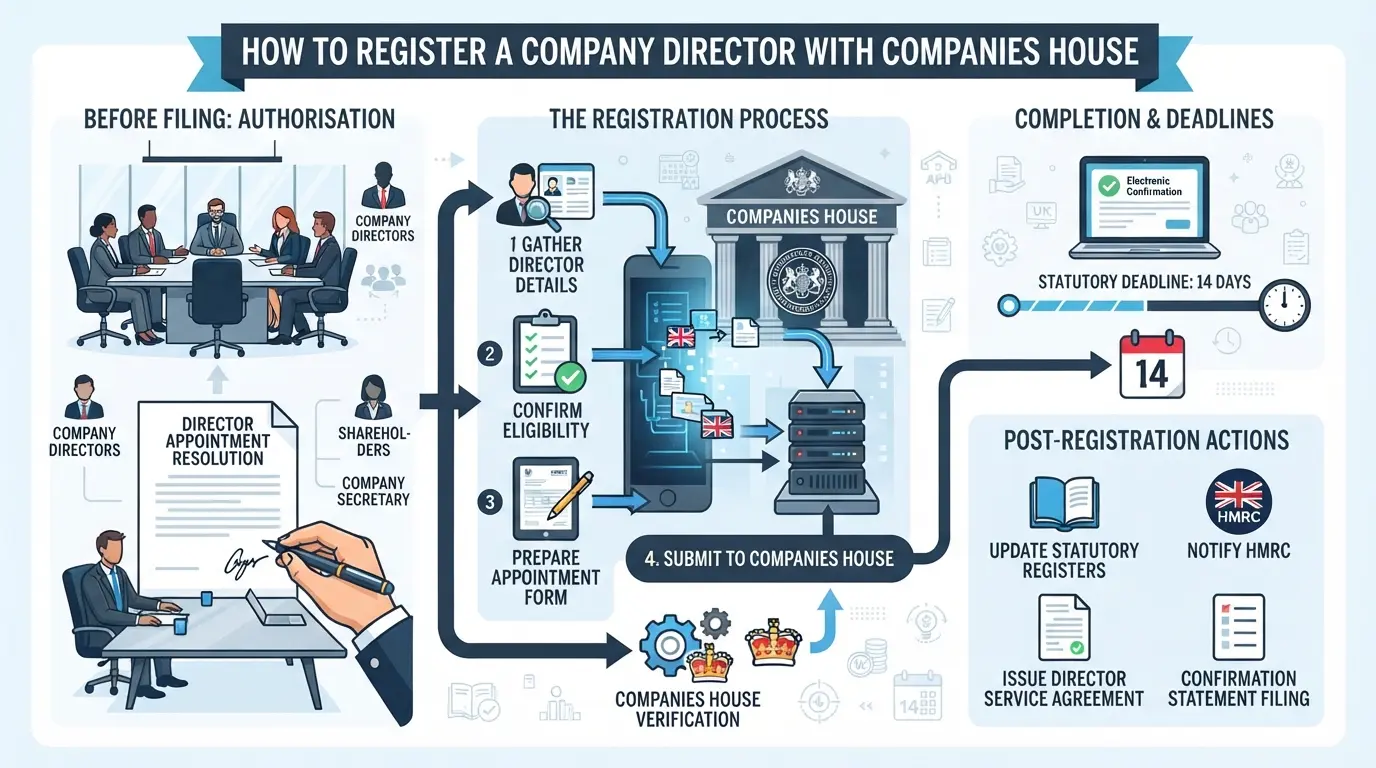
Registering a company director involves more than entering personal details into an online form. The company must first ensure that the appointment has been authorised correctly and then submit the relevant information within the applicable deadline.
Step 1: Confirm the Appointment
Establish who is being appointed, the responsibilities they will hold and the intended appointment date. The company should check its articles of association to establish whether the board or shareholders have authority to make the appointment.
Where necessary, obtain the appropriate board or shareholder approval and retain the supporting records.
Step 2: Obtain Consent to Act
The proposed director must agree to take up the role. Record that consent using the appropriate company documentation and ensure the individual understands the responsibilities associated with being a director.
The company should retain evidence of the appointment decision and consent in its records.
Step 3: Complete Identity Verification
Companies House identity verification requirements apply to directors under the current regime. The proposed director should complete the appropriate verification process and obtain the personal code required for the relevant filing.
A passport or other accepted identity document may be used as part of the verification process, depending on the route. However, supplying an identity document alone should not be assumed to satisfy every Companies House requirement.
Step 4: Prepare the Required Information
The company should prepare the information required for the appointment filing, including the director’s name, date of birth, nationality, occupation, service address and other applicable particulars.
Check every detail carefully. Incorrect information can cause administrative delays or require corrections after submission.
Step 5: Submit the Appointment Filing
Notify Companies House using the appropriate filing method. For an individual director’s appointment, Form AP01 is the relevant statutory form where applicable.
The company generally has 14 days from the date the appointment takes effect to notify Companies House. Follow the current filing instructions and make sure the required identity-verification information is provided.
For a more detailed explanation of the appointment procedure, read our guide to appointing a director through Companies House.
Step 6: Check the Public Register
After submitting the filing, check the company’s Companies House record to confirm that the information has been processed and the director’s details are displayed correctly.
Processing times can vary, so do not assume that every submission appears on the public register immediately. If information is missing or incorrect, follow the relevant Companies House guidance.
What Information Is Needed to Register a Company Director?
The exact information depends on the filing method and the circumstances of the appointment. Preparing the details in advance can help reduce avoidable errors.
Personal Details
The company will generally need the director’s full legal name, date of birth, nationality, occupation and country of residence, together with the applicable address information.
Ensure that the details are accurate and consistent with the information used during identity verification.
Service Address and Residential Address
A director’s service address is used for official correspondence and appears on the public register. Their residential address is treated differently and is not ordinarily displayed publicly in the same way.
The company should distinguish between these addresses when completing the relevant filing. A service address must meet the applicable requirements and should be one at which official correspondence can be received.
Identity Verification and Personal Code
The current Companies House identity-verification regime requires directors to complete the applicable process. The personal code associated with verification must be provided when required for the relevant filing.
The company should confirm that the incoming director has completed the correct process before submitting the appointment information.
Internal Appointment Records
Keep the records that support the appointment, including relevant board minutes or shareholder resolutions and evidence of consent to act. Update the company’s register of directors and retain the supporting documentation.
What Happens After Company Director Registration?
Registering a director is only one part of the process. Once the appointment takes effect, the director becomes responsible for complying with the duties that apply to their role.
Directors’ Legal Responsibilities
The Companies Act 2006 sets out general duties for company directors. These include acting within their powers, promoting the success of the company, exercising independent judgment, using reasonable care, skill and diligence, avoiding conflicts of interest and declaring relevant interests.
Directors should understand these obligations before taking up their positions. Companies should provide access to relevant policies, financial information and governance records.
Updating Company Records
After the appointment, ensure that the company’s internal records reflect the change. Check the register of directors and any other records affected by the appointment.
If the new director also becomes a shareholder or a person with significant control, assess whether separate records or filings are required. A director appointment does not automatically mean that ownership information has changed.
Informing Relevant Parties
Depending on the company’s circumstances, the appointment may need to be communicated to its bank, accountant, insurers, advisers or other relevant parties.
If the new director will be responsible for financial or operational decisions, make sure they understand the company’s reporting arrangements and any existing commitments.
Common Mistakes During Company Director Registration
Failing to Follow the Articles of Association
The company must use the correct appointment procedure. Review the articles before approving the appointment, especially where the company has multiple shareholders or specific governance arrangements.
Providing Incorrect Personal Details
Mistakes in names, addresses, dates or other information can delay processing. Check the information against reliable records before submitting the filing.
Overlooking Identity Verification
Identity verification is an important part of the current Companies House framework. Confirm that the director has completed the required process and has the necessary personal code for the filing.
Missing the Notification Deadline
The company generally has 14 days from the effective appointment date to notify Companies House. Record the deadline and assign responsibility for making the filing promptly.
Assuming Registration Completes Every Compliance Obligation
The appointment filing does not replace all other company responsibilities. The company must maintain its records and assess whether the appointment affects any separate reporting requirements.
Registering a Director Yourself vs Using Professional Support
A company may manage a straightforward director registration internally if it understands the applicable legal requirements, appointment procedures and filing process.
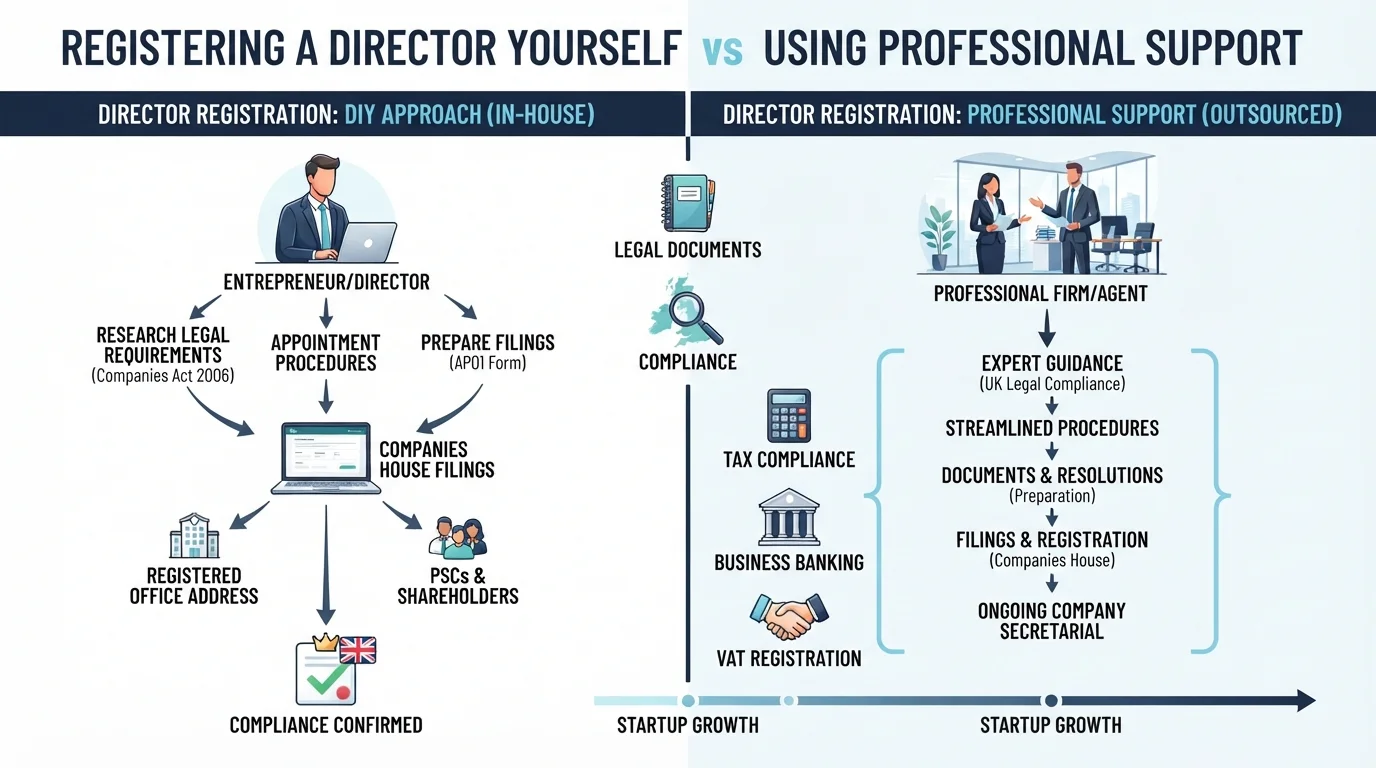
However, professional support may be helpful when the company has complicated governance arrangements, multiple appointments, overseas directors or uncertainty about identity verification and documentation.
A professional service can assist with preparing information, checking records and managing the filing process. The company remains responsible for ensuring that the appointment is properly authorised and the information supplied is accurate.
For a wider explanation of the appointment requirements, see our guide on the legal requirements and criteria for appointing a new company director.
If the company needs to understand how to add a director to an existing limited company, our separate guide to adding a director to a limited company covers that related process.
When Should You Seek Professional Help?
Professional assistance can be useful if you are unfamiliar with Companies House filings, unsure which appointment procedure applies or managing a change that involves several company records.
It may also help where an overseas director needs guidance on identity verification or where the company’s articles require careful review before the appointment can proceed.
For additional guidance on managing statutory records and appointment paperwork, read our related article on director appointment forms and Companies House requirements.
For companies that prefer help with the administrative process, Form My Company offers a Director Appointment and Resignation service. Review the service details to determine whether it meets your company’s requirements.
Frequently Asked Questions
How do I register as a director of a company?
First, the company must appoint you using the procedure set out in its articles of association. It must then complete the relevant Companies House filing, provide the required information and meet the applicable identity-verification requirements.
How do I register a company director with Companies House?
For an individual director’s appointment, the company generally uses Form AP01 or the applicable filing route. It must provide accurate director details, meet the identity-verification requirements and notify Companies House within the relevant deadline.
Can I register as a company director without living in the UK?
Yes. There is generally no UK residency requirement for an individual director of a UK company. You must still meet the applicable eligibility requirements and complete the required identity-verification and filing procedures.
What is Form AP01 used for?
Form AP01 is used to notify Companies House of the appointment of an individual director. The company should follow the current filing guidance to ensure the required information and identity-verification details are provided.
How long does company director registration take?
The time required depends on how quickly the company obtains approval, prepares the information and completes the necessary verification. Companies House processing times can vary, so check the filing status rather than assuming that registration is immediate.
Does it cost anything to register a company director?
The applicable filing route and any associated charges should be checked against current Companies House guidance. Do not assume that every method or related professional service has the same cost.
Can I register a director myself?
Yes. A company can generally manage the process itself if it follows the relevant legal requirements, uses the correct appointment procedure and submits accurate information. Professional support is optional where additional assistance is useful.
Get Help with Company Director Registration
Company director registration requires accurate information, proper authorisation and compliance with the applicable Companies House procedures. By checking eligibility, completing identity verification and keeping company records up to date, businesses can manage director changes more effectively.
If you need assistance with an appointment or a change to your company’s director records, explore Form My Company’s Director Appointment and Resignation service to review the available support.