
A UK Certificate of Good Standing costs between £50 and £150, depending on the processing speed, delivery format, and whether you order directly through Companies House or via a corporate services provider.
What factors influence the cost of a Certificate of Good Standing?
The total price depends on government filing fees, agent service charges, digital versus physical document delivery, and standard versus expedited processing speeds.
Companies House charges a baseline government fee for issuing official corporate documents. When businesses use third-party secretarial agencies, additional fees apply for document handling, expedited courier shipping, and physical apostille certifications. Standard digital requests incur lower processing overhead than expedited paper certificates requiring physical dispatch.
Administrative expenses fluctuate based on the specific delivery format chosen by company directors. Digital PDF certificates arrive via email within 24 to 48 hours for a lower fee. Physical paper copies require postal delivery, which increases shipping expenses. International postage adds extra costs for overseas corporate entities.
Processing speed determines the urgency surcharge applied to corporate filings. Standard turnaround times take three to five business days. Same-day dispatch services command premium pricing from filing agents. Choosing standard processing reduces overall corporate compliance overhead.
How do government fees compare to corporate service provider pricing?
Government filing fees remain fixed at lower rates, whereas corporate service providers add administrative value, expert reviews, and expedited handling charges.
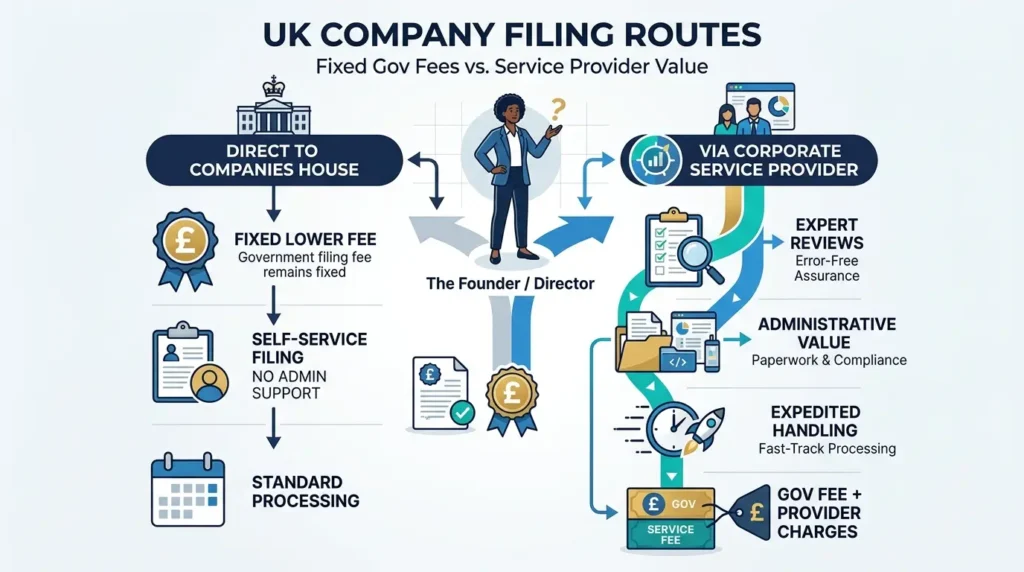
Companies House charges a specific statutory fee for extracting company registry records. Third-party corporate service providers bundle this statutory fee into comprehensive packages. These packages include manual data verification, status checks against the UK register, and secure document delivery.
Using a specialized incorporation agent saves internal administrative time. Corporate service providers check company data before submission to prevent costly rejection delays. Errors on applications stall the issuance process and waste valuable business time. Professional agents validate active company status against live government databases instantly.
Businesses balance cost against convenience when selecting a filing channel. Direct government applications require navigating official portal interfaces independently. Service providers streamline the ordering workflow for international clients needing UK documentation. This efficiency justifies the moderate markup charged by professional secretarial agencies.
What hidden fees should companies watch out for during ordering?
Hidden costs include unexpected courier delivery surcharges, international wire transfer fees, VAT additions, and extra charges for apostille legalisation.
Many online providers advertise low base prices that exclude mandatory value-added tax. Final checkout screens often append standard government taxes unexpectedly. Reviewing the complete fee breakdown before payment prevents surprise billing issues. Transparent providers display all applicable taxes upfront.
International shipping rates vary wildly depending on destination postal zones. Standard postal services cost less but lack reliable tracking capabilities. Secure courier delivery protects vital corporate documents during transit. Companies must select tracked international shipping to guarantee document arrival.
Apostille legalisation adds separate government expenses for foreign use. Documents destined for non-Commonwealth countries require official foreign office authentication. This extra legalisation step doubles the baseline cost of document procurement. Businesses verify international destination requirements before initiating orders.
How does processing speed affect total document pricing?
Expedited processing speeds double standard service costs because filing agents allocate dedicated personnel for immediate same-day document extraction.
Standard processing timelines suit companies planning routine international expansion or bank account openings. Routine applications clear registry queues within standard operating windows. Budget-conscious directors select standard delivery to minimise administrative overhead.
Urgent corporate transactions demand priority document retrieval services. M&A deals, international tender bids, and sudden regulatory audits require immediate proof of corporate status. Premium priority tiers bypass standard queue protocols entirely. Filing agents dispatch staff to secure physical or digital copies within hours.
Strategic planning eliminates the need for expensive expedited fees. Anticipating corporate document requirements weeks in advance protects operational budgets. Companies schedule periodic renewals of active status letters to maintain operational readiness affordably.
Why do international shipping and apostille requirements alter expenses?
International shipping increases logistical expenses, and apostille certification mandates Foreign, Commonwealth and Development Office involvement for foreign jurisdictions.
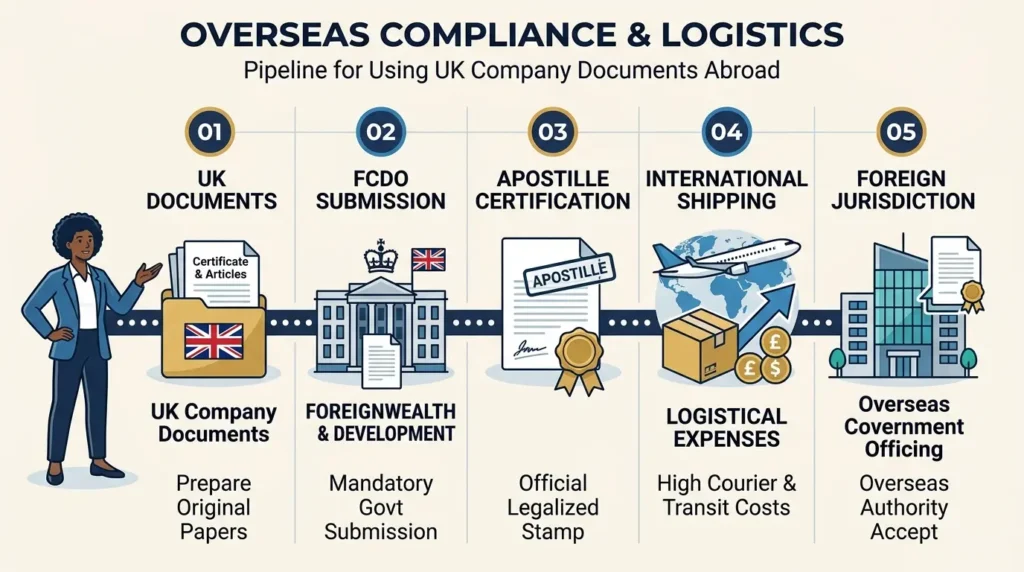
Cross-border business transactions require authenticated corporate registry documents. Foreign authorities reject standard domestic certificates lacking official government legalisation stamps. The UK Foreign Office validates company signatures for international legal validity. Each authenticated document incurs specific administrative fees.
International courier companies charge premium rates for heavy paper packets. Secure tracking systems protect sensitive corporate registry data during global transit. Digital delivery alternatives bypass physical shipping expenses entirely when foreign recipients accept electronic PDFs.
Verifying foreign authority preferences prevents unnecessary document expenditure. Some overseas banks accept digital certificates with electronic verification codes. Other international jurisdictions strictly mandate physical paper copies bearing wet ink signatures and red ribbon seals. Matching document formats to recipient demands optimizes administrative spending.
How can businesses order a certificate efficiently through Form My Company?
Form My Company provides streamlined corporate document procurement, transparent pricing structures, and expert registry verification services for UK businesses.
Securing official proof of corporate compliance protects international trade partnerships and banking relationships. Accurate registry filings prevent administrative rejection loops and operational delays. Form My Company ensures every application complies with current UK company law standards.
Enterprise directors streamline statutory compliance by leveraging dedicated corporate secretarial platforms. Transparent pricing models eliminate unexpected fees during checkout workflows. Professional document handlers review company records meticulously prior to registry submission.
Order Your Certificate of Good Standing from Form My Company to receive verified registry documents quickly. Pair this service with our How to Compare Certificate of Good Standing Prices Without Hidden Fees guide to evaluate market rates effectively. Learn more about corporate secretarial workflows by reading our detailed Certificate of Good Standing service overview. Form My Company delivers dependable administrative solutions for ambitious enterprises.
Understanding the true cost of a UK Certificate of Good Standing involves evaluating government fees, service provider markups, shipping methods, and legalisation requirements. Strategic planning allows businesses to avoid expedited surcharges and hidden administrative traps. Selecting transparent corporate partners ensures reliable document delivery within established operational budgets. Form My Company delivers efficient corporate document procurement with clear, upfront pricing for growing enterprises.
Explore More Certificate of Good Standing Guide,
How Do You Keep Your Company Eligible for a Certificate of Good Standing?
What Happens if You Submit an Out-of-Date Certificate of Good Standing?
What is a UK Certificate of Good Standing?
A UK Certificate of Good Standing is an official document issued by Companies House confirming that a registered company has been in continuous, unbroken existence and is compliant with statutory filing requirements. Businesses typically use a Certificate of Good Standing when opening international bank accounts, expanding overseas operations, or bidding on foreign contracts. Form My Company provides streamlined procurement services to secure these verified registry documents efficiently.
How long does it take to get a Certificate of Good Standing?
Standard processing for a UK Certificate of Good Standing through Companies House typically takes between three to five business days. Urgent applications can often be expedited via corporate service providers to secure digital copies within 24 hours. Form My Company streamlines this registry extraction process to ensure fast and reliable document delivery.
Can a dissolved or non-compliant company get a Certificate of Good Standing?
Companies House will not issue a Certificate of Good Standing if a business is currently dissolved, struck off, or overdue on filing statutory accounts and confirmation statements. The company must resolve all outstanding compliance issues and update its registry data before ordering the document. Form My Company assists directors in verifying active compliance status prior to application submission.
What information does a Certificate of Good Standing contain?
A Certificate of Good Standing displays the official company name, registered company registration number, and a statement confirming that the company is actively registered on the public register. It may also include details regarding the company’s registered office address and current directors if requested during the application. Form My Company ensures all retrieved documents accurately reflect current Companies House records.
Do I need an apostille on my Certificate of Good Standing for overseas use?
Documents destined for international authorities outside the United Kingdom frequently require an official apostille from the Foreign, Commonwealth and Development Office to verify legal validity. The apostille authenticates the signatures and official seals on the certificate for foreign courts and banking institutions. Form My Company helps businesses manage both certificate issuance and international legalisation requirements seamlessly.