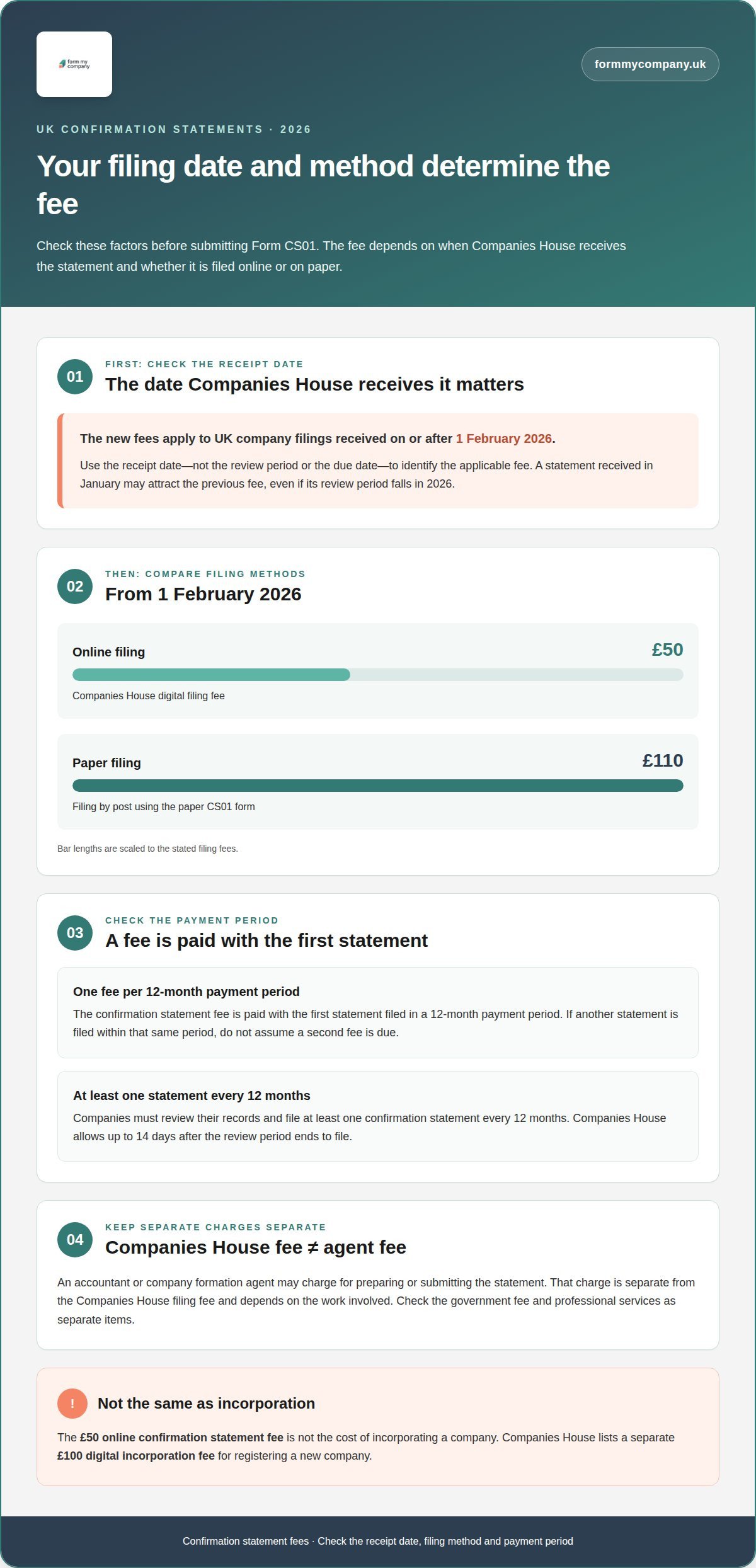
For 2026, the UK company confirmation statement fee is £50 for online filing, according to Companies House; filing the paper CS01 form costs £110. A confirmation statement is the annual filing a company uses to review and confirm its details, even if nothing has changed.
It’s easy to focus on the deadline and overlook that the filing method affects the fee. The applicable fee depends on when Companies House receives the statement, not the period it covers. Read on to see what a confirmation statement does, which details to review on Form CS01 and how to identify the right fee for your filing.
Key Takeaways
- Use Form CS01 to review your company’s details and confirm whether its public record is accurate, even if nothing has changed.
- Track the review period and filing deadline; Companies House allows up to 14 days after the review period ends to file.
- Check the date Companies House receives your statement, as the filing date determines which fee applies.
- Compare the digital and paper filing fees before choosing how to submit your statement.
- Review the details on CS01 carefully, and report changes that need separate notification before confirming the record.
What is a confirmation statement?
A confirmation statement is a filing that allows a UK company to review and confirm the information held at Companies House. Every company must file one, even if its details have not changed or it is dormant or not trading.
- Understand what the filing confirms. Use Form CS01 to check that the company’s information is current, rather than to submit its annual accounts. Review the registered office, business activities, share capital, shareholders and people with significant control (PSCs). The statement records whether the information is correct at the confirmation date. If something has changed, identify whether it needs a separate notification before confirming the record.
- Track the review period and deadline. A company must review its records and file at least one confirmation statement every 12 months. The payment period starts on the incorporation date, while an older company’s period may follow its previous annual return. Companies House says a UK company can file its confirmation statement up to 14 days after its review period ends. Don’t treat that filing window as extra time to leave the record unchecked.
- Choose the filing method with its fee in mind. From 1 February 2026, filing a company confirmation statement online costs £50, according to Companies House. Filing by post on paper costs £110. These are Companies House filing fees, not the company’s incorporation cost. The digital incorporation fee is £100, according to Companies House, but that is a separate charge for registering a new company.
- Check the payment period before paying. The confirmation statement fee is paid with the first statement in a 12-month payment period. So, if another statement is filed within that same period, don’t assume a second fee is due. The applicable fee depends on whether Companies House receives the filing digitally or on paper, and when it receives it. Keep the payment and submission details with your company records.
- Include identity details in your review. A PSC who is not a director must provide their PSC personal code within the first 14 days of their birth month, according to Companies House. Keep the relevant details organised alongside the CS01 review, and distinguish identity information from company information. For practical filing guidance, use the confirmation statement filing page.
What’s Changing from February 2026?
Check the fee rules based on the date Companies House receives your filing. Before submitting, also review identity requirements and any separate agent charges.
Confirm when fee changes take effect
Check the receipt date, not just your review period. New Companies House fees apply to UK company filings received on or after 1 February 2026. A statement filed in January may therefore attract the previous fee, even if its review period falls in 2026. Don’t assume a due date determines the charge; the date Companies House receives the filing is the key factor.
Review confirmation statement fees
Compare the filing methods before you submit. From 1 February 2026, a company confirmation statement costs £50 digitally and £110 on paper. A company pays the annual fee with its first statement in a 12-month payment period. The increase supports enhanced Companies House powers under the Economic Crime and Corporate Transparency Act, basic services, and the Insolvency Service’s investigation and enforcement activity.
- Check identity verification before filing. Companies House identity verification began on 18 November 2025. Directors must verify their identities before the company files its confirmation statement. From that date, new directors, people with significant control (PSCs) and LLP members must complete identity verification when appointed. Existing officeholders have until 18 November 2026 to verify their identity. Make sure the relevant people have completed this step and can provide their personal codes when required. This helps keep the Companies House register correct and avoids treating verification as a substitute for the CS01 filing.
- File online through Companies House. Use the Companies House online filing service and select the confirmation statement filing for your company. Review the displayed information, update any details through the appropriate process, then follow the prompts to submit the statement and pay the applicable fee. Keep the submission confirmation with your company records. This is separate from company incorporation, which registers a new company rather than confirming an existing company’s details.
- Separate the official fee from any agent charge. An accountant or company formation agent may charge to prepare or submit the filing. This charge is separate from the Companies House fee and depends on the work involved, such as checking company information or handling the submission. Ask for a breakdown of the government filing fee and professional services so you can compare the total accurately.
Information to check and update on Form CS01
Work through Form CS01 against the company’s current records before confirming its details. Separate updates that need their own filing from information reviewed in the confirmation statement.
- Match the company identity details. Check that the company name and registered number on CS01 identify the correct legal entity. Compare them with the company’s incorporation documents and Companies House record. If you manage more than one company, review each form separately. A detail belonging to another entity can lead to an inaccurate confirmation, so keep each company’s records together before starting the filing.
- Review the registered office and email address. Check the registered office address shown against the company’s current records. A change to the registered office must be reported separately before you confirm the company record on CS01. From 2026, maintaining a registered email address with Companies House is a legal requirement. The email address is used for Companies House communications and isn’t displayed on the public record.
- Check directors, the secretary and PSCs. Compare the directors, any company secretary and people with significant control (PSCs) shown on the record with your company records. Changes to directors, the secretary or PSCs must be reported separately before you confirm the information. A confirmation statement reviews the record; it does not replace the requirement to notify Companies House of changes. Reporting each update separately helps ensure it is attached to the correct person and filing.
- Compare share capital and shareholder information. Check the share details and shareholder information shown for the company against its records. Look for differences in names, holdings or share capital, and check whether any change has already been notified. Don’t use the confirmation statement to report a change that requires a separate filing. If a shareholder record has changed, establish what needs updating before confirming the existing information.
- Confirm the record only after resolving discrepancies. Review each section of CS01 and distinguish information that remains correct from changes that still need action. A statement filed in February 2026 should reflect an accurate company record, but the filing doesn’t replace separate notifications. Make a short list of outstanding updates, complete the relevant filings, then return to CS01 and confirm the details. Keep the submission record with the company’s accounts and administrative documents.
- Use the review period to plan the checks. Note the company’s confirmation statement deadline and allow time to compare CS01 with internal records. The filing period doesn’t make an incorrect detail correct, and a pending change can affect what you should confirm. Keep evidence of the review, such as updated shareholder records or correspondence about an address change. This gives the person responsible for filing a clear basis for confirming the entity’s information.
Digital annual confirmation statement fee
Use the online route to submit a company’s confirmation statement and check the charge before payment. To check the UK company annual confirmation statement fee for 2026, compare the filing method and the date Companies House receives the filing.
- Confirm the digital fee. Filing a UK company confirmation statement online with Companies House costs £50. This is the Companies House filing fee, not a charge for preparing the statement through an accountant or agent. Check that you’re filing for the correct limited company and that the online process relates to its confirmation statement, rather than another company filing.
- Check which payment period applies. A company pays the confirmation statement fee with its first statement in a 12-month payment period. Before submitting, review whether an earlier statement has already been filed in that period. This helps establish whether the annual fee is due now. Keep the previous filing confirmation and payment record with the company’s documents.
- Use the receipt date to identify the fee. Companies House applies the relevant charge based on when it receives the filing, not the period covered by the statement. Allow enough time to complete the online submission and payment before your intended receipt date. A prepared form or draft is not the same as a statement received by Companies House.
- Review the information before submitting. Check the company name and number shown in the online filing process, then compare the displayed details with your records. Complete any changes that need separate notification before confirming the register. Keep the registered email address and company administration details accessible, and distinguish private contact information from details on the public record.
- Save the submission evidence. Keep the Companies House acknowledgement and payment record with the company’s confirmation statement paperwork. Note the filing date and payment period covered. These records help distinguish a completed submission from an unfinished draft and make it easier to review filing history when the next statement is due.
- Separate this filing from other company duties. Paying the digital fee completes the payment part of this submission, but it doesn’t replace other company responsibilities. Keep the confirmation statement distinct from annual accounts and separate notifications for company changes. The annual confirmation statement fee for a UK company in 2026 depends on its filing method and the date received. Treat each filing as its own administrative task.
2024 Confirmation statement fee
Use the 2024 fee history to distinguish an older filing charge from the fee that applies now. The change took effect before February 2026 and formed part of wider Companies House fee changes.
- Check which 2024 filing method applied. From 1 May 2024, electronically filing a UK company confirmation statement cost £34. Filing by paper cost £62 per annum from that date. Before 1 May 2024, the digital fee was £13 per company. The change means a record showing £13 may reflect an earlier filing, rather than the charge for a statement received after the increase.
- Use the receipt date when reviewing old payments. Match the payment record with the date Companies House received the statement. A form prepared before 1 May 2024 but received on or after that date fell under the new fee. Check the submission confirmation, payment entry and filing history together. This gives a clearer audit trail than relying on the date someone began completing Form CS01.
- Keep the 2024 and 2026 fee periods separate. The 2024 digital charge was £34, while the fee from February 2026 is different. Don’t use an older receipt to estimate the cost of a later filing. The fee depends on the applicable schedule when Companies House receives the statement, not simply the year shown in your accounts or the review period.
- Understand the wider corporate transparency context. The Economic Crime and Corporate Transparency Act was enacted in 2023. Increased Companies House fee income funds enhanced powers under the Act, basic services, and the Insolvency Service’s investigation and enforcement activity. These funding purposes provide context for fee changes, but they don’t alter the filing details directors need to review or the method-specific charge.
- Check company information separately from the fee. Directors should review the CS01 information even when comparing a 2024 payment with a later charge. Confirm that the company’s record is correct, and distinguish the confirmation statement from accounts and separate notifications. From 2026, companies must maintain a registered email address for Companies House communications; it isn’t visible on the public record.
- Keep evidence and organise the next filing. Save the Companies House payment confirmation with the submitted statement, then note the date and filing method. If you’re preparing a current filing, use the confirmation statement filing service to support the submission process. This keeps historical 2024 charges distinct from later filing fees.
Form My Company: Digital Package
Form My Company offers a Digital Package for people setting up a UK company. If you’re choosing a structure or preparing to incorporate, this can be a useful next step after learning about the confirmation statement process. The Digital & Print Package and Entrepreneurs Choice Package provide other formation options, and LLP Formation is available for those establishing a limited liability partnership.
Choose a formation route that suits the business you’re creating, and organise its filing dates and records from the start. The confirmation statement fee is a separate Companies House charge based on the filing method and the date the filing is received.
For help choosing a formation option, contact Form My Company or visit formmycompany.uk.
Build a dependable filing routine
Turn your understanding of the UK company’s annual confirmation statement fee for 2026 into a repeatable admin process. Assign responsibility for reviewing the company record, keep supporting documents together and record each submission once it’s complete. That makes it easier to prepare for the next filing without relying on memory or searching through scattered emails.
If you’re setting up a business, choose a formation option that suits how you want to organise its paperwork. Form My Company offers the Digital Package, Digital & Print Package and Entrepreneurs Choice Package. Choose the option that fits your plans and helps you get company administration underway.
Contact Form My Company for help with your next step. Take it one clear task at a time, and keep your business records organised from the start.
Frequently Asked Questions
What happens if you file late?
A late confirmation statement can expose a company to financial penalties. A UK company can be fined up to £5,000 for failing to file; separately, the registrar can impose a civil financial penalty of up to £10,000 for a Companies Act offence, including failure to file. Keep the filing deadline in your company’s compliance calendar and retain evidence of submission. If a deadline has passed, deal with the filing promptly.
Why are fees increasing?
Higher Companies House fee income supports enhanced powers under the Economic Crime and Corporate Transparency Act, basic services, and the Insolvency Service’s investigation and enforcement activity. The Act was enacted in 2023. These funding purposes explain the policy context, but they don’t change the practical way to identify your filing charge: check the filing method and the date Companies House receives the statement.
What is the Companies House confirmation statement filing fee in 2026?
From 1 February 2026, the digital confirmation statement fee is £50, according to Companies House. Filing by paper costs £110. These are Companies House filing charges, not the cost of preparing the statement through an accountant or agent. For budgeting, identify the submission method first, then apply the fee in force on the date Companies House receives the filing.
Does the confirmation statement fee differ for online and paper filing in 2026?
Yes. The 2026 fee is £50 for digital filing and £110 for paper filing. The difference is tied to how the statement reaches Companies House, so check the selected method before payment. If an accountant or formation agent handles submission, distinguish any professional charge from the statutory filing fee. Keep both amounts clearly recorded if you’re reconciling company expenses.
When did the Companies House confirmation statement fee change in 2026?
The new Companies House fees apply to UK company filings received on or after 1 February 2026. The date the statement relates to doesn’t determine the applicable charge. For example, a filing covering an earlier review period may still attract the new fee if Companies House receives it on or after the effective date. Use the receipt date shown in your submission record when checking a payment.
How often must a UK company file a confirmation statement?
A UK limited company must review its information and file at least one confirmation statement every 12 months, even if it’s dormant or not trading. Treat the review as a recurring company administration task, rather than linking it to whether the business has traded. Keep a reminder with the company’s other compliance dates, and note when the next review period begins after filing.
What is the confirmation statement filing deadline and review period?
The review period covers 12 months, starting from the company’s incorporation date. Companies House allows a UK company up to 14 days after the review period ends to file. Filing early can start a new 12-month review period from the confirmation statement date, so consider the timing before submitting ahead of schedule. Record the period end and resulting deadline in your company calendar.
Which company details must be checked or updated in a confirmation statement?
Review the company’s registered office, registered email address, directors, secretary, people with significant control, share capital and shareholder information. Check each item against the company’s records before confirming it. Report changes to directors, the secretary, PSCs or registered office separately before confirming the record. Keep supporting records together so the person submitting the statement can resolve discrepancies first.