
To choose between an apostille and a standard Certificate of Good Standing, determine whether foreign authorities require Hague Convention legalisation. Standard certificates verify active status within the United Kingdom. Apostilles certify the official seal for international cross-border legal acceptance.
Selecting the proper corporate compliance documentation depends entirely on the jurisdiction where you submit your records. Companies House issues a Certificate of Good Standing to confirm an active registration status on the official UK register. Domestic entities accept standard certificates for bank account setups, contract executions, and tender applications across England, Wales, Scotland, and Northern Ireland.
International institutions require higher levels of document authentication before recognising corporate standing. Overseas registries, foreign courts, and international banks demand verified proof that official signatures and seals are genuine. Understanding foreign compliance requirements prevents processing delays, administrative rejections, and unnecessary legal expenses.
What Is a Standard Certificate of Good Standing?
A standard Certificate of Good Standing is an official Companies House document that confirms a UK company exists legally, maintains up-to-date filing obligations, and has paid all required statutory fees without facing insolvency or dissolution proceedings.
Companies House acts as the central executive agency responsible for maintaining UK corporate records. A standard certificate includes critical corporate details such as company name, registration number, incorporation date, and active standing status. Financial institutions request this document when opening corporate accounts or reviewing annual credit facilities within Great Britain.
The document proves that officers filed annual confirmation statements and accounts on time. 84% of UK corporate lenders request this certificate during commercial financing reviews. The document remains valid for domestic use, provided the submitting company maintains continuous regulatory compliance without breaching filing deadlines.
What Is an Apostille Certificate?
An apostille is an official certificate issued by the UK Foreign, Commonwealth & Development Office that legalises a public document for international recognition under the terms established by the 1961 Hague Apostille Convention.
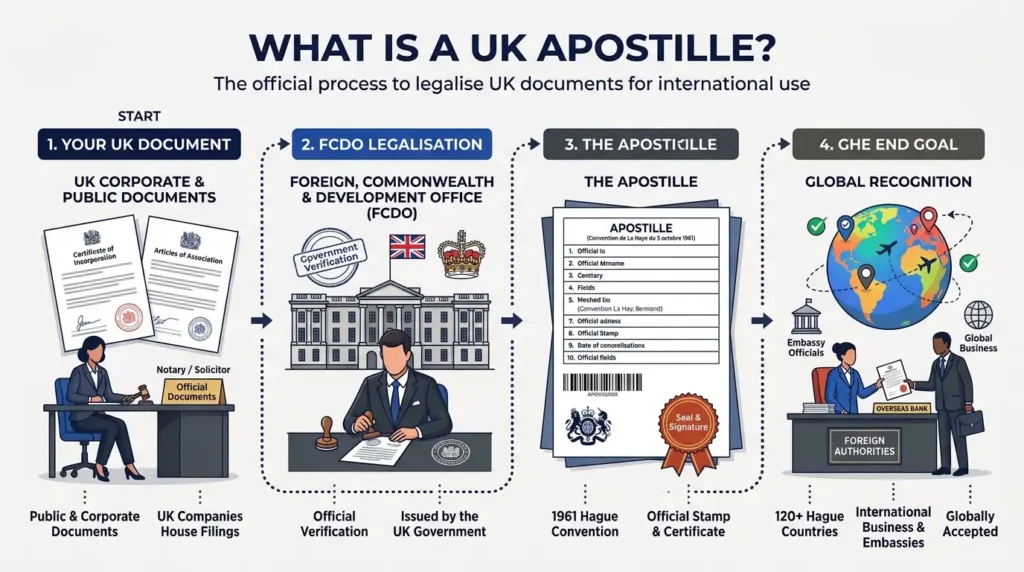
The Foreign, Commonwealth & Development Office validates the official signature, stamp, or seal affixed to a public record. An apostille attaches directly to the underlying Certificate of Good Standing. This process allows government departments in 124 Hague Convention member nations to accept the document without secondary diplomatic authentication.
Foreign governments require this legalisation layer to prevent corporate document fraud across international borders. The apostille does not validate the underlying operational details of the business. It validates the authenticity of the government official who signed or certified the document.
Companies opening branches abroad must complete this verification stage. You can review the complete process of legalisation in our guide on what is an apostilled certificate of good standing.
When Do You Need a Standard Certificate of Good Standing?
You need a standard Certificate of Good Standing when conducting business operations exclusively within the United Kingdom and domestic third parties demand official proof of active registration and compliance.
UK commercial banks routinely ask for current proof of standing before renewing credit lines or opening secondary business accounts. 72% of UK enterprise clients require prospective vendors to supply updated corporate filings before awarding public tenders. Standard certificates meet all regulatory expectations for domestic commercial activity.
Domestic court proceedings, lease agreements, and corporate mergers also require proof of continuous existence. A standard certificate satisfies local solicitors, landlords, and regulatory bodies without requiring external state validation. The issuance process takes between 24 hours and 10 working days, depending on selected processing speeds.
When Is an Apostille Certificate Required for Foreign Business?
An apostille certificate is required whenever you present your UK company documents to foreign courts, overseas financial institutions, international registries, or government authorities located in Hague Convention signatory nations.
Overseas authorities cannot independently verify the authenticity of UK public seals or Registrar signatures. Placing an apostille on your certificate provides instant legal standing across all participating international jurisdictions. Foreign authorities reject uncertified documents, causing project delays and administrative penalties.
Expanding operations into foreign markets requires strict compliance with international corporate laws. Overseas registries demand apostilled documents when establishing foreign branches, subsidiaries, or joint ventures. Selecting a complete service to order an apostilled Certificate of Good Standing from Form My Company ensures your filings satisfy international legal departments without administrative delays.
How Do Hague Convention Regulations Impact Your Document Choice?
Hague Convention regulations dictate that member nations must accept apostilled documents as legally authenticated, whereas non-member nations demand full embassy consular legalisation beyond a standard apostille.
The 1961 Hague Convention established a streamlined framework for validating public records across international borders. Member countries replace lengthy diplomatic chains with a single apostille certificate. Participating states include the United States, Australia, Japan, and all European Union member nations.
Non-signatory nations follow a separate compliance framework requiring multi-tiered document authentication. Companies expanding into non-Hague jurisdictions must first obtain an apostille from the Foreign, Commonwealth & Development Office. The document then moves to the destination country’s embassy or consulate for final verification.
What Is the Cost and Processing Time Difference Between the Two Options?
Standard certificates cost less and process faster through Companies House, while apostilles incur additional government fees and require supplementary handling time from the Foreign, Commonwealth & Development Office.
Standard issuance from Companies House takes approximately 24 hours for express processing or 5 to 10 working days for standard delivery. Standard government fees remain low, making routine domestic compliance cost-effective. Companies ordering standard documents receive digital or physical certificates depending on recipient preferences.
Apostille processing adds secondary administrative fees and extends turnaround times. The Foreign, Commonwealth & Development Office requires 2 to 15 working days to verify signatures and issue physical apostilles. Corporate expansion schedules must account for these extended lead times to avoid missing international business deadlines.
How Does Document Expiry Affect International Compliance?
Document expiry affects compliance because foreign institutions usually reject certificates issued more than 3 to 6 months prior, regardless of whether the document contains an apostille.
Companies House issues certificates reflecting corporate status on a specific calendar day. The legal standing of a business changes if directors fail to file annual returns or face winding-up petitions. Overseas institutions enforce strict freshness rules to guarantee current financial and administrative viability.
Apostilles themselves do not bear an official expiration date. The underlying Certificate of Good Standing limits overall document validity. 91% of foreign commercial banks refuse corporate filings older than 90 days. Businesses must coordinate the issuance date of the certificate with the apostille submission window.
How Can Companies House Filings Block Your Certificate Issuance?
Companies House filings block certificate issuance when a business fails to submit confirmation statements, owes statutory annual accounts, or faces active strike-off proceedings.
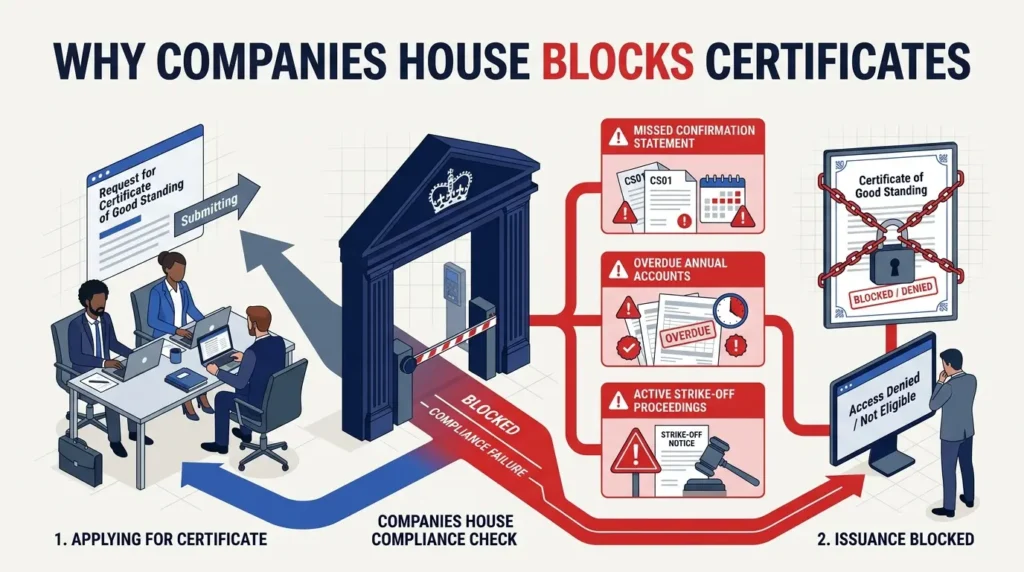
Companies House enforces strict transparency rules across the entire UK corporate register. The Registrar refuses to issue standing documentation if a company defaults on statutory reporting obligations. Outstanding late filing penalties also prevent the approval of new compliance certificates.
Resolving filing defaults requires submitting overdue accounts and paying accrued administrative fines. Companies must verify their status on the register before initiating legalisation workflows. Form My Company assists UK directors in updating statutory corporate records to ensure immediate certificate eligibility.
What Steps Are Required to Secure the Right Document Package?
Securing the right document package requires confirming destination jurisdiction rules, ordering the correct Companies House certificate, obtaining official legalisation, and delivering verified records to recipient authorities.
First, verify the exact compliance demands of the receiving institution or foreign government department. Confirm whether the authority requires a standard certificate, an apostilled certificate, or full consular legalisation. Requesting explicit written requirements prevents ordering incorrect document tiers.
Second, submit an application to Companies House for the appropriate certificate format. Third, transmit the document to the Foreign, Commonwealth & Development Office if foreign authorities mandate Hague Convention authentication. Finally, deliver the legalised documentation using secure tracked courier services to prevent loss. You can secure a verified Certificate of Good Standing to satisfy domestic or international regulatory checks. Form My Company manages corporate document requests, statutory filings, and official legalisation workflows for growing UK enterprises.
Explore More Certificate of Good Standing Guide,
Comparing DIY Companies House Requests vs Using a Certificate Provider
How to Choose the Fastest Way to Obtain a Certificate of Good Standing
Frequently Asked Questions
What is a Certificate of Good Standing in the UK?
A Certificate of Good Standing is an official Companies House document that proves a registered UK business is active, compliant, and up-to-date with statutory annual filings. It confirms that the entity faces no pending dissolution or liquidation proceedings. Businesses order this verification through Form My Company to satisfy legal, banking, and commercial due diligence requirements.
How long is a Certificate of Good Standing valid?
Companies House certificates do not state an explicit expiry date, but most UK financial institutions and foreign authorities require one issued within the last 3 to 6 months. Because corporate standing can change after missing annual filing deadlines, third parties enforce strict freshness rules. Form My Company provides updated Certificate of Good Standing requests to ensure compliance with current regulatory standards.
How do I get an apostilled Certificate of Good Standing?
To obtain an apostilled Certificate of Good Standing, the official document issued by Companies House must be submitted to the UK Foreign, Commonwealth & Development Office (FCDO) for Hague legalisation. The FCDO attaches an apostille certificate verifying the signature and official seal for foreign legal recognition. Form My Company manages both the initial certificate ordering and the full FCDO legalisation process for international business use.
Why do banks require a Certificate of Good Standing?
Commercial banks request a Certificate of Good Standing during account opening procedures or periodic compliance reviews to verify that a corporate entity legally exists and maintains active status. This document confirms that company directors have submitted all mandatory confirmation statements and accounts. Procuring a verified Certificate of Good Standing via Form My Company helps businesses satisfy anti-money laundering regulations and domestic lender checks.
Can a company in default get a Certificate of Good Standing?
No, Companies House will not issue a Certificate of Good Standing if a business has overdue annual accounts, late confirmation statements, or active strike-off notices. Directors must first resolve outstanding statutory defaults and bring corporate records up to date. Form My Company assists UK entities with updating statutory filings so they can successfully obtain their official Certificate of Good Standing.