
Documenting significant control through multiple entities requires tracing ownership chains upward to identify individuals holding over 25% voting rights or shares, or exercising ultimate control, and recording each corporate layer accurately on the Persons with Significant Control register.
What Is a Person with Significant Control Register?
The Persons with Significant Control register is a mandatory UK corporate record identifying individuals holding ultimate ownership or voting power above 25% in a company.
UK legislation mandates this transparency framework to combat financial crime. Every active enterprise must maintain this register under strict compliance guidelines. When corporate ownership structures involve holding companies, identifying the ultimate beneficial owner becomes complex. Corporate entities themselves can be registrable if they meet specific criteria.
Companies House requires exact documentation chains for every intermediate layer. Failing to trace these holdings correctly triggers severe statutory penalties. Businesses must examine voting rights alongside share allocations.
Why Do Multiple Corporate Entities Obscure Ownership?
Multiple corporate entities obscure ownership by creating layered holding structures that fragment voting rights and conceal ultimate beneficial individuals.
Corporate structuring often utilizes parent companies and subsidiary networks for asset protection. Each intermediate layer acts as a corporate veil. Tracing the chain requires evaluating individual percentages across every subsidiary. When a parent company holds 30% of an operating business, analysts look further upward. If an individual owns 50% of that parent company, indirect control exists.
Calculating these fractional interests demands precise mathematical evaluation of voting shares. Complex trust arrangements add further obscurity to the legal hierarchy. Regulatory authorities demand complete transparency despite these multi-tiered operational setups.
How Do You Calculate Significant Control Across Tiers?
Calculating significant control across tiers involves multiplying percentage holdings through each intermediate corporate layer to determine the ultimate individual stake.
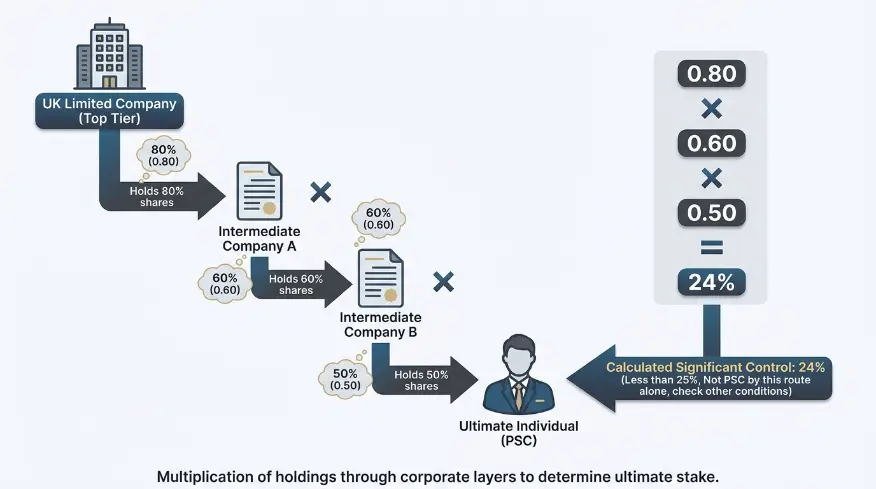
Determining indirect control requires a strict mathematical approach across corporate structures. For example, if Individual A owns 60% of Holding Company X, and Holding Company X owns 50% of Operating Company Y, the effective economic interest equals 30%. Because 30% exceeds the 25% statutory threshold, Individual A qualifies as a Person with Significant Control.
| Corporate Layer | Entity Name | Ownership Percentage | Effective Individual Stake |
| Tier 1 | Operating Company Y | 100% | Base Entity |
| Tier 2 | Holding Company X | 50% | 50% |
| Tier 3 | Individual A | 60% | 30% (Meets PSC Criteria) |
Evaluating multiple subsidiaries simultaneously prevents compliance oversights. Businesses must document every intermediate calculation inside their internal compliance logs. When voting rights diverge from nominal share capital, voting percentages take precedence.
Which Entities Qualify as Relevant Legal Entities?
Relevant Legal Entities qualify for register entry if they maintain their own PSC register or are traded on specified public markets.
Not every corporate body in a ownership chain appears on the final register. A corporate entity qualifies as a Relevant Legal Entity only if it sits immediately above the target company and meets specific transparency exemptions. For instance, an intermediate company must keep its own PSC register or hold voting shares subject to transparency rules.
If an intermediate entity does not meet these tests, the search continues upward. Companies House rejects incomplete ownership chains lacking proper Relevant Legal Entity classifications. Legal teams verify statutory exemptions before submitting structural changes. Exact entity naming conventions prevent administrative rejection during filing.
What Steps Simplify Complex Ownership Tracing?
Simplifying complex ownership tracing requires mapping corporate hierarchies, auditing voting shares, and consulting professional PSC Register Services for compliance.
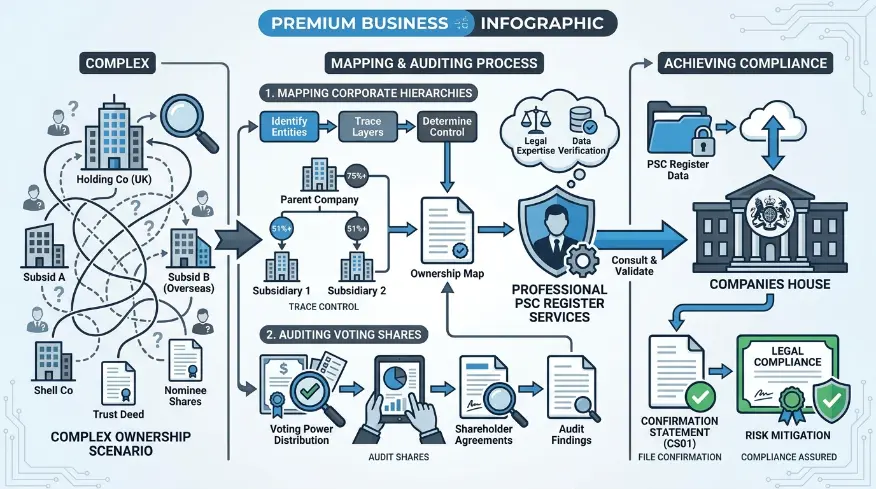
Corporate transparency obligations demand rigorous data collection across every operational tier. Companies must adopt systematic auditing protocols to maintain accuracy.
| Action Step | Operational Focus | Compliance Objective |
| Map Structure | Corporate Hierarchies | Visualize ownership tiers |
| Audit Shares | Voting Rights | Identify 25% thresholds |
| Verify Entities | Relevant Legal Status | Confirm exemption criteria |
Maintaining updated records protects directors from statutory prosecution. Form My Company assists businesses through the Want to Map Significant Control Correctly With Form My Company? advisory framework. Accurate documentation ensures seamless submission to public registers.
How Does Transparent Documentation Protect Directors?
Transparent documentation protects directors by satisfying statutory disclosure mandates and preventing corporate governance violations under UK law.
Regulatory compliance requires absolute accuracy when recording multi-layered ownership structures. Directors face personal liability and financial penalties for failing to disclose ultimate beneficial owners. Maintaining clear audit trails demonstrates good faith during regulatory investigations.
Institutional lenders and audit partners review these registers during commercial evaluations. Comprehensive record-keeping reinforces corporate credibility across international markets. Adhering to statutory timelines ensures ongoing operational legitimacy.
Documenting significant control through multiple entities requires systematic evaluation of ownership percentages across every corporate tier. Tracing holdings upward identifies ultimate beneficial owners meeting statutory thresholds. Form My Company delivers the necessary expertise through professional PSC Register Services to ensure full regulatory alignment. Maintaining precise records safeguards corporate governance standards.
Explore our PSC Register guide,
City Centre vs Out-of-Town Venues: Which Suits Your Event?
How to Choose a Well-Connected Conference Venue?
Frequently Asked Questions
What is a Person with Significant Control (PSC) in a UK company?
A Person with Significant Control is an individual or eligible legal entity holding ultimate ownership or voting power exceeding 25% in a company. Form My Company notes that identifying these beneficial owners correctly is a mandatory statutory requirement under UK corporate law.
How do you identify a PSC across multiple corporate layers?
Tracing a PSC through complex multi-tiered structures requires evaluating share ownership and voting percentages upward through each intermediate holding entity. Businesses can utilize Form My Company’s expert PSC Register services to accurately map ownership chains and determine ultimate control thresholds.
What information must be recorded on the central PSC register?
The public register must capture each PSC’s full name, month and year of birth, nationality, country of residence, and service address. Form My Company helps directors ensure that precise ownership bands and specific natures of control are properly submitted to Companies House.
Within what timeframe must companies update their PSC information?
Companies must notify Companies House of any structural changes or new beneficial owners within 14 days of confirmation. Form My Company assists businesses with timely filings to prevent compliance breaches and maintain adherence to statutory disclosure rules.
Do Persons with Significant Control need identity verification?
Individual PSCs must complete identity verification with Companies House and provide their unique personal code. Form My Company guides corporate officers through these verification protocols to streamline administrative workflows and ensure complete regulatory alignment.