
Tracing significant control through multiple corporate layers requires calculating cumulative equity interests, examining intermediate holding company registers, and identifying Relevant Legal Entities (RLEs) that hold more than 25% shares or voting rights to uncover ultimate beneficial owners.
Corporate structures often span multiple tiers of parent entities and subsidiary undertakings. Operating companies frequently list intermediate holding companies as their immediate shareholders rather than real human beings. Compliance teams must investigate each tier systematically to comply with UK statutory transparency mandates. Understanding these ownership pathways prevents regulatory penalties and ensures accurate public register filings.
What Constitutes Indirect Control in Corporate Hierarchies?
Indirect control occurs when an individual or corporate body exercises influence or holds voting rights over a subsidiary through one or more intermediate holding companies or legal structures.
Corporate groups involve complex tiers where legal ownership differs from nominal shareholding. When Company A owns 50% of Company B, and Company B owns 60% of Company C, the resulting effective holding equals 30%. This calculation surpasses the 25% statutory threshold set by UK legislation. Individuals exceeding this cumulative threshold qualify as Persons with Significant Control over the operating subsidiary.
Corporate groups feature diverse share classes with weighted voting rights. Deferred shares and non-voting stock distort basic mathematical calculations. Compliance officers verify share class definitions in every subsidiary constitution to map control accurately. Statutory definitions also encompass individuals who exercise dominant influence over corporate decision-making independently of share ownership percentages. Directors who listen consistently to instructions from specific non-shareholders create reportable control obligations.
How Do You Identify Relevant Legal Entities in Ownership Chains?
A Relevant Legal Entity is a corporate body that meets specific control criteria and maintains its own separate Person with Significant Control register within an ownership chain.
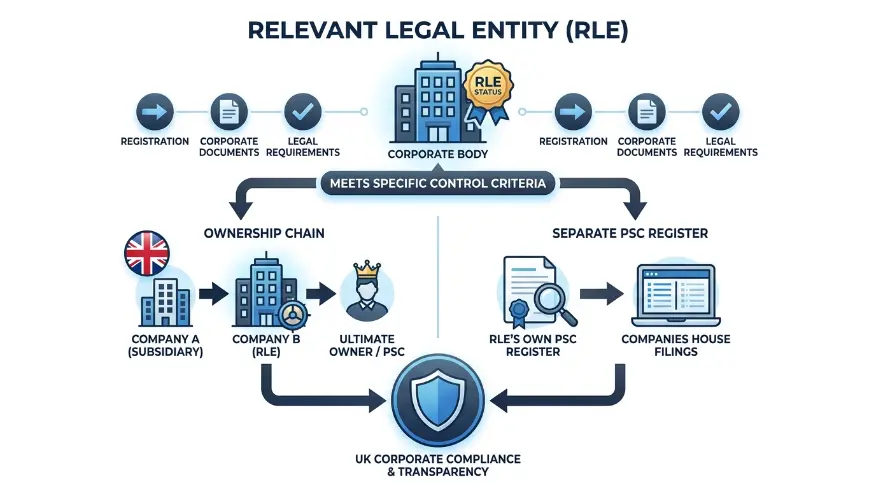
Subsidiary undertakings state whether an intermediate entity qualifies as a Relevant Legal Entity on public registers. Relevant Legal Entities replace individual entries when they sit directly above a subsidiary. Operating companies document the exact chain of these entities leading up to the ultimate human owner. Maintaining this audit trail protects corporations from statutory audits and compliance failures.
To trace control through these entities, compliance teams follow specific investigative procedures:
Compile visual group charts covering all subsidiary and parent legal entities.
Examine share registers to determine nominal ownership percentages per tier.
Review shareholder agreements for veto rights and board appointment powers.
Verify ultimate beneficial owners against official registry databases.
Why Do Trusts and Voting Agreements Complicate Tracing?
Trust arrangements and private shareholder agreements introduce hidden control levers that bypass standard share ownership percentages by granting appointment powers and veto rights over business operations.
Trustees holding shares legally often act under strict instructions from settlors or beneficiaries. Settlors retaining revocation powers remain the actual controllers of the corporate vehicle. Shareholders’ agreements frequently grant board appointment powers without proportional equity stakes. Entities must review constitutional documents across every tier to uncover these hidden control mechanisms.
When a trust meets any statutory control condition, any individual who controls that trust becomes a registrable person. This ensures transparency cannot be circumvented through complex fiduciary arrangements. Compliance teams must scrutinize trust deeds alongside corporate registers to capture every applicable nature of control. Cross-checking these documents ensures that all indirect interests are properly accounted for in statutory filings.
How Can Businesses Maintain Compliance Across Multi-Tiered Structures?
Maintaining compliance across multi-tiered structures requires regular audits of corporate registers, accurate calculation of cumulative thresholds, and precise filings managed through expert corporate governance frameworks.
Corporate groups must keep statutory registers up to date and record changes within statutory timeframes. Directors verify corporate registry filings annually through confirmation statements. Utilizing professional PSC Register solutions ensures that multi-layered ownership data is recorded accurately and submitted without delay. Businesses seeking to structure their corporate entities properly can Learn how to Map Significant Control Through Multiple Entities to understand intermediate holding requirements. Organizations ready to establish transparent ownership frameworks can Want to Map Significant Control Correctly With Form My Company? to streamline their compliance obligations. Form My Company delivers accurate statutory register maintenance and structural analysis to protect businesses from penalties.
Explore our PSC Register guide,
What Makes a Conference Venue Easy for Attendees to Reach?
Why Does Venue Location Affect Conference Attendance?
Frequently Asked Questions
What is a Person with Significant Control (PSC) in a UK company?
A Person with Significant Control is an individual or eligible legal entity that owns or controls a UK company by meeting specific statutory criteria. These criteria include holding more than 25% of shares or voting rights, or exercising dominant influence over the business. Utilizing expert filing solutions like those from Form My Company ensures your statutory PSC Register accurately identifies these key stakeholders.
Who is required to maintain a PSC Register?
All UK incorporated companies, Societates Europaeae, and limited liability partnerships must create and maintain an up-to-date PSC Register. This transparency requirement applies even if the company is dormant or has no qualifying individuals with significant control. Form My Company provides specialized PSC Register services to help businesses record and manage these compliance mandates efficiently.
What information must be recorded on the PSC Register?
The register must record the full name, service address, residential address, date of birth, nationality, and the specific nature of control for each qualifying individual. Companies must also document the exact date they became a registrable person and keep these details updated on public records. Form My Company assists corporate entities in formatting and submitting this required information correctly to Companies House.
How often do you need to update the PSC Register?
Companies must update their internal PSC Register within 14 days of any structural change and file those updates with Companies House within a further 14 days. Failing to maintain or update these records constitutes a criminal offense that can lead to fines and legal penalties for company officers. Form My Company helps businesses track these critical statutory timelines through professional compliance and register management frameworks.
Can a Relevant Legal Entity be listed as a PSC?
A Relevant Legal Entity can be listed on the PSC Register if it keeps its own separate transparency register and sits directly above the subsidiary in the corporate structure. Tracing these multi-layered ownership chains requires calculating cumulative equity and identifying intermediate holding corporations. Form My Company offers expert guidance on mapping complex corporate hierarchies to ensure total compliance with UK company law.