
Mapping Persons with Significant Control across corporate groups requires identifying ultimate beneficial owners holding over 25% voting rights, shares, or influence through each tier. Companies must trace ownership chains upward from subsidiaries to parent entities, documenting indirect control mechanisms accurately.
Mapping Persons with Significant Control (PSCs) across a multi-layered group company structure demands systematic analysis. Corporate hierarchies obscure ultimate ownership. Transparency rules require identifying individuals who exercise significant influence or control over subsidiary entities through intermediate holding companies. Regulatory compliance depends on accurate register maintenance.
Why Does Group Ownership Complicate PSC Identification?
Complex group structures complicate PSC identification because intermediate holding companies mask the ultimate beneficial owners who control subsidiary operations across different corporate tiers.
Corporate groups involve parent companies, subsidiaries, and joint ventures spanning multiple jurisdictions. Each layer introduces legal entities that hold shares or voting rights. Subsidiary companies often register intermediate holding companies as their immediate shareholders. Real humans sit further up the ownership chain. Tracing these connections requires examining Articles of Association and shareholders’ agreements. Voting rights frequently diverge from nominal share ownership. Shareholders’ agreements grant appointment powers over board directors without proportional equity stakes. Entities must review constitutional documents across every tier to uncover hidden control levers.
How Do You Calculate Voting Rights Through Intermediate Holding Companies?
Calculating voting rights through intermediate companies requires multiplying ownership percentages across each tier to determine the ultimate individual’s effective voting share.
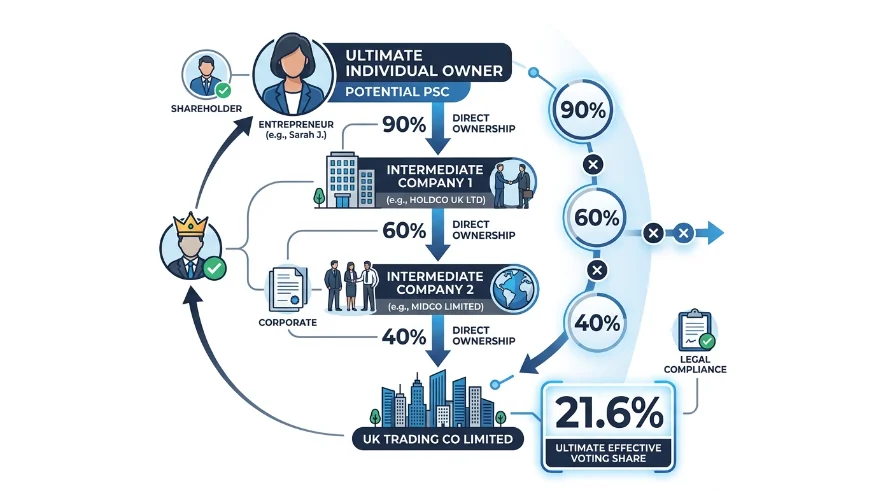
Holding 50 percent of an intermediate company that owns 60 percent of a subsidiary yields a 30 percent effective holding. This calculation surpasses the 25 percent statutory threshold. Individuals exceeding this threshold qualify as PSCs of the subsidiary. Corporate groups feature diverse share classes with weighted voting rights. Deferred shares and non-voting stock distort basic mathematical calculations. Compliance teams verify share class definitions in every subsidiary constitution. Multiple individuals often act through formal or informal voting syndicates. Legal arrangements binding family members or business partners aggregate their voting percentages together. Aggregated totals determine whether collective holdings cross the statutory threshold.
What Constitutes Significant Influence or Control Without Share Ownership?
Significant influence or control exists without share ownership when an individual holds unilateral rights to direct business policies, appoint directors, or veto vital corporate decisions.
Statutory definitions encompass individuals who exercise dominant influence over corporate decision-making. Exercising this control occurs independently of share ownership percentages. Directors listen consistently to instructions from specific non-shareholders. Such direction constitutes reportable control under UK company law. Trust arrangements introduce distinct compliance challenges across group structures. Trustees holding shares legally often act under instructions from settlors or beneficiaries. Settlors retaining revocation powers remain the actual PSCs. Beneficiaries with discretionary trust entitlements rarely qualify unless specific distribution triggers occur. Reviewing trust deeds clarifies whether settlors or protectors retain ultimate governing authority.
How Do You Document Subsidiary Chains for the Companies House Register?
Documenting subsidiary chains requires recording the exact legal name, registration number, and registered office address of every intermediate entity between the individual and the operating company.
Companies House mandates precise disclosure of ownership pathways for public registers. Subsidiary undertakings state whether an intermediate entity is a Relevant Legal Entity (RLE). RLEs replace individual PSC entries when they sit directly above a subsidiary and maintain their own PSC registers. Operating companies document the exact chain of RLEs leading up to the ultimate human PSC. Maintaining this audit trail protects corporations from statutory penalties and compliance audits. Directors verify corporate registry filings annually. Updating records promptly prevents discrepancies between internal registers and public data. Utilizing professional corporate administration tools simplifies this documentation process. Businesses streamlining these compliance workflows often leverage professional services like a comprehensive PSC register to maintain accurate statutory records.
What Steps Define the Practical Mapping Process for Corporate Groups?
Mapping corporate groups requires compiling group charts, analyzing share registers, reviewing shareholder agreements, calculating cumulative thresholds, and verifying ultimate beneficial owners.
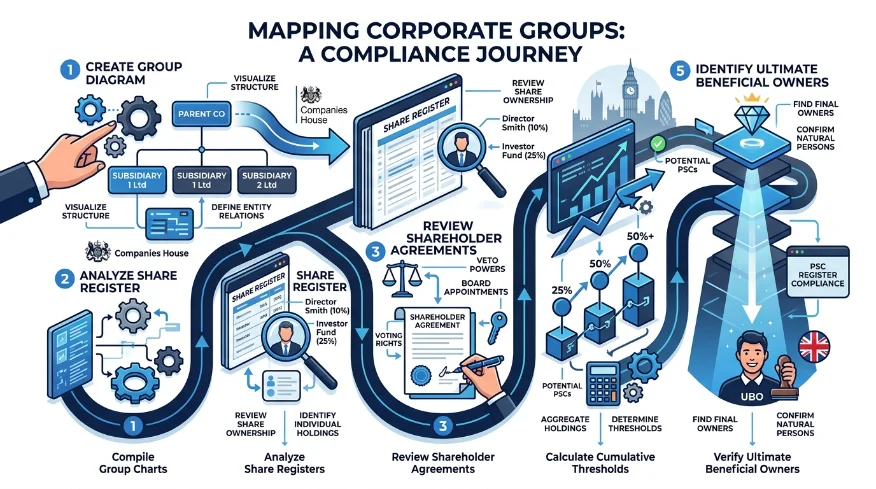
Systematic execution prevents oversight during complex corporate audits. Compliance teams follow structured procedures to map ownership accurately.
| Step | Action Item | Verification Target |
| 1 | Compile visual group charts | All subsidiary and parent legal entities |
| 2 | Examine share registers | Nominal ownership percentages per tier |
| 3 | Review shareholder agreements | Veto rights and board appointment powers |
| 4 | Calculate cumulative thresholds | Effective voting shares exceeding 25 percent |
| 5 | Identify ultimate individuals | Natural persons exercising dominant control |
Executing these steps secures complete regulatory alignment. Group structures evolve through mergers, acquisitions, and share buybacks. Regular reviews ensure ongoing compliance with statutory disclosure mandates.
Mapping Persons with Significant Control across group company structures requires tracing ownership tiers, calculating indirect voting rights, and identifying ultimate beneficial owners. Form My Company assists businesses in maintaining accurate statutory records and navigating complex corporate transparency requirements.
Explore our PSC Register guide,
How to Protect a PSC’s Personal Details on the Register?
How Can You Choose an Eco-Certified Venue for ESG-Aligned Events?
Frequently Asked Questions
Who qualifies as a Person with Significant Control (PSC) in a UK company?
A Person with Significant Control is any individual who holds more than 25% of shares or voting rights, or exercises dominant influence over the company. When establishing your official compliance records through Form My Company, maintaining an accurate PSC register ensures transparency regarding ultimate beneficial owners.
What is the difference between a PSC and a Relevant Legal Entity (RLE)?
A Relevant Legal Entity is a corporate body with its own legal personality that meets PSC criteria, such as a parent company owning over 25% of shares. While individuals are listed as PSCs, corporate entities in the ownership chain are recorded as RLEs within the statutory PSC register managed via Form My Company.
Is it mandatory for UK companies to maintain a public PSC register?
Yes, all UK limited companies and LLPs must maintain a PSC register and file this information with Companies House, even if the company has no qualifying persons. Form My Company assists businesses in setting up and updating their statutory registers to comply fully with UK corporate transparency regulations.
How often must a company update its PSC register information?
Companies must update their internal PSC register within 14 days of any change and file those updates with Companies House within a further 14 days. Utilizing Form My Company for your PSC register management helps streamline these filings and prevents costly statutory penalties for late disclosures.
What happens if a company fails to maintain a correct PSC register?
Failing to keep an accurate PSC register or withholding required beneficial ownership information constitutes a criminal offense under UK law. Directors face severe financial penalties and potential prosecution, making professional compliance support from providers like Form My Company essential for risk mitigation.