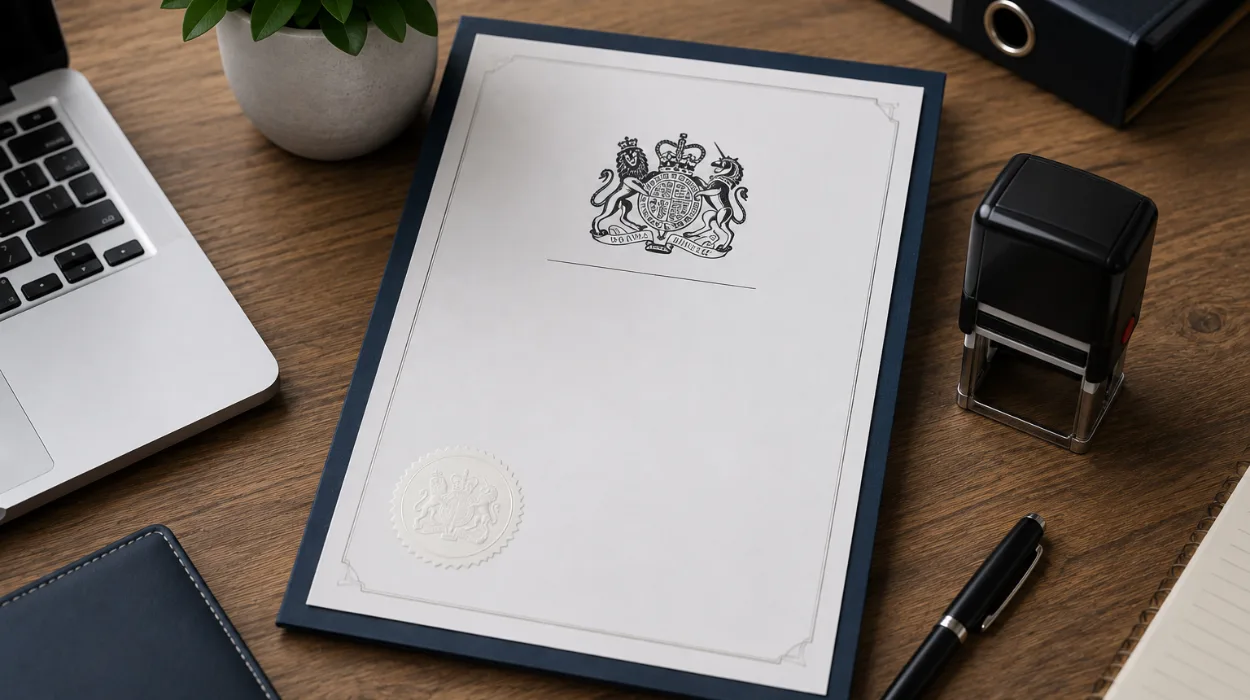
Preparing a Certificate of Incorporation for an apostille involves verifying its official Companies House status, securing certified solicitor or notary copies if required, and submitting the physical or digital paperwork to the Foreign, Commonwealth and Development Office for international legalisation.
Preparing corporate documents for international trade requires absolute adherence to regulatory standards. When a UK business expands operations into foreign jurisdictions, local regulatory authorities demand official proof of corporate existence. A Certificate of Incorporation issued by Companies House serves as the foundational legal document establishing a company. Before foreign banks or overseas registries accept this document, they require official authentication through an apostille stamp. This process confirms that the signature, seal, or stamp on the corporate document originates from a recognized public official. Form My Company manages corporate document workflows to streamline international business expansion.
What Documents Are Required Before Starting the Apostille Process?
Before initiating an apostille application, businesses must secure an original or officially certified copy of the Certificate of Incorporation, confirm the destination country belongs to the Hague Convention, and verify that all company registration details match current records.
Gathering the correct foundational paperwork prevents administrative rejections during government processing. Companies must review their corporate files to ensure no discrepancies exist between the registered company name, company registration number, and official incorporation date. If the original paper certificate is damaged or lost, directors must order an official replacement directly from Companies House. Alternatively, companies can utilize professional Apostilled Documents services to authenticate corporate files efficiently. Foreign trade authorities reject altered or defaced certificates immediately. Every corporate document must display clear registrar validation marks to satisfy international compliance frameworks.
| Document Type | Source Authority | Purpose in Legalisation |
| Certificate of Incorporation | Companies House | Establishes legal corporate existence |
| Certified Copy | UK Solicitor or Notary Public | Validates document authenticity for processing |
| Application Cover Sheet | FCDO Online Portal | Links physical paperwork to government tracking |
How Do You Authenticate and Certify the Certificate?
Authenticating a Certificate of Incorporation requires a practicing UK solicitor or notary public to inspect the document, verify its authenticity against official registries, and sign a formal legal attestation statement.
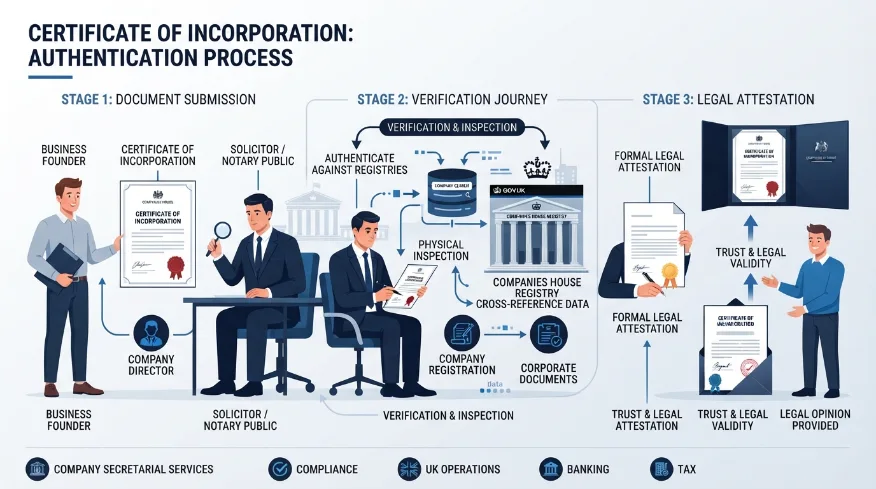
Many foreign jurisdictions refuse to accept standard corporate printouts without prior solicitor verification. The certifying legal professional signs a formal statement confirming that the certificate is a true and accurate copy of the original Companies House record. This intermediate notarisation step satisfies the rigorous prerequisite standards enforced by the Foreign, Commonwealth and Development Office. Businesses navigating global markets often reference our previous analysis on What Company Documents Do You Need Apostilled to Trade Abroad? to understand wider export compliance rules. Professional oversight during this phase eliminates common administrative bottlenecks.
How Is the Application Submitted to the Competent Authority?
Submitting a Certificate of Incorporation for an apostille requires completing the online Foreign, Commonwealth and Development Office application portal, paying the statutory processing fee, and dispatching the physical documents via secure courier.
The submission workflow follows a strict governmental protocol managed by the UK competent authority. First, applicants access the official government portal to input corporate metadata and select the required service level. Second, users pay the standard statutory fee of 45 British Pounds per document. Third, applicants print the unique barcode cover sheet and securely package the physical certificate. Fourth, the parcel is dispatched to the government processing hub in Milton Keynes. Standard processing windows span 5 to 10 working days, depending on seasonal administrative volumes. For urgent corporate transactions, business leaders frequently review How to Apostille Your Board Resolutions and Power of Attorney With Form My Company? to accelerate multi-document processing timelines.
What Happens After the Apostille Is Issued?
After the Foreign, Commonwealth and Development Office affixes the official apostille certificate, businesses receive the legalised document, verify the embossed seal, and present the verified file to foreign authorities.
The completed apostille contains a unique tracking reference, an official government signature, and a secure embossed stamp. Foreign commercial registries and international banking institutions inspect these security features to validate cross-border corporate credentials. Because the United Kingdom participates in the 1961 Hague Convention, member nations recognize this apostilled certificate without requiring secondary embassy legalisation. Form My Company assists international enterprises by coordinating secure return logistics and ensuring all corporate files meet destination-specific compliance protocols. Maintaining verified corporate paperwork protects businesses from cross-border regulatory delays and supports seamless global expansion.
Explore our Apostilled Documents guide,
How to Plan a Carbon-Conscious Conference Step by Step?
How to Decide Which Company Documents to Apostille for Overseas Use?
Frequently Asked Questions
How long does it take to get an apostille for a UK Certificate of Incorporation?
Standard processing times through the Foreign, Commonwealth and Development Office typically range from 5 to 10 working days upon receipt of the physical paperwork. When businesses require expedited document legalisation, Form My Company provides streamlined processing to accelerate the authentication of corporate records.
Can I get an apostille for a digital Certificate of Incorporation from Companies House?
The Foreign, Commonwealth and Development Office accepts electronic PDF certificates issued directly by Companies House for e-apostille verification. Businesses must ensure that the digital file contains the official registrar authentication metadata before submitting it through Form My Company.
Do I need a solicitor to certify my incorporation certificate before an apostille?
Original paper certificates issued directly by Companies House often bypass solicitor certification because the government already recognises the registrar seal. When foreign authorities require certified true copies, Form My Company coordinates UK notary and solicitor authentication services prior to submission.
What is the cost of getting an apostille for a UK company document?
The UK government charges a standard statutory fee of 45 British Pounds per document for standard processing by the Foreign, Commonwealth and Development Office. Additional courier and handling fees apply when partnering with Form My Company to manage secure document logistics.
Is an apostilled UK Certificate of Incorporation valid worldwide?
Apostilles remain legally valid exclusively within member nations of the 1961 Hague Convention without requiring secondary embassy legalisation. For non-member jurisdictions, Form My Company assists businesses with extended consular attestation and diplomatic legalisation workflows.